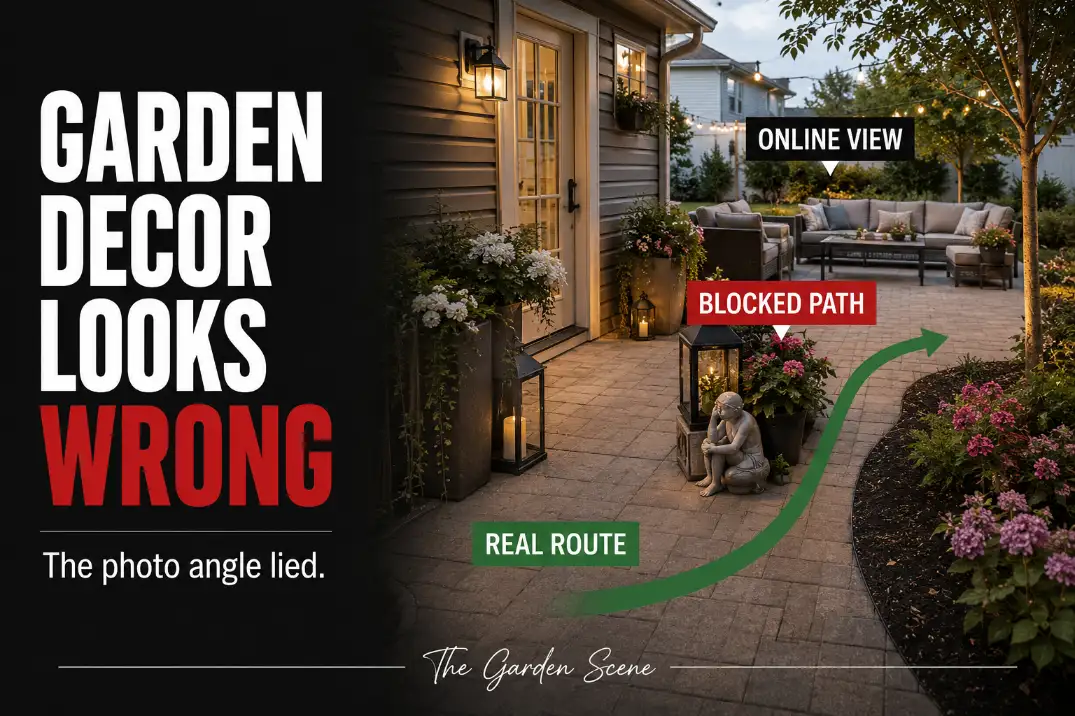
Garden decor usually feels wrong in real life when it is arranged for the camera instead of the route. The object may be attractive, but the placement steals clearance, redirects movement, blocks maintenance, or creates too many competing focal points.
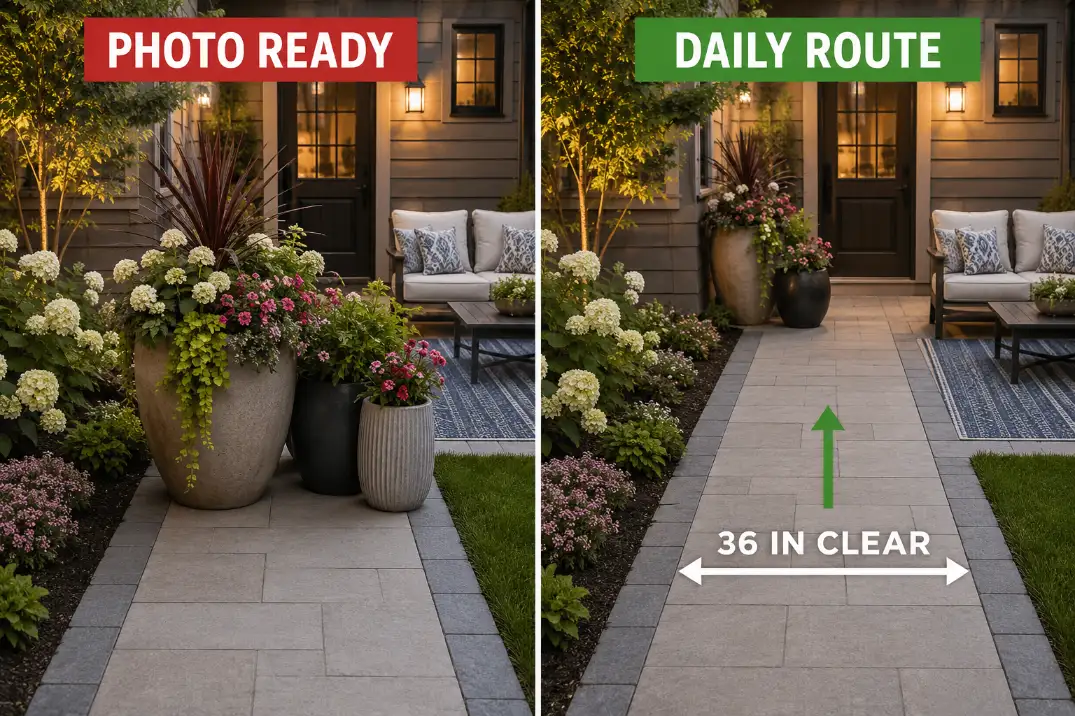
The first checks are simple: can people still walk through the space with about 36 inches of clear route, can chairs pull out without hitting decor, and can doors, gates, hoses, mowers, or trash bins still move normally? If people drift 12 to 18 inches around a planter, lantern, fountain, or decorative bench, the decor is already changing how the space works.
That is the difference between a good-looking garden photo and a livable outdoor area. An online inspiration image rewards one view. A yard has to survive daily movement, weather, cleanup, guests, pets, and repeated use for months.
When Decor Ignores How a Space Is Used
Decor should support the way the space is used before it tries to improve the way the space looks.
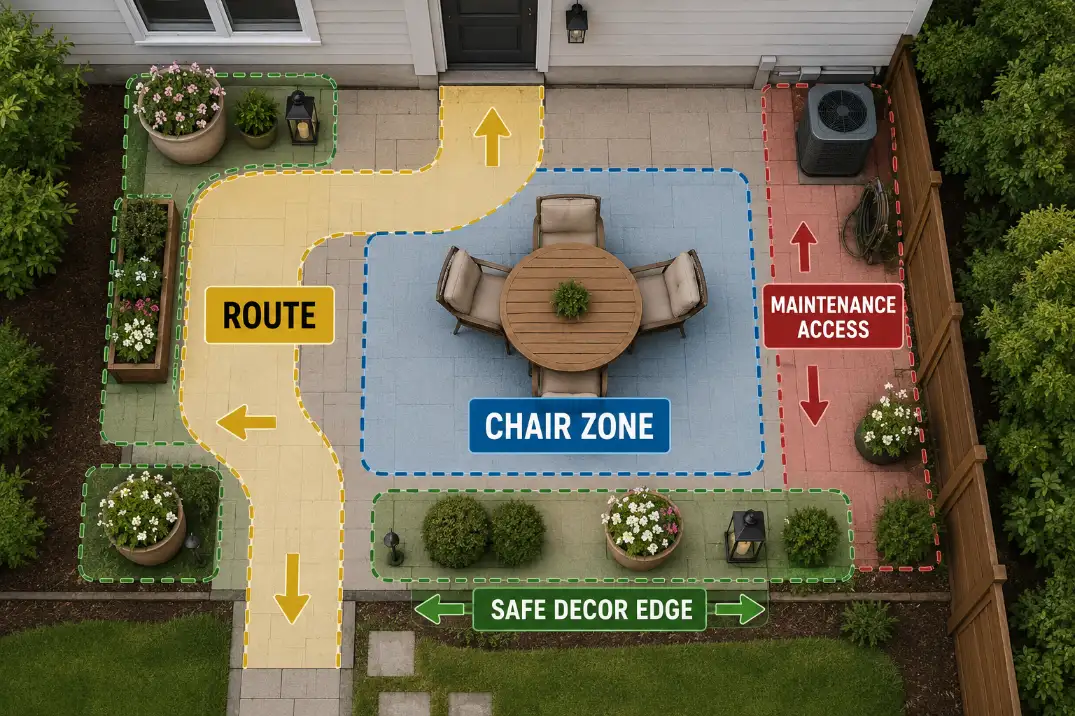
The common mistake is treating open space as empty space. In a real yard or patio, open space often has a job. It may be the walking line from the back door to the grill, the chair pull-out zone, the mower route, the hose path, or the area where guests naturally stand during a party.
The Visual Footprint Is Not the Real Footprint
A planter may only take up 2 square feet on the ground. But if people need to curve around it, the real space it consumes is larger.
That is why a small decorative object can make a patio feel awkward even when the patio does not look crowded. The decor is not failing because it is ugly. It is failing because it sits inside the movement footprint.
This same problem shows up in patio transitions where the entry looks finished but the route feels pinched. If the decor sits near a door or walkway, the principles in Patio Entry Mistakes That Hurt Outdoor Spaces become more important than the decorative style.
The Maintenance Route Matters Too
Decor also has to leave room for boring tasks.
If a decorative urn makes trimming slower, if lanterns collect leaves every week, or if a statue blocks the hose route, the placement will start to feel annoying long before the object itself wears out.
A good rule is to test whether the space can still be cleaned, watered, swept, and crossed without lifting or moving the decor. If the answer is no, the placement is probably too precious for everyday use.
The Difference Between Viewing and Living
A garden photo has one best angle. A garden has dozens of real angles.
That difference explains why so much decor looks better online than it feels at home.
A Camera Can Hide the Problem
A camera can crop out a blocked gate, a tight chair, a narrow walkway, or a decor cluster that sits too close to the back door.
Real life cannot crop those things out.
A decorative setup may look balanced from 15 feet away but feel clumsy when someone carries groceries, pulls out a dining chair, waters plants, moves a grill, or walks through the space at night.
Daily Repetition Changes the Judgment
Living with a space creates repetition.
A minor sidestep twice a day becomes noticeable within a few weeks. A decorative item that blocks the same route 500 times per month stops feeling charming and starts feeling badly placed.
That is why decor should be judged by use frequency, not just visual strength.
A focal point viewed for 20 seconds should not interfere with a route used every day.
Pretty Still Has to Behave
The best garden decor does not disappear. It simply behaves.
It holds a view, marks an edge, frames a seating area, or adds character without taking over the route. When decor needs constant avoidance, constant adjustment, or constant cleanup, the style is not the issue. The placement is.
Common Decor Placement Mistakes
The biggest decor mistake is placing an object where the space looks empty instead of asking why that space is empty.
Usually, that “empty” area is doing quiet work.
Decorating the Shortcut
People naturally choose the easiest path.
If decor blocks that path, people will not respect the design. They will walk around it, squeeze past it, or create a new shortcut through the lawn or planting bed.
This is especially common near front entries, side gates, and patio corners. The issue is similar to Front Yard Visitor Path Mistakes, where the design looks intentional but visitors still follow the route that feels most obvious.
Creating Decorative Islands
Decorative islands often look good online because they give a photo a center.
In real life, they often split useful space into smaller pieces.
A patio with one flexible 12-foot open area may function well for dining, guests, and moving furniture. Add a decorative feature in the middle, and the same patio may become two awkward zones that do less.
Choosing Decor That Needs Too Much Space
Some decor fails because the object is too deep, too tall, too wide, or too visually loud for the area.
A bench may need sitting clearance. A fountain may need splash room. A tall planter may cast shade or block a view. A lantern group may need a safe edge location so people do not kick it at night.
| Decor Type | Where It Often Fails | Better Placement Rule |
|---|---|---|
| Large planter | Walkways, door swings, chair zones | Place along edges with 36 inches of route left open |
| Lantern group | Patio corners used for movement | Keep outside foot traffic and away from door paths |
| Sculpture | Middle of small patios or lawns | Use as an edge focal point or end-view anchor |
| Decorative bench | Narrow entries or small landings | Use only where sitting clearance actually exists |
| Fountain | Tight patios or near dining chairs | Leave splash, sound, and maintenance access |
| Trellis or screen | Too close to doors or paths | Set back enough to preserve movement and airflow |
This is where decor overlaps with space planning. If the patio already struggles with clutter or storage, adding decorative objects usually makes the problem more visible. A better first move may be to simplify the layout or use storage that supports function, as explained in Reduce Patio Clutter Without Losing Function.
How to Test Decor Before Making It Permanent
Large decor should be tested before it is anchored, planted around, wired, or treated as permanent.
A placement that looks right on day one can still fail after a week of real movement.
Run the 7-to-14-Day Test
Leave large decor in a temporary position for 7 to 14 days.
Use the space normally. Do not walk around it carefully just because it is new. Let the yard reveal whether the object belongs there.
Watch for three signals:
- people naturally curve around it
- chairs, doors, gates, or carts come close to hitting it
- cleanup takes longer because the object is in the way
If any of those happen repeatedly, the decor should move before the surrounding layout is built around it.
Test Real Activities, Not Just the View
A decor placement should survive ordinary use.
Carry a cooler through the patio. Pull out every dining chair. Walk the route at night. Move the hose. Bring the trash bin through the side path. Try sweeping around the object after leaves fall.
These tests are more useful than standing back and judging the view.
Pro Tip: Use painter’s tape, cardboard, empty pots, or temporary stakes to mark the footprint of a future planter, fountain, bench, or sculpture before buying the final piece.
Know When the Fix Stops Making Sense
Small adjustments work when the object is almost right.
If moving the decor 12 inches restores the route, the placement just needed refinement. If the object still blocks movement after being shifted 24 to 36 inches, the piece may be wrong for that location.
That is the point where rearranging stops making sense and replacement, downsizing, or edge placement becomes the better decision.
Creating Focal Points Without Creating Obstacles
A focal point should stop the eye, not stop the body.
That is the cleanest way to separate good garden decor from decor that only looks good online.
Use Edges First
The safest focal points usually sit at edges, corners, ends of views, or backdrop zones.
A large planter at the end of a walkway, a wall-mounted feature behind seating, or a decorative screen along a boundary can create attention without occupying the middle of the route.
This is why many strong outdoor spaces feel both decorated and easy to use. The decor frames the living area instead of standing inside it.
For front entries, the same principle helps keep the space welcoming while still giving it character. Front Entry Usability Ideas follows that same balance between visual appeal and everyday movement.
Choose One Strong Moment
Another fix that often wastes time is adding more small decor to make a weak area feel finished.
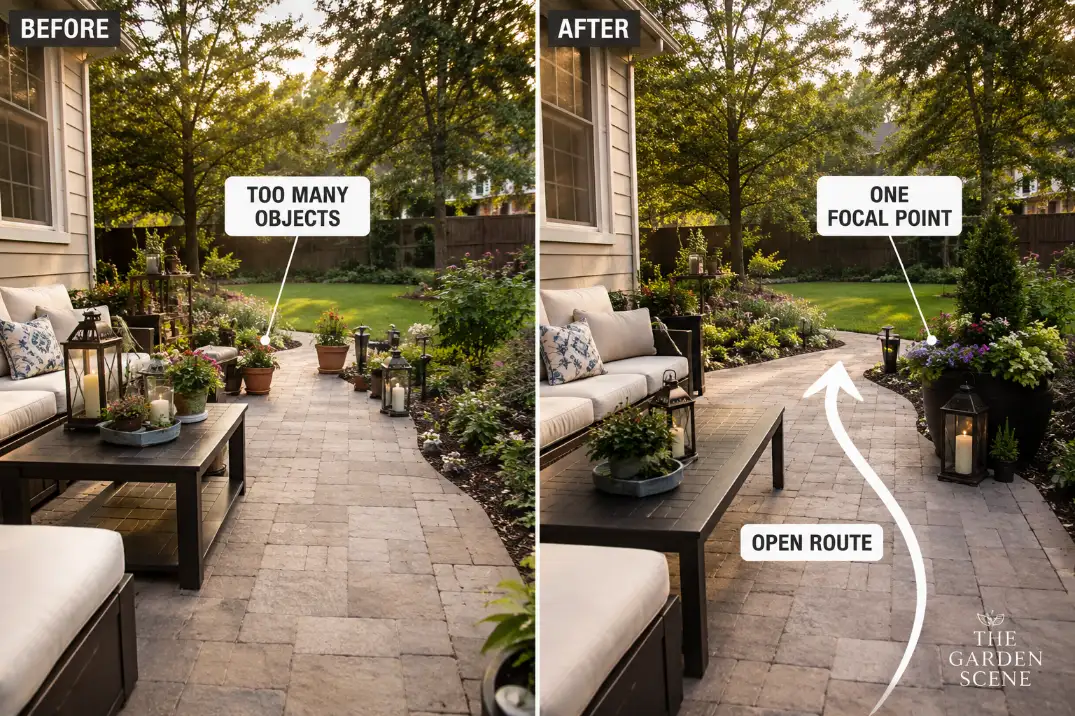
Usually, the better move is fewer objects with stronger placement.
Five small accents can create noise. One clear feature with 24 to 36 inches of breathing room can create a stronger focal point and make the space feel calmer.
Keep Decor Out of Decision Points
Decision points are places where people choose where to go next: doorways, path intersections, patio corners, gate entries, driveway edges, and seating openings.
Decor placed there often creates hesitation.
If a guest has to pause to figure out whether to walk left or right around a decorative object, the placement is doing too much.
Quick Reality Check Before You Commit
Use this check before buying, anchoring, or building around garden decor.
| Question | Good Sign | Warning Sign |
|---|---|---|
| Can people move naturally? | About 36 inches of clear route remains | People curve around decor |
| Can seating still work? | Chairs pull out without contact | Decor sits inside the chair zone |
| Can maintenance happen easily? | Sweeping, trimming, watering, and mowing stay simple | The object has to be moved often |
| Does the decor guide attention? | One clear focal point | Several objects compete |
| Has it been tested? | Placement works for 7–14 days | It was installed after one good view |
The best garden decor does not make the space look styled at the cost of making it harder to live in.
It gives the eye somewhere to land while leaving the body a clear way through. That is the difference between decor that photographs well and decor that actually belongs in the yard.
For broader guidance on choosing landscape plants by use, including focal point, border, screen, and foot traffic roles, see the University of Minnesota Extension plant design tool.