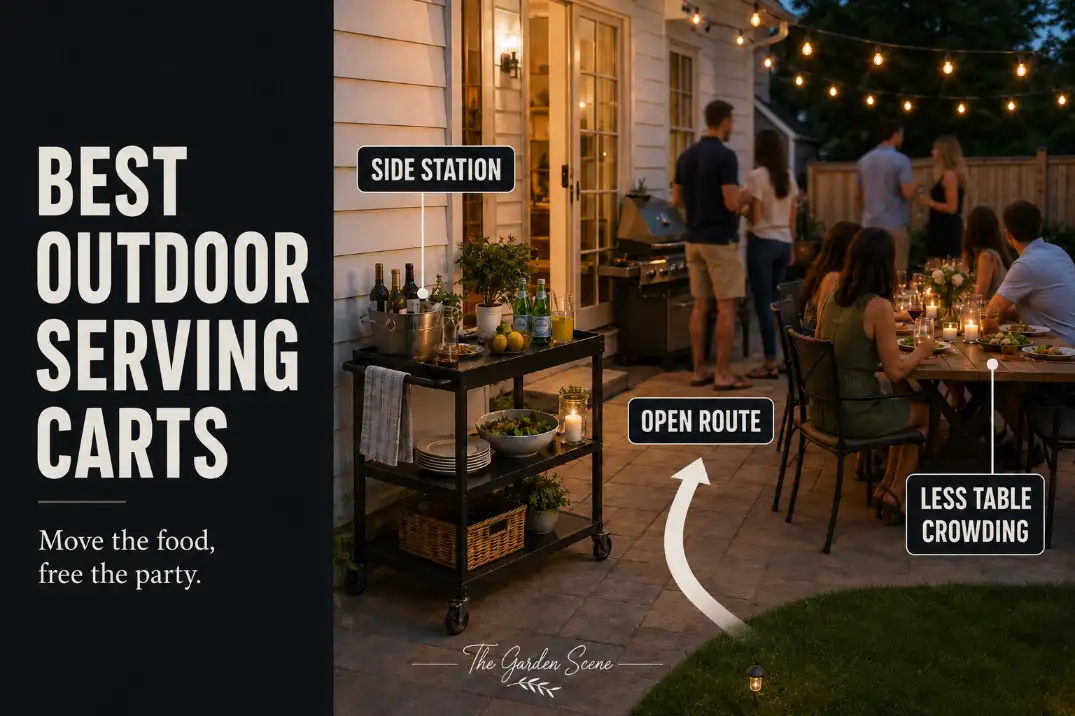
The best outdoor serving cart for a crowded patio party is not the biggest cart you can fit. It is the cart that removes one stop point from the main party route.
When the back door, food table, drink refills, used plates, and dining chairs all compete inside the same 4-foot zone, the patio starts to feel crowded even if the square footage is not terrible. A good cart solves that by moving one job to the side.
Start with three checks: where guests enter, where they stop first, and what they come back for again. A serving cart differs from a regular side table because it can shift between setup, serving, refill, and cleanup. That mobility matters most during the first 30 minutes of a party, when greetings, food, drinks, and chair movement all hit the same route.
Quick Answer: Which Outdoor Serving Cart Should You Buy?
For most crowded patio parties, start with a two-shelf rolling outdoor serving cart with locking wheels. It gives food or supplies their own service edge while keeping at least 36 inches of walking space open.
First decide what is causing the crowd
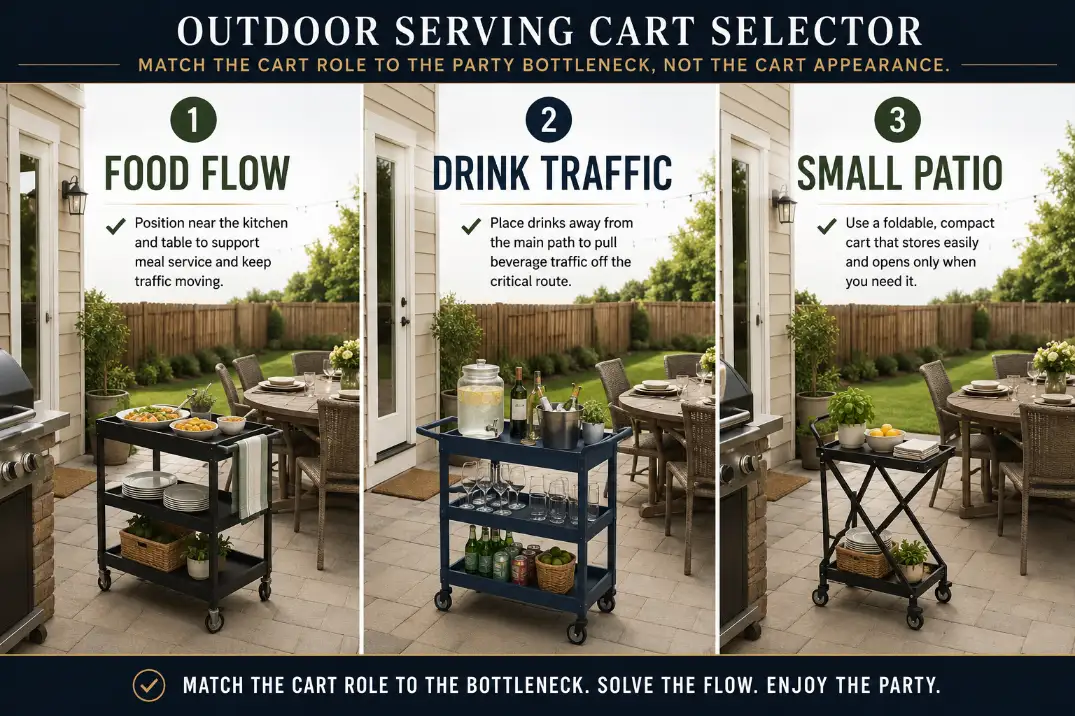
Food crowding and drink traffic look similar, but they need different cart choices. If guests gather around the dining table because plates, sides, utensils, and napkins are all there, a rolling serving cart is the better first buy. If guests already have food but keep returning for cups, ice, cans, bottles, or refills, a drink cart will usually improve the patio faster.
That distinction matters because a bigger food cart will not fix repeat drink traffic. It may only make the food station larger while the same people keep crossing the patio for beverages.
If the dining table is already doing too many jobs, start with a rolling serving cart. It gives the party a second service point without turning the whole patio into a buffet line.
BEST WHEN FOOD CREATES THE CROWD
Outdoor serving carts with wheels
Choose this when guests keep gathering around the dining table just to grab plates, sides, napkins, or refills.
It works because it moves the serving stop to the patio edge while keeping the table usable for sitting and eating.
Skip narrow decorative carts; look for locking wheels, two usable shelves, and a top wide enough for real serving trays.
🔴 SHOP outdoor serving carts with wheels
Use a drink cart when people keep returning
A drink cart is not just a styled bar accessory. In a crowded patio party, it solves the repeat-stop problem. People may serve food once, but they often return for drinks several times over 2 to 3 hours. If the cooler, cups, ice, and bottles are beside the food line, the food station never fully clears.
A dedicated outdoor bar cart works best when it sits about 6 to 10 feet away from the food cart or dining table. That distance is close enough to feel connected but far enough to split the crowd. It also keeps melting ice, bottle caps, cans, and sticky drink spills away from the main food surface.
If guests keep coming back for drinks after they already have food, a larger food cart is not the right fix. Split the repeat traffic with a separate outdoor bar cart.
BEST WHEN DRINKS CAUSE REPEAT TRAFFIC
Outdoor cooler carts
Choose this when guests return for cups, ice, cans, bottles, or refills more often than they return for food.
It works because it pulls repeat drink traffic away from the food line, dining chairs, and back-door route.
Look for a wipe-clean top, lower storage, locking wheels, and enough depth for an ice bucket or drink tub.
🔴 SHOP outdoor cooler carts
This food-versus-drink split is the same kind of flow decision that shapes better backyard entertaining layouts. If your patio jams at the entry, table, trash, and serving zone all at once, the route logic in Outdoor Entertaining Flow Ideas is a useful next layer.
What Makes an Outdoor Serving Cart Actually Solve the Problem?
A serving cart can look useful online and still disappoint outside. The real test is not whether it has a nice handle or a styled shelf. The test is whether it stops guests from clustering, helps the host refill without crossing the whole patio, and stays stable when people use it.
Locking wheels prevent the cart from becoming unstable
Wheels matter because the cart has to move before the party and stay still during the party. A cart may roll from garage storage to the patio, from grill prep to serving, and from serving to cleanup in the same evening. If the wheels are weak, the cart becomes annoying before guests even arrive.
Small plastic wheels can catch on paver joints, deck gaps, pea gravel, or uneven concrete. On smooth concrete or a level deck, smaller wheels can work. On pavers, textured slabs, or a route with a 1/2-inch height change, larger wheels are worth prioritizing.
Locking wheels solve a different problem: guest confidence. If the cart shifts when someone reaches for a plate, people hesitate, grab awkwardly, or avoid using the cart. A stable cart makes the serving station feel intentional instead of temporary.
Two shelves separate active serving from backup clutter
Two shelves are not just about holding more stuff. They keep the top surface from turning into a messy search zone. The top can hold food, a tray, drinks, or dessert. The lower shelf can hold extra cups, napkins, utensils, paper towels, or refill containers.
That separation changes how guests behave. A clean serving station lets one person grab what they need in about 10 to 20 seconds. A crowded top makes people pause, move items around, ask where things are, and hold the line without meaning to.
For 12 to 20 guests, that delay becomes visible. The cart should shorten the stop, not give the stop more surface area to spread out.
Outdoor-safe surfaces reduce cleanup friction
Outdoor-safe material matters because parties are not gentle. Ice drips, cans sweat, sauces spill, and trays slide. A cart with a fussy surface may look better before the party but become harder to clean afterward.
Powder-coated metal, outdoor resin, stainless accents, teak, acacia, or sealed wood can all work, but the finish and hardware matter more than the category name. If the cart will stay outside for more than a few hours after the party, drainage gaps, easy-clean shelves, and rust-resistant hardware are more useful than decorative trim.
Do not overestimate how protected a covered patio really is. Wind-driven rain can still wet the lower shelf, and summer sun can heat dark metal surfaces fast.
Pro Tip: If you plan to leave the cart outdoors between parties, choose open shelves or slatted surfaces instead of tray-like shelves that hold rainwater.
When a Compact or Foldable Cart Is the Better Buy
A full rolling serving cart is not always the smartest choice. If the patio is narrow, the deck has tight stairs, or the cart has to be stored in a garage after every party, a foldable cart can solve the hosting problem without becoming everyday clutter.
Small patios need temporary serving space
A compact or foldable serving cart works best when the party needs short-term support, not a full buffet station. It can hold dessert, condiments, backup plates, drink refills, or a small tray, then fold away when the patio returns to everyday use.
The key is being honest about capacity. If you usually host 6 to 8 people, a compact cart can be enough. If you regularly host 14 or more, a small folding cart may reduce clutter, but it will not fully control the serving line.
If the patio cannot afford another permanent piece of furniture, do not force a large cart into the layout. A foldable cart is the better buy when temporary serving space matters more than buffet capacity.
BEST WHEN STORAGE SPACE IS TIGHT
Folding service carts with wheels
Choose this for small patios, townhouse decks, and homeowners who need the cart stored after the party.
It works because it adds temporary serving space without becoming permanent patio clutter.
Look for a stable frame, secure locking mechanism, outdoor-safe shelves, and folded storage depth under about 10 inches.
🔴 SHOP Folding service carts with wheels
A foldable cart is especially useful when grill prep, serving, and seating already compete for the same patio edge. If the cart is meant to support cooking as much as serving, the layout ideas in Compact Prep Table and Grill Cart for Small Patios can help you avoid mixing guest serving space with the cook’s working zone.
Serving Cart Comparison for Crowded Patio Parties
| Cart Type | Best Use | What It Solves | What to Avoid |
|---|---|---|---|
| Rolling serving cart | Main food station | Moves plates, sides, and refills off the dining table | Narrow decorative carts with weak shelves |
| Outdoor bar cart | Drinks, ice, cups, refills | Pulls repeat drink traffic away from food and chairs | Placing it beside the food line |
| Foldable serving cart | Small patios and storage-limited homes | Adds temporary serving space without permanent clutter | Expecting it to hold a full buffet |
| Grill prep cart | Raw-to-cooked staging and tools | Gives the cook a working surface away from guest serving | Mixing prep tools with guest plates |
| Utility-style outdoor cart | Heavy supplies and cleanup | Moves bulky items before and after the party | Parking an industrial cart in the seating zone |
A grill prep cart can overlap with a serving cart, but they are not the same job. Prep involves tools, trays, raw food, cooked food, and timing. Serving involves guest access, flow, and presentation. Mixing the two often creates confusion, especially when the cook is still working while guests reach for plates.
If your grill, dining table, and serving cart all need the same patio strip, the spacing logic in Patio Layout for Grill, Prep, and Dining can help keep the cart from landing in the wrong working lane.
Where the Cart Should Go During the Party
Placement decides whether the cart helps or becomes another pinch point. A good cart in the wrong spot can block guests just as badly as an oversized dining chair or cooler.
Keep the cart off the back-door landing
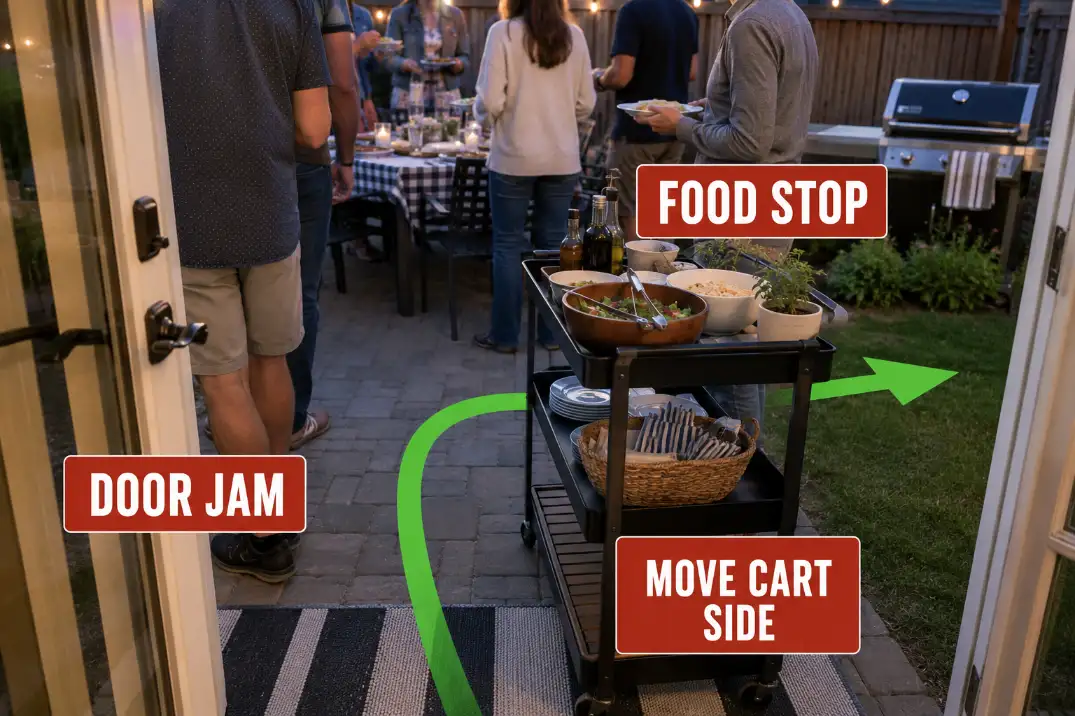
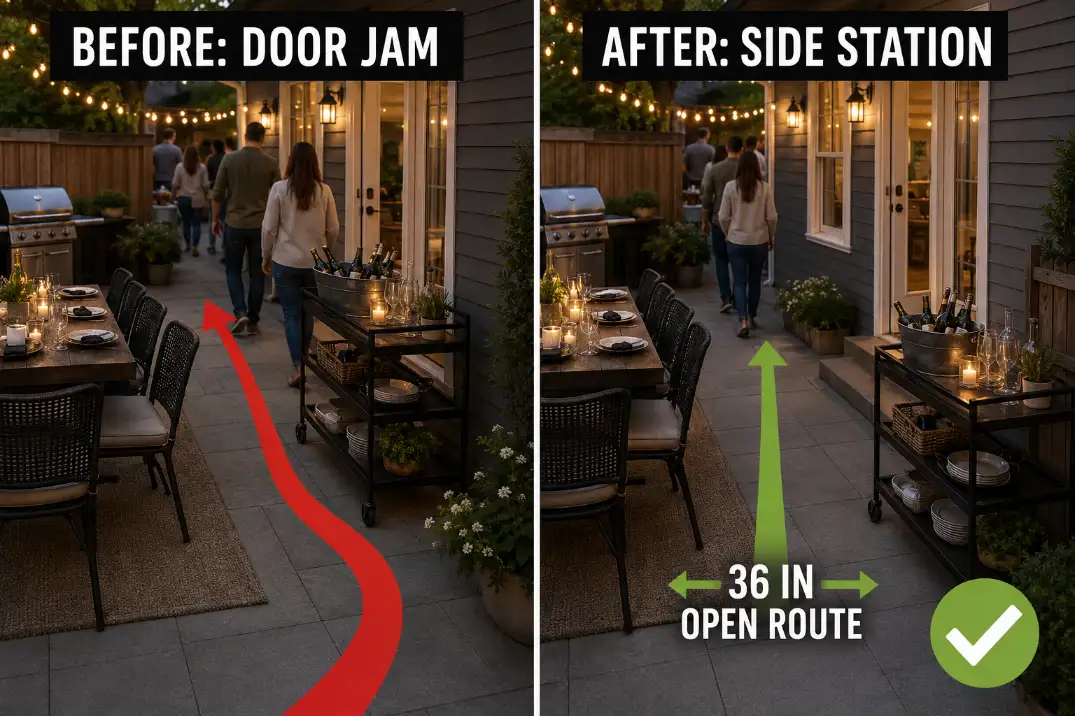
The back door is usually the most underestimated crowd zone. People pause there to step outside, greet others, carry food, hold the door, or decide where to go. If the cart sits directly outside that door, it turns entry into a serving line.
Keep the first 3 to 4 feet outside the door open whenever possible. If your patio is tight, angle the cart along a side wall or fence instead of facing it toward the door. Guests should be able to enter, move past the cart, and choose whether to stop.
This is the same reason a clear entry route matters in Keep Patio Entry Clear. Entry space is not empty space; it is the first piece of party flow.
Keep food, drinks, and trash from sharing one corner
A crowded patio party usually breaks down when food, drinks, and trash share one corner. Guests arrive at the cart for food, return for drinks, and then come back again with used plates. That creates repeat traffic in the same spot.
A better layout gives each stop a small role. Put the food cart on one side of the dining zone, the drink cart several feet away, and trash slightly beyond the main route. The trash spot does not need to be beautiful, but it should be obvious. If guests cannot find it in 5 seconds, used plates and cans will land on the cart.
Leave chair movement room
Serving carts often fail because they are placed where chairs need to slide back. A dining chair can need 24 to 30 inches of pullout space before a person can stand comfortably. Add a cart behind that chair and the seating side becomes a squeeze zone.
Before the party, pull every chair out as if someone is standing up. Then roll the cart through the route. If the cart cannot pass without turning sideways, it should not live behind the dining seats.
A layout that works on paper can still feel cramped once chairs, guests, plates, and coolers enter the scene. For a broader size-based check, Patio Furniture Layout by Size gives a useful way to judge whether the cart is solving a space problem or adding to it.
What People Usually Overbuy
The most overestimated feature is size. A huge cart looks practical online, but on a crowded patio it can behave like a second dining table. More surface area does not help if it blocks the lane people need to use.
The most underestimated feature is wheel quality. A serving cart that rolls smoothly when empty may feel completely different with drinks, trays, plates, and ice on it. If it wobbles under weight, guests will stop trusting it.
The fix that often wastes money
Buying extra trays, tiered stands, or decorative organizers rarely fixes a crowded party setup. Those accessories may make the cart look styled, but they do not separate traffic. If guests are still stopping in the same 4-foot area, the problem is layout, not accessories.
A better first fix is to assign the cart one job. Use it for food, drinks, dessert, or cleanup support. Do not ask one cart to do everything unless the party is small.
When a serving cart stops making sense
A serving cart stops making sense when the patio has no stable route for it. If the only possible location blocks the back door, grill, stairs, or chair movement, a folding side table or fixed buffet surface may be better.
It also stops making sense when the cart must cross gravel, grass, or a steep threshold every time it is used. In that case, a stationary outdoor cabinet, deck box, or side table may do the job with less frustration.
This is where clutter control matters. If the cart is mostly being used to hold random patio items between parties, the better fix may be storage, not serving. A cart should support the event, while Reduce Patio Clutter Without Losing Function focuses on the everyday items that make outdoor spaces feel crowded before guests even arrive.
Quick Buying Checklist
Use this checklist before choosing an outdoor serving cart for patio parties:
- Choose a cart that keeps at least 36 inches of walking space open when parked.
- Look for locking wheels if guests will reach from the cart.
- Use a two-shelf design when plates, napkins, cups, and refills need separation.
- Pick larger wheels if the cart crosses pavers, deck gaps, or uneven concrete.
- Avoid narrow carts if the main job is holding serving trays.
- Choose outdoor-safe materials if the cart will stay outside more than a few hours after the party.
- Match the cart to one bottleneck: food, drinks, grill prep, dessert, or cleanup.
Questions People Usually Ask
Is a bar cart better than a serving cart for patio parties?
A bar cart is better when drinks are the main repeat stop. A serving cart is better when food and plates are causing the crowd. For larger parties, separating the two works better than trying to make one cart handle both jobs.
Should the cart stay outside all season?
Only if the material and hardware are built for exposure. A covered patio still gets humidity, blown rain, dust, and heat. If the cart has wood shelves, thin hardware, or non-outdoor wheels, storing it indoors between parties will usually extend its life.
How many shelves should an outdoor serving cart have?
Two shelves are usually the most practical. The top shelf handles active serving, while the lower shelf keeps backup plates, utensils, napkins, or drink refills nearby without crowding the top.
Is a foldable serving cart strong enough for parties?
It can be strong enough for small parties if the frame locks securely and the shelves do not flex under weight. For heavy trays, drink tubs, or frequent entertaining, a fixed-frame rolling cart is usually the better choice.
Final Takeaway
For crowded patio parties, the best outdoor serving cart is the one that removes pressure from the busiest stop point. Choose a rolling serving cart if food is the problem, a bar cart if drinks create repeat traffic, and a foldable cart if storage space matters more than buffet capacity.
Do not buy only by size or style. Buy by the job the cart needs to perform during the first hour of the party, when guests arrive, drinks move, food comes out, and the patio route gets tested for real.
If the cart will hold food for more than a short serving window, the timing and handling guidance from the USDA Food Safety and Inspection Service is worth checking before the party.