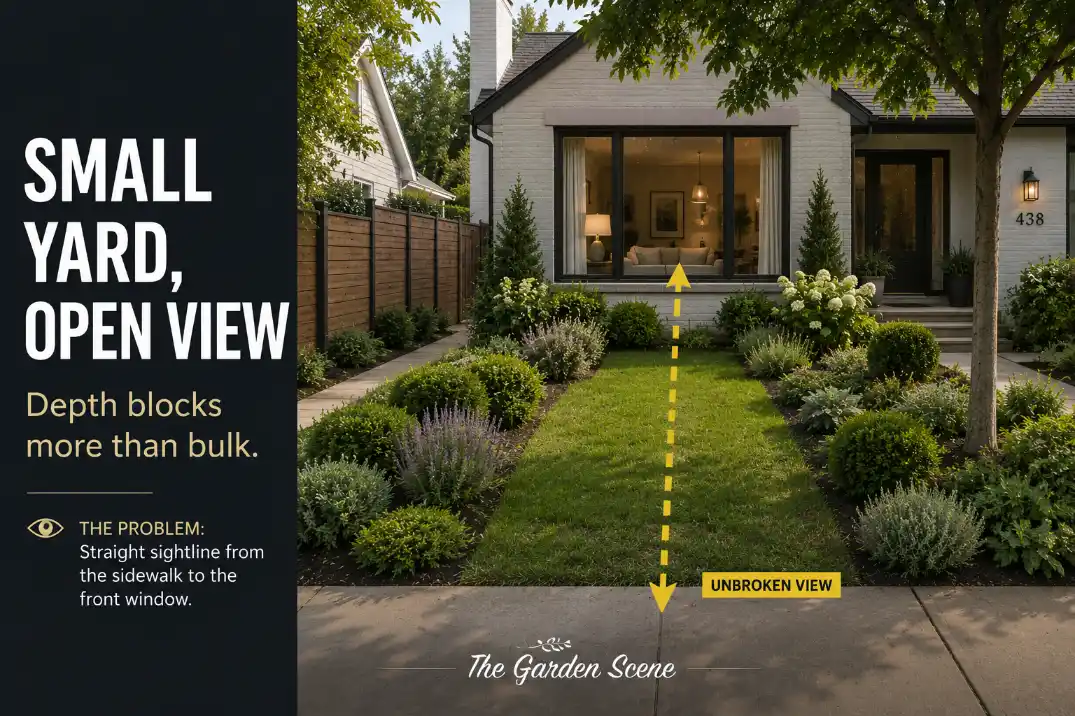
Small front yard privacy usually fails because the planting is placed where the yard has room, not where the view actually travels. A 3-foot shrub at the curb may look finished, but it often does little if the sightline from the sidewalk still passes over it into a 4- to 5-foot-high window.
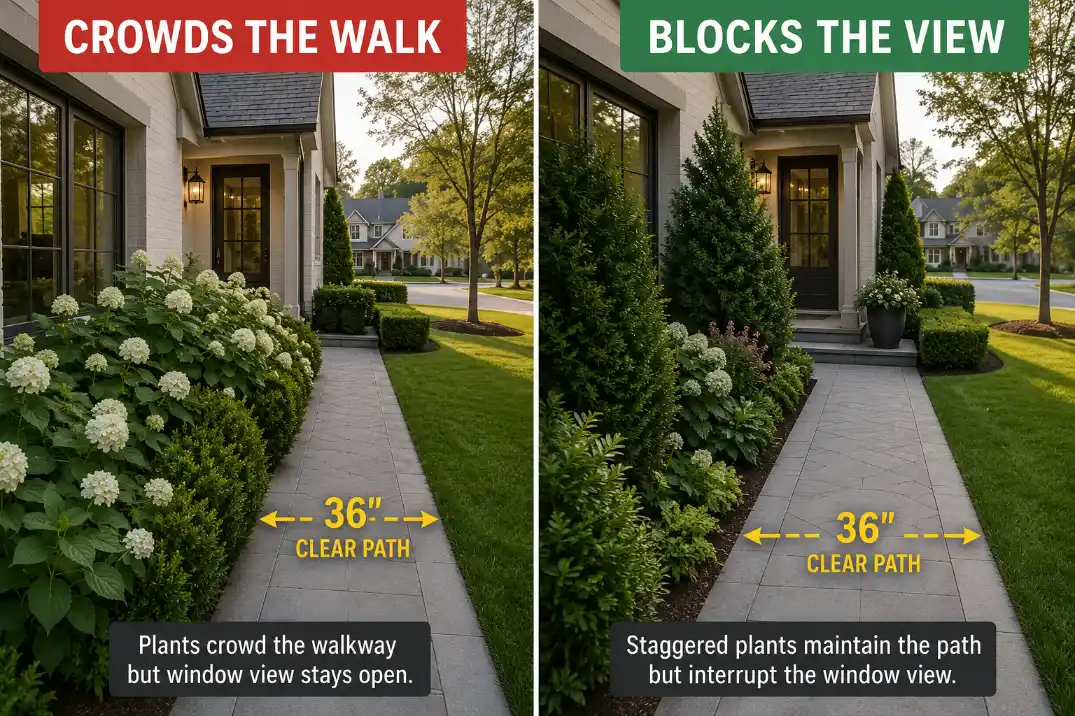
Start with three checks: where people pause, which window sits closest to eye level, and whether the walkway still has at least 36 inches of clear width.
This is not the same as filling a front bed. The goal is to interrupt the view without darkening the house, crowding the entry, or making the yard feel smaller.
Small Yard Privacy Problems
The real issue is usually one exposed sightline
Most small front yards do not need a wall of plants. They need one or two broken view lines. The strongest privacy pressure usually comes from the sidewalk, street parking, a neighbor’s front walk, or a driveway where people slow down.
The mistake is treating the entire yard as exposed. That leads to too many plants in too little space. A better first move is to stand at the sidewalk and look toward the windows, porch, and entry.
If one clear lane lets the eye travel straight to glass, that lane matters more than the total amount of planting.
For broader privacy strategy beyond compact yards, Landscaping for Privacy is a useful companion because it explains the bigger screening logic without forcing every yard into a fence-style solution.
Cosmetic coverage is not privacy
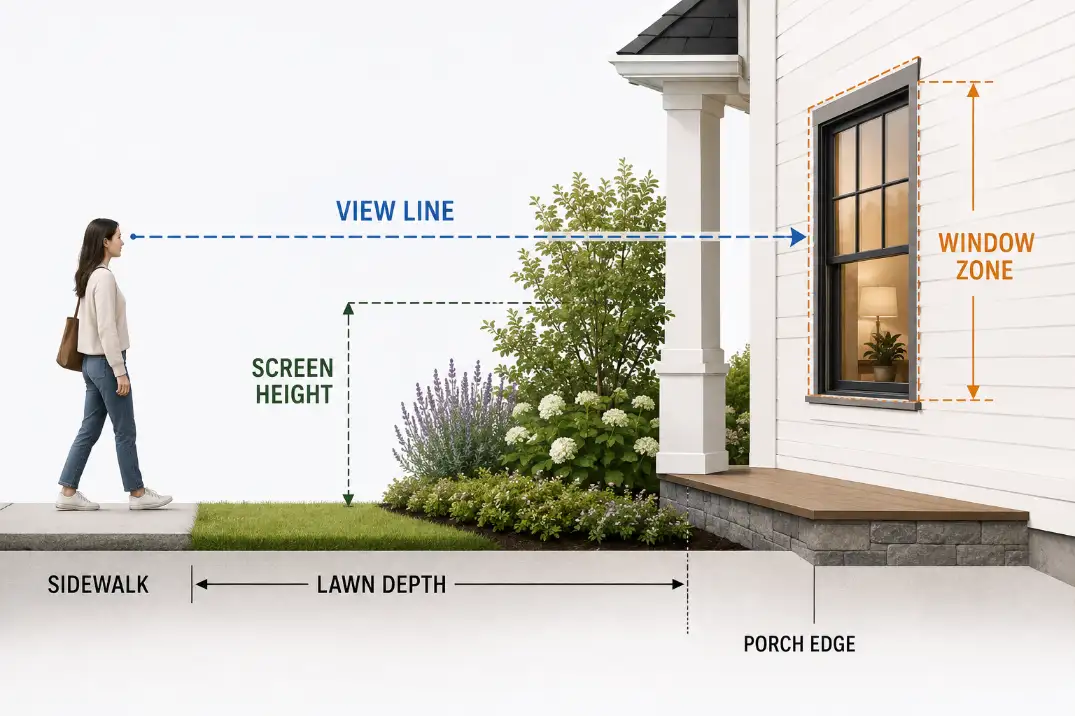
Low flowers, mulch curves, and small foundation shrubs can improve curb appeal, but they rarely block eye-level views. Pedestrian eye level is often around 5 feet above the sidewalk. If your plants mature at 18 to 30 inches, they soften the yard but usually do not screen a window.
That does not make low planting useless. It just means it should support the privacy layer, not pretend to be the privacy layer.
Privacy Without Losing Space
Use depth before height
In a compact front yard, depth usually works better than one tall hedge. A layered screen can be only 3 to 5 feet deep and still feel private if it interrupts the view at the right angle. The first layer may stay low near the walk, while the second layer sits closer to the window or porch where it blocks the actual line of sight.
A narrow evergreen shoved against the sidewalk often creates more maintenance than privacy. Once it grows into the path, you either shear it constantly or lose walking clearance.
Keep light in the house
Small-yard privacy should not turn the front rooms dark. This is where people often overestimate height and underestimate spacing. A solid 6-foot hedge near the window may block the view, but it can also block winter light, airflow, and curb appeal.
Better privacy often comes from partial screening: staggered shrubs, an open-branch small tree, a narrow trellis with vines, or a tall planter placed off-center from the window. The view is interrupted, but the house still feels open.
Pro Tip: If the room already feels dim, avoid placing dense evergreens directly across the full window width. Offset the screen so it blocks the street angle, not the entire glass.
Screening Front Windows
Match plant height to the glass
Window privacy depends on where the glass begins. If the lower edge of the window is around 3 feet above grade, a 4- to 5-foot mature shrub may be enough. If the window starts higher, a small ornamental tree or taller narrow screen may work better.
A practical rule: if a plant’s mature height is below the lower third of the window, it is probably a softening plant, not a privacy plant.
For yards where fencing is not allowed or would feel too heavy, Front Yard Privacy for Small Yards Without a Fence covers the same no-fence constraint in more depth.
Avoid the foundation-only trap
Foundation planting is often too close to the house to solve street privacy. It may frame the window nicely, but from the sidewalk the view can still pass between shrubs or over them. In many small yards, the stronger move is a staggered mid-yard plant placed 4 to 8 feet in front of the window, depending on yard depth.
Screening the Porch
Porch privacy is more about seated eye level than standing eye level. Someone sitting on a porch is often 3 to 4 feet above the porch floor, so a lower screen can work if it is placed close enough to the exposed edge.
Screen the side first
The front of the porch usually needs openness so the entry still feels welcoming. Side exposure is often more uncomfortable because neighbors, driveways, and sidewalks create angled views. A compact shrub group, tall planter, or narrow trellis near the porch corner can block that angle without closing the whole front.
The fix that often wastes time is adding more low plants across the front bed. It makes the porch prettier, but the exposed side angle remains.
Leave the entry gap open
A small yard gets visually smaller when the entry path disappears behind plants. Keep the door approach obvious from the street. Privacy should frame the arrival, not hide it.
Privacy Near the Walkway and Driveway
Walkways need clear edges
Near a front walk, choose plants by mature width first and beauty second. A 2-foot-wide plant beside a 3-foot path is very different from a 4-foot-wide plant beside the same path. Once stems lean into the walking zone, the yard starts to feel neglected even if the plants are healthy.
If the walkway edge needs trimming every 2 to 3 weeks in peak growing season just to stay passable, the plant is probably too large for that position.
Driveways need sight clearance
Driveway privacy has a stricter limit. Do not create a blind corner where drivers, children, pets, or pedestrians cross. Keep lower planting near the driveway apron and shift taller screening back where it does not block visibility.
This is also why suburban front-yard privacy is different from backyard screening. Front Yard Privacy Without a Fence in Suburban Neighborhoods explains how openness, neighbor expectations, and curb visibility change the design.
Compact Shrub Layers
Choose slower, denser forms over fast bulk
Fast growth sounds attractive, but in small front yards it often becomes the problem. A plant that gains 2 feet a year can outgrow its role quickly near windows, walks, and driveways. Slower shrubs with dense branching usually make better privacy because they stay in scale longer.
Evergreen shrubs help where year-round screening matters, especially in northern states after deciduous plants drop leaves. In hot climates like Arizona, drought tolerance and reflected heat near paving matter more. In humid Florida yards, airflow around dense shrubs is important because tight planting can hold moisture against foliage.
Use the right form for the exposure
| Privacy Need | Best Small-Yard Form | Avoid |
|---|---|---|
| Front window view | Staggered 4–6 ft shrub or small tree | Low curb-only planting |
| Porch side exposure | Tall planter, upright shrub, or narrow trellis | Closing the whole porch front |
| Walkway edge | Narrow, slow-growing shrubs | Wide plants that need constant shearing |
| Driveway edge | Low planting near apron, taller plants set back | Tall shrubs at the visibility corner |
| Paved or rented space | Large planter 18–24 inches wide | Small pots that dry out daily |
For more detailed plant-and-container combinations, Privacy Plants and Planters for Front Yard Privacy can help when soil beds are limited or the privacy point is close to a porch.
Planters, Trellises, and Small Screens
Planters are useful when the privacy need is seasonal, rented, paved, or close to the house. They work best at porch corners, beside steps, or along a short exposed edge. For shrubs, a container at least 18 to 24 inches wide is usually more realistic than a narrow accent pot.
Small trellises and partial screens can also work when plants alone would take too much ground space. The important word is partial. A narrow lattice panel, open slat screen, or vine support can interrupt a view without creating a fence-like front yard. In HOA-heavy neighborhoods, partial screens often feel less confrontational than a full fence while still solving the exposed angle.
In summer heat, small containers may need water daily, while larger planters may hold moisture for 2 to 4 days depending on sun and wind. That maintenance difference matters more than the planter’s style.
Small Trees for Privacy
Use canopy to filter, not block
Small trees are valuable because they screen at window height without filling the ground plane. A multi-stem ornamental tree can filter views while keeping the yard open underneath. The goal is filtered privacy, not a dark wall.
The key is mature spread. A tree with a 15-foot canopy may be too wide for a narrow frontage unless it can be pruned naturally. A better choice is often a small tree with a 6- to 10-foot spread placed slightly off the window centerline.
Do not plant for today’s empty space
New trees look harmless because they are thin at planting. The decision should be based on mature canopy, trunk position, root space, roof clearance, and walkway clearance. If the tree will need constant correction to avoid the roofline, driveway, or path, it is not a compact privacy solution.
Avoid Overplanting
Overplanting is the fastest way to make a small front yard feel smaller. It usually happens when the first layer does not solve privacy, so the owner adds more plants instead of moving the screen to the correct line.
A routine fix stops making sense when pruning becomes the design. If a shrub only works when clipped hard several times a season, the plant is carrying the wrong job.
Simple Small Yard Layouts
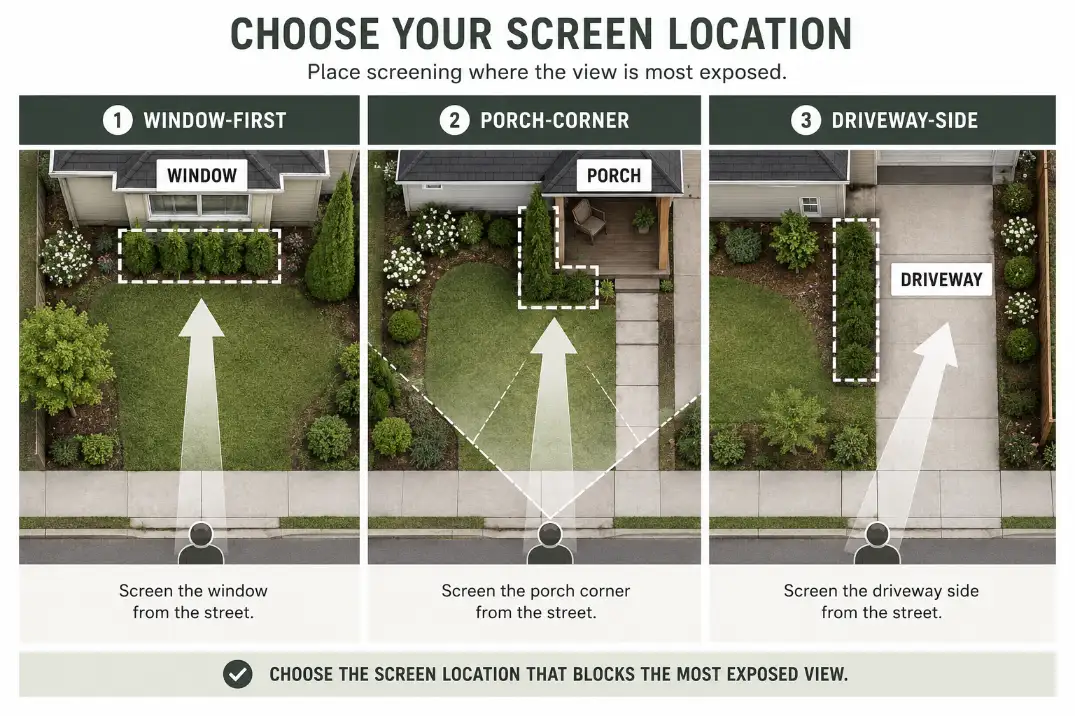
Window-first layout
Use this when one front window is the main privacy problem. Place the main shrub or small tree where it breaks the sidewalk-to-window view, then add a lower edge plant closer to the walk for softness. Avoid this layout if it blocks too much light across the full window width.
Porch-corner layout
Use this when the porch feels exposed from one side. A tall planter, upright shrub, or slim trellis near the porch corner can block the side angle while keeping the steps open. Avoid filling the entire porch front unless the entry is still obvious from the street.
Driveway-side layout
Use this when the driveway creates the most uncomfortable view into the house. Keep low planting near the driveway apron and move taller screening back toward the house. Avoid tall shrubs at the sidewalk corner where they can block visibility.
For small yards where the goal is to keep the space feeling open, Small Front Yard Design Ideas That Feel Spacious pairs well with privacy planning because it focuses on scale, breathing room, and visual order.
Questions People Usually Ask
Can a small front yard be private without a fence?
Yes, but it usually needs targeted screening rather than a full border. One staggered shrub layer, a porch-side planter, small tree, or partial trellis can block the most uncomfortable view while keeping the yard open.
How tall should front yard privacy plants be?
For front windows, 4 to 6 feet is often enough if the plant sits in the right sightline. Taller is not automatically better, especially near sidewalks, driveways, or low porches.
What is the biggest mistake in small front yard privacy landscaping?
The biggest mistake is adding more plants before identifying the view line. Privacy comes from placement first, plant quantity second.
For broader official guidance on choosing and caring for woody landscape plants, see University of Minnesota Extension.