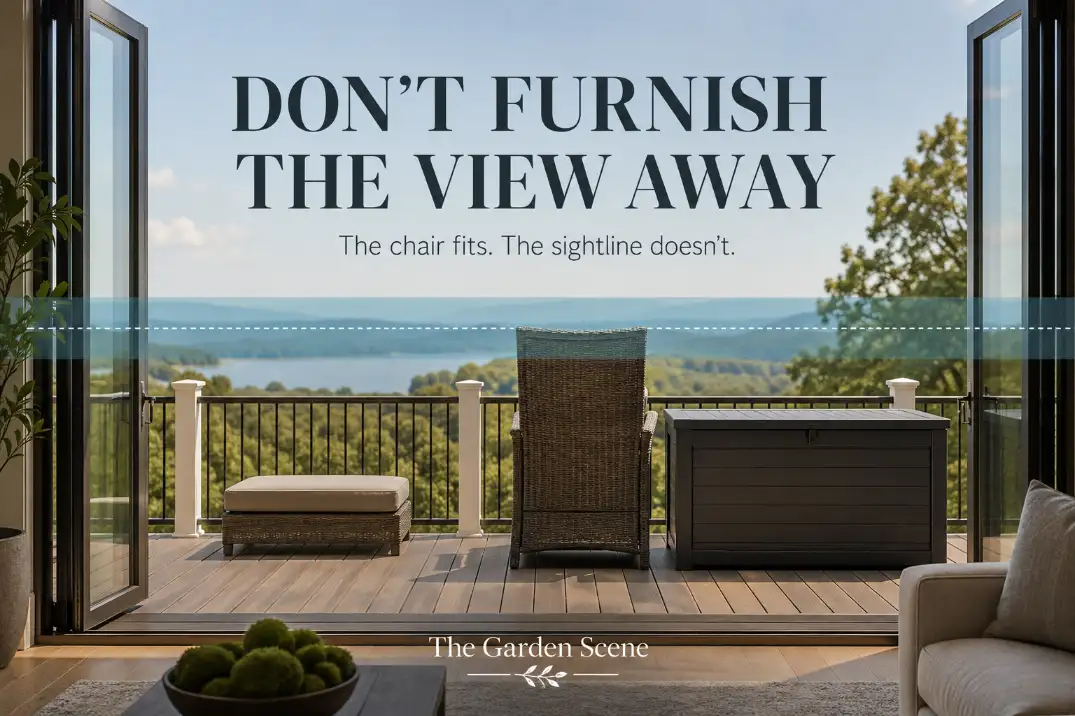
Deck furniture around railings works best when the railing side is treated as the view frame of the house, not leftover space for bulky pieces.
The first checks are simple: does the furniture rise above the top rail, can someone pass behind a seated person with about 30–36 inches of clearance, and does the view still feel open from 8–12 feet inside the room?
This is not the same as a small-deck problem. A deck can have enough floor space and still feel blocked because the tallest furniture sits exactly where the eye wants to travel.
The useful fix is usually lower first, lighter second, and fewer pieces only if the layout still fails after that. A smaller chair can still be wrong if its back cuts through the main sightline.
The Railing Side
The railing side is the easiest edge to misunderstand. It feels natural to push furniture there because it creates a boundary. That is partly right, but only if the furniture respects what the railing is already doing.
Separate the main view rail from the side rail
Not every railing deserves the same treatment. The main view rail is the section seen from the back door, kitchen, dining room, or main indoor sitting area. That rail should stay visually light. A side rail, especially one facing a fence, neighbor wall, driveway, or less important view, can usually carry taller furniture with less damage.
A useful split is this:
- Main view rail: low seating, open-frame chairs, slim side tables.
- Side rail: dining chairs, planters, occasional taller pieces.
- Service rail or corner: storage, folded furniture, grill tools, covered items.
That distinction matters more than symmetry. A perfectly balanced deck can still feel wrong if both sides are furnished evenly but the best view is blocked.
If the deck also has a tight route to stairs or a door, the same movement-first logic from Small Deck Layouts That Keep the Route Clear applies here: protect the path people actually use before filling the edge.
The railing is not furniture support
Do not treat the railing as a backrest, storage stop, or support surface for heavy planters and boxes. Even when the railing looks sturdy, its job is guarding the deck edge, not carrying furniture pressure or becoming a shelf.
This matters most on raised decks where people naturally lean, shift chairs, or push storage boxes tight against the guard.
The warning sign is not only damage. It is behavior. If the layout makes people lean on the rail to squeeze past furniture, the furniture is in the wrong place.
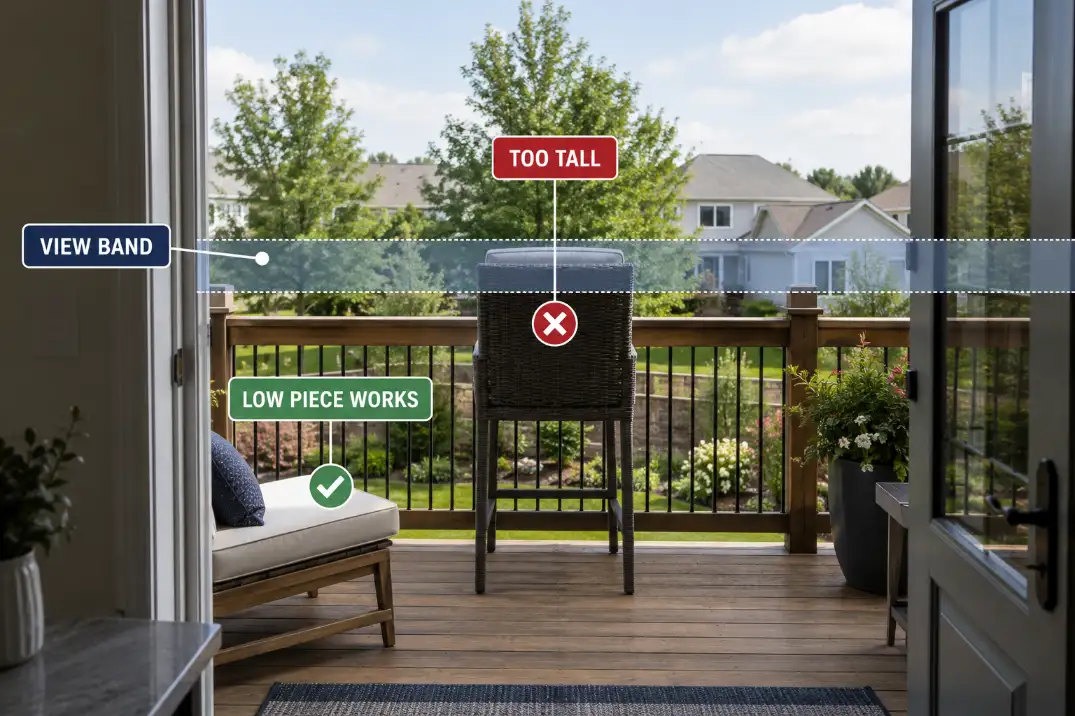
Tall Furniture Blocks More
Tall furniture does not just take up vertical space. It catches the eye, throws stronger shadows, and makes the railing feel heavier than it is. This is why a deck can look more crowded after adding only two chairs.
Chair backs usually cause the first problem
Outdoor dining tables are often about 28–30 inches high, but dining chair backs commonly reach 34–38 inches. On a deck with a 36-inch residential guard, the chair backs may line up with the rail or rise above it. From inside the house, that creates a row of interruptions where the yard should feel open.
Bar-height furniture is even less forgiving. A bar table may sit around 40–42 inches high, with stools and seated bodies rising higher in the view.
On a view-facing rail, bar-height furniture should be treated as a last-choice layout, not a clever space saver. It can work on a side rail or against the house wall, but near the primary view it often turns an open deck edge into a visual wall.
Pro Tip: Measure chair-back height before buying, not just table width. The chair back is usually what blocks the view.
Slim does not always mean open
A narrow tall planter, folded chair stack, umbrella pole, or bar cart may have a small footprint, but it can still land directly in the view. This is the condition many homeowners underestimate: view blockage is controlled by height and location, not only square footage.
Swapping one tall object for a “slimmer” tall object often wastes time if it stays in the same sightline. The stronger fix is moving height to a corner, side rail, or house wall where the view is already interrupted.
Low Pieces Near the View
Low furniture is not automatically better, but it is usually more forgiving near the main railing because it lets the edge breathe.
Use height as the first filter
For the main view rail, look for pieces that keep their strongest visual mass under about 28–32 inches. Low lounge chairs, backless benches, ottomans, compact coffee tables, and small side tables usually work better than upright dining chairs.
A piece can be slightly taller and still work if it has an open frame. A solid storage box at 30 inches high may feel heavier than an open lounge chair at the same height because the box reads as a block.
| Furniture choice | Best placement | Move it when | View decision |
|---|---|---|---|
| Low lounge chair | Main view rail | Seat depth blocks route | Usually best near view |
| Backless bench | Long rail run | People cannot exit easily | Good if kept visually light |
| Dining chair row | Side rail | Backs cross main view | Use carefully |
| Bar-height set | House wall or side zone | It faces the best view rail | Avoid on main view edge |
| Storage deck box | Corner or wall side | Lid becomes a clutter shelf | Keep off primary view |
Judge the used position, not the photo position
A layout can look open when every chair is tucked in. That does not mean it works. A dining chair may pull back 18–24 inches in use. A lounge chair can occupy 36 inches or more once someone sits down and angles their legs.
If the railing side is also a walking route, keep about 30 inches for a tight pass and closer to 36 inches where people regularly carry plates, drinks, cushions, or grill tools. Less than 24 inches behind a seated person usually feels like squeezing, even if it still looks passable on paper.
For decks where the back door, stair opening, and furniture all compete for the same small area, Deck Landing Space Between Door, Stairs, and Furniture is the more important companion issue. A good view does not help much if the furniture traps people at the exit.
Heavy Storage Near Railings
Storage is often more damaging than seating because it rarely moves. Chairs shift with use. Storage boxes sit in the same place for months and slowly collect more things.
Storage becomes a second wall
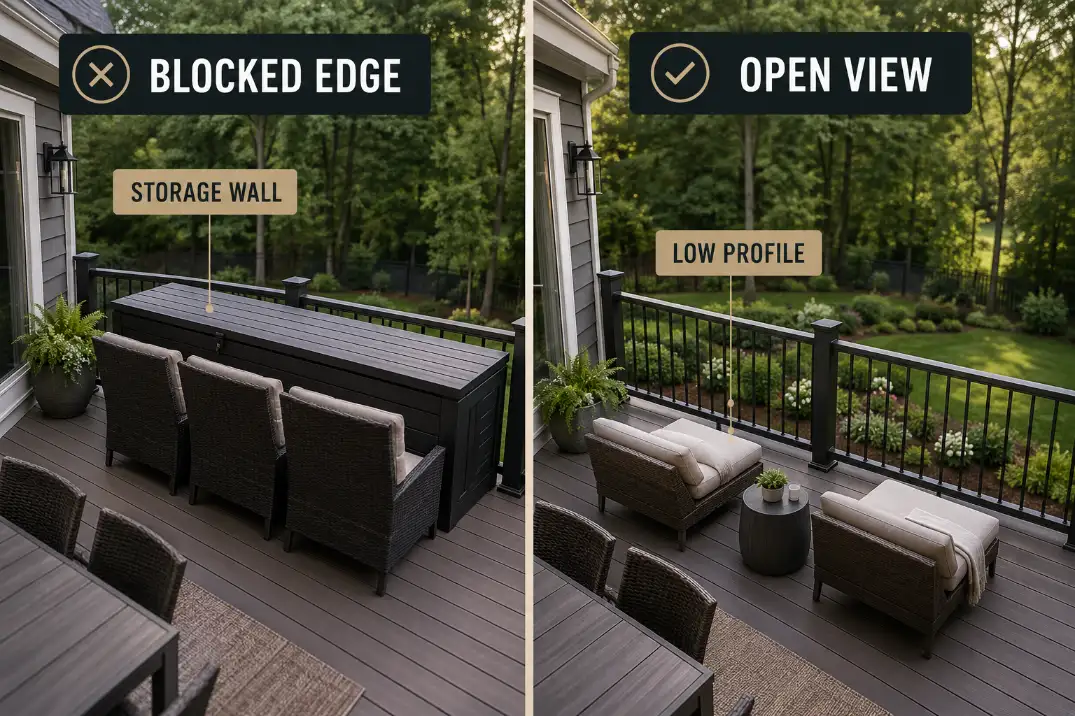
A large deck box may be 50–60 inches wide and 24–30 inches deep. Along the main railing, that behaves like a low wall. Add cushions, folded blankets, a watering can, or a planter on top, and the box becomes taller through use, not design.
The symptom is a blocked-looking deck. The underlying mechanism is fixed bulk sitting on the view edge day after day. Moving chairs around will not solve that if the heaviest object stays in the most visible position.
A practical one-week test works well here: if the lid becomes a landing spot for loose items for more than a week, it is no longer just storage. It has become visible clutter.
When organizing stops making sense
If storage takes more than about 15–20% of the usable deck floor, the issue is not organization. The deck is being used as a holding area. At that point, buying a prettier storage box usually wastes money.
Storage belongs where you would accept visual weight even when no one is outside. That usually means near the house wall, against a less important side rail, or under a built-in bench that stays below the view line.
For more on when seating-storage hybrids help or hurt, Outdoor Storage Benches and Patio Problems fits this decision well.
Seating Without Trapping People
A railing-side layout should preserve the view without turning the seating area into a dead end. This is where many good-looking layouts fail in real use.
Break long seating runs
A long low bench can work beautifully along a railing, but only if people can enter and leave without everyone shifting. Continuous seating along the rail becomes awkward when there is no gap, side table break, or open corner.
The better layout is often slightly less complete. A broken seating run with one small table gap may look less built-in, but it lets people move without stepping over legs or leaning on the guard.
This is also where “just add another chair” becomes the wrong fix. The deck may have room for the chair footprint, but not for the chair in use.
Put taller seating where the view is already interrupted
Dining chairs, swivel chairs, and high-backed lounge pieces make more sense near the house wall, beside a grill zone, or along a side rail. They can still be part of the deck layout without becoming the first thing seen from indoors.
For broader furniture sizing decisions, Patio Furniture Layout by Size helps separate what fits physically from what works comfortably.
Open From Inside Too
The deck is often viewed from inside the house more often than it is used outside. That is why the indoor sightline test should happen before the final furniture decision.
Test from daily standing points
Stand 8–12 feet inside the room that opens to the deck. Check the view from the kitchen sink, dining table, sofa, and main walking path. If the furniture forms a heavy band across the lower half of the glass, the deck will feel crowded even when nobody is on it.
This is especially important in northern states where a deck may sit unused for 3–5 months. During that time, the view from indoors becomes the main value of the deck. A low, quiet layout often feels better all winter than a fully furnished layout that blocks the yard.
Seasonal changes expose bulky choices
In summer, cushions, plants, and open umbrellas can make a dense deck feel styled. In winter, when cushions are stored and leaves drop, the furniture silhouette becomes more obvious.
In rainy Midwest springs or coastal California moisture, covered storage tends to migrate toward the railing because it feels convenient. Over time, that convenience becomes the blockage.
The healthier condition is a railing edge that still looks open when nothing is staged. The failing condition is an edge that only works when accessories distract from the bulk.
Quick Railing-Side Check
Use this before moving or buying anything:
- Does the main furniture mass stay below the top rail from inside the house?
- Can someone pass behind a seated person with about 30–36 inches of space?
- Are tall pieces kept away from the primary view rail?
- Is storage placed where visual weight is acceptable year-round?
- Does the deck still feel open after cushions and accessories are removed?
- Can people leave the seating area without stepping over legs or leaning on the railing?
The Best Fix Is Lower First
The best deck furniture around railings is not always the smallest furniture. It is the furniture that keeps height, bulk, and movement in the right places.
Do not start by removing useful pieces. Start by lowering the view edge. Then make bulky pieces lighter or move them to a side zone. Only after those two steps should you reduce the furniture count. Lower first. Lighter second. Fewer last.
That order matters because most railing-side layouts fail before they run out of space. They fail when the view band gets crowded, the walking route tightens, or storage turns into a second wall.
For broader official deck construction guidance, see the American Wood Council Prescriptive Residential Wood Deck Construction Guide.