Last updated: July 4, 2026
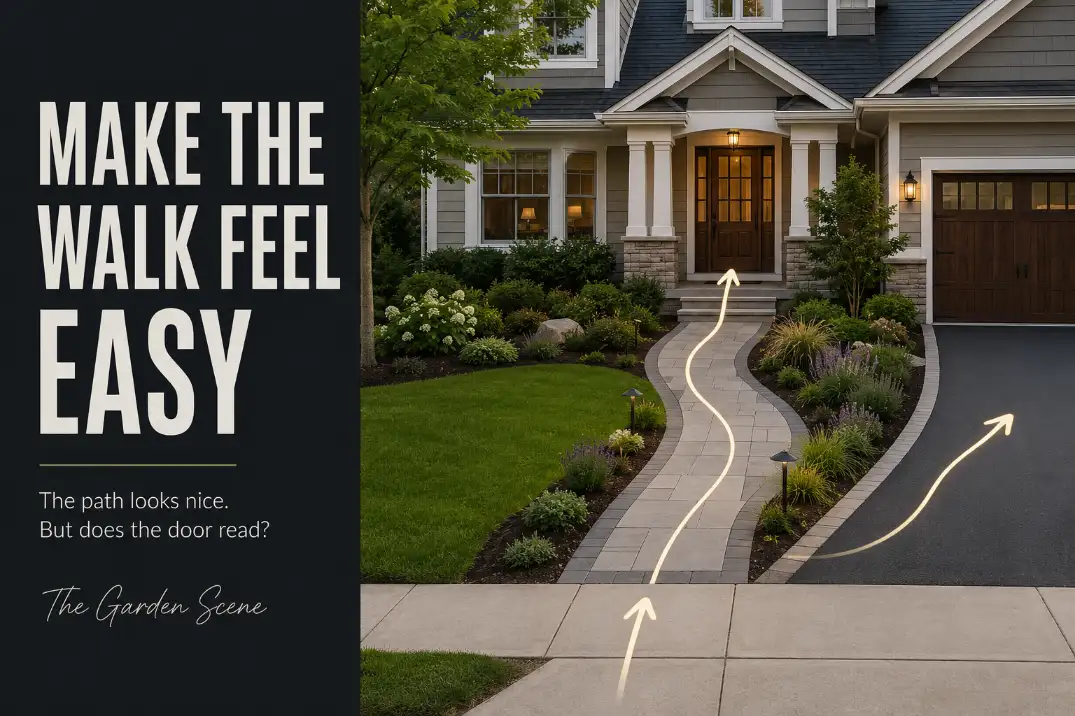
A front yard walkway does not feel inviting because the surface is expensive. It feels inviting when the first few seconds of approach do not create doubt.
A visitor steps out of a car or off the sidewalk, looks toward the house, and makes a quick judgment: Is the front door obvious? Is the walking line comfortable? Does the route feel intentional, or does the yard make them guess?
That moment is the real design test.
The strongest front yard walkway ideas start with route clarity, not paver style. The route should begin where people actually arrive, carry them without hesitation, stay wide enough to feel relaxed, use edges that guide instead of crowd, and end at a front door area where pausing feels natural.
If that route is weak, new stone, more flowers, brighter lights, or extra decor will only dress up the uncertainty.
Start With the Route, Not the Walkway Material
The first decision is not what the walkway is made of. It is whether the walkway clearly tells a visitor where to go.
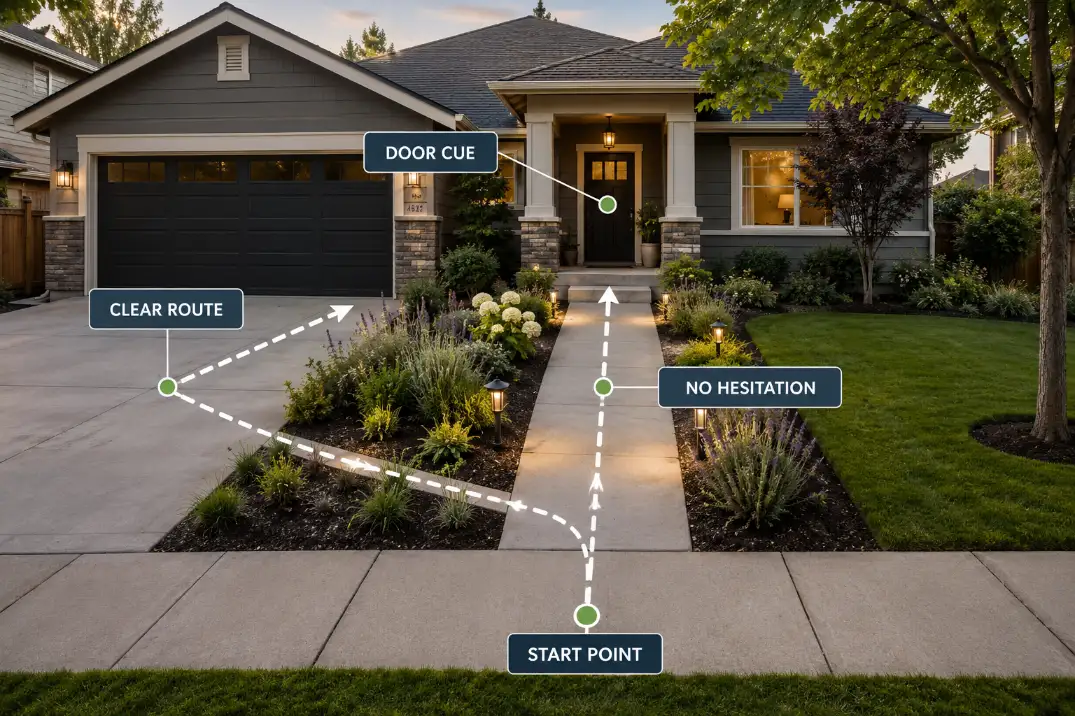
Stand where someone actually arrives. That may be the public sidewalk, the driveway edge, the curb, or the point where a side path meets the front yard. From that spot, look for the front door without using memory. If the door does not read quickly, the walkway has a route problem before it has a style problem.
A plain concrete path can feel welcoming if it points cleanly to the entry and carries movement without doubt. A beautiful stone path can feel awkward if it begins in the wrong place, bends without a reason, or sends the eye toward landscaping instead of the door.
The sidewalk approach and the driveway approach often need different attention. From the sidewalk, the path should invite someone from the public edge toward the home. From the driveway, the route should not force guests to cross lawn, step through planting, or search for the “real” path after getting out of the car.
That does not mean every front yard needs several walkways. It means the main approach should respect real use. Broader front yard entrance planning starts with the same principle: the yard should explain how to enter before it asks anyone to admire the landscaping.
A simple field test works better than a style board. Stand at the sidewalk. Then stand where a guest would park. In both places, ask whether the front door feels like the obvious destination. If the answer changes, the walkway may need a clearer start point, a stronger connection, or a better final cue near the door.
Remove the Small Frictions That Make Guests Hesitate
A walkway often stops feeling inviting through small interruptions, not obvious failure.
A guest steps out of the car and is unsure whether to use the lawn or the path. A package carrier slows at a tight bend. A shrub brushes the walking line. The porch looks close, but the final step area feels cramped. At night, the ground is visible, but the entry still does not feel like the destination.
Those are movement frictions. They make the approach feel less generous even when the walkway is clean, safe, and attractive.
A path can be wide enough on paper but feel narrow because plants lean over the edge. It can be well lit but still feel cold because the light reveals the surface without helping the arrival point. It can use expensive material and still feel hesitant because the start point is not where people naturally arrive.
Walk the path the way a visitor would. Carry a bag. Walk beside another person. Approach from the driveway, not just the sidewalk. Try it after dark. The place where your pace changes is usually the place the design needs attention.
Small access frictions also affect how intentional the whole front yard feels. Some front yard mistakes that make access feel less intentional are not really about taste; they are about whether the entrance works without explanation.
| Walkway feels like this | The real problem is usually | Better idea to test |
|---|---|---|
| Pretty but confusing | Door cue is weak | Strengthen the route line before adding decor |
| Narrow even when paved | Edges or plants visually squeeze the path | Pull planting back and reveal the full corridor |
| Cold or exposed | No edge rhythm or soft transition | Add low repeated planting or warmer edge texture |
| Awkward near the door | No arrival zone | Slightly widen or frame the final step area |
| Safe but not welcoming | Lighting/materials support function but not mood | Add subtle warmth without cluttering the route |
Use Width and Alignment to Make the Walk Feel Easy
Width is not only a measurement. It is how much permission the path gives someone to move naturally.
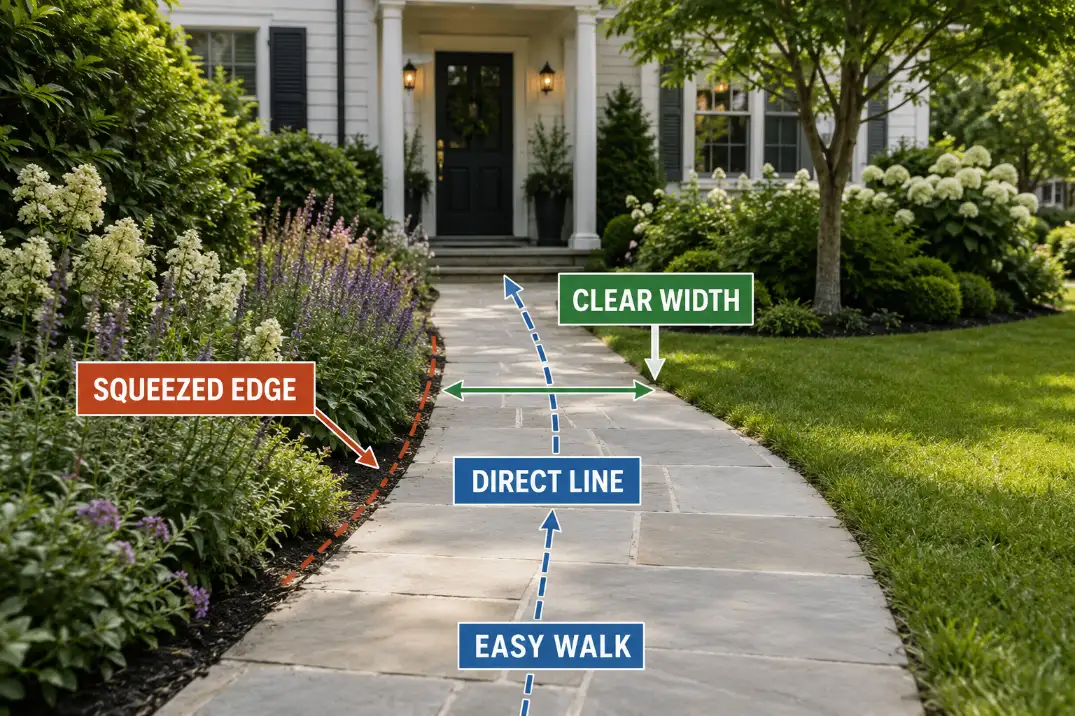
A 36-inch walkway can work as a practical minimum in many residential front yards. It lets one person move through without the path feeling like a stepping strip. Where guests regularly arrive, where people walk side by side, or where planting grows close to the edge, 42 to 48 inches usually feels more relaxed.
The real issue is usable width. A 42-inch path can feel tighter than a 36-inch path if shrubs spill over both sides. A walkway beside a driveway can feel pinched if car doors, trash bins, steps, or foundation planting crowd the first few feet. Seasonal growth matters too. A path that feels open in early spring can feel narrow by midsummer if edging plants lean into the walking line.
Alignment should reduce thinking. A straight path feels calm when it points cleanly toward the front door or porch. It says, “This is the way in.” That directness is especially useful when the entry is modest, the house has a deeper setback, or the facade has several competing visual cues.
A curve can feel inviting, but only when it solves a real site condition. A gentle curve around a tree, slope, planting bed, or driveway edge can make the approach feel natural. A curve that wanders only to look decorative can make the route feel less certain.
If the driveway, door, and sidewalk are fighting each other, keep the distinction clear. This article is about inviting feel, not full entry-route engineering. More technical driveway and front-door access layouts can solve competing arrival points in detail. Here, the test is simpler: does the path line make the next step obvious?
Let Edges Guide the Eye Without Squeezing the Path
Edges should guide the walk, not compete with it.
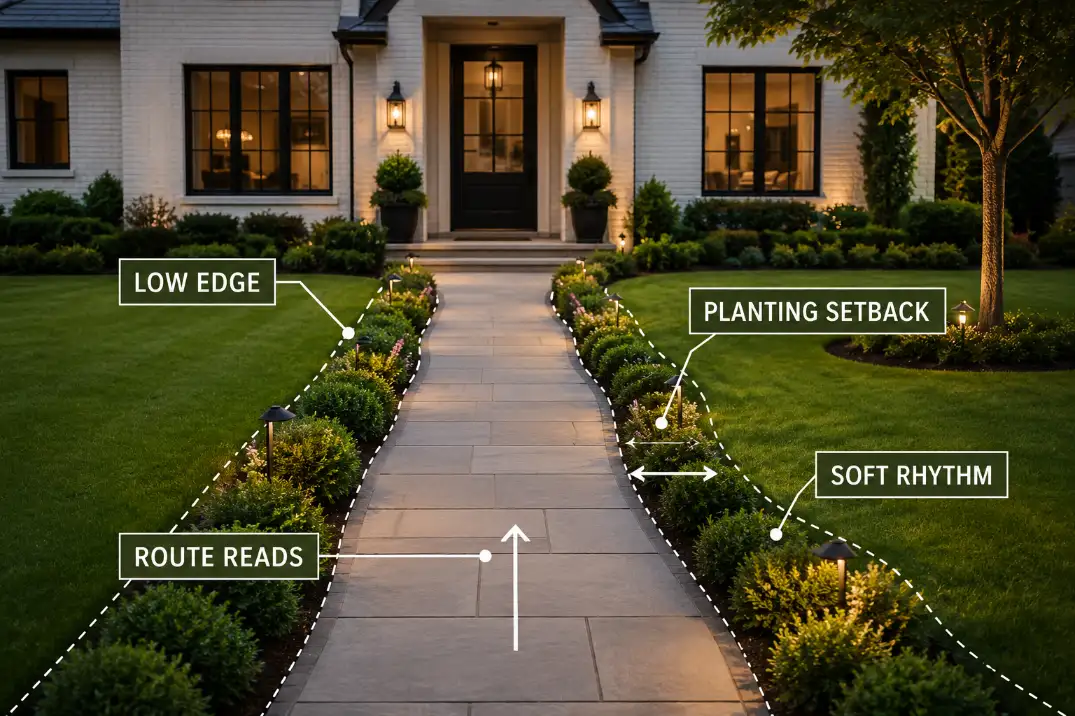
A bare path across open lawn may function, but it can feel exposed or unfinished. A path buried between heavy planting may look lush, but it can feel tight and uncertain. The inviting middle ground is edge rhythm: enough repetition to lead the eye, enough softness to warm the route, and enough restraint to keep the walking surface visible.
Edge rhythm can come from low planting, a repeated grass-like form, a consistent bed line, or a simple border that runs with the path. The repetition matters because it quietly tells the visitor where the route continues.
The mistake is letting the edge become the main event.
Tall plants beside a narrow walk make the path feel smaller. Loose mulch spilling over the edge blurs the walking line. Mixed plant heights that jump up and down along the route can make the approach feel busy instead of calm. Even attractive planting works against the walkway if it hides the front door or interrupts the view of the surface.
Near the path, keep forms low enough that the walking corridor and door cue stay visible. If a plant needs to lean, flop, or spill to look good, it usually belongs farther back from the path, not on the edge itself.
For yards where the path is part of a larger planting composition, front yard landscape ideas with a walkway to the front door can carry the broader planting relationship. Here, the edge has one job: make the approach feel guided without making the route feel narrow.
Editorial note: A front walkway does not need heavy decoration to feel inviting. It needs a route that stays readable while the edges make movement feel guided, not squeezed.
Use Material, Planting, and Lighting as Support, Not the Starting Point
Material, planting, and lighting should confirm the route, not rescue it.
A walkway surface should feel stable, predictable, and visually calm enough that the visitor trusts the approach. Brick, pavers, concrete, flagstone, stepping stones, and gravel can all work in the right setting. The useful question is not which one looks best in isolation. It is whether the surface helps the route feel continuous and easy to read.
A busy pattern can make a short walkway feel noisy. Stepping stones can feel charming when their spacing matches a natural stride, but uncertain when they read like decoration scattered through a bed. Loose gravel can look relaxed, but if it migrates into planting or onto the driveway, the entrance starts to feel less finished.
Planting should soften the walk without hiding the door. Low, repeated planting can warm up the route. Taller planting should frame from behind or beside the main edge, not lean into the walking corridor. The front door still has to win visually.
Lighting should follow the same discipline after dark. It should reveal edges, steps, turns, and the arrival point without glare. The most welcoming walkway lighting is not always the brightest. It is the lighting that lets someone understand where the path begins, where it continues, and where it ends.
A separate guide to front yard lighting that supports the entry route can go deeper into fixture placement; for this walkway decision, the rule is simple: light the route, not just the objects beside it.
Decor has the narrowest role. A planter, bench, urn, house number, or seasonal accent can help mark the arrival area, but it should not compete with the door or block the walking line. If an object makes people step around it, the walkway has traded welcome for clutter.
Drainage and permeability belong in the same support category. A path that puddles, washes mulch across the edge, or feels slick after rain will not feel inviting for long. But water behavior should stay a comfort filter here, not turn the article into a drainage guide.
Create a Clear Arrival Zone at the Front Door
The walkway should not just reach the door. It should give people a place to arrive.
That arrival zone may be a porch, stoop, landing, widened section of paving, or subtly framed area at the final step. Its job is practical: give someone room to pause, shift a package, find keys, wait for the door to open, or stand beside another person without blocking the path.
This is where many good-looking walks lose their welcome. The route is clear, the surface is attractive, and the planting is controlled, but the final few feet feel abrupt. The path narrows right before the door. A planter crowds the hinge side. A step appears without a strong visual cue. The porch light exists, but the landing still does not read as a place.
A better arrival zone usually feels slightly wider or more defined than the path that leads to it. The change can be subtle. The walkway may flare near the porch. The final paving area may widen by a foot or two. The edge planting may pull back. The material may shift just enough to signal arrival. A light may mark the landing instead of only lighting the wall.
The front door should remain the strongest cue. Too many pots, signs, lanterns, furniture pieces, or seasonal decorations can make the entry feel busy instead of welcoming. The goal is not to stage the door. It is to make the end of the walk feel complete.
A useful test is to pause at the door with another person beside you. If one person has to stand on the planting edge, step backward onto the path, or turn sideways to avoid a pot, the arrival zone is too tight for how the entry is being used.
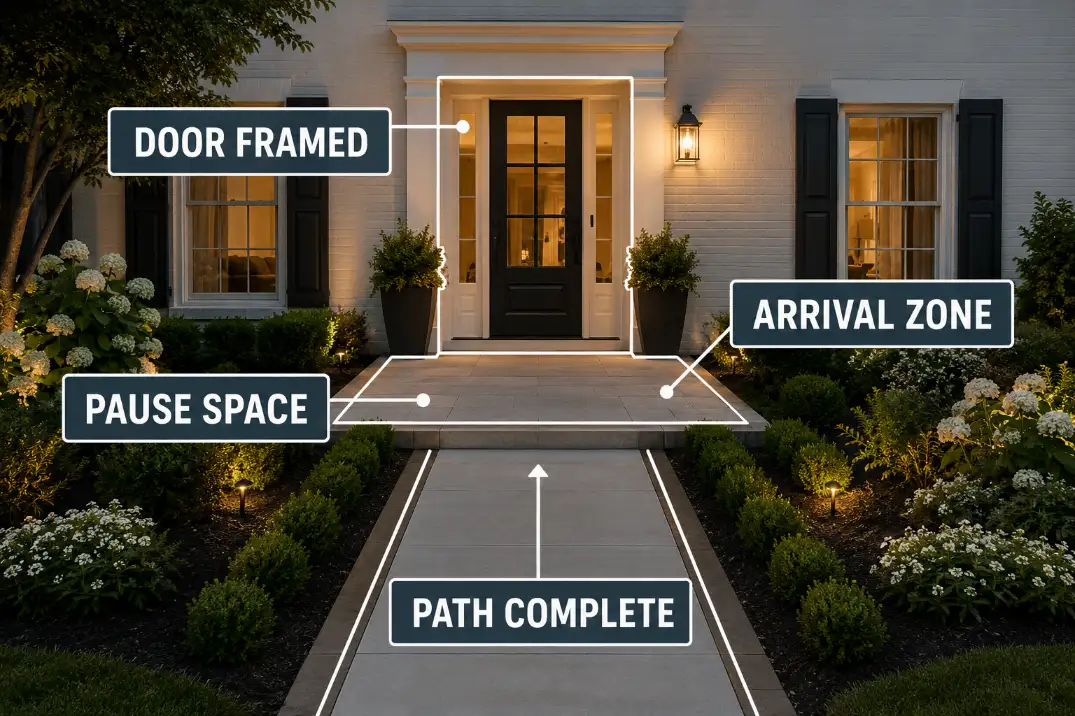
Match the Walkway Idea to the Problem You Actually Have
Choose the walkway idea that removes the first moment of hesitation, not the one that looks best by itself.
If guests do not know where to go, start with the route line. If the path feels tight, reveal or widen the walking corridor before adding taller edge plants. If the walk feels cold, use low repeated planting or warmer edge texture instead of random accents. If the door area feels awkward, fix the arrival zone rather than adding more surface pattern halfway down the path.
This matters even more in tight front yards, where every inch of path width, planting setback, and door visibility carries more weight. In those conditions, narrow front yard design problems can make a short approach feel either efficient or squeezed.
| If the walkway problem is | Start with this idea | Avoid starting with |
|---|---|---|
| Guests do not know where to go | Strengthen the route line | Extra plants or decor |
| The path feels tight | Reveal or widen the walking corridor | Taller edging plants |
| The walk feels cold | Add soft, low edge rhythm | Random accent pieces |
| The door area feels awkward | Create an arrival zone | More surface pattern |
| Night approach feels uncertain | Light edges, steps, and arrival | Bright exposed fixtures |
The final test is simple: walk the route as if you have never seen the house before. Start at the sidewalk. Start at the driveway. Look for the door. Walk beside someone. Notice where the path narrows, where the eye loses the destination, and where the final pause feels unfinished.
Fix that first hesitation before upgrading the surface or adding decoration.
A front yard walkway feels inviting when the whole approach makes sense: the start point is clear, the door reads, the walking line feels comfortable, the edges guide without crowding, and the last few feet feel like a place to arrive.
Once that route works, material, planting, lighting, and decor can add warmth. Before that, they are only decoration on a path that still makes people think.
For broader accessible-route context, the U.S. Access Board explains route basics in its ADA guide to accessible routes.