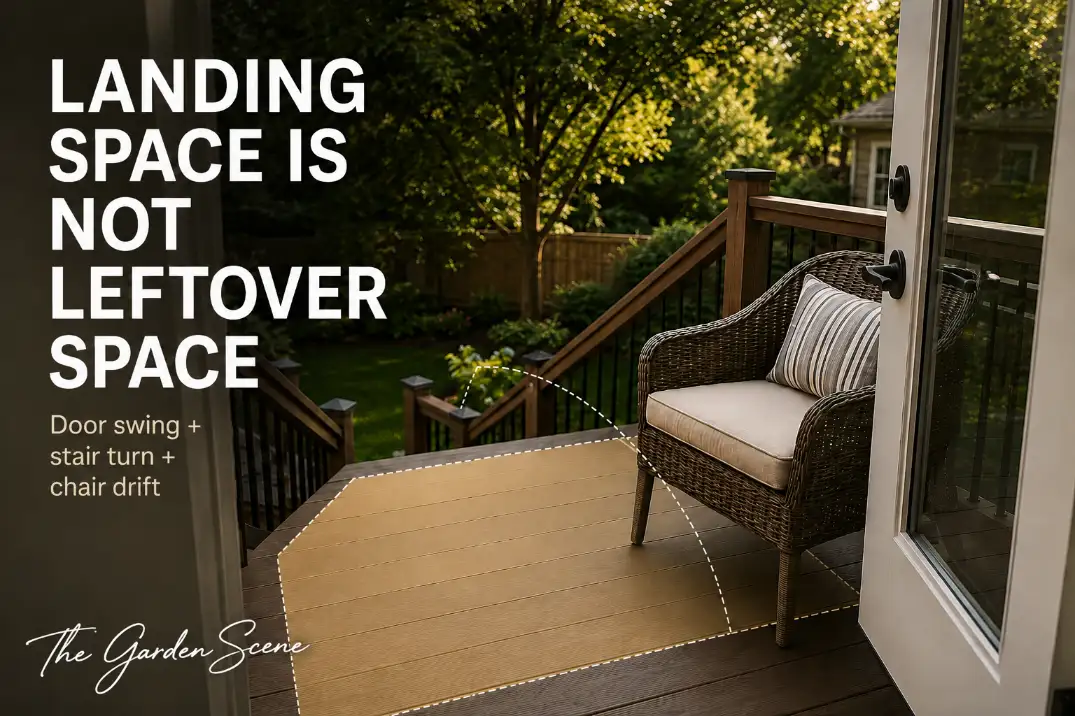
A deck landing between a back door, stairs, and furniture usually fails because the usable space changes after the door opens and the chairs move. The deck may measure large enough on paper, but the real test is whether someone can step out, pause, turn toward the stairs, and pass a pulled-out chair without shifting sideways.
Thirty-six inches is the baseline landing depth to protect; 42 to 48 inches is the more realistic comfort target when the same landing also handles a stair turn. This is not just a small-deck decorating problem.
Furniture crowding looks inconvenient, but landing crowding changes foot placement at the threshold, where people are often carrying food, opening a storm door, managing a dog, or stepping out in wet weather.
The Real Problem Is the Conflict Zone
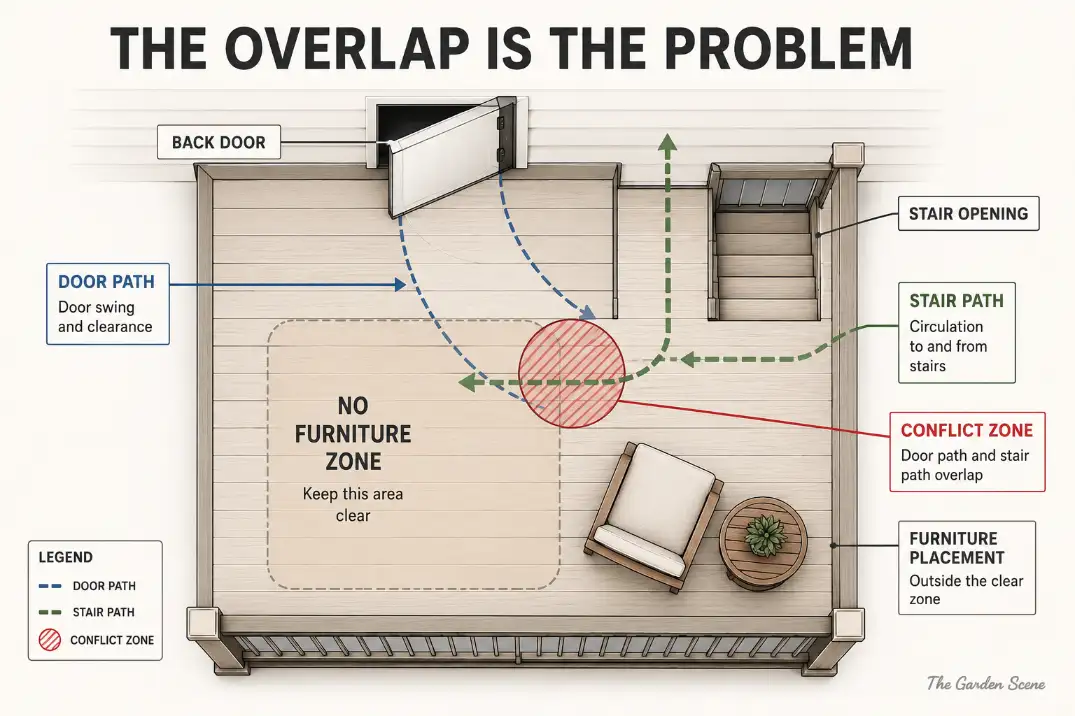
The tightest part of this layout is usually not the whole deck. It is the overlap between the door path, the stair path, and the sitting zone. A 10-by-12-foot deck can still feel unsafe if the table sits in the wrong 3 feet of space. A smaller deck can work well if the landing zone stays protected.
Door swing comes before furniture
Start with the door, not the chairs. If the door swings outward, its arc can consume 30 to 36 inches of deck surface before anyone even steps outside. If the door swings inward, the outside still needs a calm pause zone because people rarely step out empty-handed every time.
The common mistake is measuring from the house wall to the stair opening and calling that the landing. That number is incomplete. The better measurement is the open, uninterrupted floor left after the door opens and after one chair is pulled back.
For a similar threshold problem, Raised Deck Layout for a Back Door and Stairs shows why the stair connection often drives the whole deck layout rather than acting like a detail added after furniture.
Different doors change the same deck
A hinged back door, sliding door, French door, or storm door can make the same landing feel completely different. Sliding doors remove the swing arc, but they often create diagonal foot traffic because people step out from one side.
Storm doors are easy to underestimate because they add a second moving panel right where the landing is already tight.
| Door type | What changes | Main layout risk |
|---|---|---|
| Out-swing hinged door | Door arc uses deck space | Chair or planter blocks full opening |
| In-swing hinged door | No outside arc, but still needs pause space | Landing gets treated like spare floor |
| Sliding glass door | Exit point shifts to one side | Traffic cuts diagonally toward stairs |
| French doors | Wider opening feels generous | Furniture creeps into both exit paths |
| Storm or screen door | Adds a second door movement | People stand awkwardly while opening it |
The priority is simple: protect the operating space first, then arrange furniture around what is left.
Code Clearance vs Comfortable Clearance
A landing can be close to a basic minimum and still feel poor in daily use. That is the part many homeowners misread. Code-type clearance tells you whether a landing may pass as a required surface.
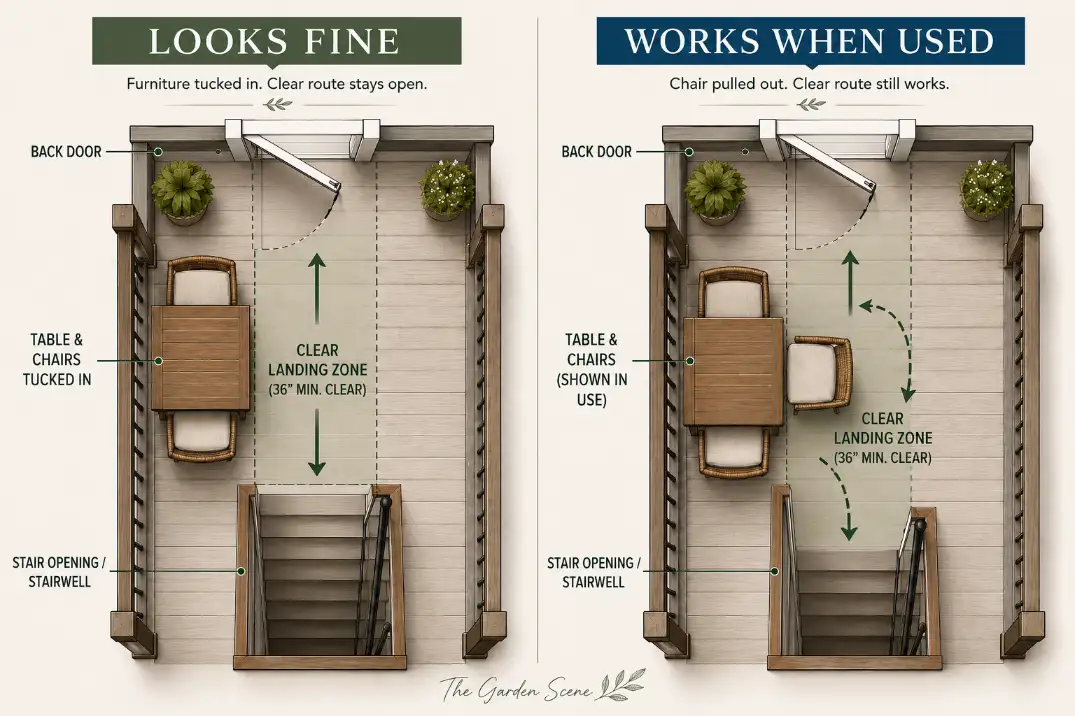
Real-use clearance tells you whether the deck works when a chair moves, the door opens, and someone turns toward the stairs.
Local deck and stair codes can vary, so treat these spacing targets as layout guidance, not a replacement for permit review, inspection requirements, or local code confirmation.
Thirty-six inches is not the comfort target
Thirty-six inches is the number to protect, not the number to celebrate. It may work for a straight step-out route with no furniture nearby. It becomes tight when the stair opening sits beside the door, when an outward-swinging door cuts across the landing, or when chairs slide backward during a meal.
A landing that has 36 inches clear when everything is tucked in may drop to 18 or 24 inches once a dining chair is pulled out. That change is enough to make people turn sideways instead of moving naturally.
The better target depends on movement
For a landing that also feeds stairs, 42 to 48 inches of open operating space is more forgiving. It gives the body room to step out, pause, turn, and descend without using the stair edge as part of the turning area.
If two people often pass each other at the door, or if kids and pets use the deck daily, the extra 6 to 12 inches matters more than a slightly larger table.
This same clear-route thinking also applies to small raised platforms in Small Deck Layout With a Clear Route, where the main design issue is not total square footage but whether the movement path stays legible.
Quick Diagnostic Checklist
Use this before buying smaller furniture or planning a deck extension.
- The door opens fully without touching a chair, planter, grill, storage box, or umbrella base.
- At least 36 inches of clear landing depth remains after furniture is placed.
- A person can walk from the door to the stairs without turning sideways.
- Pulled-out chairs do not enter the stair approach path.
- The first stair edge is visible from the doorway at night.
- Wet leaves, snow, or puddles do not collect where people pause before descending.
- The layout works during actual use, not only when chairs are tucked in.
That last point is often the deciding one. A dining chair can move 18 to 24 inches backward when someone sits down. A deck that looked passable in a photo can become a pinch point during dinner.
What People Usually Misread First
They blame deck size too early
A small landing does not automatically require a larger deck. Often, the first fix is to remove furniture from the traffic triangle: the short path from the door to the stair opening plus the nearby turning pocket.
If that triangle stays clear, a compact bench or two light chairs may still work. If that triangle is filled, even nicer furniture will not solve the awkwardness. The deck feels cramped because the first movement is compromised.
They overestimate “just a few inches”
A chair leg 4 inches into the route does not sound serious. But the body reacts before it reaches the obstacle. People shift their feet early, which pushes them closer to the stair edge, railing, or door frame.
That is the difference between a symptom and the underlying mechanism. The symptom is “the deck feels tight.” The mechanism is forced foot placement at the exact point where the body should be steady.
Also check the side pinch point. A guardrail post, stair newel, chair arm, or planter can make a route feel tight even when the floor still measures 36 inches wide.
They underestimate wet and dark conditions
A layout that feels acceptable at noon in dry weather can feel poor after rain, in freezing weather, or during evening use. In humid climates, shaded boards may stay damp longer after a storm. In northern states, snow piled near the threshold can steal several inches of usable footing for days.
If the landing stays slick for more than 24 to 48 hours after rain, furniture placement is not the first problem anymore. Surface condition, drainage, cleaning, and lighting move up the priority list.
The Spacing Rules That Actually Matter
The best spacing protects the first few seconds after someone opens the door.
| Layout condition | Minimum workable target | Better target | Why it matters |
|---|---|---|---|
| Clear depth outside door | 36 inches | 42–48 inches | Allows step-out and pause |
| Door-to-stair walking route | 36 inches wide | 42 inches wide | Reduces sideways movement |
| Chair pull-back area | 24 inches | 30 inches | Keeps seated use out of traffic |
| Table edge from stair approach | 36 inches | 48 inches | Protects the turning pocket |
| Planter or storage clearance from door swing | 12 inches | 18 inches | Prevents threshold clutter |
| Visible stair edge at night | Immediate recognition | Within 2 seconds | Reduces hesitation and missteps |
These numbers are not equal priorities. Door landing depth and stair approach come first. Chair comfort comes after safe movement. A slightly tighter seating area is usually better than a landing that forces people to twist toward the stairs.
Pro Tip: Measure the deck with chairs pulled out, not tucked in. The tucked-in version is the showroom layout, not the real layout.
Fixes That Usually Waste Space
Smaller chairs still fail in the wrong spot
Buying a smaller bistro set can help, but only if it leaves the landing zone alone. A 30-inch round table placed in the traffic path can be worse than a 48-inch bench placed along the rail. Size matters less than whether the furniture moves into the door-to-stair route.
This is where homeowners often waste money. They replace the furniture, keep the same layout, and wonder why the deck still feels tense. The fix was not “less furniture.” It was separating arrival, stairs, and seating.
Rail-side furniture can still block the turn
Pushing everything to the railing sounds logical because it opens the center. But if the stairs also begin along that rail, the furniture may still block the stair approach. Clear floor in the middle does not help much if the turning pocket is squeezed at the edge.
A bench often works better than loose chairs near a landing because it has a fixed depth. Chairs drift. Benches stay honest. If you need two loose chairs, angle them away from the stair opening so pulled-back legs do not enter the walking path.
A rug does not create clearance
An outdoor rug can visually organize a deck, but it cannot fix a blocked landing. In fact, a rug can make the problem feel more finished while the actual movement path remains wrong. If the rug edge sits near the first step down or curls in damp weather, it adds another small trip cue exactly where the layout is already compressed.
If the furniture is part of a broader back-door seating problem, Patio Layouts for Back Door Seating gives useful context on keeping seating close to the house without letting it swallow the entry route.
A Better Way to Arrange the Landing
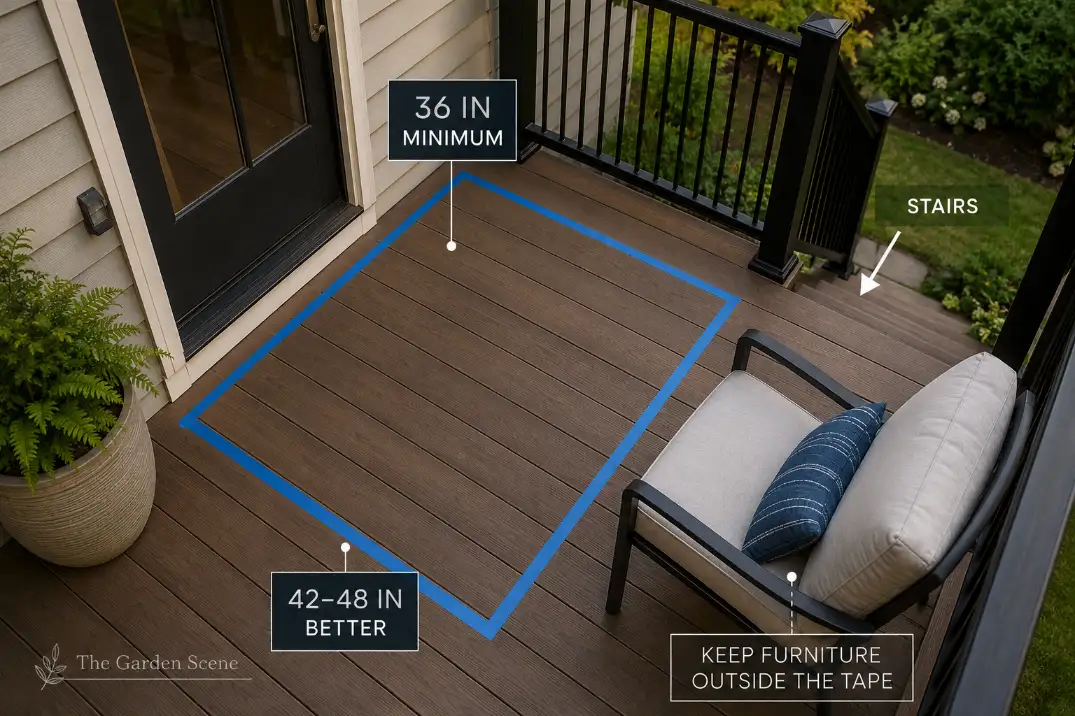
Step 1: Mark the no-furniture zone
Before moving furniture, mark a rectangle outside the door that is at least as wide as the door and at least 36 inches deep. Then extend a clear route from that rectangle to the stair opening. This zone should not hold chairs, planters, deck boxes, umbrella bases, dog bowls, or accent tables.
This area may look empty, but it is not wasted. It is the part of the deck that makes every other use feel normal.
Step 2: Place fixed-depth pieces outside the route
Use predictable furniture near the landing. A narrow bench, slim console, or built-in rail bench usually behaves better than movable dining chairs. Keep deep lounge chairs and sectionals away from the door-to-stair route unless the deck is wide enough to hold both circulation and seating.
A 20- to 24-inch-deep bench can often sit outside the route while a 32-inch lounge chair cannot. On a landing, that difference is not just comfort. It controls whether people can move without negotiating around furniture.
Step 3: Move storage away from the threshold
Deck boxes are a quiet problem. They seem harmless because they are low, but they attract shoes, cushions, toys, grilling tools, and packages. Once the top becomes a drop zone, the landing shrinks.
If storage has to live on the deck, place it outside the first 4 feet from the door or along a wall that does not serve the stair approach. For a similar clutter pattern at ground level, Keep a Patio Entry Clear explains why the entry zone should stay lighter than the rest of the outdoor room.
When Rearranging Stops Making Sense
The platform is too shallow for seating
If the deck platform outside the door is only 36 to 42 inches deep and the stairs begin immediately in front of or beside the door, do not treat it as a seating deck. Treat it as a landing.
That does not mean it has to feel bare. A wall hook, one narrow planter outside the swing area, or a slim rail-side bench may still work. But a table-and-chair setup belongs on a lower patio, an expanded deck bay, or a separate sitting area.
The stair turn is awkward even with furniture removed
This is the clearest sign that furniture is not the root cause. If the landing still feels tight when the chairs, planters, and storage are gone, the issue is circulation geometry. The door, stair opening, railing, and platform depth are forcing the awkward move.
At that point, the meaningful fixes are larger: widen the landing, shift the stair run, add a small intermediate platform, or move the seating zone completely away from the threshold. Those cost more, but they solve the actual conflict instead of decorating around it.
The first step is hard to read
If someone opens the door at night and cannot identify the first stair edge within about 2 seconds, lighting and contrast need work before styling. A clear landing still feels unsafe when the stair edge disappears into shadow.
Low glare lighting, visible tread edges, and a clean stair approach matter more than extra decor here. This is especially important on decks used after dinner, in winter, or near shaded back doors where moisture and darkness arrive together.
Pro Tip: Stand inside with the door closed, then open it and look toward the stairs. If your eye finds the furniture before it finds the first step, the layout is sending the wrong signal.
What Works Best in Real Deck Layouts
The most reliable arrangement is simple: keep the landing and stair route open, then let furniture occupy the leftover zone instead of competing with the route.
On many raised decks, that means a bench along the rail, a small table in the far corner, or seating shifted to a lower patio where chairs can move freely.
A dining layout needs more discipline than a lounge layout because chairs change position during use. A lounge layout needs more depth because cushions and ottomans occupy more floor. Neither is automatically wrong. The wrong choice is the one that asks the landing to double as a room.
For decks that connect into a larger outdoor living area, Better Flow From House to Patio is a useful next step because the same door-to-destination logic applies beyond the deck itself.
Questions People Usually Ask
Can furniture sit on a deck landing at all?
Yes, if the landing function stays clear. A narrow bench or small fixed piece can work if it does not reduce the door, pause, turn, or stair path. Loose chairs near the stair opening are harder to control because they move during use.
Is 36 inches always enough?
No. Thirty-six inches is a baseline, not a comfort standard. It may work for a simple straight route. A landing with an outward-swinging door, a tight stair turn, frequent carrying, kids, pets, or winter ice usually feels better with 42 to 48 inches of clear operating space.
Should the stairs or furniture move first?
Move the furniture first because it is cheaper and reveals the real problem. If the landing still feels awkward when the furniture is gone, the stair position, platform depth, door swing, railing pinch point, or lighting is the more likely cause.
For broader official guidance on residential landing and stair requirements, see the ICC Digital Codes.