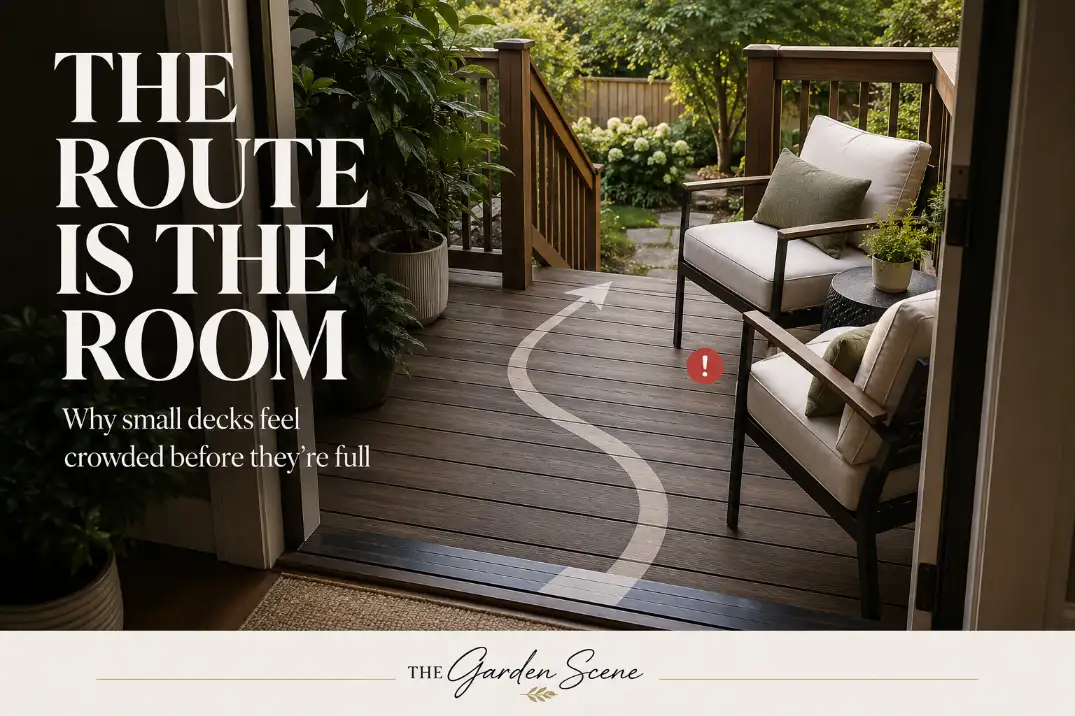
A small deck usually fails from route conflict before it fails from lack of square footage. Check three things first: where the door opens, where the stairs begin, and whether someone can move between them without turning sideways.
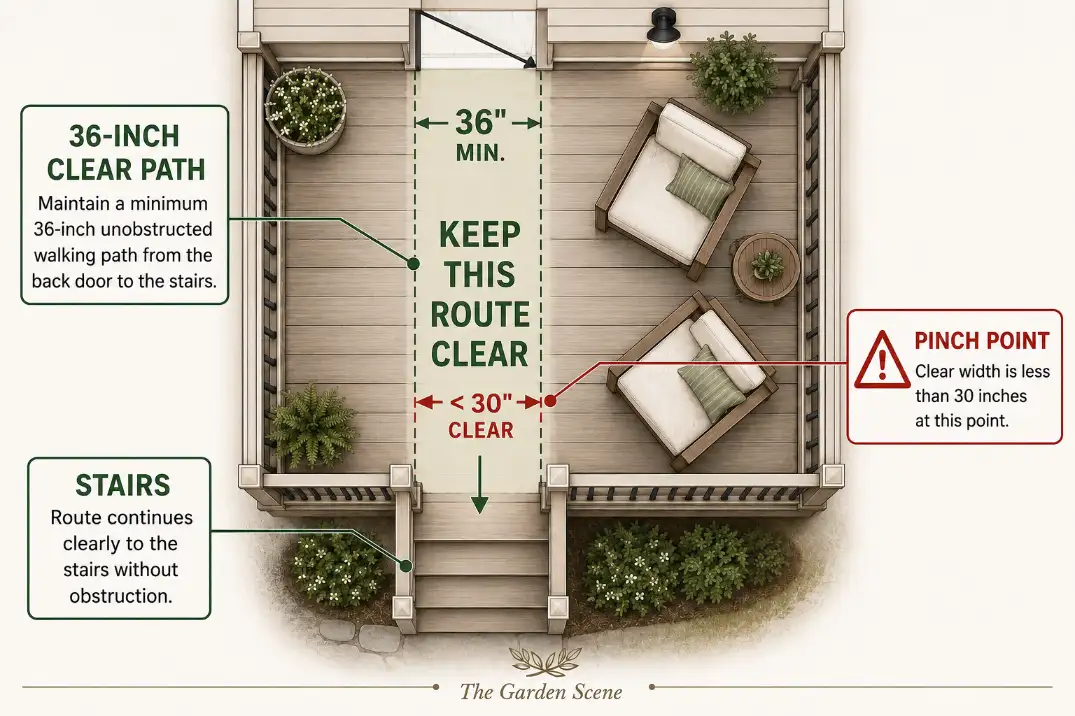
A daily-use route should stay close to 36 inches wide. Once it drops below about 30 inches, the deck may still look furnished, but it starts feeling irritating every time someone carries food, lets out the dog, or walks down the steps.
This is different from a deck that simply feels unfinished. The problem is not that the space needs more decoration. More often, the route is broken.
Smaller chairs may help if the passage is only a few inches tight. They will not fix a layout where the only natural path cuts straight through the seating area.
Before the Furniture
The First Design Decision Is Where People Walk
On a small deck, the first design decision is not where to sit. It is where people walk. Seating, plants, storage, and a small table all have to live around that route, not compete with it.
For most everyday decks, the door-to-stair path wins. Keep the first 3 feet outside the door clear, then protect a walking lane close to 36 inches.
A 42-inch lane feels noticeably better if people often carry trays, coolers, garden supplies, or laundry baskets through the space. A 24-inch squeeze path is not efficient. It is the layout telling you something has been placed in the wrong job.
This is why the entry zone matters more than it looks like it should. The same mistake that makes patios awkward shows up on decks: people decorate the edges first and only notice the route later.
The planning logic behind Keep Patio Entry Clear applies here because the entry zone is not leftover space; it is the working part of the deck.
Furniture Footprints Are Larger Than Product Dimensions
A chair listed as 28 inches deep may need 36 to 42 inches once someone sits down, shifts back, and walks around it. A small table can become a large obstacle when chairs pull out. That is why a deck can look perfectly arranged while empty and still fail the moment two people step outside at the same time.
For a deck under about 100 square feet, start with one primary function. Two chairs and a shared table usually work better than a four-seat dining set that has to be rearranged every meal.
A slim bench can outperform a bulky loveseat because it creates seating without stealing the turning space near the stairs.
Try the two-person route test before changing anything: one person opens the door while another walks toward the stairs. If either person has to pause, turn sideways, or wait, the deck does not have a clear enough route for everyday use.
The Door-to-Stair Route
The Door Swing Counts as Deck Space
A hinged door can consume 30 to 36 inches of deck space before anyone steps outside. Sliding doors reduce that swing conflict, but they do not remove the need for a landing zone. The area immediately outside the door should stay plain and open. That is not wasted space; it is the part that keeps the rest of the deck from feeling fussy.
When the door opens directly toward the stairs, keep furniture out of that straight line. When the stairs sit off to one side, avoid forcing a diagonal route through a chair group.
Diagonal squeeze paths can look clever in a plan view, but they feel clumsy when someone is carrying a plate or stepping around another person.
Small decks connected to sliders have their own version of this problem: chairs drift toward the glass, then the usable side of the doorway gets pinched.
If your deck starts at a sliding door, the clearance principles in Patio Layouts for Sliding Glass Doors and Walkways are especially relevant because the door opening controls the rest of the layout.
Stair Position Should Decide the First Move
If the stairs sit directly across from the door, use side seating and keep the straight route open. If the stairs sit in a corner, keep that corner clear first and place chairs on the opposite edge. If the stairs interrupt the best view edge, protect the stair route before chasing the view.
That last point is where many small decks lose their calm. The best-looking seat is not always the best-working seat. If a chair blocks the stair approach every time someone sits down, the view is not solving enough to justify the friction.
What People Usually Blame First
The deck size gets blamed first. Sometimes that is fair, but it is not the most useful diagnosis. An 8-by-10-foot deck with one clean path can feel calmer than a 10-by-12-foot deck where stairs, chairs, planters, and storage all fight for the same corner.
People also overestimate the value of filling corners. Corners feel like free space, so they attract plant stands, deck boxes, and side tables. But a corner beside the stair opening or door landing is not free. It is part of the turning radius.
Pro Tip: Tape the furniture footprint on the deck and leave it there for 24 hours before buying anything large. Walk the route with a tray, a bag, or a folded chair in hand.
Layout Choices by Deck Size
Small Footprints Need Fewer Jobs
The smaller the deck, the less forgiving it is when one item tries to do too much. A 6-by-8-foot deck is usually a pass-through space with a small pause point, not a dining room.
An 8-by-8-foot deck can handle two chairs if the stair route stays open. An 8-by-10-foot deck may support a bench and one movable chair.
A 10-by-10-foot deck can usually choose compact dining or compact lounging, but not both comfortably.
A 10-by-12-foot deck gives more options, but the rule does not change. One main zone still needs to win. The extra square footage should improve clearance, not invite every outdoor feature onto the platform.
| Deck condition | Best first layout choice | Avoid first |
|---|---|---|
| 6×8 deck | Folding chair pair or open landing | Fixed dining set |
| 8×8 deck | Two chairs and a shared table | Deep loveseat |
| 8×10 deck | Slim bench plus movable chair | Four bulky chairs |
| 10×10 deck | Compact dining or lounge, not both | Grill, dining, and storage together |
| 10×12 deck | One primary zone with a light edge | Full outdoor-room setup |
The fix that often wastes money is buying a smaller version of the same wrong layout. If the route cuts through the seating group, shaving 4 inches off a chair rarely changes the experience.
The better move is usually rotating the use pattern, removing one item, or shifting seating to the least disruptive edge.
For furniture decisions by footprint rather than style, Patio Furniture Layout by Size is useful because the same clearance math applies whether the surface is a deck or patio.
Railings Are Not Walls
The Edge Should Guide, Not Crowd
Railings define the deck edge, but they should not be treated like interior walls. Pushing every object against the railing often creates a ring of furniture with no comfortable middle. The deck looks organized from above, yet the actual walking space becomes a narrow channel.
There is also a safety distinction worth keeping clear: guards, railings, stair openings, and handrails are not decorative layout zones.
Furniture, planters, and storage should not make the stair approach harder to see or use. A small deck can be casual, but the stair edge should stay visually legible.
A chair with its back near a railing may feel secure. A chair facing directly into a railing can feel boxed in. Leave at least 18 inches between small accent pieces and the main route, and avoid tall planters where they visually thicken the edge.
Keep the View Edge Light
Light Does Not Mean Empty
The view edge is not always the best place for the biggest furniture. If the railing faces a yard, garden, or sunset, keep that side visually light with low seating, a slim bench, or movable chairs.
Deep lounge furniture placed along the view edge can make the deck feel smaller because it turns the open side into a second wall.
Light does not mean bare. It means the edge still lets the yard feel connected to the deck. A 12- to 16-inch-deep bench can sometimes do more for everyday use than a 30-inch-deep lounge chair because it supports sitting without swallowing the route.
In humid climates such as Florida or coastal parts of California, bulky furniture pressed tight to railings can also slow drying. If cushions or deck boards stay damp for more than 24 hours after ordinary rain clears, the issue may be airflow as much as material choice.
When Zones Start Competing
Dining, Lounging, and Storage Do Not Deserve Equal Space
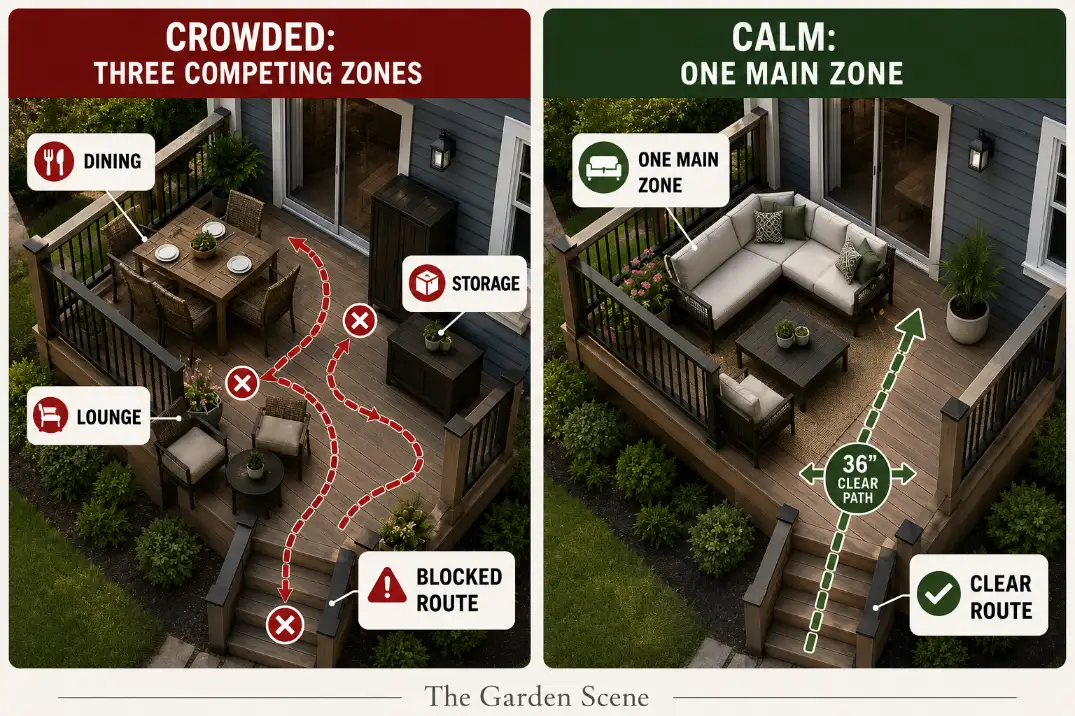
On a small deck, not every outdoor function gets a full zone. Everyday use should decide the winner. If the deck is mostly for morning coffee, two comfortable chairs beat a dining table for six. If it supports weeknight meals, a compact dining setup beats decorative lounge seating.
The least useful compromise is half-building every zone. A small grill, two dining chairs, a storage box, four planters, and a lounge chair can all fit physically while failing together. The deck becomes a holding platform with seating, not an outdoor room.
This is where subtraction beats shopping. If one item has to be moved more than twice a week so people can use the stairs, open the door, or reach the yard, it is not serving the layout.
The decision-making behind Remove Patio Furniture From a Cramped Space works well for small decks because removal often restores function faster than replacement.
A Quick Diagnostic Checklist
- The door opens fully without hitting a chair, planter, or deck box.
- The door-to-stair route stays near 36 inches clear.
- Two people can pass the door and stair route without pausing or turning sideways.
- No chair backs into the stair opening when someone sits down.
- The first 3 feet outside the door remains open.
- Cushions and deck boards dry within about 24 hours after ordinary rain.
- At least one railing edge stays visually light instead of fully lined with furniture.
- Nothing must be moved more than twice a week for normal access.
One Calm Route
When the Standard Fix Stops Working
The standard fix is buying narrower furniture. That works when the route is only slightly tight, such as a 32-inch passage that needs to become closer to 36 inches.
It stops working when the stair location splits the deck into awkward fragments or when the seating group sits directly between the door and the stairs.
At that point, the better solution is not another compact chair. It is a clearer hierarchy. Choose one side for seating. Move storage off the deck. Replace a deep chair with a bench. Keep the stair approach open even if that means leaving a corner unused.
A small deck does not need to hold every outdoor activity. It needs to let the ordinary ones happen without a shuffle. If the door opens cleanly, the stairs are easy to reach, and the main seat does not block the way, the layout is already doing the most important work.
For deck details where layout choices start touching stair, guard, and handrail safety, use the American Wood Council deck guide as the official reference point.