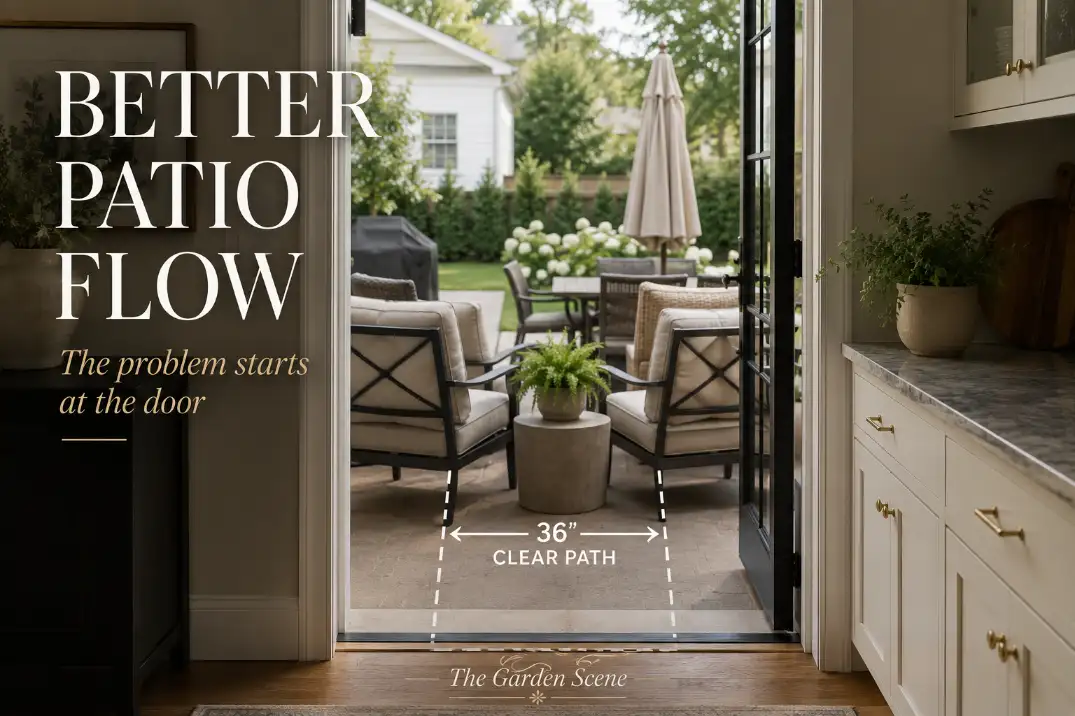
Most patio flow problems are not caused by the patio being too small. They happen because the first 6 to 8 feet outside the door are asked to do too much: open the door, step down, pass through, carry food, reach seating, avoid a grill, and still feel calm.
When that first move is awkward, the whole patio feels disconnected from the house.
Start with three checks before buying furniture or adding decor. You need at least 36 inches of clear walking width from the active door to the main patio zone, 30 to 36 inches behind dining chairs, and a landing that does not force someone to step sideways immediately after leaving the house.
A patio can look generous and still fail here. Size limits what fits; flow decides whether the space works.
The First Fix Is the Path, Not the Furniture
Protect the first step outside the house
The most important part of the patio is often the least decorated part: the first few feet outside the door. That zone has to absorb door movement, body movement, trays, pets, kids, guests, and quick trips in and out of the house. If it is crowded, the patio starts with friction.
A strong target is a 4-by-4-foot clear landing outside the main exit when space allows. On smaller patios, that landing can be tighter, but once it drops below about 36 inches deep, the transition starts to feel like a squeeze.
This matters even more with sliding glass doors because people usually step out while turning slightly, not walking straight forward.
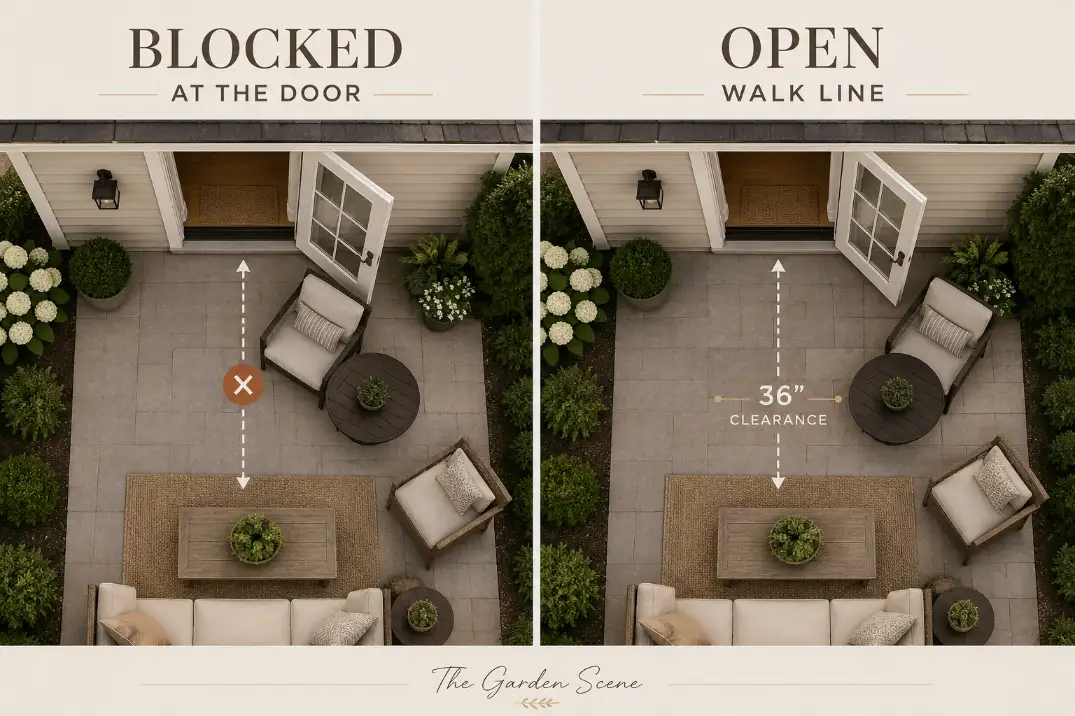
The layouts that look most balanced from indoors are often the ones people walk around in real life. A sofa, dining table, or pair of chairs may frame the view nicely, but if it sits directly in the exit path, the patio works against daily use.
Better flow often comes from shifting the seating zone 18 to 36 inches off the door’s direct line, even if the layout becomes less symmetrical.
If the area right outside your door already feels awkward, the more specific breakdown in Back Door Patio Transition Awkward is useful because it focuses on the threshold zone instead of treating the patio as a blank outdoor room.
Keep the main route visually quiet
The walking route should be easy to understand within one second of opening the door. That does not mean it has to be plain. It means the route should not be interrupted by small objects pretending to be harmless.
A 24-inch planter, lantern cluster, storage box, or side table can wreck flow when it sits along a 36-inch walkway. The item may look small by itself, but it steals passing room from the exact place people need to move.
This is why patios can feel cluttered even when they do not contain much furniture.
Pro Tip: Tape the main walking path on the patio for 24 hours before changing the layout. If people keep stepping outside the tape, the route is fighting the way the space naturally wants to work.
Flow Starts Before the Door
Align the indoor route with the outdoor route
House-to-patio flow does not begin at the exterior slab. It begins inside the house. The last 4 to 6 feet before the door should aim naturally toward the outdoor route.
If a kitchen island, dining chair, console table, dog bed, shoe basket, or indoor plant stand forces people to angle awkwardly before they even reach the door, the patio inherits that friction.
This is why some patios feel wrong even after the outdoor furniture improves. The path from the kitchen to the door may bend, then the path from the door to the patio may bend again. Two small turns are often more annoying than one longer route.
The cleaner arrangement is simple: let the indoor walking line continue through the active door panel and into the main patio route. The indoor and outdoor zones do not need to match perfectly, but they should agree on where movement happens.
Do not decorate the threshold into a bottleneck
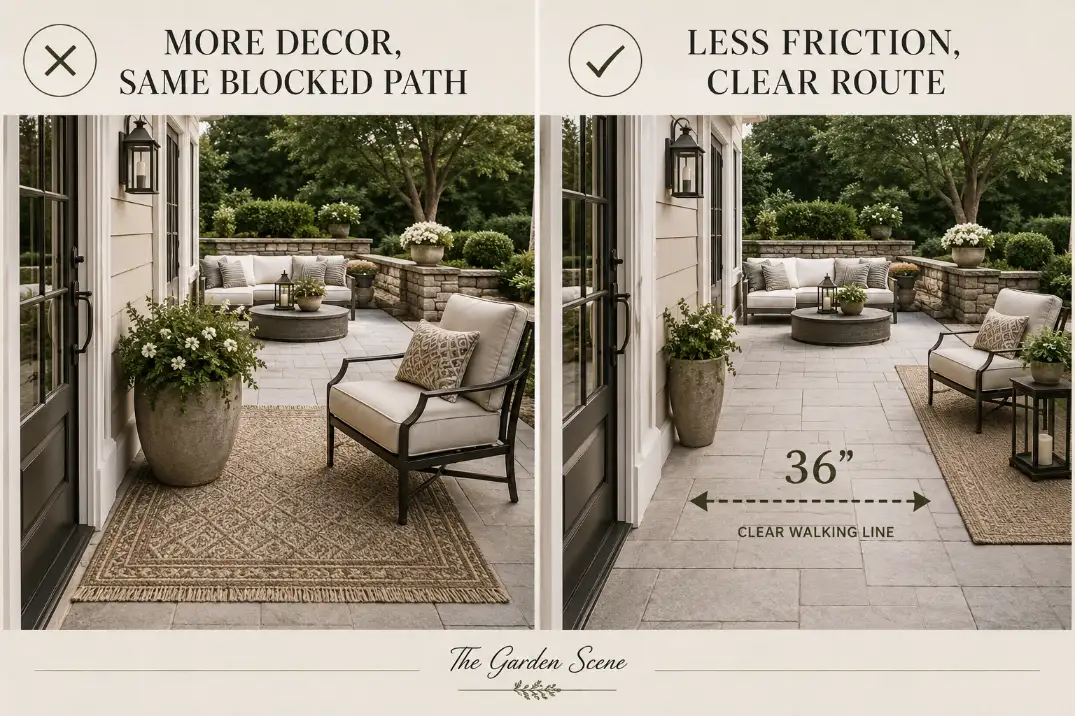
The threshold is not the place to solve emptiness with objects. A rug that bunches near the slider, a plant stand beside a hinged door, or a planter immediately outside the exit can make the transition feel narrower than it is.
This is one condition homeowners often underestimate. A 1-inch door lip may not matter when walking empty-handed, but it becomes more noticeable when someone carries a tray, opens a screen door, steps outside at night, or moves through with wet shoes.
Once the transition includes a 4- to 7-inch step down, the landing and walking direction matter more than the decorative edge.
Match the Layout to the Door Type
Sliding doors follow the active panel
For sliding doors, design around the panel people actually use. The fixed glass panel does not need equal clearance if nobody walks through it.
The mistake is centering the furniture on the full glass opening instead of the active opening. That creates a patio that looks aligned from inside but feels off in use. Protect a 36- to 48-inch route from the active panel first, then let the seating sit beside it.
For patios where the door and walkway compete with furniture, Patio Layout for Sliding Glass Doors and Walkways gives a sharper explanation of why the active walking panel should control the layout.
Hinged and French doors need swing room
A hinged back door brings the door swing into the layout. If it swings outward, that arc is not usable patio space. If it swings inward, the inside route still matters because people pause, turn, and step through the opening.
French doors need a wider landing zone when both leaves are used. If only one leaf opens most days, design for that daily path instead of the wider party-mode opening. Flow should follow real use, not the theoretical maximum opening.
What People Usually Misread First
They blame square footage too early
A 10-by-12-foot patio can work well if the route, seating, and service zones are separated. A 14-by-18-foot patio can still feel bad if every chair backs into the same crossing path. Total size matters, but it is not the first diagnosis.
The healthier condition is a patio where the main walking line stays open while people are sitting, eating, or moving around. The failing condition is a patio that only works when every chair is pushed in perfectly.
Dining chairs often move 18 to 24 inches backward when someone sits down. Lounge furniture can sprawl even more. If the layout only works in its staged position, it does not really work.
They overestimate how much furniture the patio can hold
People often judge furniture by the slab size, not by the clearance left after use. A rectangular dining table may physically fit, but it may need 7 to 9 feet of functional depth once chairs are included. A deep outdoor sofa can consume 36 to 40 inches before you add a coffee table or legroom.
The fix that wastes the most time is rearranging the same oversized pieces into slightly different positions. If the furniture is too deep for the patio, moving it around only changes where the squeeze happens.
A narrower dining table, a bench on one side, two lounge chairs instead of a full sofa, or a wall-side console may change the outcome more than another layout sketch.
For scale decisions, Patio Furniture Layout by Size is a better next read than generic patio inspiration because it ties furniture choices to usable clearances.
They confuse visual balance with usable flow
A centered layout often photographs well. It can also block the most important movement line. This is where visual design needs restraint. The strongest house-to-patio flow may look slightly off-center because it is organized around use, not symmetry.
That does not mean the patio should look random. It means the strongest visual feature should not sit where people need to walk. If the door path is open and the seating zone sits beside it, the patio will usually feel calmer than a perfectly centered arrangement that everyone has to dodge.
Visual Continuity Helps, But It Cannot Rescue a Blocked Path
Repeat materials only after the route works
Indoor-outdoor flow often improves when the patio feels visually connected to the room inside. Similar flooring tones, repeated wood or metal finishes, aligned sightlines, and a clear view to the seating area can make the patio feel like a natural extension of the house.
But visual continuity is a support layer, not the foundation. Matching cushions to the kitchen stools will not fix a 28-inch walkway.
A beautiful outdoor rug will not make a chair-back collision disappear. Repeating materials works best after the door path, landing, and furniture clearances are already right.
This is the condition people commonly overestimate: how much style can compensate for bad movement. Style can soften a transition. It cannot replace a route.
Use sightlines to pull people outward
The view from inside the house should suggest where to go. A clear chair grouping, open walking line, or focal planter beyond the route can gently pull the eye outside. The mistake is putting the focal point directly in the path.
A better composition is layered: open route first, seating beside it, focal detail beyond it. That keeps the patio inviting without turning the threshold into a display shelf.
The Layout Order That Actually Works
1. Draw the movement spine
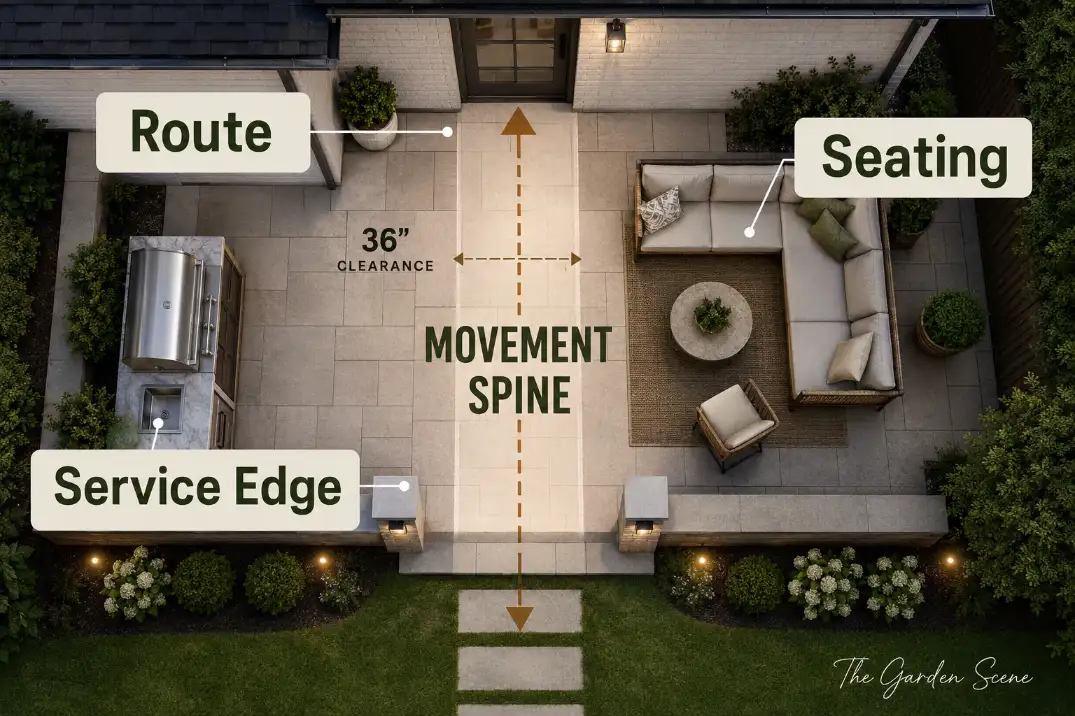
Think of the patio as having a spine from the house to the main outdoor function: dining, lounging, grilling, yard access, steps, or a side gate. That spine should remain open before any furniture zone is added around it.
On many patios, the best spine is not centered. It may run from the door along one side, then open into seating. This feels more natural than pushing everyone through the middle of a conversation area.
A good test is whether two people can pass each other without one stepping into a planting bed or backing into a chair. For everyday use, 36 inches is the practical minimum; 42 to 48 inches feels noticeably easier for families, pets, and guests.
2. Place sitting beside the route, not on it
The seating area should feel connected to the house without sitting directly in the exit path. Many patios fail here because the furniture is arranged for the view from inside, not the way people actually move through the door.
Let the route pass beside the seating zone. Angle chairs slightly toward the house, use a bench against a wall, or float a small table off-center. If the patio is narrow, slimmer arms, open legs, and lighter silhouettes help the space feel less barricaded.
3. Separate service movement from relaxation
The grill, hose bib, storage cabinet, trash route, and yard access should not all cut through the seating area. A patio can tolerate one crossing path. It starts to feel chaotic when every task slices through the same small zone.
Place the grill where smoke, heat, and traffic do not interrupt the first door-to-seat movement. A practical starting point is keeping the grill at least 10 feet from combustible siding when required by the grill manual and local conditions, while still allowing 36 inches of working clearance in front of it.
If that pushes the grill into the main walking path, the patio may not support that cooking zone in that exact spot.
A Simple Flow Comparison
| Patio condition | What it feels like | Better target |
|---|---|---|
| Door opens into chair backs | Immediate friction | Keep first 36–48 inches clear |
| Indoor route bends before the door | Patio feels disconnected | Align the inside path with the outdoor route |
| Dining chairs block the route when pulled out | Layout only works when staged | Allow 30–36 inches behind chairs |
| Grill sits between door and seating | People cross the cook zone constantly | Move grill to a side service edge |
| Water sits near threshold | Movement feels unsafe after rain | Slope surface away 1/8–1/4 inch per foot |
| Decor fills walkway edges | Patio feels busy despite enough space | Keep the route visually quiet |
When the Standard Fix Stops Working
Rearranging stops helping below minimum clearance
There is a point where layout advice becomes wishful thinking. If the patio is less than 8 feet deep from the house wall to the outer edge, a full dining set with pull-out chairs may be the wrong primary use. If the main route narrows below 30 inches after furniture is placed, people will feel the squeeze even if the patio looks tidy.
At that point, the fix is not another furniture shuffle. It is changing the furniture type or reducing the number of jobs the patio is trying to do. Built-in bench seating, a smaller round table, a wall-side console, or one strong lounge function instead of two competing zones can work better.
Drainage can override layout
Flow is partly movement, but it is also confidence underfoot. If runoff crosses the main path, if the patio gets slick with algae in humid climates, or if freeze-thaw movement creates uneven edges in northern states, the walking route becomes hesitant.
This is where homeowners often overestimate what furniture can solve. A rug may hide discoloration, and planters may distract from an edge, but they do not fix a wet or unstable route. If water collects near the threshold for more than 24 hours after normal rain, solve that before refining the seating.
The patio drainage logic in Patio Drainage Layout Problems connects surface behavior to layout decisions more directly than a decorative patio guide would.
Shade and airflow can change the route people choose
People do not always use the path you design. They use the path that feels comfortable. In Arizona heat, a route across an exposed slab may be avoided in the afternoon.
In humid Florida conditions, a covered but stagnant corner can feel worse than a sunnier area with air movement. On coastal California patios, moisture and shade can keep surfaces damp longer than expected.
If the “correct” route is hot, wet, smoky, or crowded, people will cut around it. That is not misbehavior; it is feedback. The layout may need shade repositioned, a clearer side route, or a seating shift that follows the comfortable path instead of fighting it.
For more on comfort zones, Backyard Layout for Shade, Seating, and Airflow supports the environmental side of the decision without pulling the patio flow conversation off topic.
Quick Diagnostic Checklist
Check the patio in use, not just when it is cleaned up:
- 36-inch clear route from the active door to the main patio zone
- Indoor walking line aimed toward the outdoor route
- 30 inches behind dining chairs when someone is seated
- Stable first step while carrying food or drinks
- Threshold area dry within about 24 hours after normal rain
- Grill, storage, and trash routes kept out of the seating path
- Furniture layout still usable when chairs are pulled out
The Best Final Layout Usually Looks Less Centered
The strongest house-to-patio flow often looks slightly understated. The door path is open. Furniture sits beside the movement line. The grill and storage have a service edge.
The indoor route points naturally toward the outdoor route. The patio does not try to make every feature equally important.
That restraint is what makes the space feel easy. A patio with better flow does not ask people to dodge furniture, turn sideways at the threshold, step into wet spots, or interrupt the cook zone just to sit down.
It gives the first 6 to 8 feet outside the house a clear job, then lets the rest of the patio become useful.
For broader official guidance on safe walking surfaces and exterior route accessibility, see the U.S. Access Board.