Last updated: April 7, 2026
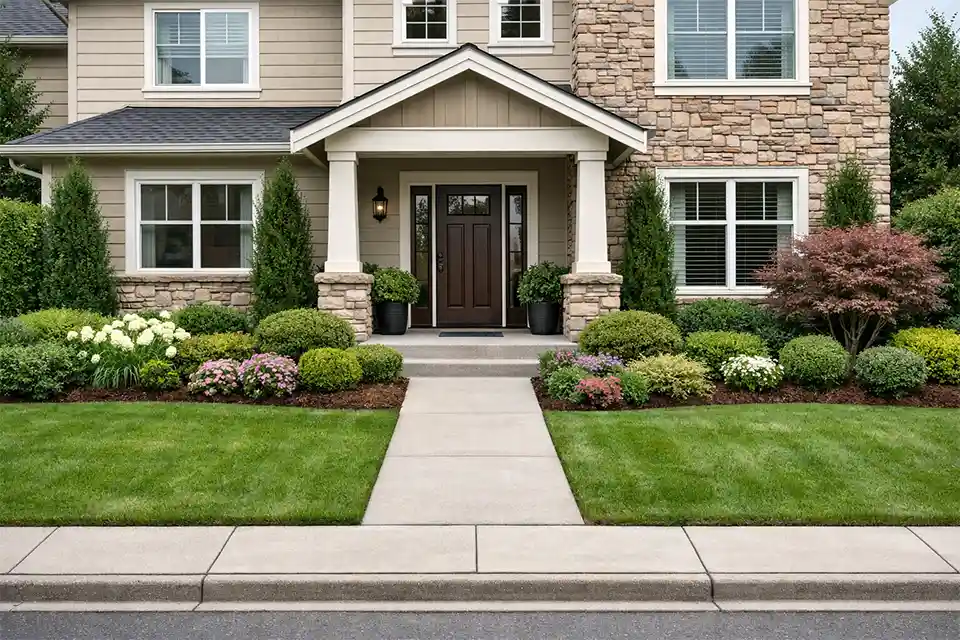
Most suburban front yard ideas fail for the same reason: they improve parts of the yard without fixing how the whole front of the house reads from the street. The common pattern is easy to spot.
The lawn takes up too much visual space, shrubs rise too high under windows, and the front door gets visually outcompeted by the garage, driveway, or scattered planting. The first checks should be simple.
From the curb, can you identify the entry within 3 seconds? Do most window-line plants stay under about 30 to 36 inches? Does the front yard still look organized from 40 to 60 feet away? If not, the issue is usually structure before style.
That is what separates a front yard that feels polished from one that only looks recently updated. Many homeowners treat suburban curb appeal as a color problem when it is more often a proportion problem.
Flowers help, but they rarely rescue a weak layout. The suburban front yard ideas that actually work are the ones that improve entry clarity, scale, privacy, and maintenance at the same time instead of chasing visual interest one bed at a time.
What usually makes a suburban front yard look weak
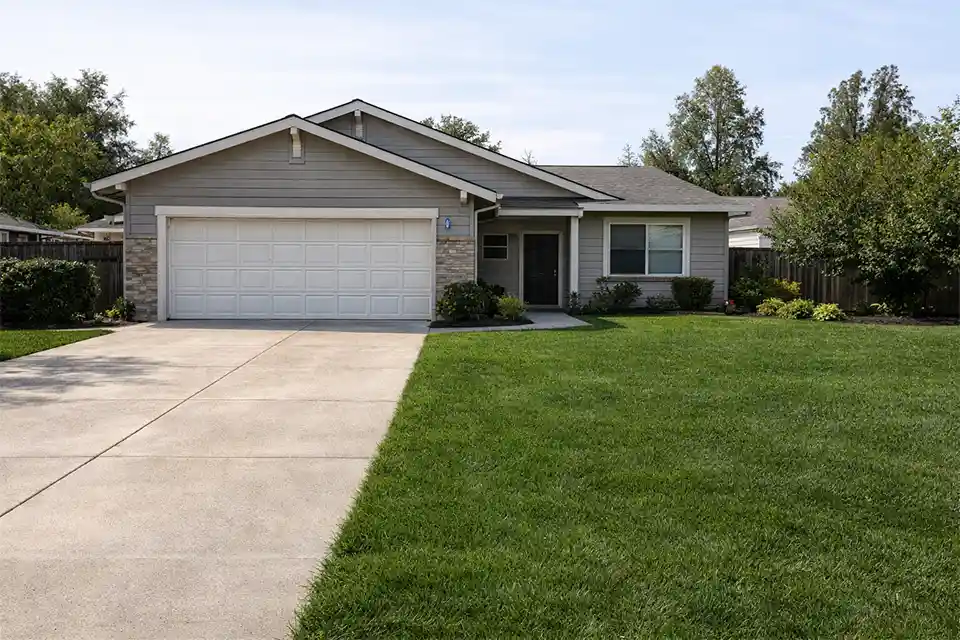
The most common problem is not poor taste. It is weak hierarchy. If the garage reads first, the driveway reads second, and the front door reads last, the yard will struggle no matter how healthy the planting is.
Too much uninterrupted lawn is usually part of the problem. On a typical suburban lot, blank turf can make the house feel detached from the ground. But the opposite mistake is just as common: too many small beds, too many plant types, too many accents trying to create charm. That usually creates visual static, not character.
The better distinction is this: a flat yard needs structure, while a busy yard needs editing. Most people misread those as planting problems, then keep buying plants. That is also why front yard landscaping mistakes that lower home value are often less about plant quality than about scale, placement, and what the eye notices first.
The first design decisions matter more than the decorative ones
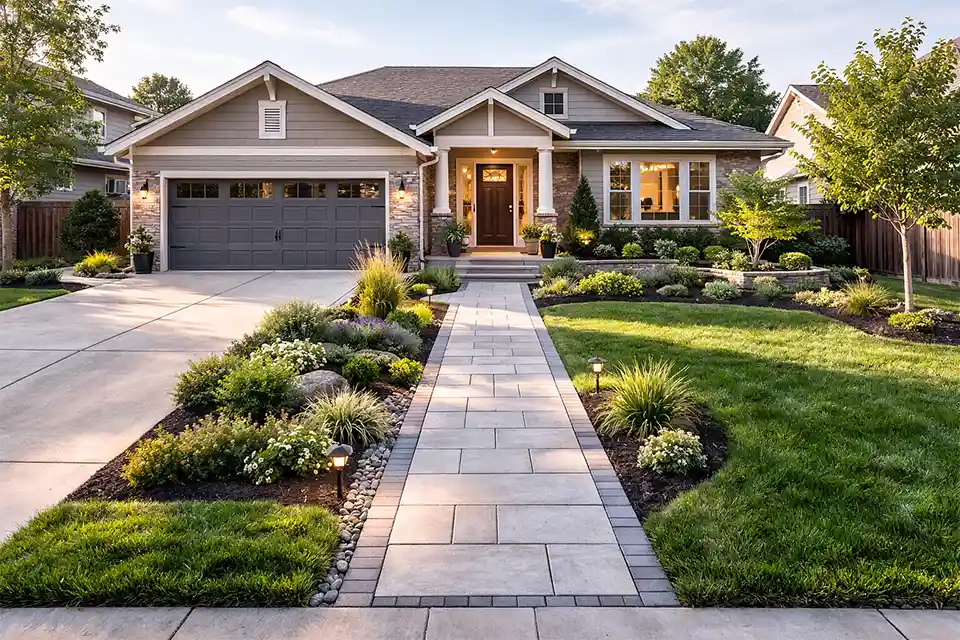
The strongest suburban front yards usually get four decisions right early: entry emphasis, bed shape, plant height, and privacy placement.
Entry emphasis comes first because it changes how the house is understood in a few seconds. If the walkway feels secondary to the driveway, or if the planting hides the front approach instead of supporting it, the whole yard feels less resolved.
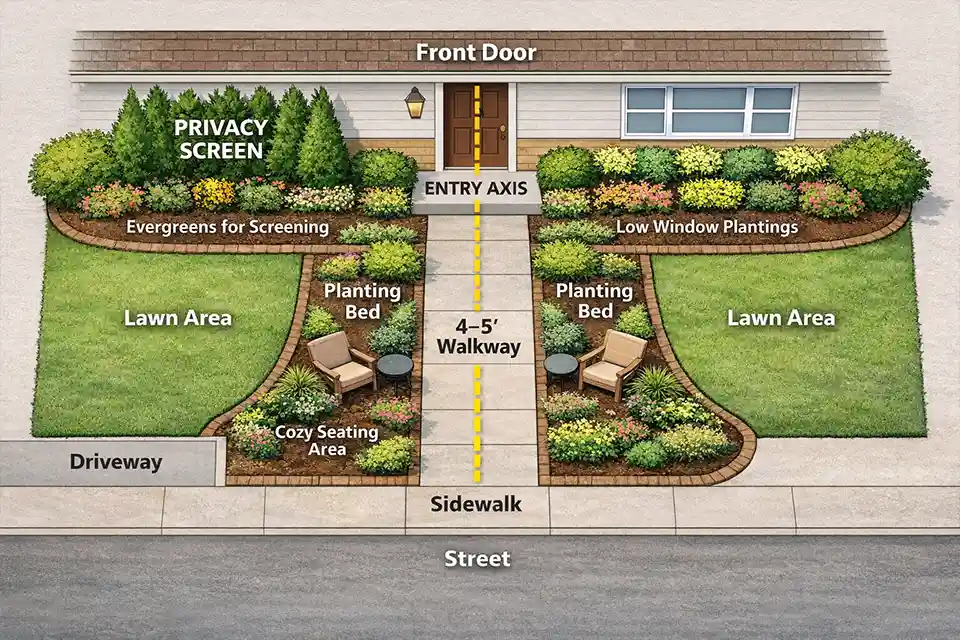
A front walk around 4 to 5 feet wide usually reads more comfortably than one closer to 3 feet, especially when it leads to a house with a two-car garage taking up a large part of the facade.
Bed shape matters next. One broad, clean foundation bed often does more than three or four smaller ornamental pockets. Repetition is stronger than variety here. A suburban front yard almost always looks better when the eye can follow one or two intentional lines instead of constantly resetting.
Plant height is where maintenance problems often begin. Shrubs that mature to 5 to 7 feet and are planted directly below windows usually create pruning pressure within 2 to 3 years. Lower planting, usually in the 18- to 36-inch range near windows and paths, keeps the house visible and the yard easier to manage.
Privacy placement should be selective. In many suburban neighborhoods, the exposed area is not every edge equally. It is usually one window, one seating spot, or one angle from the sidewalk. Treat that pressure point first.
What people usually misread first
Many homeowners overestimate color and underestimate mass. A front yard can have attractive plants and still feel wrong because the visual weight is in the wrong places. Seasonal color is not worthless, but it ranks below structure, proportion, and circulation.
They also overestimate symmetry. Symmetry can help on a straightforward facade, but it starts breaking down on lots with wide driveways, awkward side spacing, narrow frontage, or off-center entries. In those cases, forcing perfect balance often makes the yard look more rigid, not more refined.
Privacy is another area people regularly misjudge. Full-edge screening sounds logical, but on most suburban front yards it closes off the house faster than it improves comfort.
Layered planting works better when it interrupts the line of sight without acting like a wall. That is why front yard landscaping for privacy without fences usually performs better than trying to create enclosure where the front yard does not have enough depth to support it.
The suburban front yard ideas that pay off most
Some ideas are simply more useful than others. These are the ones that tend to improve both appearance and performance.
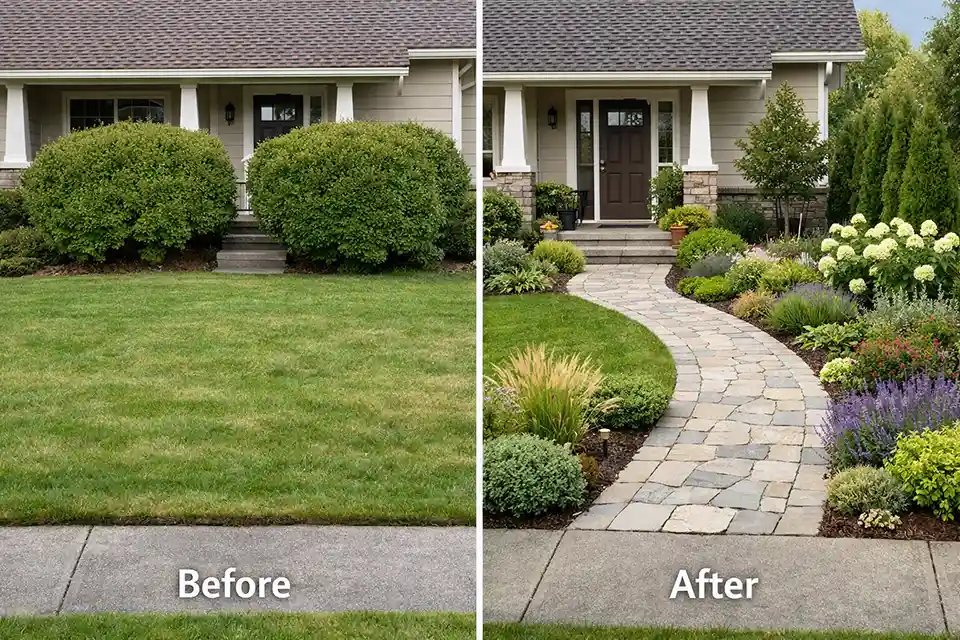
Give the entry visual priority
If the front door is not the clear destination, the yard feels incomplete. Use the walkway, lighting, and lower foundation planting to guide the eye there before you add decorative features.
Convert some turf into shape, not just planting
On many suburban lots, moving just 15% to 25% of visible lawn into defined beds creates more depth than adding another layer of flowers. The gain is not just visual. Defined bed edges also reduce trimming drift and make the yard easier to maintain.
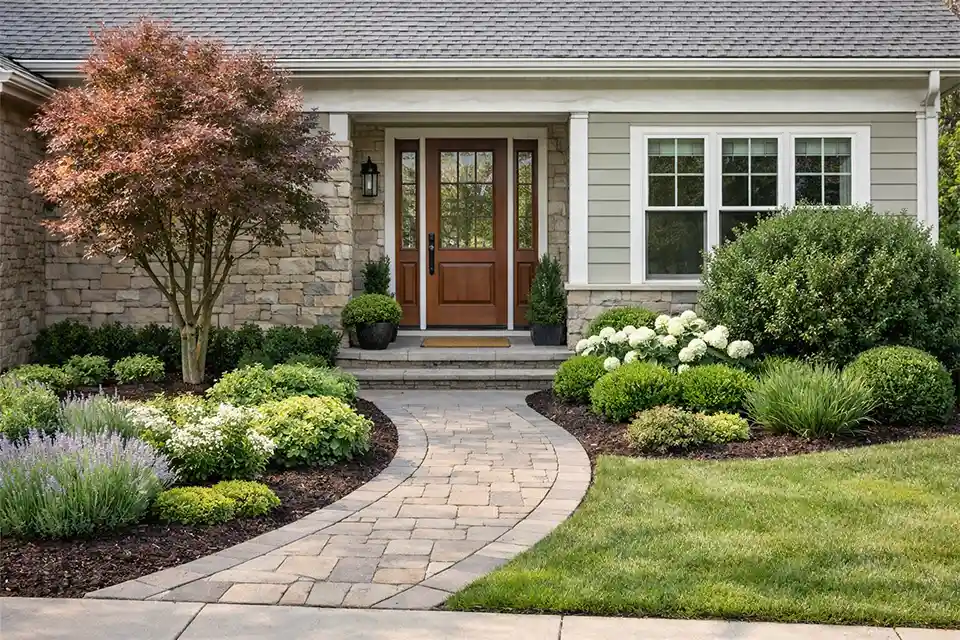
Keep window-line planting low
This is one of the simplest high-value moves. When plants near windows stay mostly below 36 inches, the house reads more cleanly, sightlines improve, and long-term pruning pressure drops.
Use one taller element with a job
A small ornamental tree, grouped screening plants, or a larger shrub should solve a real problem: soften a garage-heavy facade, frame the entry, or interrupt one exposed line of sight. Taller plants should not be mirrored everywhere just to look “finished.”
Make privacy local, not universal
If the issue is exposure from one sidewalk angle or one street-facing window, screen that area. A front yard becomes more comfortable faster when it solves the actual pressure point instead of treating every edge like a defense line. Homes dealing with very shallow setbacks and front-yard privacy pressure usually prove this quickly.
Choose mature size before aesthetic preference
This is where many decent front yard plans start failing. A shrub that looks appropriately sized in a container can become too heavy for the location within 24 to 36 months. Plant role matters more than nursery appearance.
A quick layout check before you buy anything
Use this from the curb and from the porch:
-
The front door reads clearly within 3 seconds.
-
The walkway feels visually stronger than the driveway edge.
-
Window-line planting stays mostly below 36 inches.
-
The lawn has shape but does not carry the whole design alone.
-
One taller planting zone solves a specific problem.
-
The yard still feels open even where privacy is improved.
If only one or two of those are true, the layout needs work before the plant list does.
Why the obvious fix often wastes time
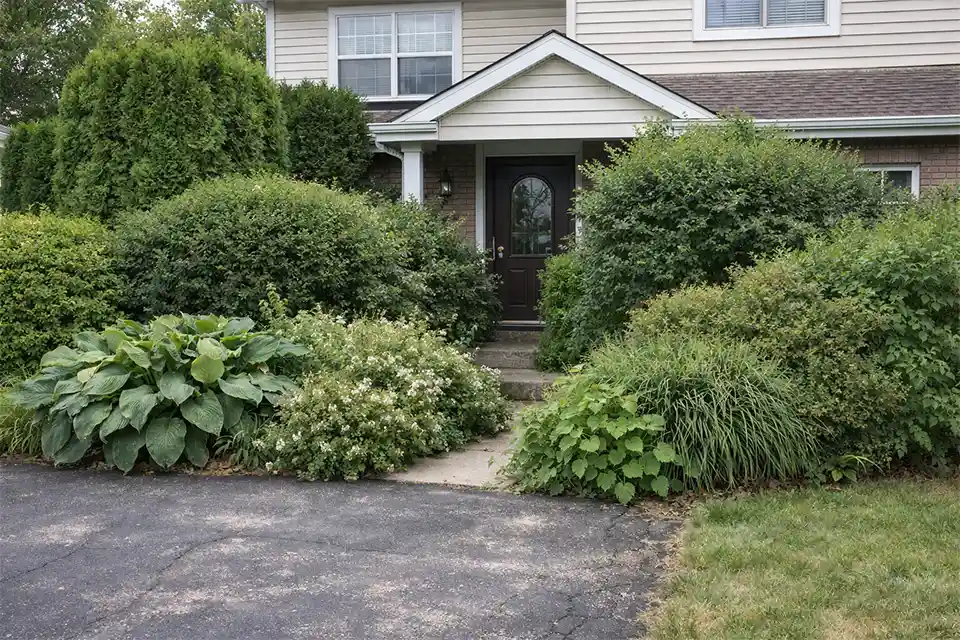
The obvious fix is usually adding more plants or choosing faster-growing ones. That often backfires. More plants do not fix weak geometry, poor entry emphasis, or a driveway that dominates the composition. They usually just make the maintenance load heavier by the second or third growing season.
Fast growth is an even more common trap. It promises quick fullness, but fullness is not the same as structure. In front yards, fast-growing screens and hedges often become oversized before they become helpful. That pattern shows up repeatedly with fast-growing front-yard hedges: the first season looks encouraging, and the long-term shape gets harder to control.
Pro Tip: Mark mature plant widths on the ground with a hose or landscape paint before planting. A layout that feels slightly underfilled on day one usually looks more balanced by year three.
What changes on different suburban lots
The same design move does not perform equally on every lot.
On narrow frontages, too much symmetry can make the house look tighter. A more selective composition, with stronger planting on one side and more breathing room on the other, often reads better from the street. That is one reason front yard design problems on narrow lots are often caused by forcing balance where the site no longer supports it.
On sloped front yards, the layout has to work with water as well as with sightlines. Even a 5% to 10% slope changes how bed edges, mulch stability, and foundation planting behave after rain.
In those cases, what looks elegant on a flat lot can fail quickly without drainage-aware shaping, which is exactly why sloped front-yard landscaping and drainage issues end up changing the design logic.
On busier suburban streets, privacy becomes more important, but the answer is still not enclosure everywhere. Partial screening, layered depth, and strategic plant height usually perform better than one dense front barrier because they reduce exposure without making the house feel withdrawn.
Better moves versus weaker ones
| Weaker move | Why it disappoints | Better move | Practical result |
|---|---|---|---|
| Add scattered accent plants | Creates clutter without fixing hierarchy | Strengthen one or two major bed lines | The yard reads more clearly |
| Use large shrubs under windows | Leads to pruning and blocked sightlines | Keep most window planting around 18 to 36 inches | Cleaner facade and easier upkeep |
| Leave most of the yard as turf | Makes the lot feel flat | Convert 15% to 25% of visible lawn into beds | More depth and better structure |
| Screen every front edge | Makes the house feel closed off | Screen the exposed zone only | Better privacy with less heaviness |
| Choose fast-growing coverage first | Solves short-term sparseness only | Choose by mature role and width | Better proportion after 2 to 3 years |
| Mirror everything for balance | Feels rigid on awkward lots | Balance visual weight instead | A more natural suburban composition |
When the usual advice stops helping
Standard advice says to keep suburban front yards simple, symmetrical, and neat. That works only until the lot has real pressure points: a wide driveway, a shallow setback, exposed windows, a narrow frontage, or a slope that keeps disrupting bed edges and runoff patterns.
That is when a front yard stops being a decoration problem and becomes a design problem. The useful question is not “What should I add?” It is “What is the yard failing to do?” Is it failing to guide people to the entry, soften a garage-dominant facade, create privacy where it is actually needed, or reduce maintenance pressure over the next 3 to 5 years?
The best suburban front yard ideas answer those questions first. They do not just make the house look nicer for a season. They make the whole front of the property easier to read, easier to maintain, and easier to live with.
For a practical extension reference on planning home landscapes, see the University of Missouri Extension guide.