Last updated: June 19, 2026
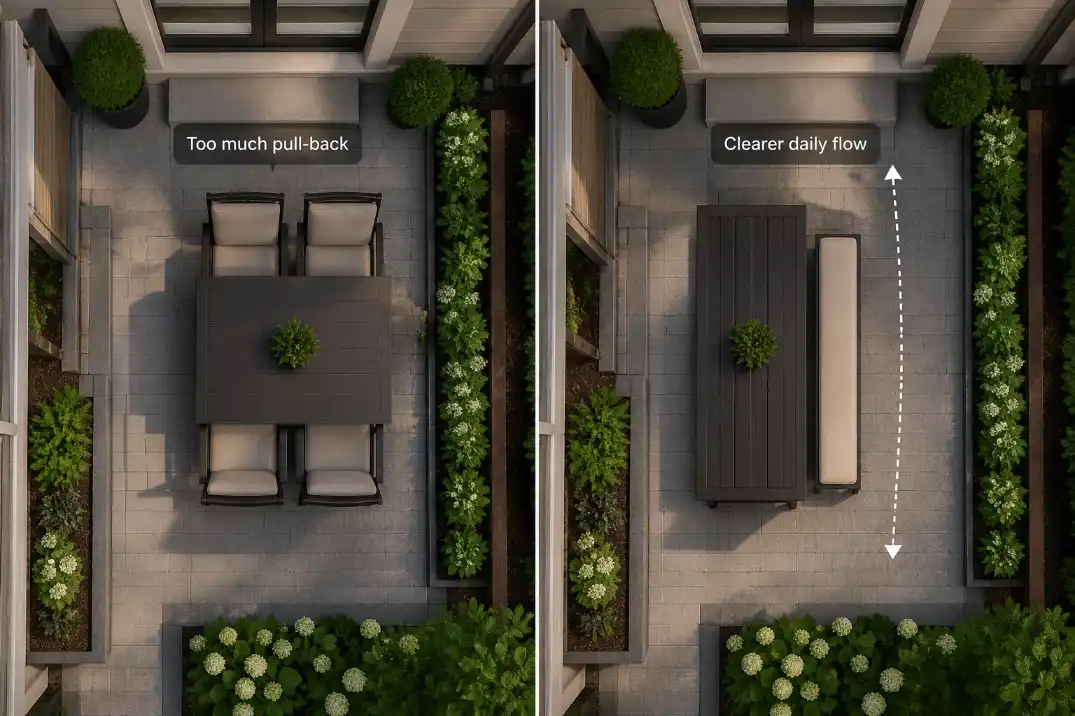
A small rectangular patio usually feels awkward for one of three reasons: the traffic path cuts through the furniture, the table is too deep for the available width, or every piece is centered as if the space were a square.
The fastest fix is not buying smaller decor. It is reserving a clear 30- to 36-inch walking lane, leaving 42 to 48 inches behind dining chairs where people need to pull out seats, and keeping coffee tables about 16 to 18 inches from lounge seating.
This is different from a patio that is simply too small. A 9-by-12 or 10-by-14 rectangle can work well when the long side carries movement and the furniture sits in one deliberate zone.
The warning sign is when someone has to step sideways within the first 10 seconds of walking outside. That is a layout problem before it is a square-footage problem.
Start With the Route, Not the Furniture
The walking lane is the real skeleton of the patio
Most rectangular patios fail because the nicest view, grill, or sofa gets chosen first. Flow should come first. Mark the route from the door to the yard, gate, steps, grill, or garden path before placing anything else.
In many homes, that path naturally runs along one long edge of the patio rather than through the center.
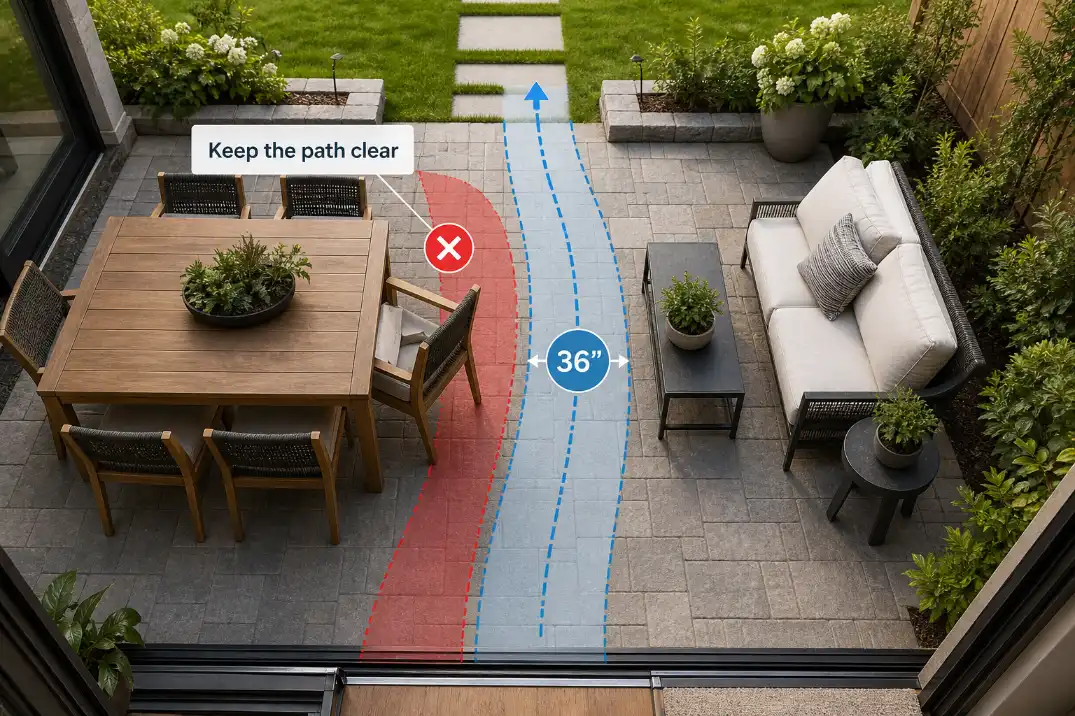
A clear lane of 30 inches is workable for one person. A 36-inch lane feels noticeably better when people carry plates, open a screen door, or pass each other near the house.
Once the path is protected, the furniture choices become easier because the leftover zone is honest. That is where many layouts improve immediately.
If your patio is especially skinny, the same spacing logic used in Long Narrow Patio Furniture Layout Ideas applies even when the space is not extremely long. The key is to stop treating the center as usable floor if it is really the travel lane.
Centered layouts often look better than they work
On a rectangular patio, centered furniture can look balanced in a photo and still feel bad in use. A centered dining table may leave two narrow strips on either side, neither wide enough for real movement. A centered sofa and coffee table can force people to walk between knees and the table every time they move.
Better flow usually comes from asymmetry. Push the main seating or dining zone slightly to one side, then give the other side a clean route. This can feel less formal on paper, but it works better outside, where people are constantly carrying food, opening doors, moving chairs, and stepping around pets or kids.
Small Rectangular Patio Layout Ideas That Actually Work
The best small rectangular patio layout ideas are not separate decorating themes. They are different ways to protect movement while giving one activity enough room to feel intentional. The right choice depends less on style and more on where the door, yard exit, grill, and main view sit.
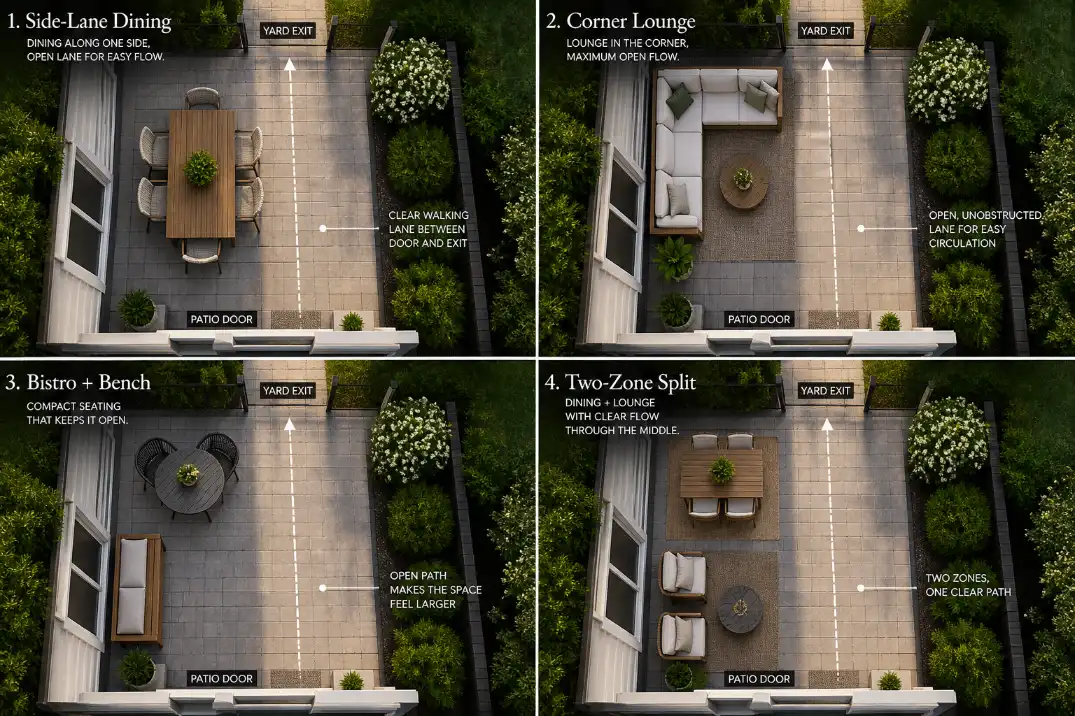
1. The side-lane dining layout
This is the most reliable layout when the patio door is near one short end and the yard or garden exit is at the other. Run the walking lane down one long side and place a slim dining table parallel to it. The table should sit close enough to the opposite edge that the walkway remains visually obvious.
This layout works especially well on 9-by-12 and 10-by-12 patios when the table is not too deep. A 28- to 32-inch-deep rectangular table usually behaves better than a wide round table because it follows the patio’s shape. The mistake is placing the table in the center and hoping both sides can function as circulation. They usually cannot.
2. The corner lounge layout
A corner lounge layout places the largest seating piece along a long edge or back corner, then uses one or two lighter chairs facing it. The traffic path stays open along the opposite edge. This is often the best choice for patios that need conversation seating but still serve as the route to the lawn.
The benefit is not just saving space. It keeps the center from becoming a collision zone. A small rectangular patio feels calmer when the middle is partly open instead of filled with furniture legs.
For patios close to 8 by 10 feet, this approach is often more realistic than forcing a dining set. The more detailed spacing examples in 8×10 Patio Furniture Layout Ideas can help if your patio is just large enough to tempt you into adding too much.
3. The bistro-and-bench layout
This layout works when the patio needs to support coffee, casual meals, and occasional conversation without pretending to be a full outdoor dining room. Place a small bistro table near one end and a bench along the long side. The bench reduces chair pull-back on one edge, which can save 18 to 24 inches of practical movement space.
This is a strong choice for townhouse patios, condo patios, and fenced rectangular slabs where storage, door clearance, and plant containers all compete for the same floor. It also gives the patio a finished look without requiring four movable chairs.
4. The two-zone narrow split
A rectangular patio can sometimes hold both dining and lounging, but only if one zone is clearly secondary. A bistro table plus two chairs near one end and a bench or loveseat at the other can work. A full dining set plus full lounge set usually does not.
For a 12-by-16 patio, two real zones are possible if the long dimension is used carefully. The guidance in 12×16 Patio Furniture Layout Ideas is useful here because that size is often where homeowners overestimate how much furniture can fit without interrupting movement.
Choose the Main Use Before Adding Extras
Dining needs more clearance than it seems
Dining is the least forgiving use on a small rectangular patio. A 36-inch-wide table sounds compact, but it may need 9 feet or more of usable width once chairs are included.
For comfortable use, allow roughly 24 inches per seated person along the table edge and 42 to 48 inches behind chairs where people need to sit down and get up.
That does not mean a narrow rectangle cannot support dining. It means the table shape has to match the patio. A slim rectangular table parallel to the long edge often works better than a round table, even though round tables are commonly marketed for small spaces. Round tables save corners, but they can waste depth when chair movement matters.
For tighter dining layouts, the spacing logic in Patio Dining Set Space is more useful than simply checking the table dimensions on a product page. The footprint that matters is the table plus moving chairs, not the table alone.
Lounge layouts tolerate tighter edges
A lounge zone can be more forgiving because people do not pull chairs in and out as often. A loveseat, two lounge chairs, and a small table can work in less depth than a four-person dining set if the walkway stays outside the seating pocket.
The common mistake is using deep outdoor club chairs that are 32 to 36 inches front-to-back, then adding a bulky coffee table. On a shallow rectangle, that quickly eats the whole patio. A bench, slimmer lounge chairs, or an armless loveseat often improves flow more than removing a decorative item.
Pro Tip: If a chair must be moved every time someone walks past, it is not “flexible seating.” It is a layout penalty.
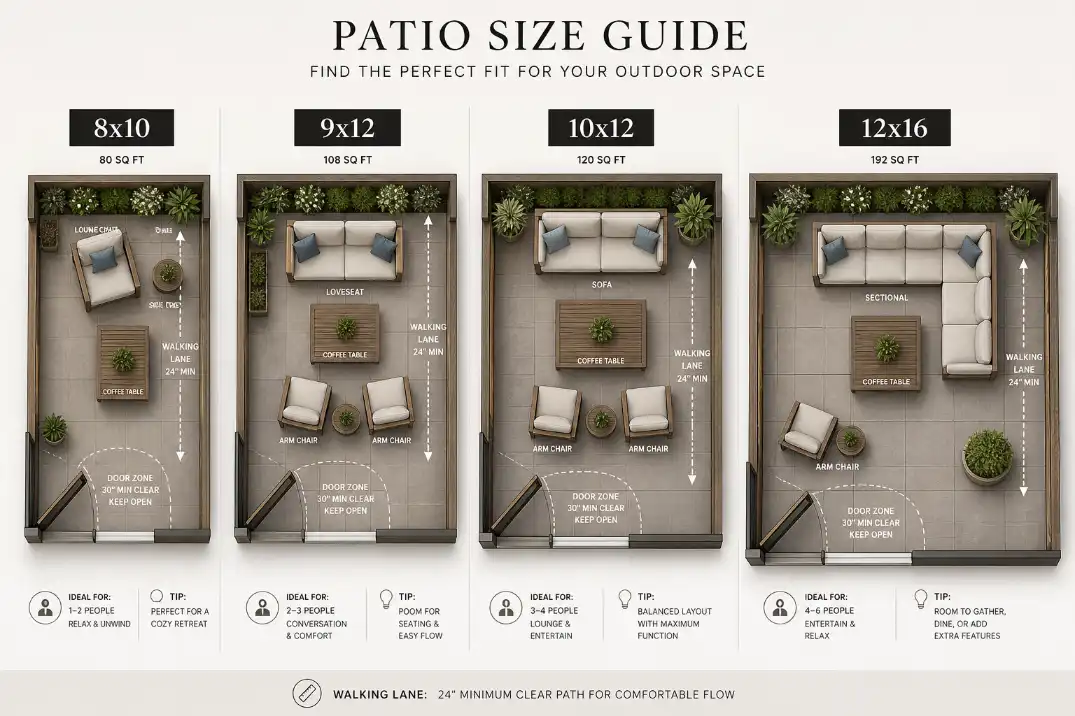
Match the Layout to the Patio Size
This is where many rectangular patios go wrong. The owner chooses furniture for the lifestyle they want, not the space the patio can actually support. A small patio can still be useful, but it usually needs one confident layout rather than three partial ones.
| Patio size | Best layout direction | What usually fits | What usually fails |
|---|---|---|---|
| 8×10 | Corner lounge or bistro set | Two chairs, small table, bench | Four-seat dining set |
| 9×12 | Side-lane dining or compact lounge | Slim table or loveseat setup | Centered round dining table |
| 10×12 | Dining-first or lounge-first | One primary zone with clear route | Dining plus full lounge |
| 10×14 | Lounge with secondary bistro | Loveseat, chairs, narrow table | Oversized sectional |
| 12×16 | Two-zone layout | Dining plus small lounge | Two full-size zones |
For a true 9-by-12 rectangle, 9×12 Patio Layout Ideas for Narrow Spaces is the closer companion than a general small patio guide because the narrow dimension is usually what decides the layout. A few extra feet of length do not help much if the chair pull-back zone still blocks the walking lane.
The smaller the patio, the less symmetry helps
In a large outdoor room, symmetry can create calm. In a small rectangular patio, symmetry often steals the only useful path. Two chairs on one side and a bench on the other may work better than four matching chairs.
A table shifted 12 to 18 inches off center may feel more natural than a perfectly centered one.
That is the difference between a layout that photographs well and a layout that survives daily use.
What People Usually Misread First
Open floor is not the same as usable flow
A patio can look open when empty and still fail once chairs move. The test is not whether the furniture fits while tucked in. The test is whether the patio works after people have been sitting there for 20 minutes, when chairs are angled, bags are on the ground, and someone is walking through with a tray.
This is why product measurements can be misleading. A 6-foot table may technically fit, but if both long sides need chair pull-back, the patio may need closer to 10 feet of functional width. Healthier layouts preserve one obvious route even when the space is in use. Failing layouts depend on everything being perfectly pushed in.
Decor rarely causes the main problem
Planters, lanterns, and side tables can clutter a small patio, but they are rarely the primary cause of poor flow. The bigger issue is usually one oversized furniture footprint. Removing three small accessories will not fix a dining set that needs 48 inches behind each chair.
That is the fix that often wastes time: trimming small items while leaving the main obstruction untouched. If the largest piece blocks the natural route, the layout will still feel cramped after the cleanup.
For patios where the space feels crowded even after rearranging, Remove Patio Furniture From a Cramped Space helps separate pieces that earn their footprint from pieces that only look useful.
Flow-Friendly Furniture Choices
Benches solve one specific problem well
Benches are not automatically better, but they are excellent when chair pull-back is the problem. A bench against a wall, fence, or built-in edge can reduce the clearance needed on that side. This can make a dining layout possible where four loose chairs would constantly drift into the walkway.
The tradeoff is comfort and access. A bench works best for casual meals, kids, or short stays. If adults regularly sit for 90-minute dinners, individual chairs may still be worth the extra space.
Narrow tables beat tiny tables in many rectangles
A small square table can feel efficient, but it may not use the long dimension well. A narrow rectangular table, about 28 to 32 inches deep, often fits better because it follows the patio’s shape. It also keeps serving dishes, plates, and elbows organized along one line instead of pushing people into all four sides of a small table.
For lounges, the same logic applies. A narrow rectangular coffee table or two small nesting tables usually flow better than one chunky square table in the middle.
Lightweight secondary pieces should move, not block
Side chairs, stools, and small tables should be easy to move without becoming permanent obstacles. The problem is not having flexible pieces. The problem is pretending a heavy chair is flexible when no one actually moves it.
Pro Tip: On a tight rectangular patio, one excellent movable stool is often more useful than two extra chairs that live in the walking lane.
Add Visual Width Without Stealing the Path
Rugs should define zones, not cross the route
An outdoor rug can make a small rectangular patio feel more intentional, but only if it supports the layout. Use the rug to anchor the seating or dining zone, not the walking lane. If the rug forces people to cross through the furniture group, it is working against the patio.
A long, narrow rug under a slim dining table can help reinforce the patio’s direction. A rug that floats in the middle of the rectangle often encourages the same centered layout that caused the flow problem.
Planters belong at corners and edges
Tall planters, privacy pots, and storage boxes are easy to underestimate. A planter that is only 16 inches wide can still ruin the corner where a chair needs to pull out or where someone turns toward the yard.
Use vertical planters near corners, blank wall sections, or the far edge of the patio. Avoid lining both long sides with containers unless the patio is wide enough to lose 12 to 18 inches on each side. The patio may look greener, but the usable rectangle will shrink.
Shade should not land in the walkway
Umbrellas and shade stands can become hidden layout problems. A cantilever umbrella base, for example, may sit exactly where the walking lane should be. On a rectangular patio, wall-mounted shade, a narrow pergola, or a shade sail often protects the space without putting a heavy base in the traffic route.
This is a condition homeowners commonly underestimate. Shade feels like an overhead issue, but the base or support posts often decide whether the layout still works on the ground.
When the Standard Fix Stops Working
Smaller furniture has a limit
Scaling down helps only to a point. Once chairs become too narrow, tables too small, or seating too upright, the patio may look better but get used less. A compact layout should still support normal movement: sitting down, reaching the table, opening a door, carrying food, and turning around without backing into a planter.
A routine downsizing fix stops making sense when every piece is already compact and the patio still needs the same circulation route. At that point, the better move is changing the use. A two-chair lounge may outperform a cramped four-seat dining layout. A built-in bench may beat four individual chairs because it removes rear pull-back space on one side.
The house door can dictate the whole layout
Swing doors, sliding doors, steps, and threshold landings are not minor details. If the door opens outward or people pause there to remove shoes, set down drinks, or call pets inside, that area needs to stay clear. Treat the first 3 feet outside the door as active space, not leftover space.
This is a condition many homeowners underestimate. They plan the patio as a rectangle on paper, then forget the doorway behaves like a busy intersection. If the first move outside requires dodging a chair, the rest of the layout will feel worse than its measurements suggest.
For more general spacing mistakes, Small Patio Design Mistakes That Waste Space covers several choices that make compact patios feel smaller than they are.
Small Rectangular Patio Checklist
Use this quick check before buying new furniture or moving heavy pieces:
- Is there one uninterrupted 30- to 36-inch route from the door to the next destination?
- Can dining chairs pull back without entering the main walking lane?
- Is the largest furniture piece aligned with the long side rather than floating in the center?
- Can someone cross the patio while another person is seated?
- Does the layout still work after a 48-hour tape test?
- Are plant beds, grill zones, shade bases, or steps narrowing the real usable rectangle?
- Is one use clearly dominant, or are two zones competing for the same floor?
The 48-hour tape test is simple: mark furniture footprints with painter’s tape and live around them for two evenings before buying or moving pieces. If everyone keeps stepping across the taped furniture, the design is already telling you the path is wrong.
The Best Layout Is Usually the One With Less Ambition
A small rectangular patio improves when the layout accepts the shape instead of fighting it. Keep the main path visible, place the largest furniture along the long dimension, and choose one primary use before adding extras. The most successful layouts are rarely the fullest ones. They are the ones that still work when chairs are pulled out, people are moving, and the patio is being used instead of photographed.
The practical threshold is simple: if the patio only works when every chair is tucked in and nobody is walking, it does not work yet. Protect the route first. Then decide what furniture deserves the remaining space.
For broader guidance on organizing outdoor areas by function and use, see Oklahoma State University Extension.