Last updated: July 2, 2026
Privacy planters fail when they are treated like outdoor decor with plants added afterward. In a front yard, the planter is part of the privacy system. It decides how much root space the plant gets, how fast the soil dries, how stable the screen feels in wind, and whether the planting still looks intentional from the curb after the first season.
The real decision is not “Which privacy plant is best?” It is: what exposure will this planter live in, and what plant form can that planter actually support?
A tall evergreen in a shallow container can lean, dry out, or look temporary. A beautiful lightweight planter can fail if it cannot hold enough soil or weight. A soft ornamental grass can filter a sidewalk view in summer and leave the window exposed when it is cut back.
This is not a full front yard layout guide or a no-fence privacy strategy. The job here is narrower: choose the plant form and planter material direction that fit sun, shade, wind, reflected heat, watering access, and the amount of privacy the front yard needs.
Start With Exposure, Not Plant Names
Exposure is the first filter because containers make site stress sharper. A plant that behaves well in the ground may struggle when its roots are lifted above grade, surrounded by hot air, and boxed into limited soil.
A front yard privacy planter usually has to handle several pressures at once:
- full sun that dries container soil faster than an in-ground bed
- reflected heat from concrete, asphalt, siding, brick, or stone
- wind from the street, driveway, corner lot, or open lawn
- shade from the porch, house wall, garage, or mature trees
- limited watering access
- public visibility from the sidewalk or curb
- mature spread near a walkway, window, porch, or driveway edge
This is where many privacy planters start to fail. The plant looks dense at purchase, the planter looks clean, and the first week feels like a quick privacy win. Then the roots dry faster than expected, the container heats up, and the plant has less room to recover from stress.
For a hot front walk or concrete-heavy entry, the same exposure logic used for front yard plants near hot concrete matters even more in containers. A planter raises the root zone out of the ground, so heat and drying can become sharper.
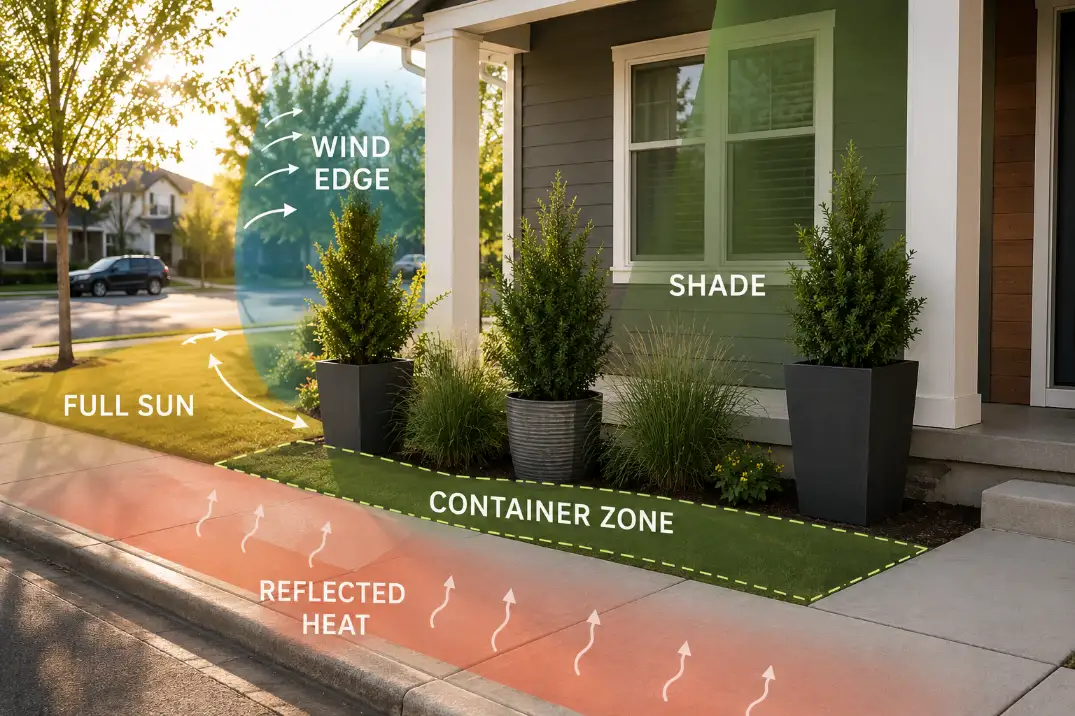
A simple field read helps: if the spot feels harsh to stand in during the hottest part of the day, it will be harsh for a container plant. If wind pushes leaves, trash bins, or lightweight furniture in that area, it can also push tall privacy plants. If the spot is shaded most of the day, dense evergreen screening may be slower or thinner than expected.
Match the Plant Form to the Privacy Job
Choose the plant form by the kind of privacy you need, not by the plant that looks fullest at the nursery. Front yard privacy can be dense, vertical, soft, seasonal, flexible, or architectural. Each form solves a different problem and creates a different maintenance pressure.
Dense shrubs
Dense shrubs work best when the privacy problem is lower and broader: a street-facing window, porch edge, or shallow front yard view. They create visual mass, which makes the screen feel settled instead of temporary.
The trade-off is width. A shrub that gives real privacy usually needs room to mature. In a narrow planter, it can become clipped, stressed, or awkward. Dense shrubs also need enough soil volume so they are not constantly thirsty.
Choose this form when you have room for a wider planter and want the screen to feel substantial. Avoid it when the walkway, entry, or driveway edge will force constant pruning.
Narrow evergreens
Narrow evergreens are useful when the privacy problem is vertical but space is tight. They can interrupt a window sightline or soften a direct street view without spreading across the whole frontage.
Their weakness is stability. Tall, narrow plants in lightweight containers can become top-heavy, especially near a driveway, exposed entry, or corner lot. They also show stress clearly because one leaning or browning plant breaks the whole rhythm.
Choose narrow evergreens when you need vertical interruption and can give them a deep, stable planter. Avoid them when the container must be small, portable, or placed in a wind channel.
Ornamental grasses
Ornamental grasses are good for soft filtering. They move, catch light, and make a front yard feel less closed off than a hedge. They are useful when you want privacy without making the entry feel blocked.
The trade-off is seasonality. Many grasses do not provide the same privacy all year, and they need cleanup when they collapse, brown, or get cut back. They are better as a filter than a hard screen.
Choose grasses when partial privacy is enough. Avoid relying on them as the only screen for a window that needs consistent year-round coverage.
Vines on support
Vines can create a narrow privacy plane when there is no room for a deep shrub or wide planter. They work best beside a porch edge, railing, or simple support structure.
The problem is maintenance. A vine is not just a plant; it is a plant plus a support plus pruning. In a front yard, overgrowth becomes public very quickly.
Choose vines when the support looks intentional and the edges can be maintained. Avoid them when the goal is low-care privacy or when the support would make the front yard look temporary.
Mixed container groups
Mixed containers work when the privacy need is partial or flexible. A taller vertical form, a lower shrub, and a soft grass can filter views without creating one heavy wall.
The risk is mixing plants with different water, sun, or root needs. A grouping can look polished for a few weeks and then separate in performance as one plant dries out, one stretches for light, and one outgrows the container.
Choose mixed containers when the exposure is consistent and the privacy need is moderate. Avoid them as a way to force incompatible plants into one display.
Field note:
The plant form that looks most private on day one is not always the one that holds up best. In containers, I trust plant forms that still make sense after pruning, wind, heat, and seasonal cleanup. A slightly less dramatic plant in the right planter usually beats an impressive screen with no root room or stability.
Use the Planter as Part of the Privacy System
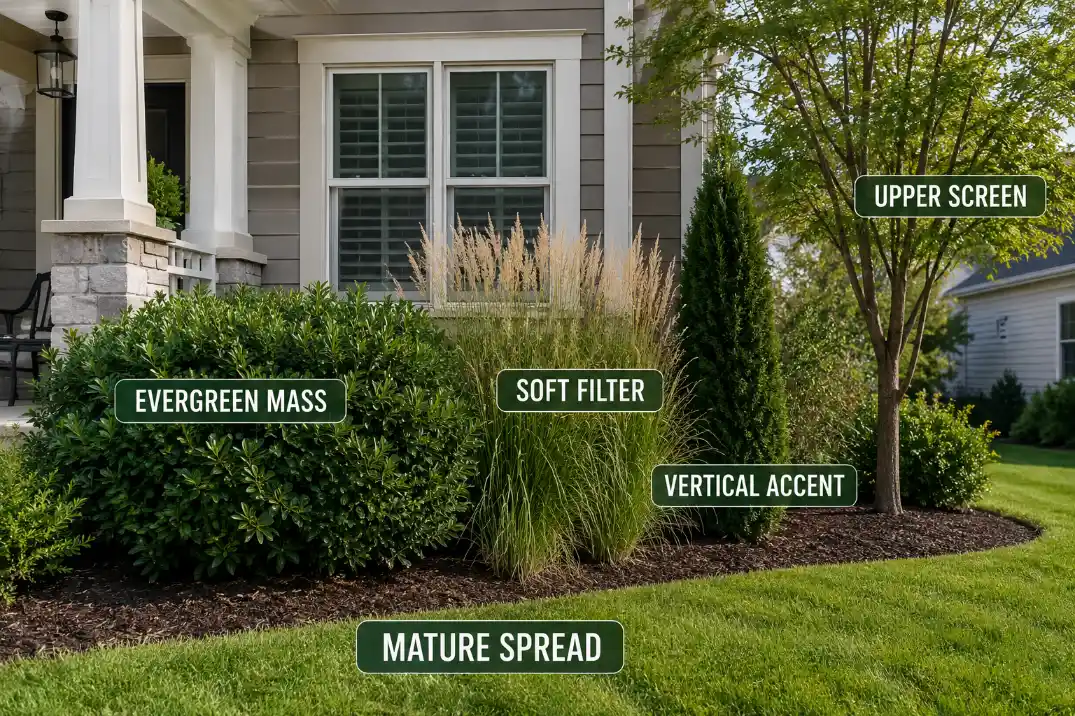
A privacy planter has to do more than look good beside the house. It has to lift the screen to the right height, hold enough soil, resist wind, drain properly, and still leave the front yard readable from the street.
A taller planter can raise the screen without forcing you to use an overly tall plant. That matters near a street-facing window, where you may need privacy at eye level but do not want a hedge swallowing the house. A deeper planter gives roots more room and slows drying. A wider planter improves stability and lets the plant mature without looking pinched.
The mistake is treating the planter like a style object first and a structural container second. A narrow lightweight planter may look refined when empty, but once it carries a tall evergreen or dense shrub, it has to resist wind, watering cycles, root pressure, and curb-facing wear.
| Front yard condition | Plant form that usually fits | Planter direction | Watch out for |
|---|---|---|---|
| Hot sun with reflected heat | Tough shrubs, selected grasses, heat-tolerant verticals | Light-colored composite, fiberglass, concrete, or stone-look with enough soil volume | Dark metal, shallow soil, fast drying |
| Wind-exposed sidewalk or driveway edge | Lower shrubs, sturdy grasses, limited narrow evergreens | Heavy, wide, stable planters | Tall plants in light containers |
| Shaded porch or front wall | Shade-tolerant shrubs or softer mixed containers | Moisture-aware wood, composite, or fiberglass | Expecting dense sun-loving privacy in low light |
| Narrow window or walkway edge | Narrow evergreens, vines on support, controlled mixed planters | Deep rectangular planters with stable bases | Plants that mature too wide |
| Far from easy watering | Drought-tolerant forms with larger soil volume | Larger planters that do not dry instantly | Small decorative pots used as privacy screens |
| Highly visible curb-facing frontage | Tidy shrubs, structured evergreens, restrained grasses | Durable planters that match the exposure and house style | Messy seasonal collapse or mismatched containers |
The difference is simple: a decorative planter holds a plant; a privacy planter supports a job. It must help the plant stay upright, hydrated, proportional, and visually calm from the street.
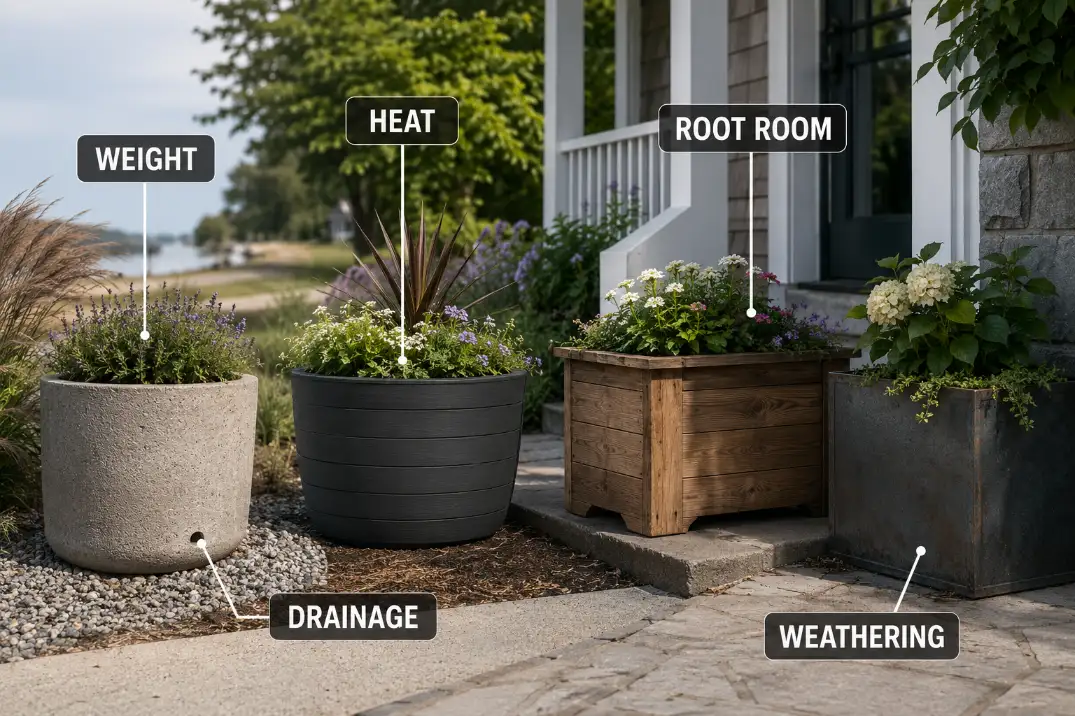
Choose the Planter Material by Heat, Moisture, and Weight
Material choice should start with the harshest condition the planter will face. In a front yard, that is often not style. It is reflected heat, wind, wet shade, freeze-thaw exposure, or the weight needed to keep a tall screen from feeling temporary.
Fiberglass and composite planters
Fiberglass and composite planters often make sense when you want a clean front yard look without extreme weight. They can work for shrubs, grasses, and narrow vertical forms if the size is generous enough.
Their trade-off is stability. A tall privacy plant still needs enough width, soil volume, and base weight. Lightweight is convenient; too light is risky.
Use this direction when you want a refined container that can handle visible front yard use without looking temporary. Avoid undersized versions for tall plants.
Wood planters
Wood can soften a front yard privacy screen. It often feels less harsh than metal or plastic near a porch, siding, or entry path.
The trade-off is moisture. Wood needs drainage awareness, liner decisions, and rot control. It can also weather unevenly in a highly exposed front yard.
Use wood where the exposure is not brutally wet or hot and where the natural look suits the house. Avoid it when the planter will be constantly hit by sprinklers, runoff, or damp shade.
Metal planters
Metal can look sharp, but it is not always forgiving for privacy planting. Dark metal near concrete, asphalt, or a hot wall can intensify heat around the root zone. That may be manageable for a decorative annual planter; it is less forgiving for a privacy shrub expected to last.
Use metal carefully in protected or less heat-intense positions. Avoid dark metal for hot reflected-heat locations unless the design clearly manages root insulation, soil volume, and watering.
Concrete and stone-look planters
Concrete, cast stone, and stone-look planters are strong choices where wind and stability matter. They can make a front yard privacy screen feel permanent instead of temporary.
Their trade-off is flexibility. Once placed and filled, they are hard to move. That is fine when the exposure and privacy need are clear. It is a problem when you are still testing the sightline or may need seasonal adjustment.
Use this direction for exposed frontages, driveway edges, and tall plant forms that need a stable base. For driveway-specific screening, the planter also has to work with vehicle movement and open sightlines, so tall planters for driveway privacy may be the better next decision.
Resin and plastic planters
Resin and plastic planters can be useful when portability, budget, or low weight matters. They are not automatically wrong. The question is whether they are being asked to do a structural privacy job.
Small or very light containers are weak choices for tall evergreens, exposed corners, and windy front yards. They usually work better for smaller mixed groupings, temporary seasonal privacy, or protected porch areas.
Use them when the privacy need is light or the exposure is protected. Avoid relying on them as the main support for a tall front yard screen.
Ceramic and terracotta-style containers
Ceramic and terracotta-style containers can look beautiful near a front entry, but they are less forgiving in harsh exposure. They may dry faster, heat up, crack in freeze-thaw climates, or limit the size of the plant you can realistically support.
Use them for protected entry accents or smaller privacy layers. Avoid making them carry the full privacy job in a windy, hot, or exposed front yard.
Practical note:
In front yard privacy work, the planter that “disappears” is often better than the planter that steals attention. If the material is too shiny, too small, too light, or too decorative for the plant mass above it, the whole screen starts to feel temporary. The best planter usually looks calm because it is doing the hard work quietly.
Pair the Plant and Planter Before You Commit
The useful test is whether the plant and planter still make sense as the plant matures. A combination that looks full on installation day may become crowded, thirsty, unstable, or messy once the roots and canopy start doing what healthy plants do.
Use these pairing rules:
- Tall, narrow plants need deep planters with enough width and weight.
- Dense shrubs need soil volume and realistic watering access.
- Ornamental grasses need room for spread and seasonal cleanup.
- Vines need a support that looks intentional from the street.
- Mixed containers should use plants with similar sun and water needs.
- Any privacy planter near a walkway must respect mature spread, not just current plant size.
The most common mismatch is a tall plant in a small, light planter. It looks like a fast privacy fix, but the plant has no real base. The first warning signs are leaning, fast drying, thinning foliage, and constant adjustment after wind or heat.
Looks good at purchase:
Tall plant, narrow container, instant height.
Still works after a season:
Right-sized plant, stable planter, enough soil, manageable spread.
That second version may look less dramatic at first, but it usually creates better privacy because it grows into the job instead of fighting the container.
Best-Fit Combinations for Common Front Yard Conditions
Use this section as the final filter, not as a plant list. Exact species still depend on region and hardiness, but the plant form and planter direction should already be clear before you choose names.
| Front yard condition | Best plant direction | Best planter direction | Avoid |
|---|---|---|---|
| Hot sunny frontage | Tough shrubs, selected grasses, heat-tolerant narrow evergreens | Larger light-colored composite, fiberglass, concrete, or stone-look planters | Dark metal, tiny pots, moisture-hungry plants |
| Wind-exposed entry or sidewalk edge | Lower dense shrubs, sturdy grasses, carefully selected vertical forms | Wide, heavy, stable containers | Tall evergreens in lightweight planters |
| Shaded porch or front wall | Shade-tolerant shrubs, softer mixed containers | Composite, fiberglass, or moisture-aware wood | Full-sun plants expected to stay dense in shade |
| Narrow window or walkway edge | Narrow evergreens, controlled vines, upright mixed forms | Deep rectangular planters with stable bases | Wide shrubs that will crowd the path |
| Far from easy watering | Drought-tolerant forms with larger root volume | Larger planters that hold moisture longer | Small decorative containers used as screens |
| Highly visible street-facing frontage | Tidy shrubs, restrained grasses, structured evergreen accents | Durable, calm-looking planters suited to the exposure | Messy seasonal plants as the only privacy layer |
Before you commit, do a quick field check:
- Stand where the street, sidewalk, or driveway view actually comes from.
- Notice whether the planter area is hot, windy, shaded, or hard to water.
- Check the mature width, not only the current plant size.
- Decide whether you need year-round privacy or seasonal filtering.
- Make sure the planter still leaves the front yard looking cared for from the curb.
For busy-street exposure, plant toughness and visibility pressure become more important than plant popularity. A deeper look at choosing front yard plants for busy streets can help when traffic, dust, wind, and curb-facing wear are part of the problem.
When the Problem Is Layout, Not the Plant or Planter
Plant and planter selection works only when the privacy problem is specific enough for a container to solve. If the issue is a direct sidewalk-to-window sightline, a blocked-looking entry, or whole-yard exposure, the better decision may be layout first and planting second.
Use plant and planter selection when the privacy need is focused: a window edge, driveway side, porch corner, or shallow street-facing zone. Use a broader layout strategy when the issue is entry visibility, walking route, whole-yard exposure, or a front yard that feels closed off after adding screening.
That distinction matters. A planter can raise, soften, or focus a privacy screen. It cannot fix every sightline by itself.
If your main concern is keeping privacy from making the entry feel blocked, the next decision is less about plant material and more about how the front yard reads from the street. In that case, use a separate framework for front yard privacy that still looks welcoming.
For the plant-care side of the decision, Penn State Extension notes that sun and wind dry container soil and that containers need watering based on conditions, not a fixed assumption. (extension.psu.edu)
The right privacy planting is not the tallest plant or the heaviest planter. It is the combination that fits the exposure, holds enough root space, stays stable, and still looks intentional from the curb. Choose the exposure first, then the plant form, then the planter material.
That order prevents most front yard privacy planters from becoming expensive decoration instead of a working screen.