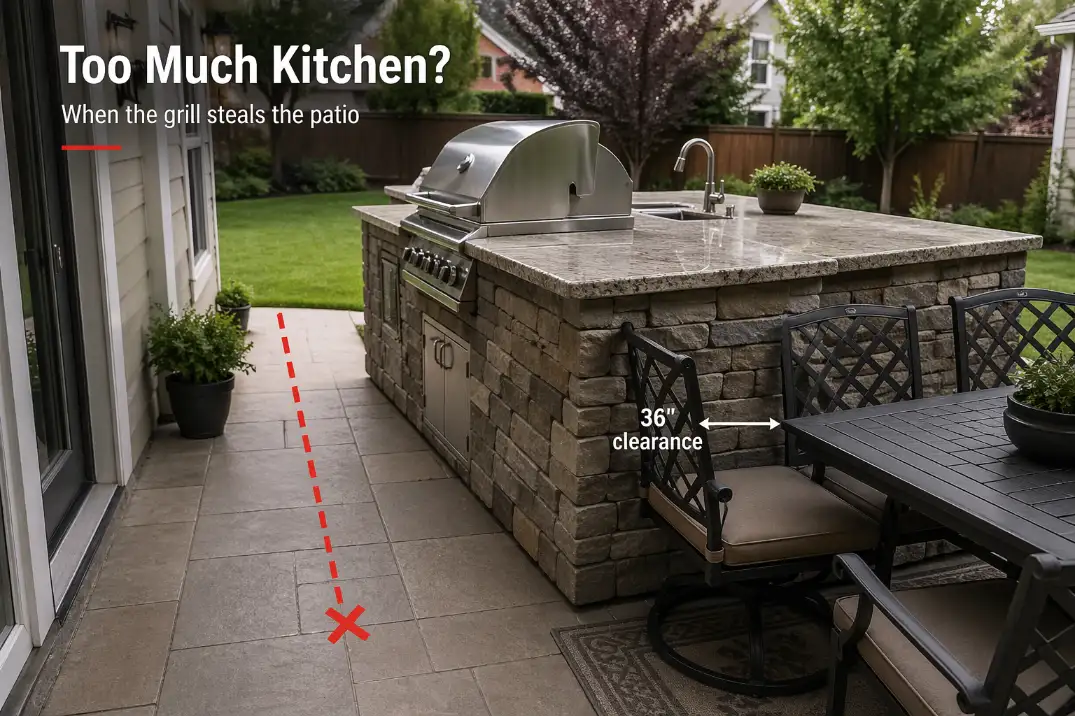
Outdoor kitchen mistakes waste backyard space when permanent features are built before anyone tests how people will actually move, cook, sit, and serve outside.
The grill may be the focal point, but the real problem is usually everything attached to it: counter runs, appliance doors, stool overhangs, utility locations, and the lost passage around them.
Start with three checks. Keep at least 36 inches of clear walking space where people actually move. Leave 30–36 inches behind dining chairs when they are pulled out, not tucked in.
Make sure fridge doors, drawers, and grill lids can open without turning the cook zone into a bottleneck. If those three checks fail, the kitchen is already consuming too much of the backyard.
This is different from a normal small-patio problem. Furniture can be moved. A built-in island, gas line, masonry counter, or sink cabinet usually cannot. That is why outdoor kitchen mistakes are so expensive: they lock a bad space decision into hardscape.
The Real Space Problem: Too Much Kitchen, Not Enough Yard
Fixed features decide where people can walk and turn
An outdoor kitchen does not waste space just because it is big. It wastes space when it takes the part of the patio that should stay open for movement, dining, serving, or the transition into the yard. A built-in island that is 30–36 inches deep, plus a 36-inch working zone in front, can claim 6 feet of depth before chairs, planters, or pathways are even considered.
On a patio that is only 10–12 feet deep, that is not a minor compromise. It is the layout. Once dining chairs need another 30–36 inches behind them, the whole patio starts to feel narrow even though the square footage has not changed.
Test the footprint before utilities or masonry
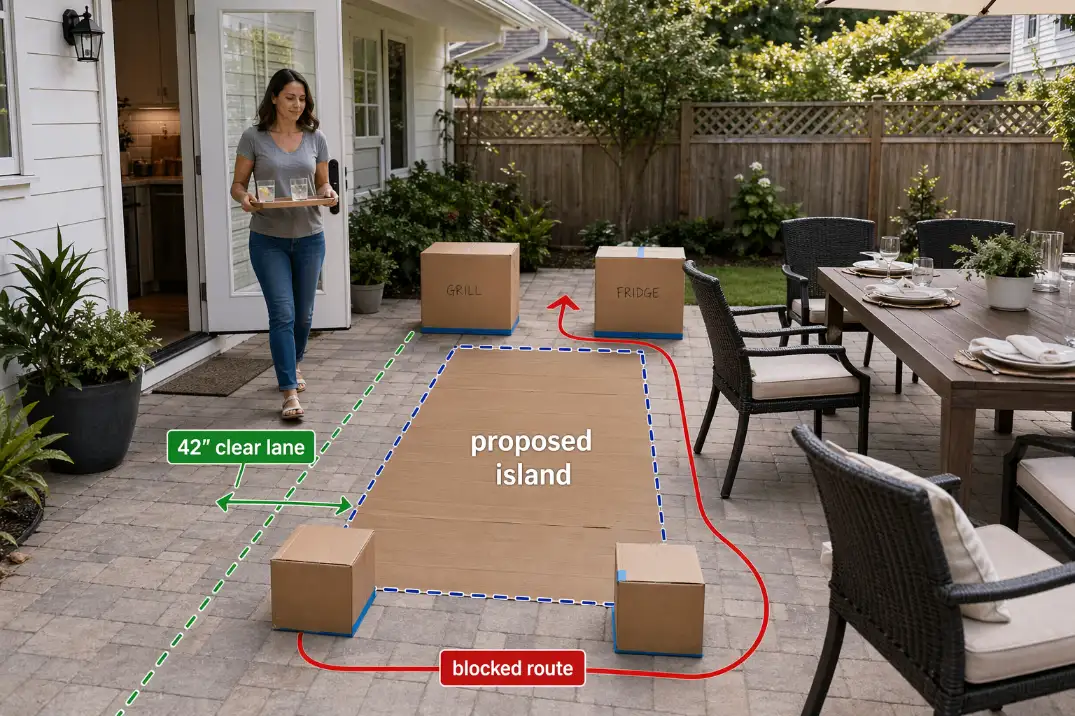
One of the easiest ways to avoid wasting space is also one of the most overlooked: mock up the kitchen before building it. Mark the proposed island footprint with painter’s tape, cardboard, or boxes.
Pull the dining chairs out. Open the back door. Walk the route to the grill and the table as if you were carrying food.
This quick test exposes problems drawings often hide. A layout can look balanced on paper and still feel cramped when someone opens the grill lid, another person reaches the fridge, and guests are seated nearby.
Mistake 1: Building Around the Grill Instead of the Traffic Path
The cook zone should not become the hallway
The most common layout mistake is placing the grill where it looks centered from the house instead of where it works. If people have to pass behind the cook to reach the table, lawn, side gate, or seating area, the kitchen is sitting in the wrong zone.
A clear 36-inch passage is the practical minimum. A 42–48 inch lane feels much better once real use begins. Below 30 inches, the space may still photograph well, but it starts to feel tight the first time someone carries a tray through while chairs are occupied.
That same conflict shows up in Small Patio Grill Placement Near a Dining Area, where the grill fits in a technical sense but steals the exact circulation space the patio needs.
The center of the patio is usually the wrong place
A center island often looks custom and expensive, but on a small or medium patio it can consume the most flexible part of the backyard. The middle is often the only space that can adapt to weekday dinners, larger gatherings, kids, or a looser seating arrangement.
Placing the kitchen along an edge usually preserves more usable room. That edge still needs safe clearance and comfortable access, but it does not force the entire patio to orbit around one fixed mass.
Mistake 2: Treating Counter Length Like Function
Counter length is not the same as landing space
Many outdoor kitchens waste space by adding long counters when what the grill actually needs is better landing space. The useful question is not how much stone can fit. It is how much working surface the cook truly needs near the grill.
A 12-inch strip may be better than nothing, but it is usually too narrow for real use. Around 24 inches of landing space beside the grill is a much better minimum. A 30–36 inch landing area is more comfortable if the grill is used often. That small, functional zone is usually more valuable than a long decorative counter that pushes the table into a corner.
Distance from the house changes how big the kitchen becomes
A kitchen that sits too far from the house often becomes larger because it has to duplicate indoor functions. If the grill is only 15–25 feet from the back door, many households do not need an outdoor sink, beverage fridge, storage wall, trash pullout, and oversized prep run. If it is 40–50 feet away near a detached patio or pool, some of those additions become more justified.
That is the real mistake. Distance does not just affect convenience. It affects how many fixed features get added outside, and every extra fixed feature consumes more backyard.
Mistake 3: Adding Appliances Without Counting Their Real Footprint
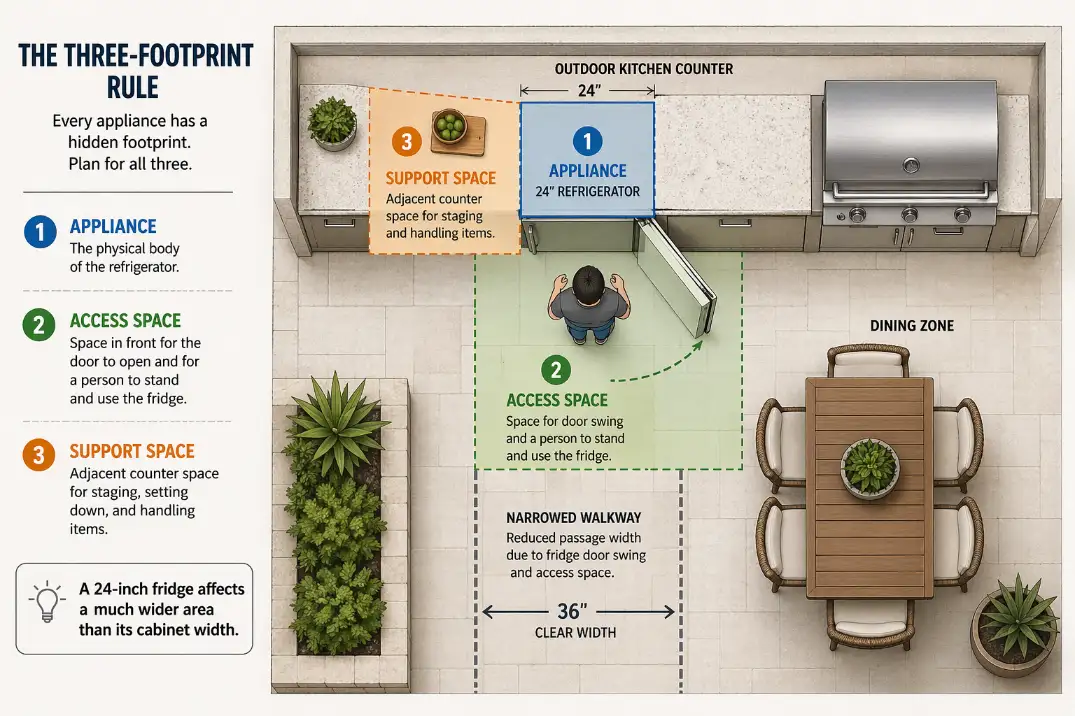
Every appliance has three footprints
A big reason outdoor kitchens feel tighter than expected is that appliances take more room than their product dimensions suggest. Each one has three footprints: the appliance itself, the access space needed to open and use it, and the support space needed around it.
A 24-inch refrigerator is not just a 24-inch decision. It needs a door swing, standing room, airflow, and a walkway that still works while someone is using it.
A trash pullout needs room to extend. A side burner needs landing space. A pizza oven or smoker often needs tool space, heat clearance, and extra circulation around the cook.
That broader pattern also appears in Small Patio Design Mistakes That Waste Space: the footprint people budget for is rarely the footprint the feature actually consumes.
Closed-door layouts almost always look better than real use
This is where many outdoor kitchen plans become misleading. Drawings and 3D renders usually show appliances closed, stools tucked in, and the space empty. Real use looks nothing like that. Doors swing open. People stand still while using them. Chairs move backward. Serving trays need somewhere to land.
If a layout only works when everything is closed, it does not really work.
Mistake 4: Letting Bar Seating, Wind, and Night Use Undercut the Layout
Permanent bar seating often takes the best open edge
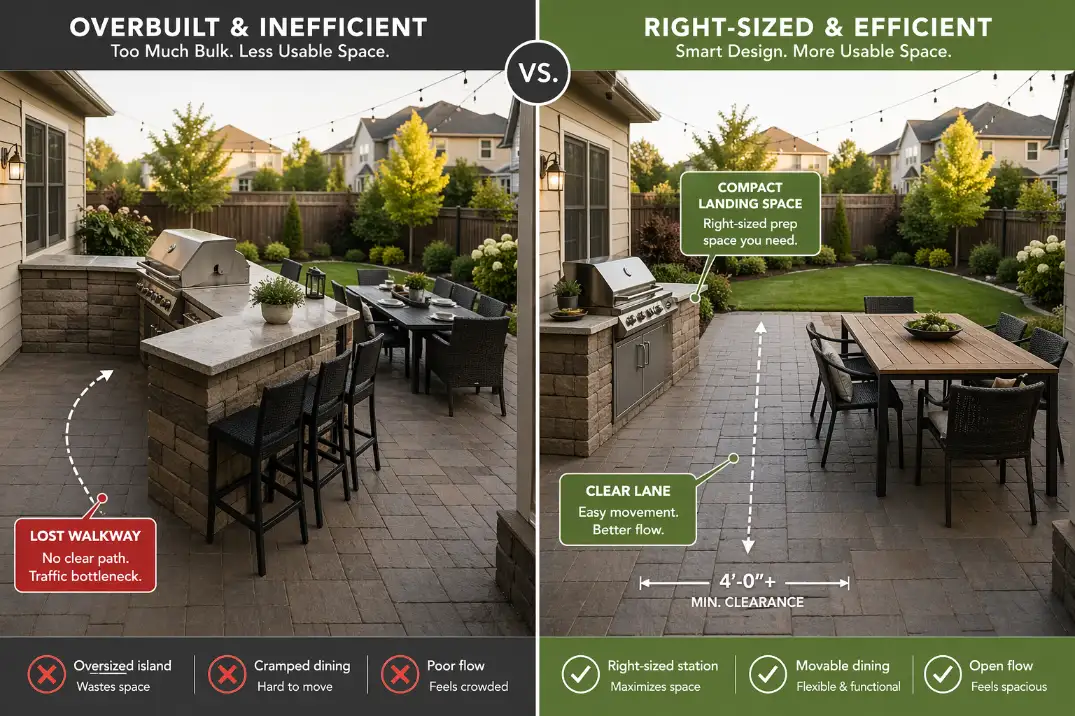
Built-in bar seating is one of the most overestimated outdoor kitchen features in smaller backyards. It looks social, but it often claims the patio edge that should have remained flexible for circulation or dining.
Allow about 24 inches of width per stool and roughly 30 inches behind the stool for sitting, standing, and passing. Three stools can quietly consume a 6-foot counter run and a deep clearance band behind it. That is a large claim on a patio that may already be balancing grill space and dining space.
In many backyards, the first thing to cut is permanent bar seating, not the dining zone. Dining earns its footprint more often. Bar seating often photographs better than it performs.
Smoke, ventilation, and lighting decide whether the kitchen gets used
A layout can be technically sound and still waste space if smoke repeatedly blows toward the table, the grill sits under a poorly ventilated cover, or the prep zone becomes unusable after sunset.
Under covered patios, ventilation is not optional. Smoke and heat need a clear escape path, not just open sides somewhere nearby.
This is especially important in breezy side yards, coastal settings, and open suburban lots where wind shifts across the patio.
If wind is already a known issue, Windy Backyard Outdoor Kitchen Mistakes is more useful than a generic planning list because smoke direction can turn good seating into dead space.
Night use matters too. Lighting is not decoration here. One task light over the prep or grill zone and low-glare path lighting can be the difference between a kitchen that gets used after 6 p.m. and one that becomes a daytime-only feature.
Mistake 5: Using Materials and Decorative Bulk That Age Into Dead Space
Indoor-style finishes do not belong outside
An outdoor kitchen that ages badly becomes a space problem, not just a maintenance problem. Swollen cabinet fronts, rusted hardware, loose veneer, cracked finish layers, or warped doors make storage harder to use and the whole structure less appealing to stand around.
That risk changes by climate. Freeze-thaw cycles can stress masonry and stone in northern states. Coastal moisture can corrode hardware faster. Humid conditions can punish poorly ventilated cabinets. Dry, dusty yards can turn low storage into a debris trap.
Decorative bulk is not the same as useful storage
This is another place where homeowners often overestimate visual mass. Thick stone cladding, heavy end panels, and hollow decorative bulk can make an island look substantial while hiding unusable cavities that collect dirt instead of providing storage.
The island gets larger, but the working value does not improve.
Service access matters too. Appliances, gas lines, electrical outlets, shutoffs, and drains need to be reached without tearing the kitchen apart. If every access point is buried for the sake of a cleaner facade, the kitchen may look custom while functioning poorly over time.
What to Prioritize Instead
| Decision Area | Better Choice | Space-Wasting Mistake |
|---|---|---|
| Main path | Keep 36–48 inches clear | Letting the island block house-to-yard movement |
| Grill counter | Add 24–36 inches of landing space | Extending decorative counter length into the dining zone |
| Appliances | Count access and support space | Planning around appliance width only |
| House distance | Stay close enough to avoid duplication | Building so far away that every function moves outside |
| Seating | Use flexible dining or movable chairs | Locking the patio into permanent bar seating |
| Construction | Choose durable, serviceable materials | Building decorative bulk that ages into dead space |
The order matters. Movement comes first. Cooking clearance comes second. Useful landing space comes third. Appliances, bar seating, and decorative mass come after that. When the order gets reversed, the outdoor kitchen starts to dominate the yard instead of supporting it.
That is also why this issue overlaps with Backyard Zoning Mistakes That Disrupt Outdoor Flow. In both cases, the problem is not one bad feature by itself. It is a fixed feature taking the space that the whole layout needed to stay open.
Quick Pre-Build Checklist
- Can someone walk from the back door to the yard without crossing behind the cook?
- Is the main circulation route at least 36 inches wide, and preferably closer to 42–48 inches?
- Can dining chairs pull out 30–36 inches without colliding with the island?
- Does the grill have useful landing space within arm’s reach?
- Have appliance door swings and standing positions been tested, not just drawn?
- Has the island footprint been mocked up with tape, boxes, or temporary furniture?
- Will smoke and heat clear the seating area and covered structure?
- Can the utilities and appliances be serviced without dismantling the kitchen?
If two or more of those checks fail, the design is probably overbuilt for the space.
The Bottom Line
Outdoor kitchen mistakes waste backyard space when counters, appliances, stools, and utility decisions are allowed to outrank movement, seating, and real use.
The most expensive version of this mistake is not usually the wrong grill. It is building too much kitchen into the part of the backyard that needed to stay open.
In many homes, the best outdoor kitchen is the one that leaves the backyard easier to use after the cooking is done: a compact cooking station with a useful landing area, a clear path, comfortable nearby seating, and enough open patio left to make the yard feel better, not smaller.
For broader official guidance on safe outdoor cooking placement, see the National Fire Protection Association.