If plants keep dying on a sloped backyard bank, the problem usually is not that every plant choice is wrong. More often, the bank itself never holds moisture and soil evenly enough for roots to settle in.
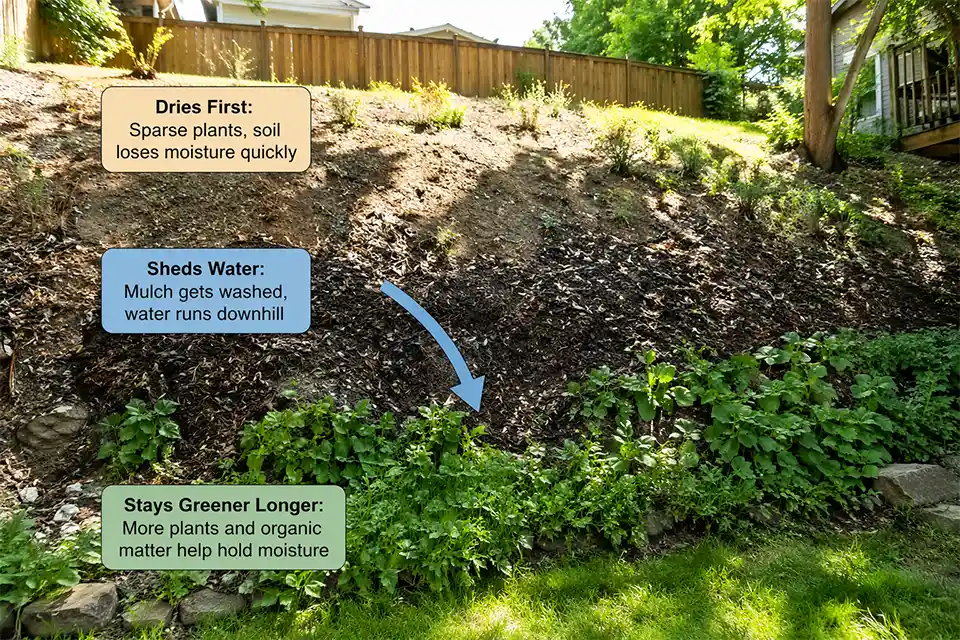
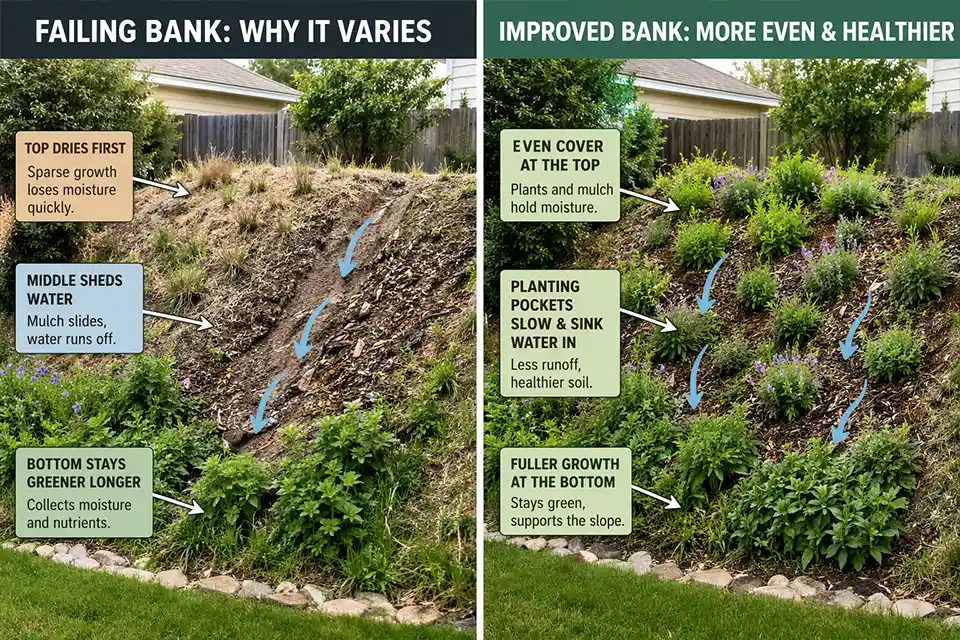
The top dries too fast, the middle starts shedding water and fine soil downhill, and the bottom often stays greener simply because it catches what moved.
If the upper part turns dry and crusty within 24 to 48 hours after rain, if a test hole hits hard soil within about 4 to 6 inches, or if water runs down the face instead of soaking in, the bank is working against the planting.
That is the real distinction here. A normal bed fails because the plants are wrong for the spot. A slope bank often fails because the spot never behaves like a dependable growing area in the first place.
Why the same bank fails in different ways
The top dries out first
The highest part of the slope usually struggles first. It gets more exposure, loses moisture faster, and often has the thinnest usable soil. That is why plants near the top may stay smaller, fade sooner, or collapse during the first hot stretch of summer even while lower plants still look passable.
The middle is where the bank starts shedding
The middle section is often the most misleading part. It may look planted, mulched, and watered, but this is where water starts gaining speed. Mulch slides, fine soil moves, and roots end up too close to the surface.
If you keep seeing bark, loose soil, or exposed roots shifting downhill after storms, the middle of the bank is acting more like a runoff lane than a garden bed.
The bottom can look better for the wrong reason
The lowest part often stays greener longer because it catches more moisture and more loose material. That does not mean the whole bank is healthy. It often just means the bank is acting like three separate planting zones, and treating all three the same is what keeps the replanting cycle going.
That is also why planting trouble on a slope often overlaps with wider soil movement. When the surface keeps washing open, the pattern starts looking a lot like Bare Soil Washout on a Sloped Backyard, even if the first thing you noticed was only weak or dying plants.
What people usually blame first, and why that misses the point
“It must be the wrong plants”
Sometimes it is. But on a slope bank, plant choice is often blamed too early. A plant labeled drought tolerant, sun loving, or low maintenance can still fail if the soil around its roots keeps drying hard, shifting, or washing thin.
The visible symptom is plant decline. The deeper problem is that the growing conditions keep changing too much for roots to lock in.
“I just need to water more”
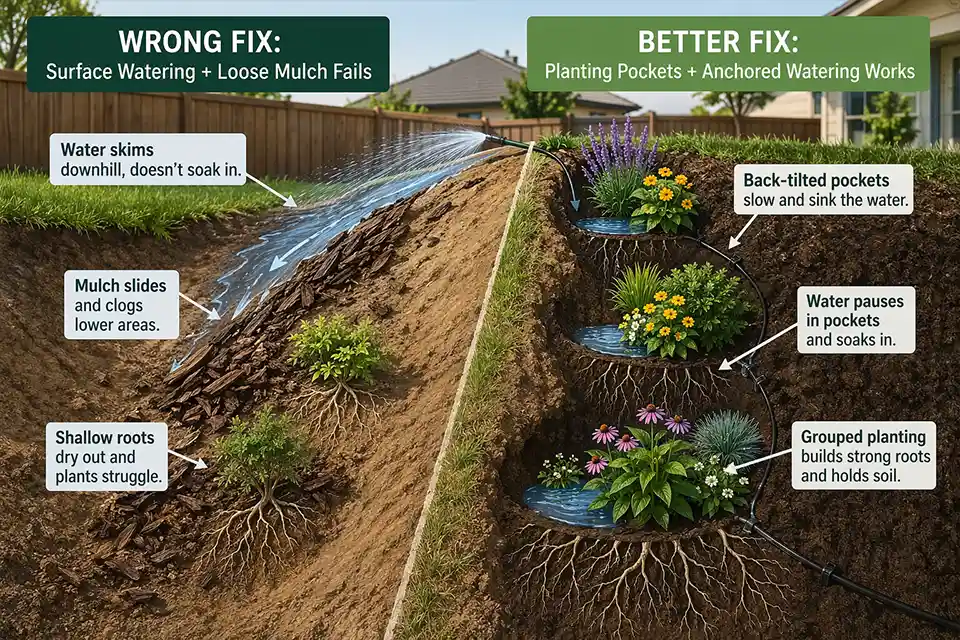
This is one of the biggest time-wasters. On a bank, extra water often means extra runoff unless the surface can hold it long enough to soak in. If the bank looks wet for a moment but dries again in a day or two, the answer usually is not constant extra watering. It is changing how the bank holds water.
“A thicker mulch layer will fix it”
Sometimes mulch helps. Sometimes it just becomes moving material. A loose 3- to 4-inch mulch layer on a slope can slide, bury crowns, and make the bank look tidier without making it more plantable. On a struggling slope, mulch needs to be held in place by roots, planting pockets, netting, or surface structure.
Pro Tip: If the bank looks freshly fixed right after mulching but messy again after the next hard rain, that is usually a slope problem pretending to be a mulch problem.
What actually makes plants struggle here
Shallow usable soil
A bank can look like it has enough soil from above and still give roots very little room. If you hit dense clay, rock, or compacted fill within 4 to 6 inches, many plants will never build enough root mass to handle heat and runoff. That is why they may survive their first few months, then stall or fade within one growing season.
This is a close cousin of the same failure pattern seen in Front Yard Plants Struggling in Shallow Topsoil. The location changes, but the basic limit is similar: roots are getting less workable soil than the surface suggests.
Water that moves past the roots
On a good planting bed, water pauses long enough to soak in. On a weak bank, it skims off the surface or drops downhill before roots get much benefit. That is especially common on smoother banks and on slopes steeper than about 3:1, where gravity starts winning too often.
Planting that is too scattered
This is where many slope articles stay too generic. A few decorative plants spaced far apart rarely do much to calm a bank down. They leave too much exposed surface between them, so water keeps speeding up and soil keeps shifting. Slopes usually do better when planting works as a pattern: repeated pockets, closer spacing, and plants that help knit the surface together instead of sitting like isolated accents.
That is part of why Tiered Backyard Problems on a Steep Slope becomes relevant when a bank is simply too steep to keep treating as one normal bed.
Sun exposure can quietly make the problem worse
A south- or west-facing bank usually runs hotter and dries faster than a more sheltered slope. In warm parts of the U.S., that can turn a marginal planting area into a failure-prone one by midsummer. So if the top half of the bank gets full afternoon sun and reflected heat, the issue may look like weak plants when it is really a faster drying surface with too little room for roots to recover.
Quick diagnostic checklist
- The top of the bank dries hard within 24 to 48 hours
- You hit dense or poor soil within about 4 to 6 inches
- Mulch or loose soil keeps moving downhill after rain
- Plants at the top fail before plants at the bottom
- Replants look fine at first, then fade within one season
- Water runs over the face instead of soaking in where it lands
What changes the outcome
Build small planting pockets instead of treating the whole bank as one bed
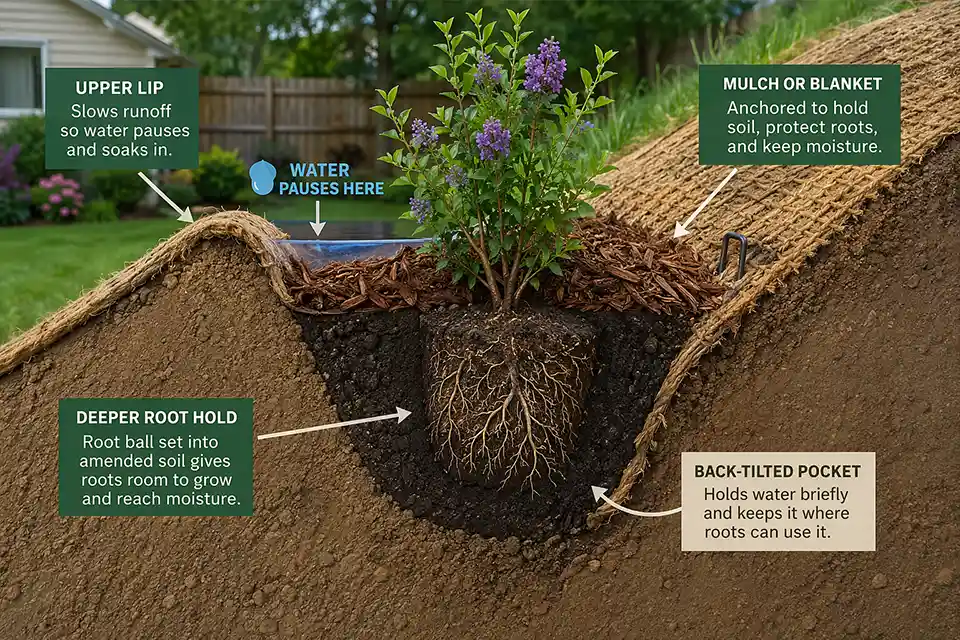
This is often the biggest improvement. Rather than spreading compost, soil, or mulch across the whole slope and hoping it stays put, create repeated planting pockets cut into the face of the bank. Even a shallow back-tilted pocket, usually around 12 to 18 inches wide for small plants, can slow water long enough to help roots settle in.
Match the planting style to the bank, not just the plant tag
The most reliable slope plantings usually share three traits: they cover surface soil, they repeat in groups, and they help hold material in place. That matters more here than chasing one perfect plant variety. A bank usually does better with layered, knitting growth than with a few standout plants spaced too far apart.
Put water where it can pause
The goal is not simply to add more water. It is to stop water from escaping too quickly. That is why drip lines and hand watering work better when aimed into planting pockets or shallow basins instead of onto a smooth slope face. If water pauses even briefly, roots get a chance. If it races downhill, the bank stays thirsty even after watering.
| What you see | What it usually means | What actually helps | When replanting is a waste |
|---|---|---|---|
| Dry, weak plants at the top | Fast drying and shallow soil | Create planting pockets and improve cover | When new plants fail in the same spot again |
| Washed mulch in the middle | Surface shedding and soil movement | Anchor the surface before replanting | When every storm reopens the area |
| Greener growth only at the bottom | Uneven moisture across the bank | Treat the bank as zones, not one bed | When only the lower third ever performs |
| Plants fading after one summer | Roots never settled deeply enough | Rework the bank first, then replant | When decline repeats within one growing season |
| Watering helps briefly, then fails | Water is not staying in place | Slow and hold water near roots | When the surface still sheds water every time |
When a plant fix stops being the main fix
If the bank keeps losing soil, if water is clearly moving downhill across the face, or if the slope is starting to affect the yard below, this stops being mostly a planting problem. It becomes a slope-control problem.
That boundary matters because people often underestimate how quickly repeated small washouts turn into bigger failures, and overestimate how much a tougher plant will solve. If runoff is already moving beyond the planting area, the pattern starts leaning toward the problems behind When Water From a Sloped Backyard Runs Into a Neighbor’s Yard.
The practical cutoff
Replanting usually stops making sense when three things show up together: the soil stays thin, the surface keeps moving, and plants fail again within one growing season. That is the point to stop rotating plant choices and start changing the bank itself.
A sloped backyard bank does not get easier because you finally find the magic plant. It gets easier when the surface stops drying, shedding, and shifting so fast that roots never really get a chance.
Once the bank can hold moisture a little longer, keep soil in place, and support repeated planting pockets instead of one smooth runoff face, plant performance usually starts to improve for real.
For broader official guidance, see the Iowa State University Extension guide to gardening on slopes and hillsides.