
Most patio hazards do not begin with one dramatic mistake. They usually start when small design decisions remove margin all at once: a grill pushed too close to the house, a path narrowed by chairs, a surface that stays damp too long, or a subtle step that disappears after dusk.
The first checks should be practical. Measure whether your main route still has at least 36 inches of usable width once chairs are pulled out. Check whether water is still sitting or leaving a dark damp band 30 minutes after rain or irrigation stops. Look for any lip, settled edge, or height change greater than 1/2 inch in the walking path.
Then check the cooking zone. If heat, fabric, storage, and foot traffic all share the same corner, the layout is already doing too much in one place.
That is what separates an awkward patio from a hazardous one. A patio can be visually plain and still be safe. It can also look polished and be one rushed turn away from a burn, slip, or fall.
The mistakes that matter most
The most serious patio mistakes are not decorative. They happen when the layout asks one area to do too many jobs at once.
Overlapping zones create the first real hazard
Cooking, lounging, circulation, storage, and decorative screening all compete for the same few feet. Once they start overlapping, risk rises quickly.
The clearest example is the grill corner. Many patios treat the grill as if it only needs enough room to fit. In reality, it needs working clearance, heat clearance, and a walking buffer.
If the cook has to pivot around a chair, open a lid beneath a low branch, or stand half in the main traffic path, the design is already wrong even if it still looks tidy.
This is especially common on compact patios, where homeowners solve crowding by pushing furniture inward instead of reducing what the space is asked to do. Small Patio Design Mistakes That Waste Space becomes relevant here because wasted space often turns into unsafe space once heat and movement are added.
Surface behavior matters more than surface appearance
People often blame the material itself when the real issue is how that surface behaves under water, shade, heat, and foot traffic. A smooth dark paver can become both hotter and less forgiving than expected. A shaded section that dries an hour later than the rest of the patio is not just inconvenient. It is where biofilm, slipperiness, and cautious side-stepping begin.
The symptom is a “slick patio.” The mechanism is usually delayed drying, poor runoff direction, or irrigation overspray that keeps returning to the same route.
Single steps and subtle level changes are easy to miss
A patio edge, threshold, or isolated step is more dangerous when it is subtle than when it is obvious. A large staircase gets attention. A 4- to 6-inch drop between one patio zone and another often does not, especially in the evening when contrast weakens and people are carrying food or drinks.
Small height changes are often underestimated because they do not look structural. In use, they behave like structural risks.
What people usually misread first
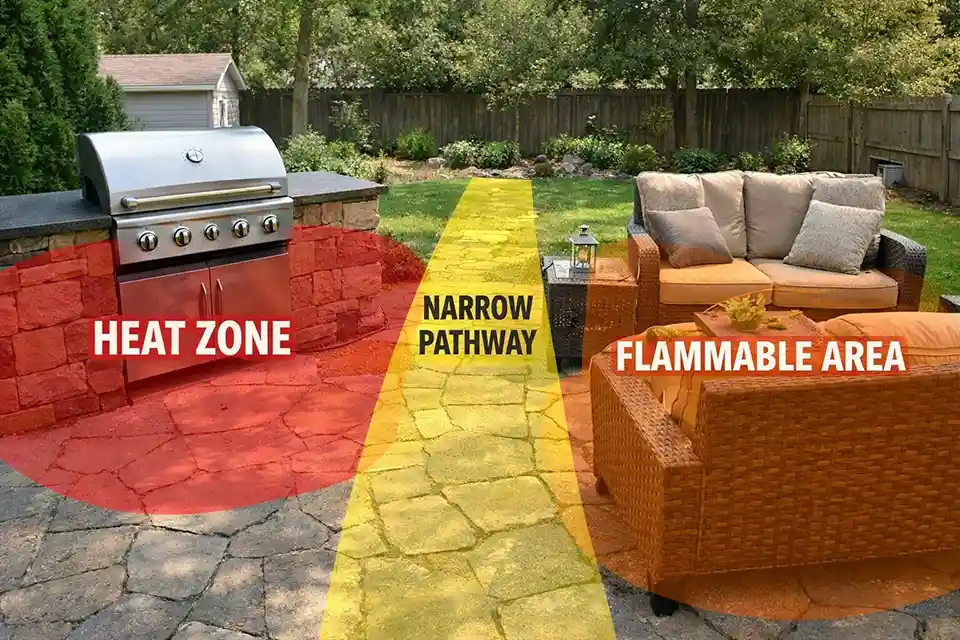
People tend to overestimate visible flame and underestimate what flame is near. The open burner gets attention. The real problem is usually the buildup around it: curtains, cushions, rug edges, dry ornamental grasses, resin storage boxes, stacked firewood, or a fence line that quietly sits too close to the heat zone.
They make a similar mistake with slips and trips. They focus on paver texture and miss the layout pattern causing the incident. A patio becomes more dangerous when water crosses the main path, when a chair leg intrudes into a turning point, or when the only route to the grill runs across the area that stays damp longest.
Patio Drainage Problems Most Homeowners Notice Too Late matters here because a slippery patio is often a drainage problem in disguise, not just a material problem.
One of the easiest errors to underestimate is the single step. Homeowners usually worry about big staircases and ignore the one drop between the patio and the yard, or between one patio zone and another. In real use, that single step causes more surprise because the eye reads the whole area as one continuous plane.
Quick risk check
- Main walking route drops below 36 inches when seating is actually in use
- Any lip, rocked paver, or threshold change exceeds 1/2 inch in the travel path
- Surface remains wet or visibly darker more than 30 minutes after rainfall or irrigation
- Grill, fire pit, or fireplace shares space with cushions, rugs, screens, or storage
- A single step or patio edge is hard to read after sunset
- You regularly reroute around furniture, cords, or planters while carrying items
Not every fire source creates the same risk
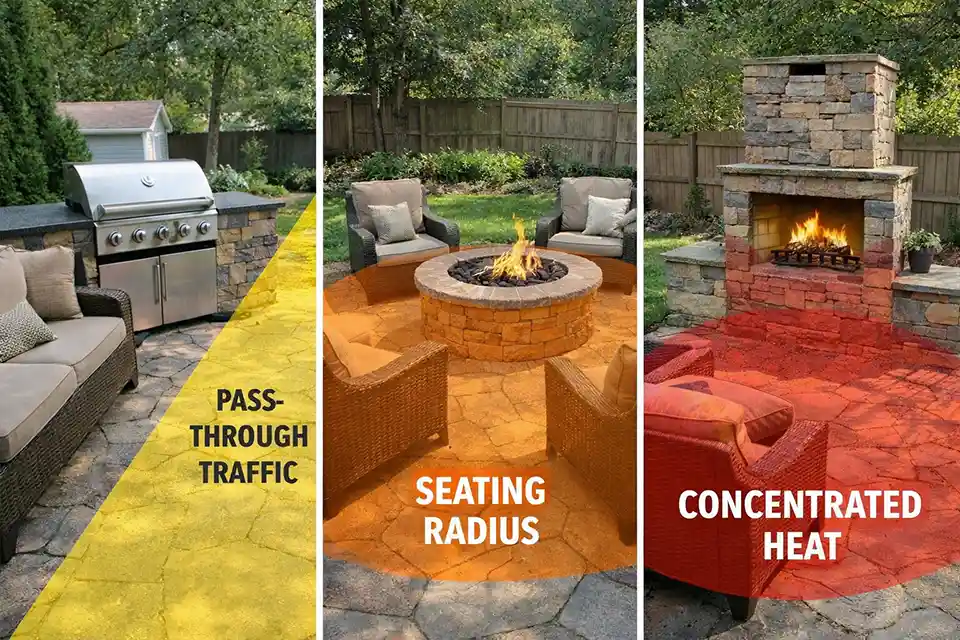
This is where many patio articles stay too generic. A grill, a fire pit, and an outdoor fireplace do not create the same hazard pattern, and local codes plus manufacturer clearance requirements matter more than a layout that merely looks safe.
Grill hazards are usually clearance and circulation problems
A grill usually creates the highest risk from side and rear clearance failures, grease flare-ups, and crowded movement. The hazard is often tight placement near siding, railing, fabrics, or the route people use to pass behind the cook.
If the grill sits within roughly 10 feet of combustible construction or directly beside stacked textiles and storage, the issue is no longer just convenience. It is fire exposure plus circulation conflict.
Fire pits create a radius problem
Even when the flame looks contained, sparks, radiant heat, and chair placement can pull fabrics, feet, and traffic too close to the hot zone. Fire pits also invite loose seating patterns, which means people stop respecting where the path should be.
That makes the risk less about one fixed edge and more about a shifting ring of unsafe proximity.
Outdoor fireplaces concentrate heat differently
An outdoor fireplace changes the problem again. The issue is usually less about random traffic crossing behind the cook and more about concentrated heat, nearby combustible finishes, and whether the surrounding wall, mantle, or decorative cladding is suitable for that installation.
That is why “we have a fire feature” is not specific enough. The right design question is what kind of heat source it is, and which surrounding decisions it makes less forgiving.
Pro Tip: If your patio needs a rug, curtain, cushion storage, and a narrow pass-through all within the same fire zone, the real fix is zoning, not accessorizing.
The material choices that quietly create risk
Material mistakes do not always look like mistakes on day one. That is why they often survive the design phase.
Slip risk is usually an exposure problem, not just a texture problem
Smooth or polished finishes can be easier to clean, but they tend to be less forgiving when fine dust, algae film, or irrigation overspray is added. A patio that stays damp in the same band for 30 minutes or more after watering has a performance problem, not just a cleaning problem.
More textured finishes usually hold traction better, but texture alone does not solve the issue if water repeatedly crosses the path and drying time stays slow. A shaded wet band is not just a maintenance nuisance. It is a slip pattern that keeps renewing itself.
Heat retention changes how people move through the patio
Very dark dense surfaces can hold heat well into the evening, especially in Arizona, inland California, or other hot dry areas with intense afternoon sun. Some lighter or more textured finishes stay more usable underfoot and are less likely to change how people move through the space.
What matters is not chasing one universally best material. It is matching the surface to the exposure pattern. Full afternoon sun, heavy tree shade, frequent overspray, coastal moisture, or freeze-thaw conditions in northern states all change what counts as safe over time.
Patio Design Problems in Hot Climates matters here because some patios fail less from poor taste than from choosing a surface that stores too much heat for the site.
The mistake people underestimate is combining heat-retaining material with low airflow and dense furniture placement. That is when people start shifting chairs, cutting across edges, and moving abnormally through the hottest parts of the patio.
Why the obvious fix wastes time
The most common wasted fix is adding objects to compensate for a flawed layout. Rugs are used to soften a slick zone. Screens are added to hide a grill. More furniture is brought in to define a gathering area. These moves often increase risk because they trap moisture, hide edges, reduce path width, or place combustible material closer to heat.
Another weak fix is spot-leveling one or two pavers after movement has already spread. If several sections wobble, chairs feel unstable in more than one zone, or water crosses the patio differently than it did a year ago, the issue is no longer cosmetic. It is base movement or water path failure. Patio Design Mistakes That Cause Long-Term Problems fits naturally here because repeated small fixes usually mean the patio is asking maintenance to solve a design problem.
Brighter lighting is another partial fix that gets too much credit. Flooding the patio with more light does not reliably reveal a low step, a wet sheen on smooth pavers, or a cord where people turn. Better safety usually comes from placement and contrast: seeing the edge, the change in plane, and the actual route.
When a problem is minor, and when it is redesign-worthy
Not every patio issue deserves a rebuild. The important question is whether the problem stays isolated or starts interacting with other risks.
Minor defects can still be fixed directly
A small isolated defect can often be repaired without changing the whole patio. One localized edge under 1/2 inch, one paver that has shifted slightly, or one small damp area that dries within 15 to 20 minutes after watering is usually still a direct fix.
The key is whether the defect stays local and predictable.
A real hazard changes how the patio is used
A patio crosses into hazard territory when people start changing their behavior around it. They turn sideways to pass through, avoid one damp strip, step around a chair leg, or hurry over a hot surface. At that point the issue is affecting movement, not just appearance.
That change in behavior is often a better warning sign than the visible defect itself.
Interacting hazards usually mean the layout is wrong
A routine fix stops making sense when hazards stack together. If the same patio has a crowded grill area, a route under 36 inches, and water lingering across that route, patching one symptom at a time is usually money spent twice.
| Condition | Usually a minor fix | Usually a real hazard | When redesign makes more sense |
|---|---|---|---|
| Surface dampness | Small area dries within 15–20 minutes | Main path stays wet 30+ minutes | Water repeatedly crosses the patio route |
| Unevenness | One localized edge under 1/2 inch | Repeated catches or wobble in traffic zones | Multiple settled areas return after repair |
| Fire-zone crowding | One movable chair too close | Combustibles and pass-through share the same corner | Cooking, storage, and seating overlap by design |
| Heat discomfort | Patio is hot only in peak sun | Surface stays punishing 60–90 minutes after sunset | Material, shade, and airflow are all working against the site |
| Visibility | General low ambience | One step, lip, or edge disappears at dusk | The whole route depends on added caution to stay safe |
Once a patio depends on caution instead of clarity, the design is already doing too little.
What a safer patio usually does differently
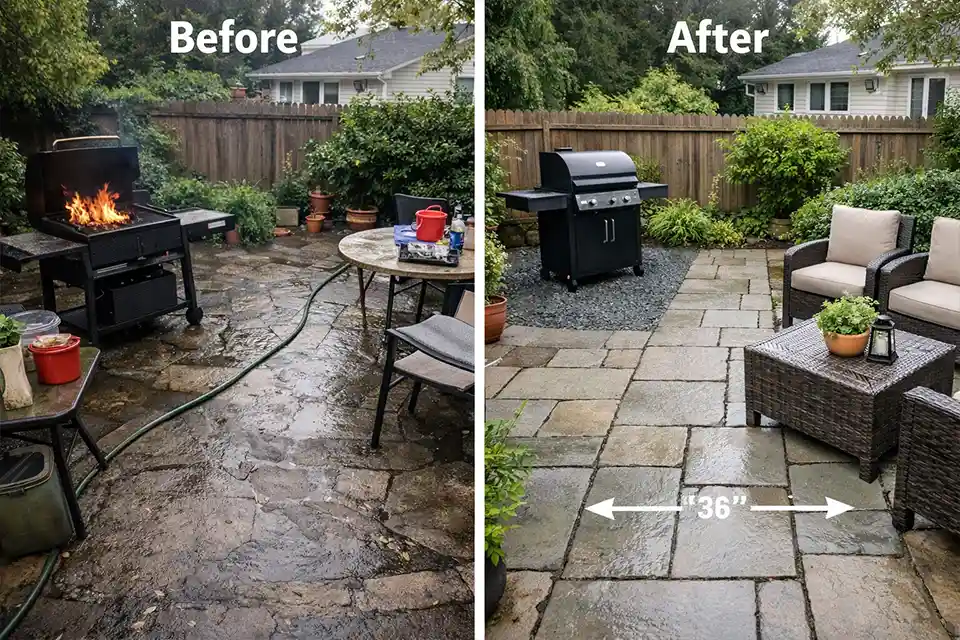
A safer patio is not necessarily bigger or more expensive. It is better separated.
It gives heat its own zone
Cooking and fire features work best when they are not sharing their immediate area with soft goods, decorative screening, or daily pass-through traffic. Heat needs space that stays usable even when people are moving, serving, and sitting at the same time.
It keeps the walking route readable
A good route stays clear in daylight and after dark. That means enough width, visible edges, and fewer intrusions at turning points. It also means not letting hoses, cords, or decorative items become part of normal circulation.
It lets water leave without crossing the path
A safer patio does not force runoff, overspray, or slow-drying shade across the main route. Moisture can exist on a patio without becoming a slip hazard, but once it consistently overlaps with foot traffic, the design is asking for trouble.
It removes clutter instead of compensating for it
That usually means fewer objects, not more. It may mean giving up one chair to preserve a real path, moving storage away from the cooking area, or abandoning the idea that every patio must function as a fully packed lounge.
How to Design a Comfortable Patio for Everyday Use connects here because patios that work smoothly are often the ones that stay safer under normal use.
One practical detail that often gets missed is timing. Check the patio during the exact hour it is most compromised. For some patios that is 5 p.m. in hard summer sun. For others it is 8 p.m. after dew starts forming, or the morning after irrigation. Safety problems are often time-specific. If you only inspect the patio at its best, you will miss the real design failure.
A patio does not become safer because it looks neater. It becomes safer when the layout leaves margin for heat, movement, moisture, and visibility at the same time.
For broader official guidance, see the National Fire Protection Association’s grilling safety page.