Last updated: June 19, 2026
Most patio design problems in hot climates start with one failure pattern: too much exposed hardscape holding too much afternoon sun for too long. If the patio looks fine in the morning but sits empty from about 1 p.m. to 7 p.m., the issue is usually not furniture first.
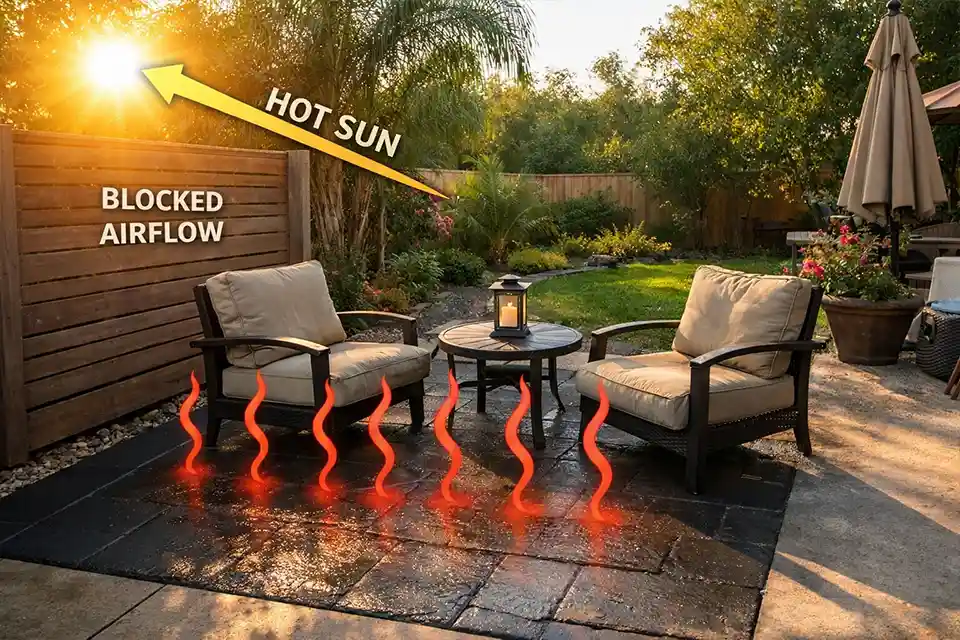
It is a combination of direct sun, heat-storing surface material, and weak airflow around the seating zone. On exposed patios, surfaces often become dramatically hotter than shaded areas and can stay uncomfortable 2 to 4 hours after sunset.
If your patio is empty all afternoon, fix shade placement first, then heat-retaining surfaces, then airflow.
That is different from a patio that is merely small or awkwardly furnished. A compact patio can still work well if one zone stays shaded through the worst 3 to 4 afternoon hours.
A large patio in Arizona, inland California, Texas, or other high-heat regions often fails because the slab itself keeps radiating heat long after the sun angle changes. That is the distinction that matters most: direct sun is what people notice, but stored heat is often what ruins actual use.
Heat Problem Signs
- The main seating area takes direct sun after 1 p.m.
- The surface is still hot 60 to 90 minutes after sunset
- Armrests, tables, or furniture frames are uncomfortable by midday
- Air feels trapped around the patio instead of moving through it
- More than half of the patio zone is exposed hardscape
- You keep adding umbrellas, cushions, or rugs, but summer use barely changes
If three or more of those are true, the patio problem is usually structural, not cosmetic.
What people usually misread first
The first mistake is blaming the material alone. Material matters, but it is usually the second decision, not the first. If the patio gets 6 to 8 hours of direct summer sun and the seating sits on the west or southwest side with no real overhead shade, even a better surface will only partly improve comfort.
The second mistake is overestimating portable shade. An umbrella helps with glare and some direct sun, but it rarely fixes a patio that is storing heat across a large exposed area. By 3 p.m. to 6 p.m., the problem is often not just the sun hitting your shoulders. It is the entire zone throwing heat back upward.
The third mistake is underestimating airflow. This is especially common in humid parts of Florida or the Gulf Coast, where filtered shade without air movement can still feel oppressive. In drier climates, people usually focus on sun and surface temperature first. In humid climates, trapped air can make a partly shaded patio still feel useless.
That broader layout logic also shows up in Backyard Design Problems in Hot Summer Climates, where exposure and use pattern matter more than decorative upgrades.
The patio design problems that do the most damage
Too much exposed hardscape
This is usually the main failure, and it deserves more weight than the other causes. Large uninterrupted paving areas act like a heat reservoir. Even when the air temperature drops a little in the evening, the patio can keep giving heat back to the body.
A practical threshold helps here: if the primary use zone is mostly surrounded by sun-exposed paving with little adjacent planting, no canopy, and no shaded edge, comfort usually collapses before the patio looks obviously wrong. That is why many patios look finished but still go unused.
Shade in the wrong place
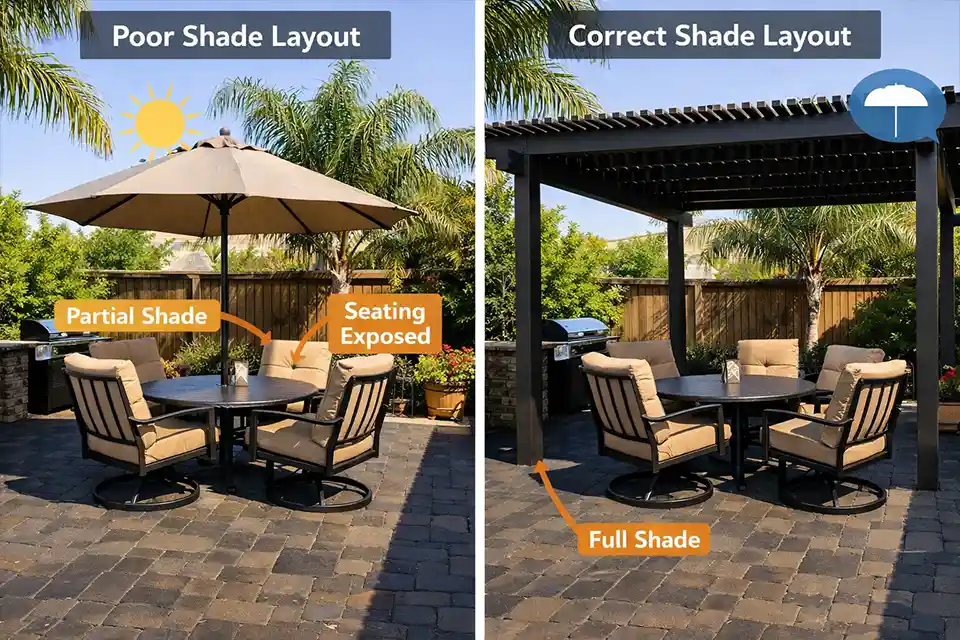
A surprising number of patios technically have shade but not over the area people actually use. The grill gets cover, but the dining set does not. The pergola looks centered, but the late-day sun still cuts across the seating line. The shade sail covers open circulation space while chairs stay exposed.
In hot climates, shade has to be aligned with the main sitting zone during the harshest hours, not just added somewhere on the patio. That is a design decision, not an accessory decision.
Low airflow around the seating zone
This is the most underestimated condition. Solid privacy panels, tight corners, heavy planter walls, and fully boxed-in patio edges often make heat linger longer than people expect. What feels cozy in spring becomes stagnant in July.
That does not mean every patio should be open on all sides. It means the main seating area needs at least one clear path for moving air. Once airflow is blocked on multiple sides, comfort drops fast, especially when the hardscape is already warm. That same problem often overlaps with Backyard Zoning Mistakes That Kill Outdoor Flow, because a poorly zoned patio tends to trap both movement and heat.
On more exposed properties, that comfort issue becomes a microclimate issue too, which is why How to Create a Microclimate in a Rooftop Garden is more relevant here than it first sounds.
Which fix matters most by patio type
This is where many articles get too vague. Not every hot patio needs the same first fix.
| Patio condition | What is actually failing | Fix that should come first | What usually wastes time |
|---|---|---|---|
| Full afternoon sun on seating | Exposure is overwhelming the use zone | Add fixed shade over the primary seating area | Buying better cushions first |
| Dark, dense paving stays hot into evening | The patio is storing and reradiating heat | Reduce exposed hot surface around the seating zone | Covering it with an outdoor rug |
| Partly shaded patio still feels oppressive | Air is trapped around the body | Reopen airflow path near seating | Adding more screens or enclosure |
| Large exposed patio rarely used in summer | The footprint is too big to cool passively | Shrink the active zone and shade that zone well | Trying to make the whole patio perform equally |
That last row matters more than people think. A smaller shaded patio often outperforms a bigger exposed patio, even when the larger one looks more impressive on paper.
Which patio materials help and which ones disappoint
Material is still a real decision, but only after shade, exposure, and airflow are doing the right job. Lighter surfaces generally reflect more sunlight than dark ones, and cooler-feeling materials help most when they support a patio layout that is already improving shade and usability.
A short ranking is more useful than a long catalog:
| Material direction | Best use in hot climates | Where it helps | Where it disappoints |
|---|---|---|---|
| Light travertine or lighter natural stone | Premium seating zones and poolside areas | Feels less punishing under strong sun | Cost is higher and shade is still required |
| Light concrete pavers | Large patios needing durability and easier repair | Strong practical middle ground | Can still get hot in full sun |
| Standard concrete slab | Budget patios with shade already planned | Works when exposure is already controlled | Large exposed slabs store too much heat |
| Dark pavers, dark stone, dense dark finishes | Limited accent areas only | Can work visually in small doses | Intensify heat gain and evening heat retention |
That is the material point many articles blur: no surface wins against bad exposure, but dark dense paving makes a bad patio noticeably worse. A lighter surface can reduce the penalty. It usually cannot rescue the layout.
Why umbrellas, rugs, and cushion upgrades usually disappoint
The most common wasted move is layering accessories onto a structurally bad patio. Better cushions, outdoor rugs, a misting fan, or a larger umbrella can help at the margin, but they do not change the thermal logic of the space.
The umbrella example is the clearest one. People often treat it like a full answer, but an umbrella usually shades a narrow patch while the rest of the patio keeps heating the air around it. Once the surrounding slab is the problem, the umbrella is trying to solve the symptom instead of the mechanism.
Material swaps are another area where people can overcorrect. A lighter surface usually helps, and dark dense materials generally make the problem worse. But swapping to a lighter finish without fixing exposure or layout often produces a patio that is only somewhat less bad. It does not usually create a patio that is truly comfortable.
Pro Tip: If your patio is empty most summer afternoons, stop upgrading accessories and ask whether the footprint, shade location, and airflow path are wrong together.
What actually changes the outcome
The right order is simple, and it is more useful than a longer list.
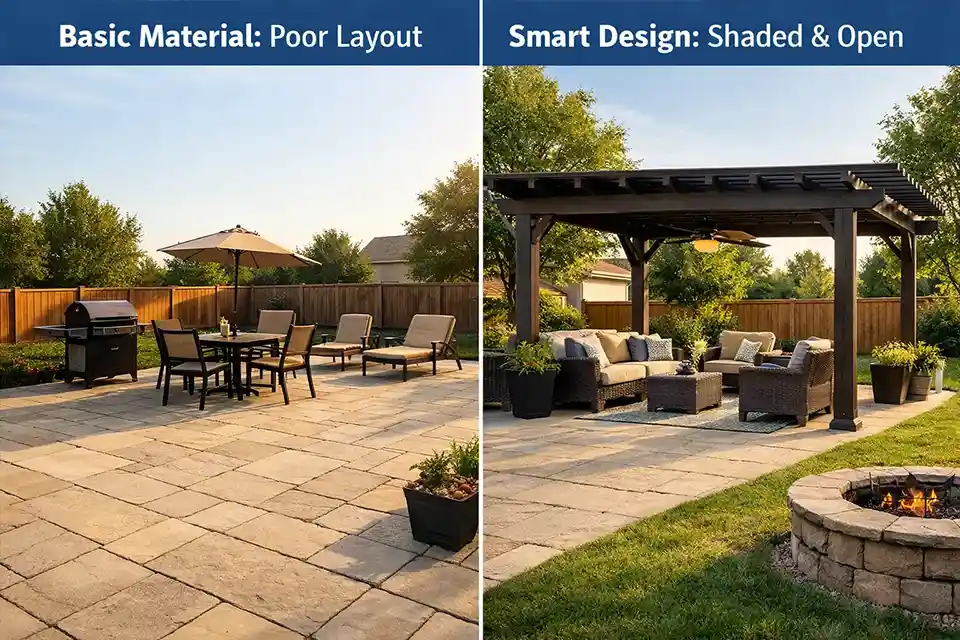
Start with the primary seating zone. Decide exactly where the patio should stay usable during the hottest 3 to 4 hours of a summer afternoon. Put fixed or reliable overhead shade there first. After that, reduce heat retention around that zone. That may mean replacing part of a large paving field, breaking up exposed hardscape with planting beds, or shifting the active seating area onto the cooler-performing section of the patio.
Then address airflow. Remove or revise the barriers that trap heat around seated people. This is often less expensive than people expect, and it does more than another decorative layer ever will.
Only after those three decisions should you spend time on furniture or styling. That is also when layout tuning becomes worth doing, and Patio Furniture Layout Fixes That Make a Big Difference becomes much more relevant.
When standard fixes stop making sense
There is a point where tweaking stops being sensible. If the patio is fully exposed, heavily paved, and still avoided after portable shade, furniture changes, and seasonal workarounds, the issue is no longer comfort improvement. It is design correction.
That usually means reducing the active footprint and building one dependable shaded zone instead of trying to rescue the entire patio. People often resist this because it sounds like giving up square footage. In practice, it is usually the first move that makes the patio usable again.
If runoff or pooling is part of the same rebuild decision, solve that first so you do not improve summer comfort on a patio that still fails during storms. Patio Drainage Problems Most Homeowners Notice Too Late is the adjacent issue worth checking before committing to surface changes.
A better standard for hot-climate patios
A good patio in a hot climate does not need to feel cool all day. That is not a realistic target in peak summer. It needs one dependable zone that stays usable without punishing the body as soon as someone sits down.
That usually means less exposed paving, better shade placement, and a cleaner airflow path. It also means accepting that some square footage is not worth preserving in its current form. The strongest patios in hot climates are selective. They protect the part that matters most and stop pretending the whole slab has to work equally well.
That is the same reason How to Design a Comfortable Patio for Everyday Use becomes a stronger companion read after the heat issue is fixed. Everyday comfort starts with thermal reality, not styling.
Questions people usually ask
Does a lighter patio material really stay cooler?
Usually, yes, but not enough to fix a bad layout on its own. A lighter surface can reduce how punishing the patio feels under direct sun, but it will not overcome poor shade placement or a large exposed slab that keeps storing heat.
Is an umbrella enough for a patio in hot climates?
Usually not. An umbrella can improve a small patch of direct sun, but it does little for reradiated heat from surrounding hardscape. If the patio stays empty most afternoons, fixed shade over the main seating zone is usually the better first move.
For broader official guidance, see the U.S. Department of Energy guide to using landscaping for summer cooling.