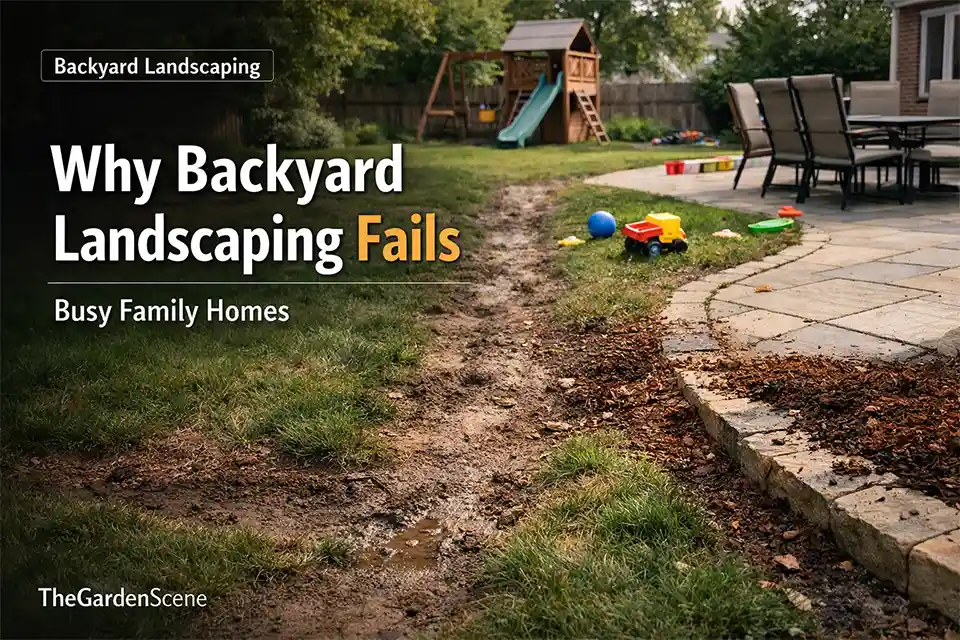
In busy family homes, backyard landscaping problems usually start in one place: daily movement gets forced across soft surfaces that were never meant to carry it. The first things to check are not fertilizer, plant color, or whether the mulch still looks fresh. Check whether a shortcut 18 to 24 inches wide has formed between the back door and the play area, whether mulch or gravel is getting kicked more than 2 inches out of place, and whether the worn strip stays damp 12 to 24 hours after rain. Those signals tell you more than a generally tired-looking yard ever will.
That is what separates a family-use backyard from a decorative one. In a low-use yard, patchy turf may really be a lawn problem. In a busy one, worn grass is often just the visible symptom. The underlying mechanism is usually traffic concentration, shallow compaction in the top 2 to 4 inches of soil, and weak separation between circulation, play, and planting. A little flattening near a swing set is normal. A muddy lane that returns within one growing season after reseeding is not. That usually means the layout is failing before the lawn is.
What to Check Before You Blame the Lawn
- A repeat walking line has formed that is wider than 18 inches
- Turf in shortcut or play areas has worn down to bare soil within 6 to 12 months
- Mulch has spread more than 2 inches onto the lawn or patio edge
- Soil in active zones feels hard 2 to 3 inches below the surface
- Water stays in the same worn area longer than 12 to 24 hours after rain
- Lawn corners near bikes, toys, strollers, or gate access keep getting thinner each month
Why Busy Family Backyards Fail First at the Edges
The lawn usually gets blamed first because it shows damage fastest. But the lawn is often not the first thing that went wrong. In family yards, the real failure point is usually the transition: the patio edge, the turn toward the play area, the side-gate cut-through, the corner where bikes and chairs clip a planting bed.
These are not random trouble spots. They are high-speed, low-attention zones. People slow down in seating areas. They do not slow down when moving a stroller, carrying groceries, dragging a hose, chasing a child, or cutting diagonally toward a gate. That difference matters. A straight route can survive family use longer than a turning zone because turning spreads force sideways, pushes loose material out of place, and widens damage faster.
The route usually matters more than the surface
This is why “just reseed it” so often disappoints. If twenty passes a day are still landing in the same strip, the grass is not the primary decision point. The route is. That same logic is what makes backyard layout problems that make spaces hard to use show up first as cleanup frustration rather than as obvious design failure.
The Failure Pattern Most Families Miss
Busy family backyards usually break down in a predictable sequence.
First comes route pressure
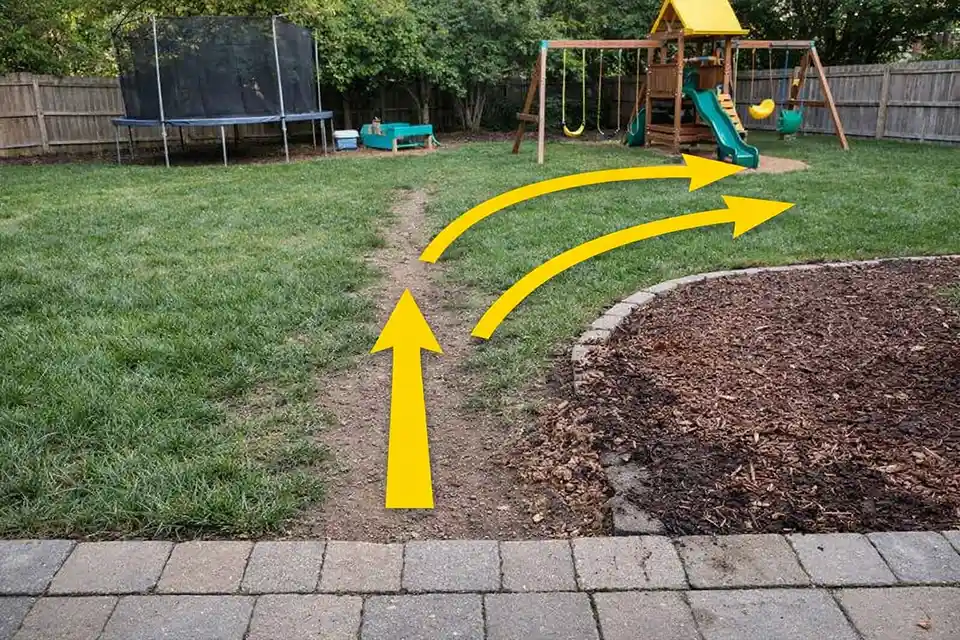
A lawn corner, bed edge, or narrow gap starts absorbing repeated traffic because it is the shortest line between two uses. This is the part families commonly underestimate. They assume the yard is wearing out because it gets used a lot. More often, it is wearing out because it gets used the same way, in the same place, every day.
Then comes surface breakdown
Once pressure builds, mulch shifts, gravel spreads, edging loosens, and the line between lawn and bed starts blurring. That is why a backyard can start feeling messy before it looks obviously damaged.
Then comes recovery failure
The ground stays wet longer, roots stay shallow, and reseeding or topping up turns into a repeating chore instead of a real fix. Families often start solving the third problem first because it is the one they can see. But if the route is still wrong, the repair is temporary by design.
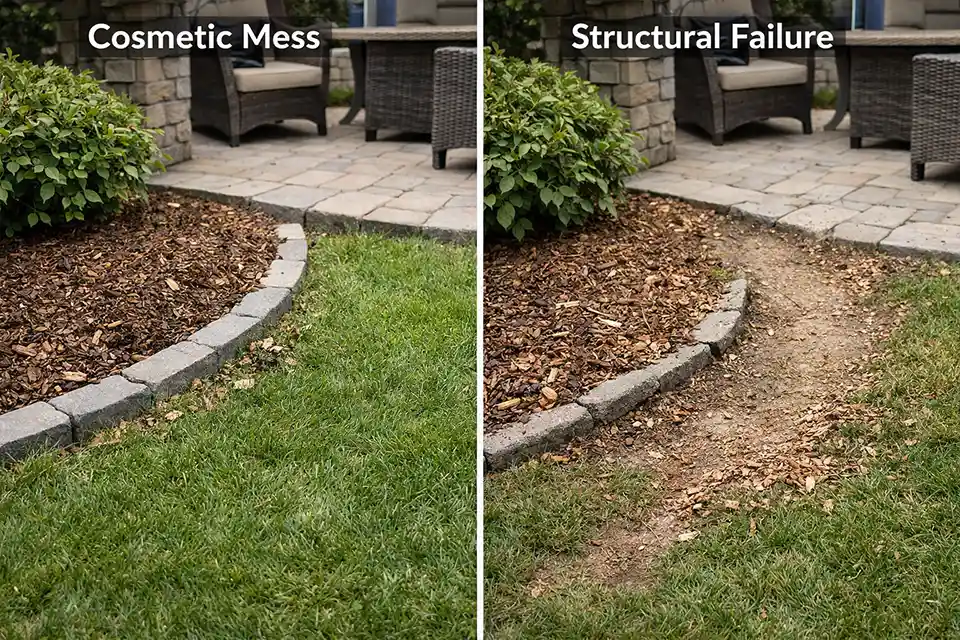
The more useful distinction is between a cosmetic mess and a structural-use problem. A little mulch spill after a busy weekend is cosmetic. A bed edge that needs sweeping, reshaping, or re-mulching every 1 to 2 weeks is not. A worn lawn patch after a birthday party is cosmetic. A route that stays thin, slick, and compacted through most of the season is not.
| Failure pattern | What families notice first | What is actually causing it | When the routine fix stops making sense |
|---|---|---|---|
| Bare strip through lawn | “Grass won’t grow here” | Repeated traffic and shallow compaction | After reseeding fails twice in one year |
| Mulch on patio or grass | “This bed always looks messy” | Loose material beside a daily route | When cleanup is needed every 1 to 2 weeks |
| Mud near play equipment | “It gets slippery after rain” | Compacted soil and slow drying | When the area stays soft longer than 24 hours |
| Flattened edge plants | “Kids keep stepping on them” | Beds placed inside circulation lines | When plants need replacing every season |
| Bike or toy cut-through at lawn corner | “That corner always gets ruined” | Shortcut pressure at a turning point | When the worn area keeps widening each month |
What people often overestimate here is plant toughness. What they underestimate is movement logic. A tougher plant at the wrong corner still gets hit. A better route usually solves more than a harder-wearing planting scheme.
What Families Commonly Overdesign
A lot of family backyards are not underbuilt. They are overdesigned in the wrong places.
Narrow decorative zones fail fast
Narrow planting strips beside patios look neat early but fail fast when kids cut corners, chairs get dragged back, or toys spill outward. Loose mulch near play zones reads as soft and family-friendly, but it rarely stays contained where running and turning happen daily.
Crisp edges are often a trap
Decorative edging around lawn pockets can look finished on installation day and become one more thing to reset by midsummer. The problem is not that family yards need to be plain. The problem is that they need to be readable under pressure. When every zone is visually soft and every boundary is easy to cross, the yard creates its own shortcuts.
This is also where some “low-maintenance” ideas disappoint. A gravel detail that behaves reasonably in a quiet side bed can become a constant sweep-and-reset issue beside a play route or seating edge, which is why backyard gravel maintenance problems often show up sooner in high-use homes.
The Fix Order That Actually Works
For busy family homes, the most effective repair sequence is usually simple.
1. Harden the route
If a patio exits straight into a lawn corner, give that transition a durable surface first. It does not need to be elaborate. It does need to acknowledge how people actually move. If the household uses a 30-inch corridor every day, pretending it is still decorative lawn usually creates more work, not less.
2. Pull planting away from the route
A play area should not bleed directly into a mulch bed. A side-gate shortcut should not pass within inches of a fragile edge planting. Decorative borders can survive in family yards, but not where daily movement wants to cut through them.
3. Only then repair the lawn or bed
This is the point many people miss. They compare one redesign move against one bag of seed or mulch. The real comparison is one redesign move against two or three seasons of repeated patching. The lawn repair is not the first fix. It is the finishing fix after pressure has been redirected.
Pro Tip: In family backyards, the first durable upgrade should usually go at the patio exit or side-gate cut-through, not in the middle of the lawn. That is where failure starts fastest.
A lot of the same logic appears in backyard zoning mistakes that kill outdoor flow, where circulation failure quietly creates maintenance problems long before the yard looks obviously wrong.
When It Stops Being a Lawn Problem
A busy backyard does not become a drainage article just because a wet patch exists. But there is a point where family wear and drainage stop being separate issues.
Soft ground after rain is not normal forever
If the busiest route also sits in a shallow low area, or if the surface remains tacky a full day after rain, water is now part of the mechanism. Once that happens, better circulation alone may not be enough. The yard may need grade correction, a firmer base, or a shift away from soft surface use in that strip.
This is where homeowners often lose time. They keep treating the spot like ordinary family wear because the damage first appeared as traffic thinning. But persistent softness is not normal once it lasts past 24 hours. That is no longer just use pressure. It is use pressure plus poor drying or poor drainage.
Pets often intensify the same route
Families sometimes assume the dog is causing a separate issue when the dog is simply reinforcing the same fast route the kids already created. That overlap is one reason backyard landscaping problems caused by pets often stack directly on top of family-use wear.
What a Family-Proof Backyard Usually Gets Right
The backyards that hold up best in busy homes usually do three things better than the rest.
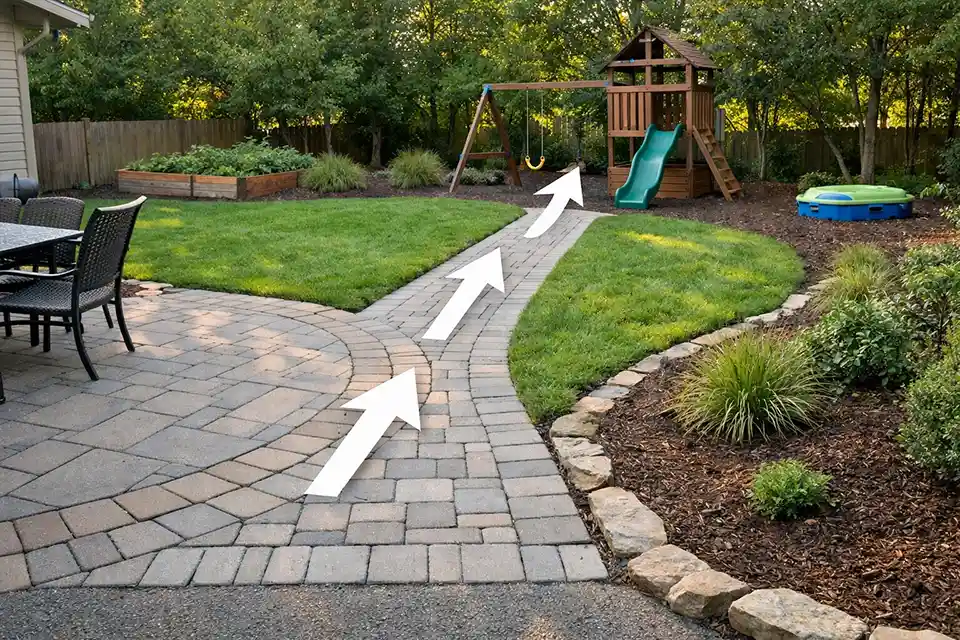
They protect routes before they protect beds
They give daily movement a durable line before trying to preserve decorative lawn or delicate planting at pressure points.
They reduce fragile details where impact is predictable
They keep loose materials away from fast-turning corners and avoid treating every edge like a decorative line that must stay crisp under daily use.
They stop asking one surface to do three jobs
A lawn can work in a family backyard when it is used as lawn. It usually fails when it is asked to be the main walkway, the turning zone, and the wettest part of the yard all at once. A mulch bed can still work when it sits outside the traffic line. It fails when it doubles as the shoulder of a daily route.
That is also why some backyards seem to deteriorate much faster than expected. They were never designed around the way the household actually moves, which is part of what makes backyard landscaping problems that get worse over time so common in real family use.
Busy family backyards do not need to look stripped down. They need to make the durable choice at the pressure points first. Once those are right, the rest of the yard usually becomes easier to keep attractive.
For a broader landscape planning guide, see the University of Maryland Extension’s Landscape Planning.