Last updated: June 19, 2026
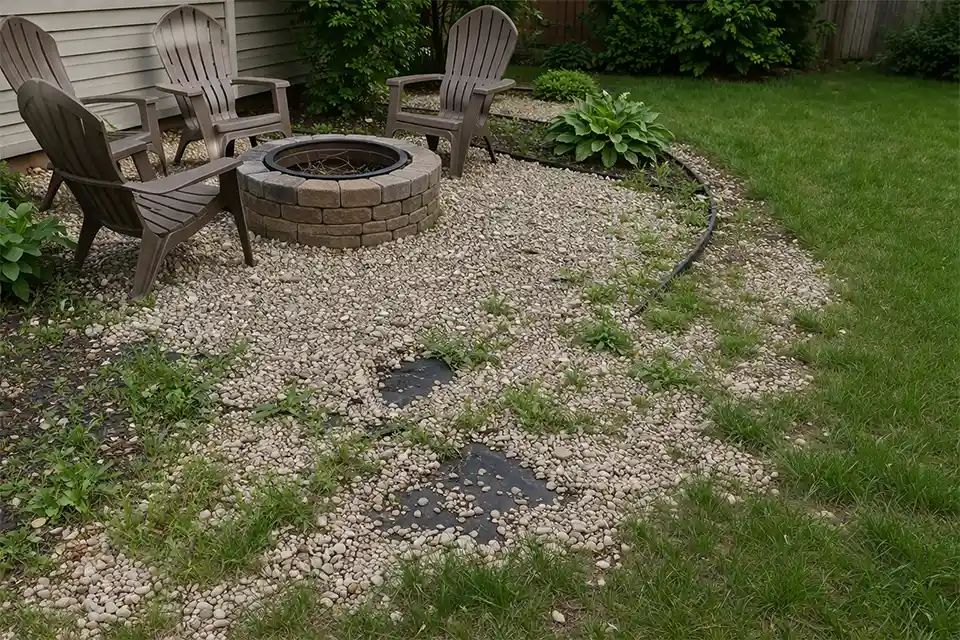
Gravel usually stops being low-maintenance for one predictable reason: the surface slowly turns into a debris-holding layer instead of staying open stone. That change starts earlier than most people think. The first checks are practical. Measure the gravel depth in the busiest spots.
If it is under about 2 inches, the surface will start exposing fabric, shifting underfoot, and letting weeds anchor more easily. Watch how long water sits after rain. If shallow puddles are still there after 24 hours, the problem is not just appearance.
Then check the edges. If stone is regularly showing up 12 to 24 inches into the lawn or beds, the border detail is already losing control.
That is different from a gravel area that only needs seasonal cleanup. A few windblown weeds or minor stone scatter after mowing are normal; repeated top-offs, recurring ruts, and wet patches are signs that the problem is underneath the surface, not in the gravel alone.
What people usually misread first
Most homeowners blame weeds first because weeds are what they can see. The more useful question is why weeds are able to establish there at all.
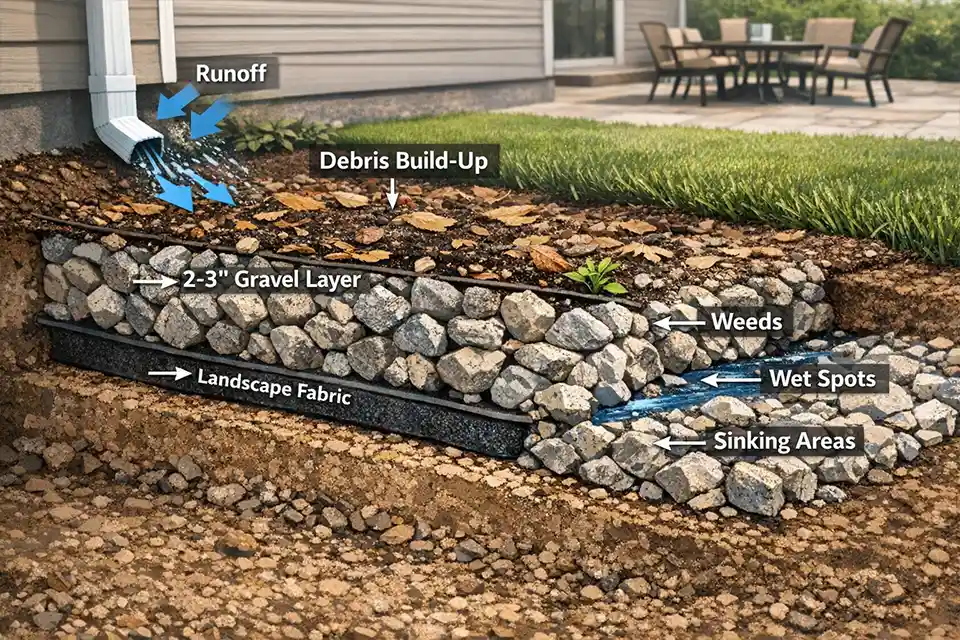
In many backyards, the real problem is surface contamination. Leaves, grass clippings, dust, and small bits of mulch settle into the gravel over time, especially where trees overhang the space or lawn borders sit right beside it.
Once that layer of fines builds up, weed seeds are no longer landing on loose stone. They are landing in something that behaves more like shallow soil.
That is why a gravel area can look clean in year one, stay manageable in year two, and then suddenly become irritating by year three.
The second thing people misread is fabric exposure. They often treat visible weed barrier as a sign that more gravel is all the area needs.
Sometimes that is true, but exposed fabric more often shows that the surface has been displaced repeatedly by foot traffic, runoff, carts, pets, or mower passes along the edge.
That same pattern shows up when front-yard gravel and rock keep spreading into lawn because the issue is rarely the rock alone. It is usually weak separation between the gravel zone and everything around it.
The hidden maintenance problems that show up later
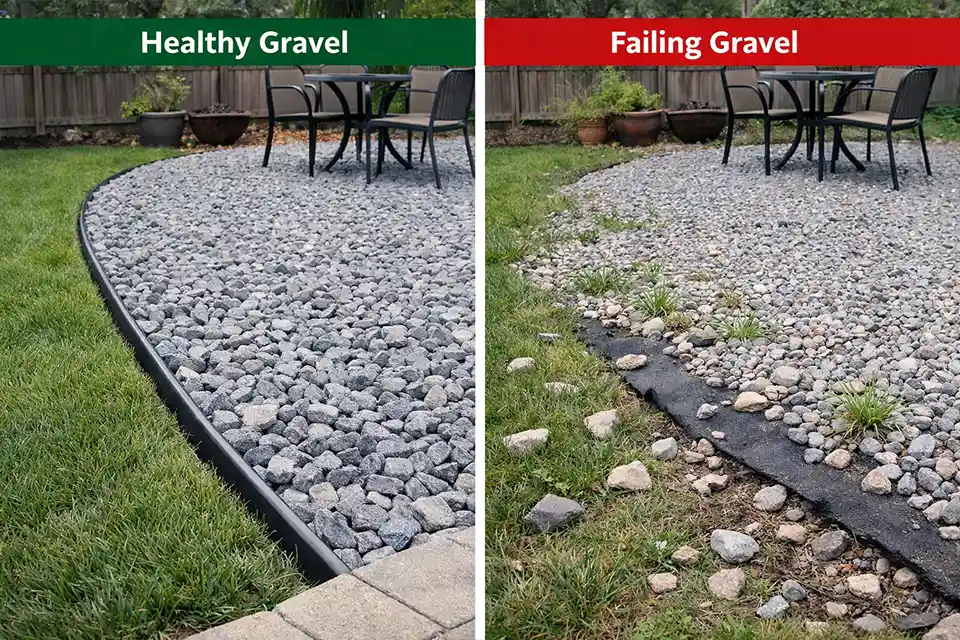
The biggest long-term problem is not usually dramatic washout. It is repeated minor correction. Gravel gets raked back into place. Then it spreads again. Weeds get pulled. Then they return because the surface is holding organic matter.
A fresh layer gets added. Then that new layer blends into the dirty surface below and the improvement disappears in a few weeks.
This is why “just add more gravel” often wastes time. If the surface layer is already contaminated, adding another half-inch to 1 inch does not restore performance. It mostly hides the problem.
The same thing happens when people lay fresh fabric over old gravel without clearing out the sediment first. That sounds efficient, but it tends to trap debris between layers and makes later repairs more annoying, not less.
What readers usually underestimate is traffic. Decorative gravel in a low-use corner behaves very differently from gravel around a fire pit, grill, gate, shed path, or play area. If the space gets daily foot traffic, a lightweight decorative stone starts shifting much faster than the photos on install day suggest.
That broader mismatch is one reason low-maintenance backyards become high-maintenance after a few seasons.
A quick diagnostic checklist that actually helps
Use this before buying more stone or new fabric.
Quick Diagnostic Checklist
- Gravel depth is under 2 inches in the most-used sections
- Water stays on the surface longer than 24 hours after ordinary rain
- The same depressions return after raking within 2 to 4 weeks
- Exposed fabric appears in more than a few isolated hand-sized spots
- Gravel has migrated more than 1 foot beyond the intended border
- Weed growth is widespread across the top layer rather than just at seams or edges
If you check three or more of those boxes, you are probably past the point where cosmetic touch-ups are the smart fix.
A useful threshold here is frequency. If the same section needs re-raking, spot weeding, or edge cleanup more than three times in one growing season, treat it as a system problem rather than routine maintenance.
When the cleanup keeps coming from the same lawn edge, this gravel containment guide can help you decide whether edging, a wider border, or a stabilizer grid is the better fix.
Why some backyards fail faster than others
Backyard gravel does not age evenly. The environmental context matters more than many install guides admit.
In humid climates, especially where summer growth is fast and debris stays damp, the surface layer gets dirty sooner and weed pressure rises sooner. In dry desert conditions, wind movement and fine dust can be the bigger issue.
In northern states, freeze-thaw cycles can lift edges, shift stone into low spots, and expose fabric faster by late winter or early spring.
Slope matters too, but not always in the obvious way. A gentle grade of 3% to 5% can be enough to create repeat movement if runoff concentrates through one route. Homeowners tend to overestimate steepness and underestimate water concentration.
A modest slope with a bad discharge point is often more destructive than a steeper area that drains broadly and evenly.
That is why gravel failures often overlap with the same logic behind sloped backyard drainage and erosion problems. The visible symptom may be stone movement, but the repair decision usually depends on water path, not just surface material.
When the standard fix stops making sense
There is a point where patching becomes the expensive option, even if each patch looks cheap by itself.
| Condition | Light maintenance still makes sense | Rebuild is usually the better call |
|---|---|---|
| Gravel depth | Mostly 2 to 3 inches, with a few thin spots | Large areas under 2 inches |
| Water behavior | Surface dries within several hours to a day | Wet spots persist beyond 24 hours |
| Weed pattern | Occasional seedlings after cleanup | Broad regrowth across the top layer |
| Surface stability | Minor texture changes after use | Ruts deeper than 1 inch keep returning |
| Edge control | Small scatter after mowing | Constant migration into lawn or beds |
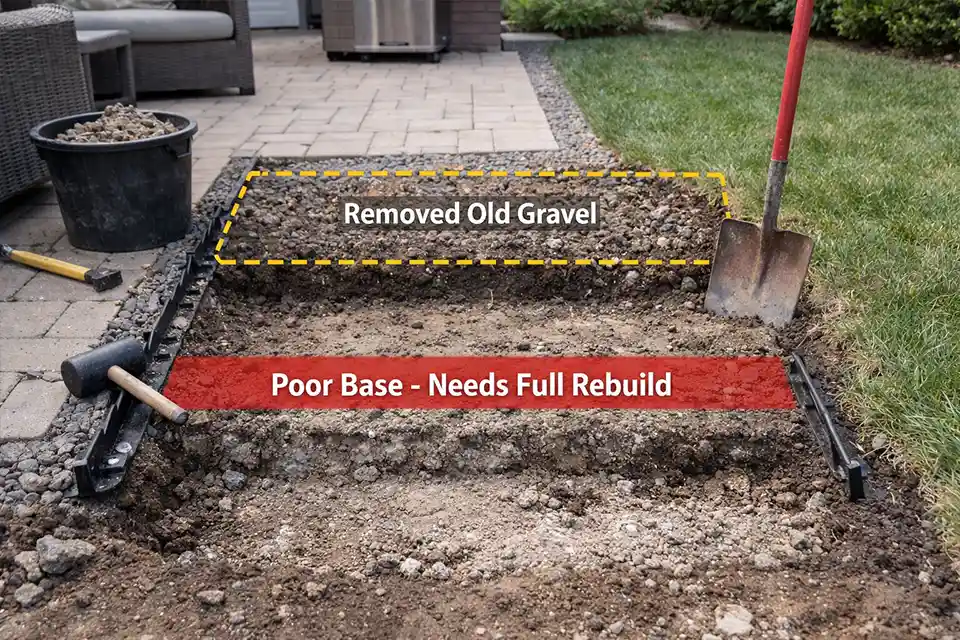
A practical replacement boundary is when roughly 25% to 30% of the area is thin, contaminated, unstable, or repeatedly wet. Below that, selective repair may still be worth it. Beyond that, partial rebuilds usually start blending into one another until you have done the same work in pieces.
One thing that gets missed in real yards is the edge. People spend money on new gravel before they fix the border that is letting it escape. If the edge keeps flexing, sinking, or allowing mower wheels to kick stone out, the surface will never stay clean for long.
Similar edge failure is why front-yard edging keeps shifting turns into a maintenance problem long before it looks like a structural one.
Pro Tip: If a downspout empties within about 6 to 10 feet of the gravel area, deal with that water first. Extending runoff away often improves gravel performance more than a fresh top-off.
What actually changes the outcome
The right repair sequence is less glamorous than most gravel makeovers, but it works better.
First, remove the contaminated top layer in the sections that are failing, not just the visible weeds. If the gravel is full of fines, it is no longer performing as gravel.
Second, correct the water source. That may mean redirecting downspouts, flattening a runoff track, or changing how one section drains into another. Third, reset or strengthen edging so the gravel has a real stopping point. Only then does adding or replacing stone make sense.
For active backyard zones, angular gravel usually performs better than rounded decorative gravel because it locks together more effectively under foot traffic.
Decorative gravel still has a place, but it belongs in low-use areas. That distinction is easy to ignore when planning a clean-looking yard, which is part of why costly backyard landscaping mistakes often show up as maintenance headaches instead of obvious design failures.
The bottom line is simple: a gravel surface fails when it starts holding debris, moisture, and movement stress instead of staying open and stable.
If the base stays firm, the surface stays open, and the edges stay controlled, gravel can remain fairly low-maintenance. If those conditions are gone, casual top-offs will not bring it back.
For a more detailed breakdown of when landscape fabric helps and when it creates new problems, see Penn State Extension.