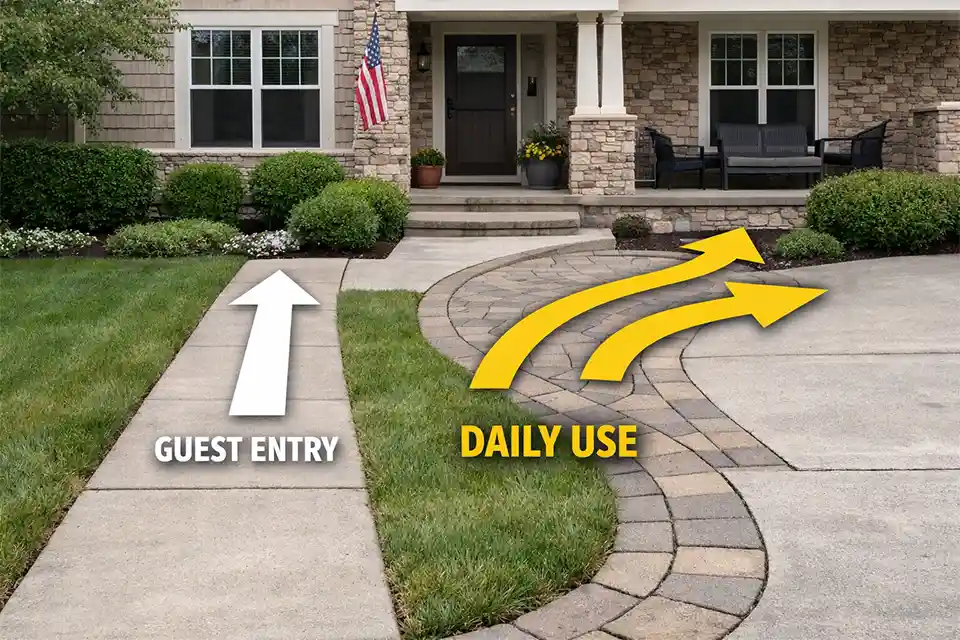
Last updated: April 18, 2026
When a front yard needs more than one path, the biggest problem is usually not square footage. It is hierarchy. One route reads instantly, the other gets ignored, and the yard starts behaving like a shortcut network instead of an entry.
The first checks are practical: can a visitor identify the front door within about 3 to 5 seconds from the curb, does the main walk stay at least 36 inches wide at true usable pinch points, and does the driveway-to-door route force people through door-swing zones or across planting edges? Those answers matter more than style.
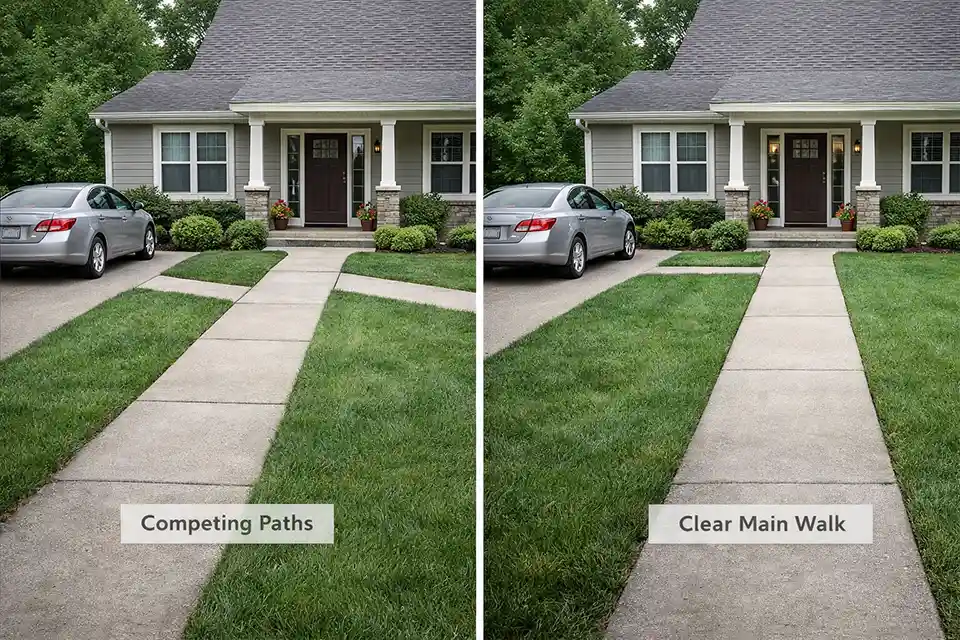
This is also different from a simple “my walkway feels awkward” problem. A single crooked walk can still look intentional. Two necessary paths that carry equal visual weight usually create something worse: hesitation. That hesitation is the symptom. The mechanism underneath it is unclear priority between arrival routes.
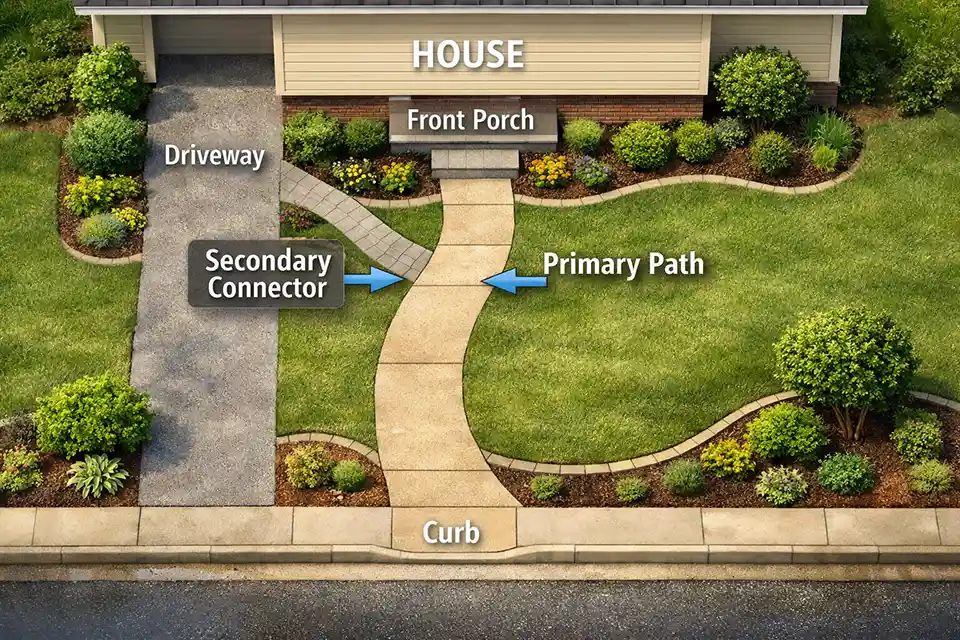
A good fix starts by naming the primary path. In most front yards, that should be the route a guest would naturally take from the street or sidewalk. The secondary path, usually from the driveway, should support that route without visually competing with it.
Quick Diagnostic Checklist
- The front door should be readable from the street in 3 to 5 seconds, even with one or two cars parked in the driveway.
- The main entry walk should hold 42 to 48 inches of clear width when the yard has regular guest use; 36 inches is workable, but it starts feeling tight quickly.
- A driveway connector can often be narrower at 30 to 36 inches without feeling undersized.
- Leave at least 24 inches between path edges and woody shrubs, or that usable width will shrink within one growing season.
- If people start cutting across mulch or lawn after 2 to 4 weeks of normal use, the routing is wrong even if the paving looks balanced.
- Standing water that remains more than 24 hours after a normal rain event points to a grading or junction problem, not a decoration problem.
What People Usually Misread First
Most homeowners overestimate symmetry and underestimate behavior. On paper, two matching paths can look polished. On site, people do not read them as composition. They read them as convenience.
They are carrying groceries, stepping around a parked SUV, walking in wet weather, or moving quickly after dark. The path that feels easier becomes the real front entrance, whether you intended it or not.
That is why the obvious fix often wastes time: adding another path to “improve access.” Access and clarity are not the same thing. In many yards, the extra strip of paving simply creates a second decision point near the porch, then leaves you with thin lawn scraps, awkward edging, and more maintenance.
This gets even more obvious on houses where the front door is partly concealed by the garage mass or by a recessed porch. In those layouts, a better reference is the entry-read problem behind Front Yard Landscaping Ideas for a Driveway and Hidden Front Entrance, where visibility matters more than decorative balance.
Another thing people get wrong is width. A path that measures 36 inches on installation day is not functionally 36 inches once plants lean in 4 to 6 inches, edging drifts, or snow storage narrows the route in colder states. The installed number is not the same as the lived number.
The Layout Rule That Usually Solves It
The most reliable front-yard layouts use a 1-primary, 1-secondary system. The primary walk handles guest arrival and visual direction. The secondary walk handles convenience from parking. They should not look equally important because they are not doing equally important jobs.
In practice, that means the driveway connector should usually branch into the main walk rather than race it. Let it join the front walk before the porch, not arrive as a rival route at the same destination line. If both paths hit the porch edge independently, the entry almost always feels busier than it needs to.
That distinction matters on offset-entry homes too. When the driveway is the easiest daily approach, the front yard can quietly train everyone to ignore the formal entrance.
The better layouts solve that by letting the driveway route feed the main sequence instead of replacing it, which is the same core issue explored in Front Yard Walkway Design for an Offset Front Door and Driveway.
| Decision Point | Healthier Condition | Failing Condition | Why It Changes the Outcome |
|---|---|---|---|
| Path hierarchy | Main walk reads first from curb | Both paths look equally important | Visitors hesitate and default to convenience |
| Width relationship | Main walk 42–48 in., connector 30–36 in. | Both paths same width throughout | No visual cue for primary arrival |
| Join location | Secondary path merges before porch | Two routes collide at porch edge | Entry feels cramped and overbuilt |
| Door visibility | Door remains legible above planting or beside parked cars | Door disappears behind garage mass, shrubs, or columns | Driveway route becomes the de facto entrance |
| Drainage at junction | Water clears within hours and sheds off path | Water collects for more than 24 hours | Surface failure starts at the meeting point |
If access and screening need to work together, tall planters for driveway privacy can be one of the easier solutions to fit in.
Where the Real Problems Usually Start
Material is rarely the first issue. Route conflict is. Three conflicts show up over and over.
The first is parked-car conflict. If an opened car door pushes into the walking line, the connector is too close to the active parking zone.
A useful rule is to keep the main walking track about 24 inches away from the likely door-swing edge or separate it with a planting strip, curb band, or grade change.
The second is maintenance conflict. Small wedges of turf trapped between two paths look precise on a plan and become annoying almost immediately.
If mowing and edging require tight corrections every 6 to 8 feet, the design is already too fragmented. People often underestimate how fast those leftover shapes make a clean front yard feel messy.
The third is drainage conflict. When the driveway surface and the walkway both push water into one low meeting point, the problem does not stay cosmetic for long. On a 2 to 5 percent front-yard grade, even a minor misread in cross-slope can send runoff across the walking line instead of off it.
That is why some oversized paved approaches create more trouble than they solve, especially in layouts that already struggle with scale, like Front Yard Design with a Large Driveway.
When the Standard Fix Stops Making Sense
There is a point where trying to preserve two fully separate, elegant-looking paths becomes the mistake. If the space between driveway edge and main walk is under about 5 feet across most of the front yard, separate routes often create narrow leftover strips that never look settled.
At that point, a shared landing or a widened transition zone usually works better than forcing two independent runs.
The same limit shows up at the porch. If the landing depth is under 6 feet, multiple arrivals stacked into that space tend to feel crowded. Readers often overestimate how much a porch can absorb.
They underestimate how quickly two path entries, a swing zone, a column base, and a planter turn into clutter.
In tight frontages, simplification matters more than ornament. That is the same reason small constrained lots usually benefit from fewer, cleaner moves rather than more expressive ones, a pattern that also shows up in Front Yard Design in Minimal Setback Space.
Lighting follows the same rule. More fixtures do not necessarily help. When two routes already compete, lighting every edge can flatten the hierarchy even further.
A stronger cue at the porch, one or two well-placed markers on the primary path, and a calmer treatment on the connector usually do more than a full row of evenly spaced lights every 6 to 8 feet.
Pro Tip: If there is already a worn shortcut through grass or mulch, trace it before redesigning anything. That line usually tells the truth about circulation faster than a sketch does.
What Ages Better
The layouts that hold up best are not the fanciest. They are the ones that make the next step obvious.
A formal main walk with a quieter driveway branch works well when the front door is clearly visible from the street and the lot has enough width to stage arrival properly.
A shared landing zone works better when the yard is compact, the driveway sits close to the porch, or two separate path lines would leave hard-to-maintain scraps of lawn and edging.
A lightly screened connector works best when the driveway route is necessary for everyday life but should not define curb appeal. Sometimes a 6- to 12-inch grade shift, a low hedge, or a short fence return is enough to keep convenience while protecting the main entry sequence.
The useful test is not whether both paths look attractive in a rendering. It is whether a first-time visitor and a tired homeowner make the same directional choice without thinking. When that happens, the design is finally doing its job.
For broader official guidance on accessible route width, slope, and surface basics, see the U.S. Access Board ADA accessible routes guide.