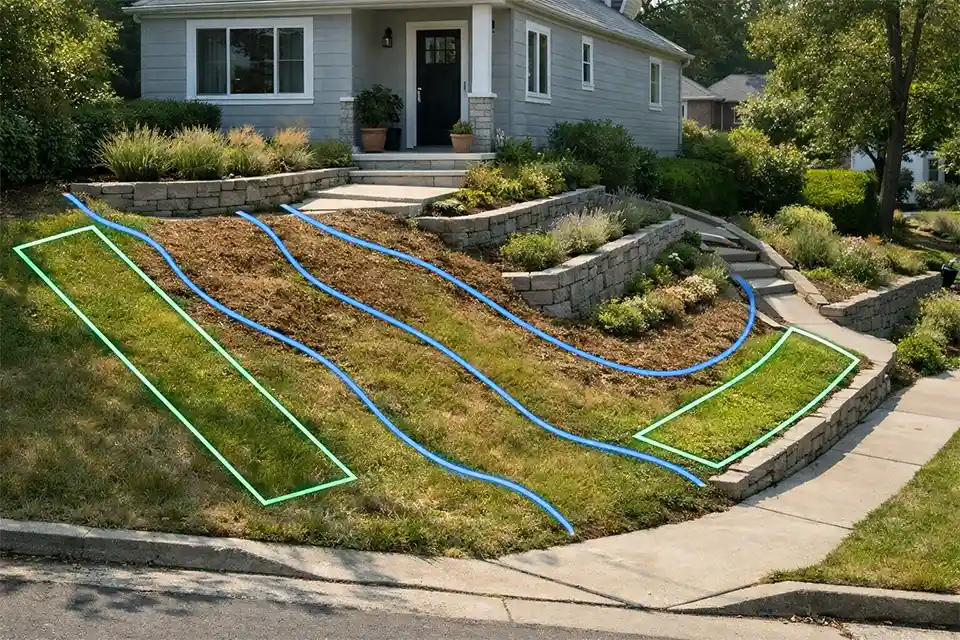
A steep front yard becomes hard to design the moment grade starts limiting safe access, stable planting, and usable flat space. Once the slope moves past roughly 15% to 20%—about 18 to 24 inches of drop over 10 feet—flat-yard ideas begin to break down.
The first checks are more useful than inspiration photos: how much elevation changes in the first 15 to 20 feet, whether runoff reaches the sidewalk in less than 5 minutes during hard rain, and whether mulch, gravel, or topsoil already shifts after storms.
Those signs tell you whether the problem is mainly visual or already structural. A steep slope can look like a small-space design issue, but it is usually a drainage, access, and stability issue first. That distinction matters because the wrong layout does not just look off. It erodes faster, costs more to maintain, and often becomes harder to use within a single wet season.
Quick Diagnostic Checklist
If three or more of these are true, design freedom is already tighter than most homeowners realize:
-
The yard drops more than 24 inches within 10 to 12 feet
-
The only level area near the entry is less than 5 feet deep
-
Water collects at the bottom for more than 24 hours after rain
-
Mulch or loose stone shifts downhill more than once each season
-
Mowing requires side-hill turns that feel unstable when the grass is damp
-
The front walk slopes sideways enough to feel awkward underfoot
-
Bare soil keeps reappearing on the same part of the slope
Those are not cosmetic annoyances. They are site limits.
What People Usually Misread First
The first mistake is assuming steep yards mainly need different plants. They do need tougher plant choices, but that is not the main bottleneck. The bigger limit is usable geometry. If most of the front yard is tilted, then the site does not really have one large landscape area. It has a few narrow bands that can hold planting, walking, or visual structure without constantly shedding water or material.
The second mistake is overestimating what added soil can fix. Bringing in 4 to 8 inches of soil may improve planting depth, but it does not create a stable flat plane on a steep grade. On exposed slopes, especially in places with intense summer storms such as parts of Florida or the Southeast, that extra soil can move quickly unless roots, edging, and water interception are already doing their jobs. Homeowners often think the soil failed. More often, the layout failed first.
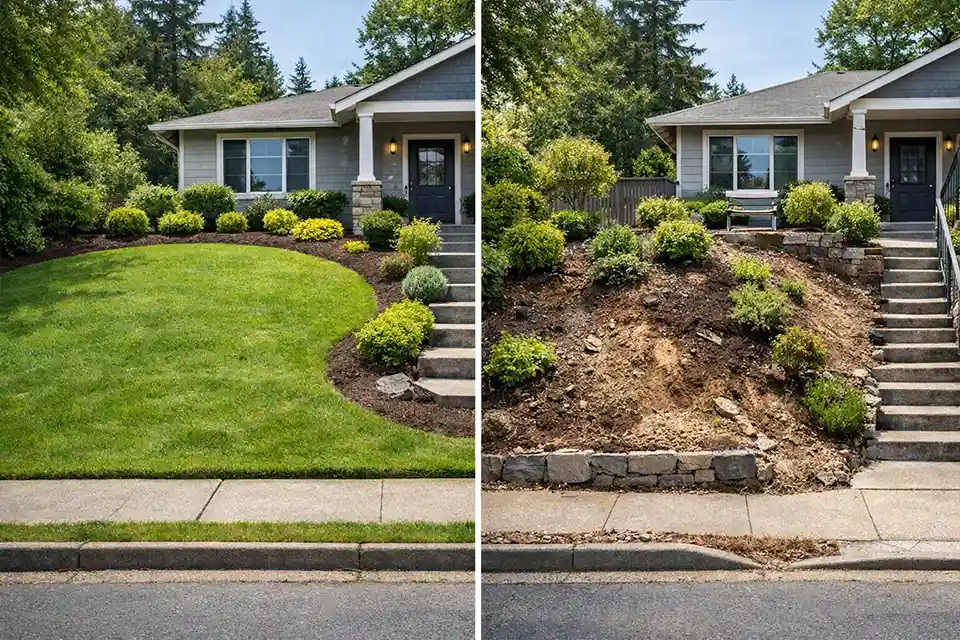
That is why the best reference point is not a generic curb-appeal article. It is a slope-specific one. Front Yard Landscaping Ideas for Sloped Yards becomes useful only when the design accepts that the whole yard will not behave like one flat canvas.
Why the Obvious Layout Fails
A central lawn is often the wrong anchor
On a steep front yard, the classic formula—lawn in the middle, flower beds at the edges, mulch everywhere else—usually creates maintenance without control. The lawn is hard to mow, the beds dry out at the top and stay wetter at the bottom, and loose materials start migrating downhill. It can look acceptable right after installation, then noticeably worse within 6 to 12 months.
That is one point people commonly underestimate: lawn is not neutral. On steep ground, it is often the most demanding and least forgiving surface in the design.
Decorative edging does not stop a grade problem
Another common waste of time is trying to stabilize the slope with border materials alone. Lightweight edging, shallow metal strip, or basic block borders may hold a bed line visually, but they do not solve runoff velocity or soil movement. If mulch already slides after storms, the problem is not just the mulch. It is the unbroken slope length and the lack of interception. That same pattern shows up in Front Yard Mulch Washes Away Every Season, where the visible failure is surface movement but the underlying issue is uncontrolled water.
One big retaining move is not always smarter
People also overestimate the value of a single dramatic retaining wall. A wall under 18 inches can help define grade changes. Once you are trying to hold 24 to 36 inches or more in one move near a walkway or driveway, the project stops being decorative. It becomes a structural choice with drainage, base prep, and long-term pressure behind it. In many front yards, two or three smaller grade breaks are more forgiving than one large hold.
Pro Tip: When a slope is visually overwhelming, the best design move is often to shorten it, not hide it.
The Design Moves That Actually Change the Outcome
Create one reliable flat zone near the entry
If the site gives you only one dependable landing, protect it. A level area 5 to 8 feet deep near the front door or porch is usually more valuable than trying to flatten scattered pockets across the whole yard. That landing becomes the visual anchor, the safer access point, and the place for detail planting people actually experience up close.
This is where many steep front yards improve fastest. Not because the whole slope disappears, but because the design stops pretending every square foot must serve the same role.
Break the slope into shorter runs
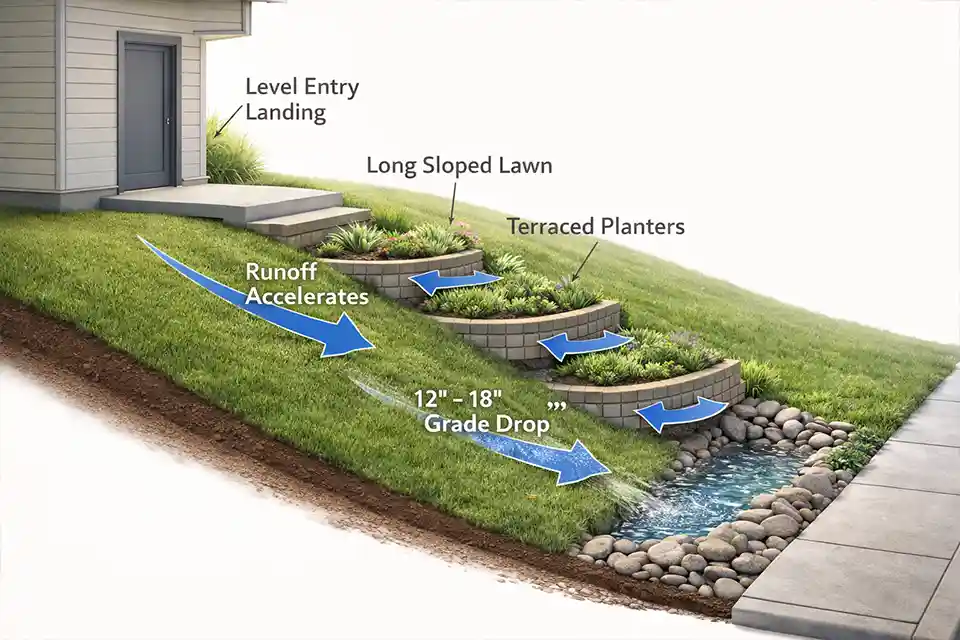
Long uninterrupted slopes build speed. Water moves faster, mulch travels farther, and maintenance gets concentrated in the same weak spots. Breaking the yard into shorter vertical intervals—often 12 to 18 inches at a time—usually performs better than allowing one continuous descent from house to sidewalk.
In cold northern states, this matters even more because freeze-thaw cycles can loosen shallow edging and shift loose material downslope over winter. A shorter run gives you more control points and fewer long failure paths.
Use planted mass where lawn used to fight the site
Steep front yards are usually more stable when lawn becomes smaller and planting becomes more structural. Dense shrub groupings, fibrous-rooted groundcovers, and repeated contour planting bands hold soil better than a broad open lawn that needs frequent mowing. The point is not to stuff the hill with random plants. It is to replace a weak surface with a stronger one.
If the slope also carries water from higher parts of the lot, then Sloped Front Yard Landscaping Problems and Drainage Issues is the more relevant model than a typical design-ideas piece.
Keep circulation simpler than you think
A steep front yard punishes over-designed paths. Curves, narrow transitions, and decorative detours can look elegant on paper but feel awkward on a hill. A direct path with controlled grade transitions usually ages better. If the walkway cross-slope feels noticeable in wet weather, that is not a minor comfort issue. It is a sign that circulation needs to be reworked before more planting is added around it.
When a Design Problem Is Really a Drainage Problem
A steep front yard becomes a drainage-first project when water behavior starts overruling layout choices. Three signals matter most.
The bottom of the slope stays wet too long
If the lower yard stays soft for 24 to 48 hours after rain, the issue is no longer just surface runoff. The outlet area may be overloaded, compacted, or poorly graded. This is where people often make the wrong call and add more plants to the wettest section, even though the site is acting like a collection basin.
Runoff is concentrated, not just present
Some water movement on a slope is normal. What is not normal is a repeat path that carves bare lines into soil, pushes mulch into the walk, or drops debris at the curb after every major storm. That is a practical threshold: once runoff chooses the same route repeatedly, the layout is no longer in charge.
Hardscape starts shifting with the slope
If steps, pavers, or landing edges begin to settle unevenly, the visible symptom is movement. The mechanism is unstable support under slope pressure or water movement. That is why Uneven or Sloped Ground? Here’s Why Your Patio Feels Unstable is still relevant here even though it is about patios. The lesson is the same: surface fixes do not hold when the grade underneath is still doing the damage.
A Better Decision Guide
| Site Condition | What It Usually Means | Best Design Response | What Usually Wastes Time |
|---|---|---|---|
| 18–24 inch drop over 10 feet | Mild to moderate design restriction | Keep one flat landing and tighten layout | Spreading beds randomly across slope |
| 24+ inch drop over 10–12 feet | Steeper slope driving layout limits | Use short terraces or planted contour bands | Treating it like a normal lawn plan |
| Water remains 24–48 hours at bottom | Drainage bottleneck below | Fix outlet and planting strategy together | Replanting the same stressed bed |
| Mulch or gravel moves every storm season | Surface materials mismatched to runoff | Reduce loose materials and intercept water | Adding more of the same material |
| Walk or landing keeps shifting | Grade support problem under hardscape | Rebuild base and control water first | Cosmetic patching at the surface |
If the yard drops more than about 24 inches over 10 feet, loose materials keep moving, and runoff repeatedly reaches the sidewalk, the layout usually needs terracing, not just better planting.
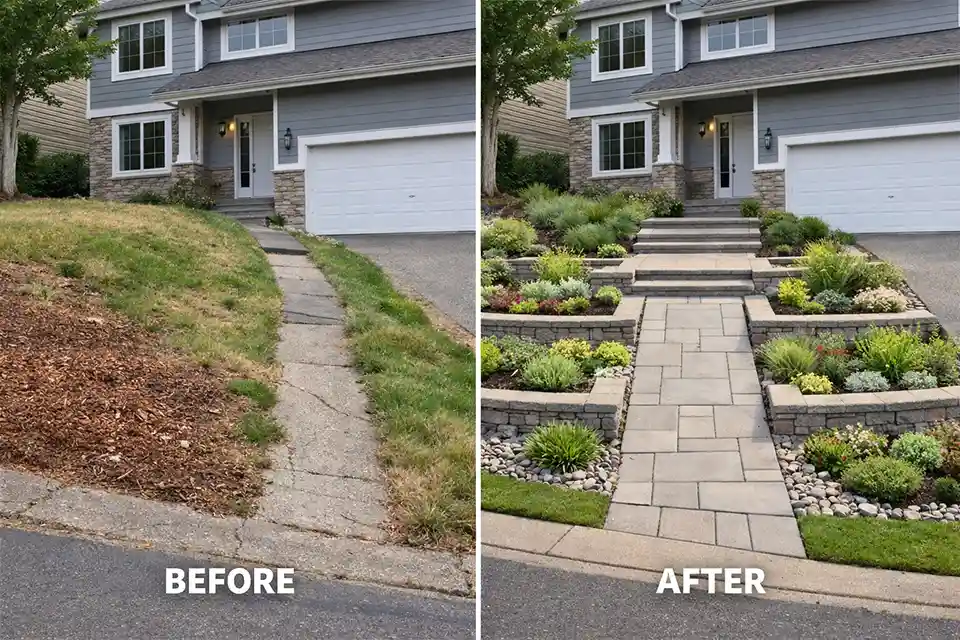
What a Successful Steep Front Yard Actually Looks Like
A good outcome here is not “flat enough.” It is stable enough, readable enough, and usable enough. The entry should feel secure in wet weather. Water should slow down instead of accelerating. Planting should stay in defined zones instead of creeping downhill. The lower yard should not act like a trap for everything washing off the upper yard.
That usually means fewer moves, not more. One clear landing. One direct path. Two or three strong planting bands. A reduced lawn, or no lawn where mowing never made sense in the first place. In practice, the best steep front yards do not hide the slope. They organize around it and stop asking it to behave like flat ground.
For broader official guidance, see Iowa State University Extension’s Gardening on Slopes and Hillsides.