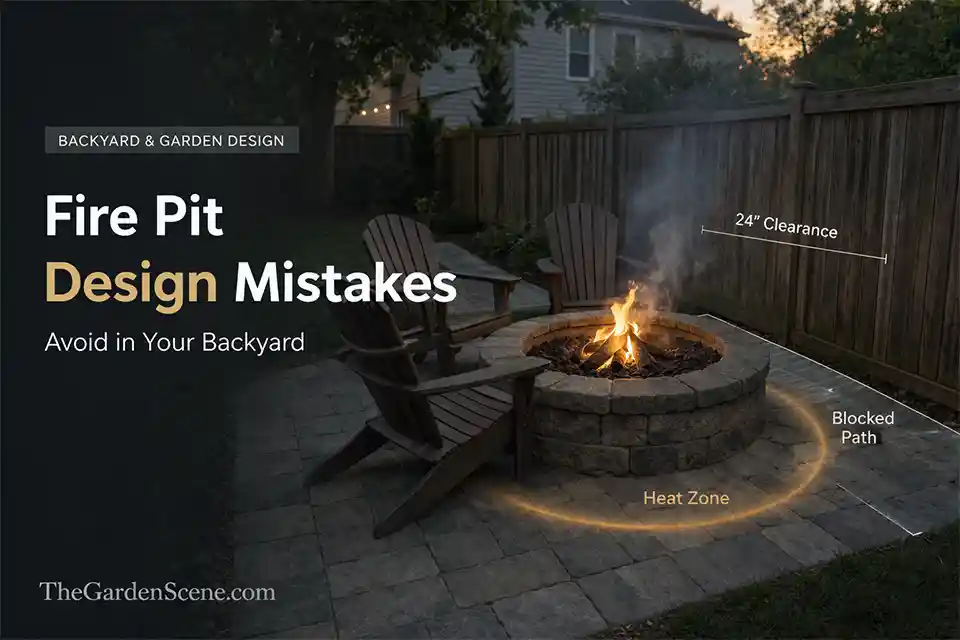
Most bad fire pit spaces are not ruined by the fire. They are ruined by the layout. The biggest failures usually happen before the first burn: the pit ends up in the wrong wind path, too close to the house or fence, too large for the patio, or dropped onto a part of the yard that never really worked for heat, seating, and movement. Those are not finishing issues. They are design mistakes that make the backyard harder to use every single time.
Three checks tell you almost everything. Keep the pit at least about 10 feet from structures and anything combustible. Pull the chairs back 18 to 24 inches and see whether a real walking path still exists behind them.
Then test the site at the time the fire pit will actually be used, usually in the evening. If smoke keeps landing in the same seats, the problem is usually placement, not fuel. If the patio already feels cramped before anyone sits down, the pit is too big, too close, or in the wrong spot.
1. Putting the Fire Pit in the Wrong Wind Path
This is one of the most common reasons a fire pit looks good on paper and feels annoying in real life.
What this mistake looks like
One side of the circle always feels hotter. Smoke keeps drifting into the same chairs. Guests keep shifting their seats during a normal burn. That is not random bad luck. It is usually a siting problem.
What people usually misread
They blame the wood, the burner, or one windy evening. More often, the pit is sitting in a repeatable air path created by the house, fence lines, or nearby structures.
A short dusk test reveals more than a midday walkthrough ever will.
2. Setting It Too Close to the House, Fence, or Low Branches
This is still the biggest mistake because it combines fire risk with layout failure.
A useful baseline
About 10 feet of clearance from walls, fences, railings, and other combustible surfaces is a strong working rule. Low branches deserve just as much attention. If limbs hang within roughly 7 feet above the heat zone, the location is too compressed.
Why this keeps causing trouble
The problem is not just flame height. It is radiant heat, drifting sparks, and repeated exposure. That is what slowly punishes fence boards, dry planting, outdoor cushions, and decorative edges. This is why Patio Design Mistakes That Create Safety and Fire Hazards overlaps so naturally with fire pit planning.
3. Choosing a Fire Pit That Is Too Large for the Patio
This is one of the easiest mistakes to make because product photos hide scale.
Why oversizing is worse than people think
A fire pit that is too large does not just look crowded. It steals space from everything around it at once. Seating gets tighter. Walkways shrink. Heat feels more concentrated. The patio starts working for the fire pit instead of the other way around.
The only test that matters
Do not judge the pit by itself. Judge the full footprint: fire pit, chairs, knees, side tables, and the path behind the seating. If all of that cannot fit without compromise, the pit is oversized.
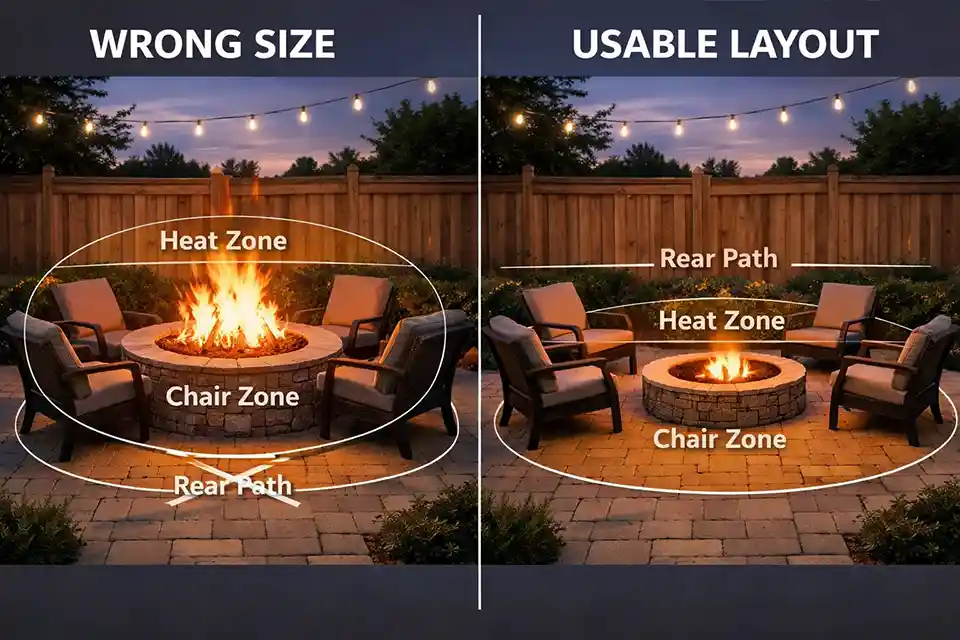
4. Making the Seating Radius Too Tight
A tight seating ring gets described as cozy. In practice, it usually means the layout was undersized from the start.
What usually works better
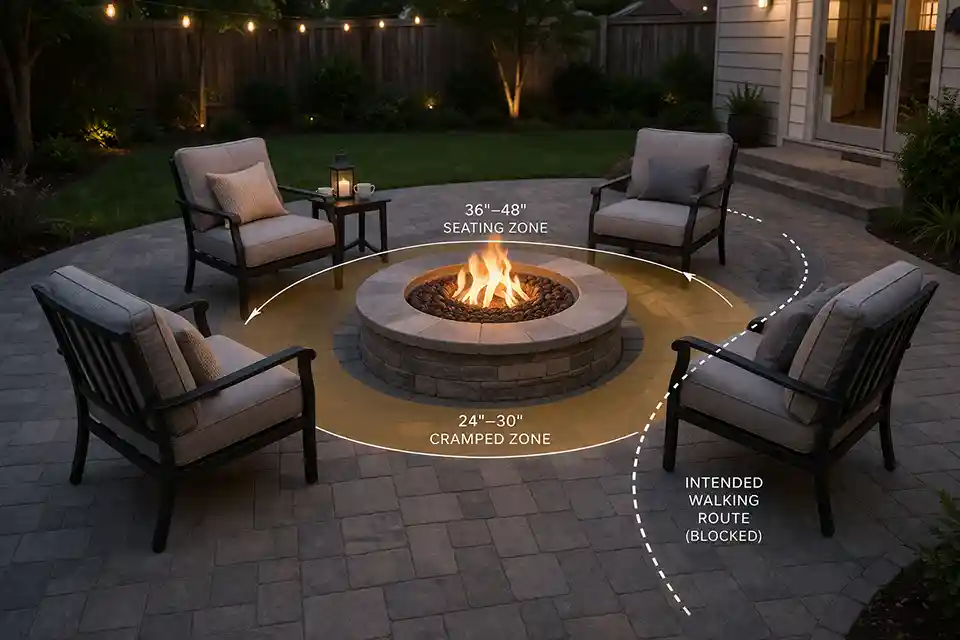
For many backyard setups, about 36 to 48 inches from the fire pit edge to the front of the chair feels more comfortable than a tighter arrangement. Around 24 to 30 inches, the space often feels too hot within 10 to 15 minutes.
The deeper failure
Heat is only the first symptom. Once chairs angle outward and people move naturally, the seating ring starts collapsing the rest of the layout. A comfort problem quickly becomes a circulation problem.
5. Blocking the Main Backyard Walking Route
This is where a fire pit stops being a feature and starts becoming a daily nuisance.
A simple way to test it
If someone has to pass between the chairs and the flame to reach the lawn, grill, gate, or back door, the pit is in the wrong place. That is not a user mistake. It is a layout mistake.
Why this gets underestimated
People imagine the yard only when everyone is seated. Real backyards also need to work when someone is carrying food, crossing after dark, cleaning up, or moving quickly with kids and pets. This is the same planning failure behind Backyard Layout Problems That Make Spaces Hard to Use, but a fire pit makes it much harder to ignore.
6. Building on a Weak Base
A fire pit area that shifts slightly is already telling you the design is underbuilt.
What early failure looks like
One edge settles about 1 inch. Chair legs stop feeling stable. Water lingers after rain. The outer ring starts looking subtly off. Those are not cosmetic flaws. They are signs the base below the visible surface is not doing its job.
The fix that usually wastes time
Adding loose gravel or leveling sand on top may improve the appearance for a while, but it rarely solves the real issue. If the sub-base is weak, poorly compacted, or exposed to runoff, the movement comes back. That is why Backyard Drainage Problems Homeowners Ignore often show up first around hardscape features.
7. Putting the Fire Pit on the Wrong Part of the Patio
This is different from a weak base. A patio can be stable and still be the wrong place for a fire pit.
Where the site quietly fails
A section that drops 2 to 3 percent across the fire pit zone may look almost level from standing height, but in use it feels off every time. Chairs rock. Tables wobble. Water tracks through the seating area. The space never quite settles.
When patching stops making sense
If the location itself fights the fire pit, fixing one low corner is usually wasted effort. At that point the smarter move is relocation, not correction. That same boundary shows up in Why an Uneven or Sloped Patio Feels Unstable.
8. Using Patio Materials That Break Down Under Heat
This is where appearance-first decisions become expensive.
What tends to fail first
Thin decorative concrete, bargain pavers, random stone choices, and moisture-trapping fill materials are usually the first to disappoint. They can look fine at the start, then crack, flake, stain, or deteriorate after repeated heat cycles.
The better rule
The materials nearest the fire should be chosen for heat tolerance first and looks second. If the product is vague about high-heat outdoor use, that uncertainty is already the warning.
9. Placing the Fire Pit Too Close to Mulch Beds, Planters, and Decor
This is one of the most common “pretty first, practical later” mistakes.
What goes wrong
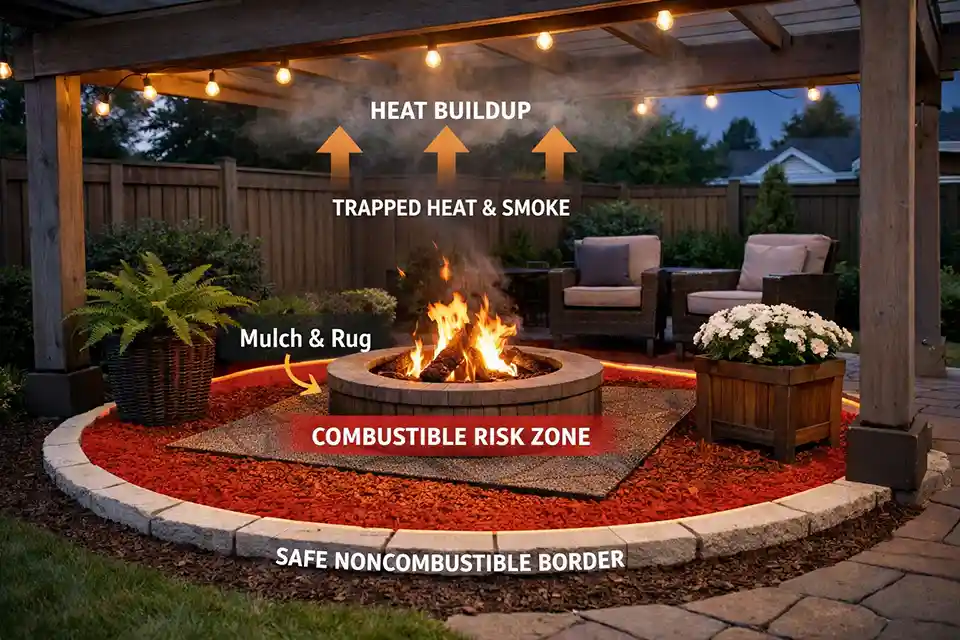
Mulch, rugs, lightweight planters, dry planting, and stacked cushions make the perimeter look finished, but they also crowd the part of the layout that needs to stay clean and manageable. The first bad decision is often not inside the bowl. It is just outside it.
What works better instead
The immediate edge should read as intentionally simple, heat-tolerant, and easy to maintain. A cleaner perimeter usually performs better than a heavily styled one.
Pro Tip: Mark the fire pit, the chair footprint, and the clean perimeter at the same time. Most failed layouts break down at the edges, not in the center.
10. Forcing a Fire Pit Into a Covered Layout
This mistake usually starts with a desire to make the patio look complete.
Why it fails
The issue is not just flame height. It is trapped heat, collected smoke, and reduced margin for anything overhead. Low pergola beams, string lights, decorative slats, and fabric details all become part of the problem.
Why the usual fix disappoints
People often try to save this layout by changing materials above the pit. That can turn into a costly distraction. If the fire pit is fundamentally too close to low cover, moving it is usually the cleaner answer.
Signs Your Fire Pit Layout Needs a Rethink
If two or more of these are true, the layout probably needs revision:
- Smoke repeatedly blows into the same seats during evening use.
- The pit sits within about 10 feet of a structure, fence, or combustible edge.
- Chairs feel cramped once they are pulled back normally.
- The main walking path through the yard cuts through the seating ring.
- The surface rocks, settles, or stays wet more than 24 hours after rain.
- Mulch, planters, rugs, or soft decor crowd the immediate heat zone.
- The fire pit sits under low cover that traps heat or smoke.
A comparison that actually helps
| Condition | Better-performing layout | Failing layout |
|---|---|---|
| Placement | Open area, tested for wind | Corner or swirl zone |
| Clearance | About 10 feet or more | Tight to fence, wall, or branches |
| Fire pit size | Fits patio without crowding | Dominates the footprint |
| Seating | 36 to 48 inches and usable | 24 to 30 inches and cramped |
| Surface | Level, stable, drains within 24 hours | Settles, puddles, or feels off |
The best fire pit layouts are rarely the most dramatic. They are the ones that still feel comfortable after 20 minutes, still drain properly after a storm, and still leave the rest of the yard usable when no fire is burning.
That broader discipline is the same reason Backyard Zoning Mistakes That Hurt Outdoor Flow matter more than they first seem.
For broader official guidance on fire pit spacing, placement, and outdoor fire safety, see the U.S. Fire Administration.