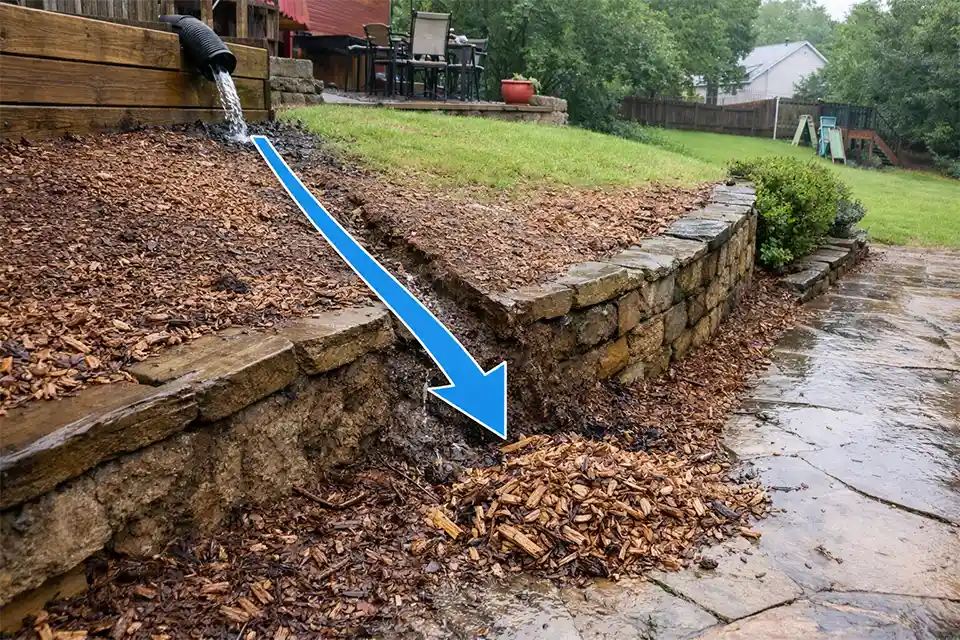
A tiered backyard on a steep slope usually fails in a repeatable order. Water gets concentrated near the top, one terrace stays wet longer than it should, the edge of that tier starts losing soil, and only after that do walls, steps, or planting beds begin to look unstable.
That sequence matters because the part that looks worst is often not the place where the problem started.
The fastest checks are also the ones that tell you the most. After a moderate rain, look for a terrace that stays dark or slick for more than 24 hours, a runoff channel deeper than about 1 to 2 inches, or a short retaining wall that looks slightly out of line from 8 to 10 feet away.
If the same strip keeps washing out after two or three storms, the issue is no longer surface-deep. A tiered slope is supposed to shorten the run of water, slow it down, and keep it from gaining force as it moves downhill.
That is the distinction that changes everything: a messy terrace is not always the first failing terrace. Before fixing anything, find where the water pattern broke.
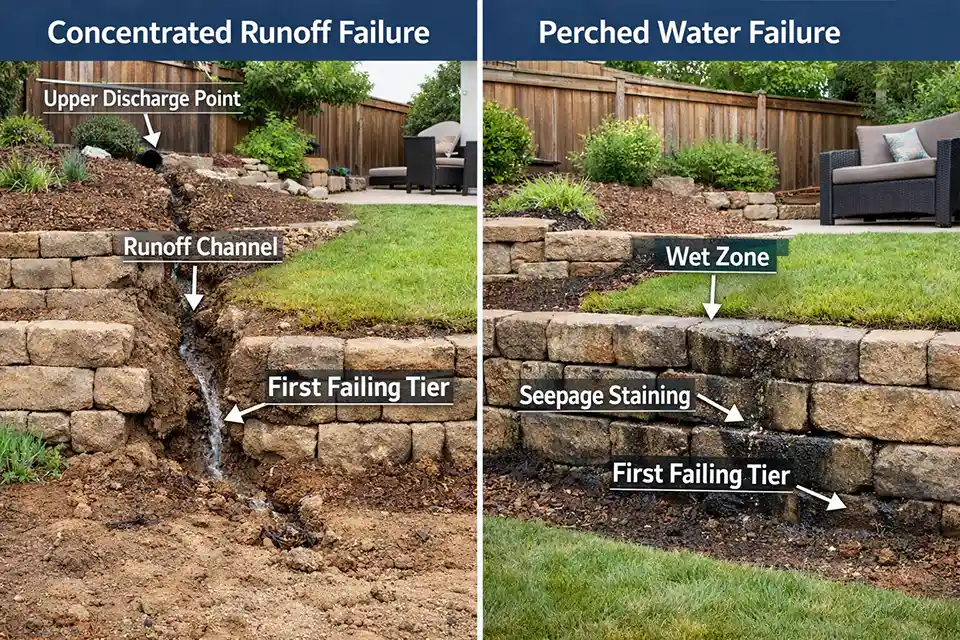
Which tiered slope problem do you actually have?
Concentrated upper-tier runoff
This is the most common failure pattern. Water from a downspout, patio edge, path, or compacted landing enters the slope at one point and turns into a narrow fast stream. The damage often appears farther downhill, which is why people keep repairing the lower terrace and getting the same result.
What it looks like: a repeating washout line, drifting mulch, exposed roots, and damage strongest directly below one entry point.
What it usually means: the upper part of the yard is sending too much water too fast into the next tier.
What to fix first: intercept or redirect the source before repairing the damaged strip.
Perched water and seepage
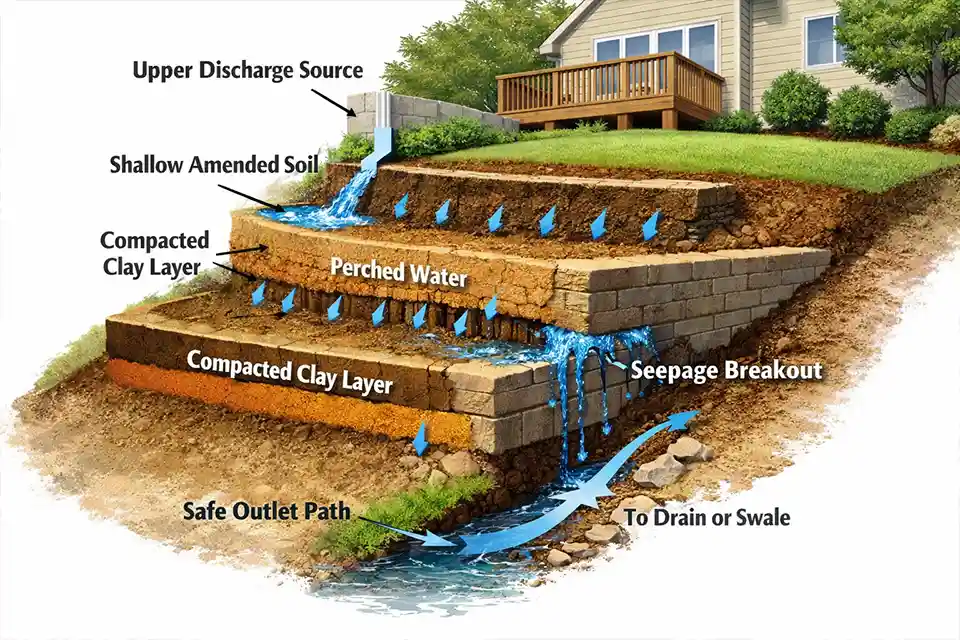
This one gets overlooked more often because the problem is not just water running across the surface. It is water moving through a shallow soil layer, hitting dense clay or compacted fill, and then breaking out at the terrace face or toe.
What it looks like: one terrace stays wet much longer than the others, the lower edge feels soft, and damp staining, algae, or moss show up near the face.
What it usually means: water is being held in the soil profile and exiting where the terrace is weakest.
What to fix first: stop adding surface-only fixes and evaluate drainage below the surface.
Toe erosion at the terrace edge
Here the front edge of a terrace starts losing support. The top may still look usable, but the downhill lip begins to unravel.
What it looks like: undercut soil, collapsing edge material, gravel or mulch collecting at the base, and softness along the lower lip.
What it usually means: the terrace is losing the support that keeps it level.
What to fix first: slow the water before it reaches the edge, then rebuild the damaged lip only after the flow path is controlled.
Stacked wall movement
This is the one people tend to underestimate. Several short retaining walls on a steep yard do not behave like separate little issues. They behave like one connected drainage-and-load system. A wall under 3 feet tall can still matter a lot if the tier above it is feeding runoff or saturated soil into it.
What it looks like: slight lean, misaligned cap blocks, widening cracks around 1/4 inch, settlement near steps, or more than one short wall showing movement over 3 to 6 months.
What it usually means: the problem has moved beyond surface erosion and into structural loading or undermining. If that pattern sounds familiar, Retaining Wall Failure Signs in a Sloped Backyard is the more useful companion read.
What to fix first: treat drainage path and wall stability as the same problem, not two separate ones.
What people usually misread first
The ugliest terrace is not always the first broken terrace
The worst-looking level often sits below the real trigger. In practice, the first failing tier is usually where water first changes behavior: from spread-out flow to concentrated flow, or from shallow infiltration to seepage.
That is why patching the lowest visible damage so often wastes time. The symptom is downhill. The mechanism started upslope.
Mulch movement gets too much attention
Mulch that slides downhill is useful evidence, but it is not the diagnosis. It tells you the water is moving too fast across the surface. It does not tell you whether the deeper problem is source concentration, weak infiltration, or saturated backfill.
That same pattern is what keeps Bare Soil Washout in a Sloped Backyard coming back after a tidy refresh.
Plant choice gets blamed too early
Plants can help hold the surface together, but they do not fix a terrace that is staying wet for the wrong reason. If there are only 3 to 5 inches of amended soil over compacted ground, roots are working in a thin layer while the real water movement is happening somewhere else.
This is one of the easiest ways to waste effort: overestimating the value of a better plant list and underestimating the value of drainage geometry.
Quick diagnostic checklist
- A terrace stays wet longer than 24 hours after rain.
- The same runoff strip cuts deeper than 1 inch more than once.
- Mulch or fines move downhill after 2 to 3 storms.
- A wall or edge looks visibly out of alignment from 8 to 10 feet away.
- Crack width is around 1/4 inch or getting wider over 3 to 6 months.
- Water leaves the bottom tier in a defined stream rather than a thin spread.
If three or more are true, this is no longer simple upkeep.
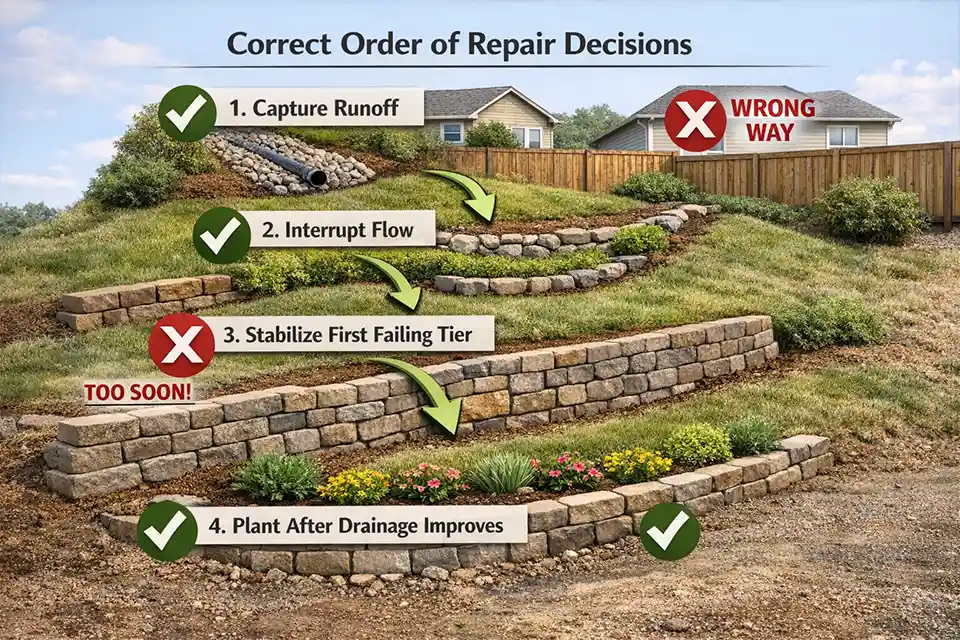
What to fix first
1. Fix the water source before the damage zone
If runoff starts at a roof downspout, hardscape edge, or compacted upper landing, that source gets fixed first. Source correction is usually more valuable than lower-tier cleanup.
This is the single most important prioritization in the yard. If you repair the damage zone while the feed zone stays active, the slope keeps teaching you the same lesson.
2. Break the flow path before rebuilding the terrace
A tiered slope is supposed to interrupt water momentum. If water still runs directly from one level to the next, the system is underperforming. That may call for a swale, an intake point, a regraded shoulder, or another interception move that spreads or reroutes flow before it hits the weak edge.
If the lower boundary is receiving runoff, Sloped Backyard Water Running Into a Neighbor’s Yard is part of the same problem, not a separate one.
3. Stabilize the first true failure tier
Do not assume every terrace needs rebuilding. Usually one level is doing the most damage to the rest of the stack. That tier may not be the lowest or the ugliest. It is the one where concentrated flow first becomes seepage, settlement, toe loss, or movement.
4. Replant only after the moisture pattern improves
Plants are the finish layer, not the rescue layer. If the surface still looks glossy several hours after rainfall, or the tier still feels soft a day later, the site is not ready for planting-based stabilization.
Pro Tip: Take photos from the same spot after each major storm for 8 to 12 weeks. Small changes in lean, washout, and wet patterns are easier to trust in repeat images than by memory.
Which fix fits which failure pattern?
| What you see | Most likely cause | Fix first | Escalate when |
|---|---|---|---|
| Narrow washout line below one upper entry point | Concentrated runoff source | Redirect or extend discharge, then repair washout | Channels return after 2 repair cycles in 12 months |
| One terrace stays wet and soft | Perched water or seepage | Evaluate underdrain or subsurface drainage path | Wetness lasts beyond 24 hours repeatedly |
| Lower edge slumps or unravels | Toe support is being lost | Slow water above the edge and rebuild support | The edge keeps softening after storms |
| Slight wall lean or cap misalignment | Water pressure or undermining | Stop inflow and assess drainage plus wall condition | Movement increases over 3 to 6 months |
| Water exits at fence line or neighbor side | Unsafe discharge path | Rework outlet path immediately | Runoff leaves in a defined stream |
A soggy terrace is more likely a drainage-path problem than a plant problem. A recurring washout line is more likely an entry-point problem than a mulch problem. A leaning wall is more likely the result of water pressure or toe loss than ordinary settling.
Why the obvious fix fails
More mulch is usually a delay, not a repair
On gentle grades, mulch can reduce splash and buffer the surface. On steep terraces, it often becomes moving material. After a few hard storms, it shifts downhill and exposes the same weak band again.
Replanting too early can loosen a weak edge
If the lower 6 to 12 inches of a terrace edge stay wet, repeated digging and amending can create another soft path for water. It feels productive and often makes the edge less stable.
Small wall touch-ups can hide a larger problem
Resetting a few blocks, patching joints, or topping off soil may improve appearance for a while. If backfill is still saturating or the toe is still washing out, that repair has a short life.
When the standard fix stops working
Maintenance zone
Minor surface washout, no visible wall movement, no terrace staying wet beyond about 24 hours, and no runoff leaving the property in a concentrated stream.
Drainage-redesign zone
The same problem comes back after two repair cycles in a year, one tier stays soft after each moderate storm, seepage shows near the terrace face, or the lower edge fails even after cleanup and regrading.
Structural-review zone
Visible lean, bulging, widening cracks, settlement near stairs, or movement appearing in more than one short wall. At that point the yard is no longer behaving like a surface-landscaping problem.
That is also where Sloped Backyard Problems: Drainage, Erosion, and Safety becomes the broader companion topic.
What changes under different conditions
Clay-heavy yards
Clay slows infiltration and makes perched water more likely. That shifts many failures from obvious washout to long wetness, seepage, and soft lower edges.
Sandy or silty yards
These often drain faster but erode more easily. That makes narrow channels, undermining, and toe loss more likely than long ponding.
Wet climates and repeated storm periods
In places with frequent rain, one storm may not cause visible failure, but three wet weeks often will. Cumulative loading gets underestimated on steep terraces.
Freeze-thaw regions
In northern states, a small alignment issue in fall can become a clearer movement problem by late winter or spring as wet soil expands and contracts.
A few questions people still have
Can plants alone stabilize a steep tiered backyard?
Sometimes on mild slopes with shallow surface erosion. Not when runoff channels keep returning, water is emerging from the soil, or walls are moving.
Which problem should you fix first if you have more than one?
Fix the one that is feeding the others. That is usually the highest concentrated water source or the first tier where water behavior changes. On steep tiered yards, upstream causes beat downstream symptoms almost every time.
Does every tier need a wall?
No. Some terraces can be shaped and planted rather than structurally retained. But once a tier is holding cut or fill that keeps shifting, drainage and support matter more than appearance.
A steep tiered backyard works best when every level does one clear job: shorten the slope, slow the runoff, and keep the next terrace from taking concentrated flow. Once one tier stops doing that, the whole yard starts behaving like one connected failure system instead of a few separate messy spots.
For broader official guidance, see the USDA Natural Resources Conservation Service.