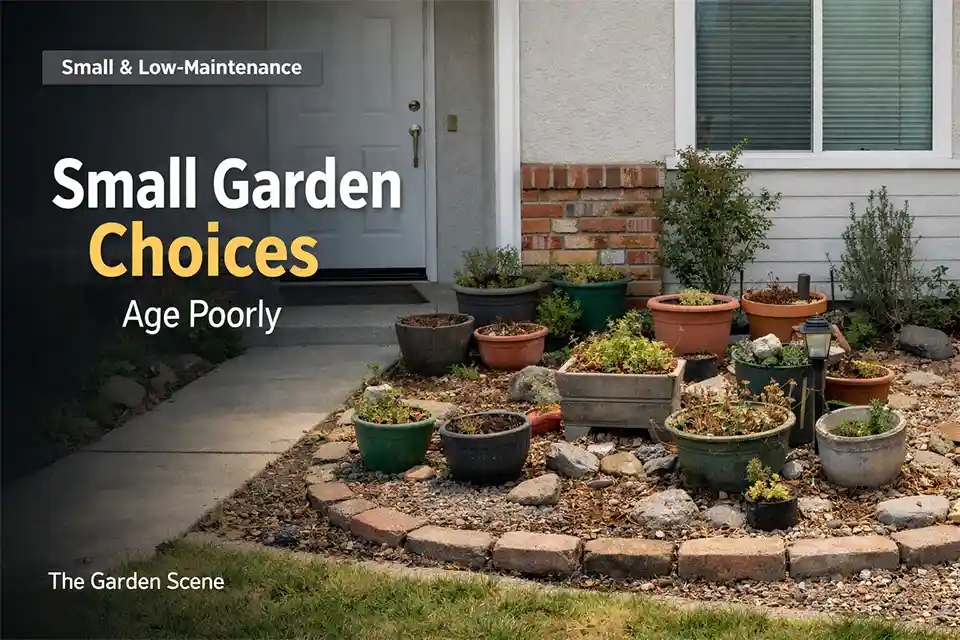
Small gardens do not usually lose curb appeal because they are small. They lose it because too many separate ideas get forced into too little space.
The first checks are more useful than any trend list: are there more than 2 to 3 visible finishes in the bed, does more than about one-third of the soil still show after the second growing season, and do the pots, edging, or accents look smaller than the front door and facade behind them? Those signs tell you more than flower color ever will.
That is also what separates a quiet garden from a weak one. A restrained front bed can still look intentional in winter. But if it reads thin, cluttered, or slightly cheap from 20 to 30 feet away in most seasons, the issue is usually structural. In small front spaces, visual overload ages faster than plants do.
What makes a small garden look dated fastest
Too many little features
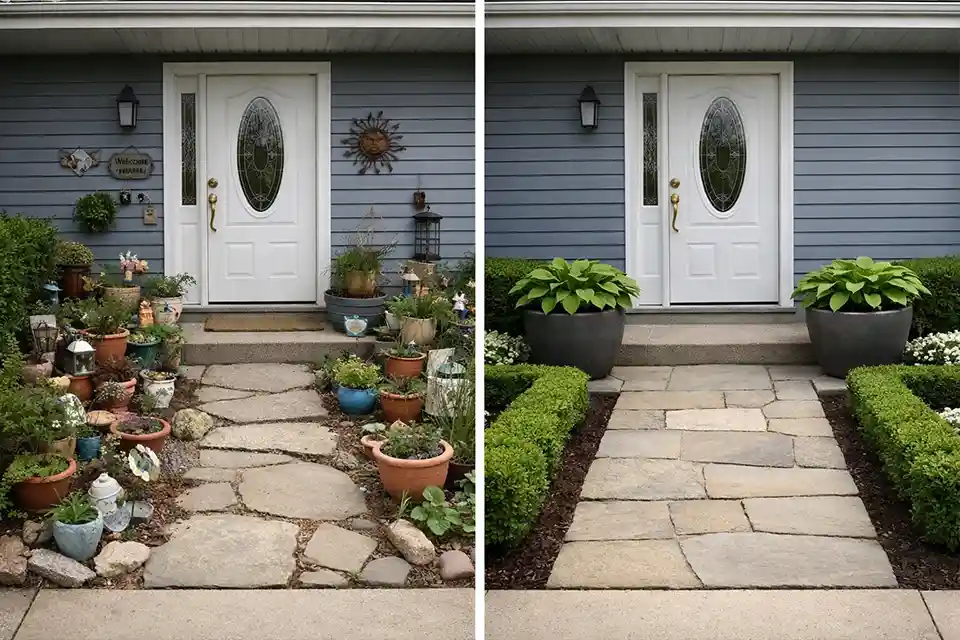
This is the most common mistake, and it usually matters more than plant choice. A compact front bed filled with miniature lanterns, novelty decor, stepping stones, several pot styles, and multiple edging types may look “finished” on install day. By the next season, it often looks restless.
Small gardens do not have enough visual room to absorb lots of separate accents. Each extra piece competes with the entry instead of supporting it. Once the eye starts landing on objects before it lands on the house, curb appeal is already slipping.
The same kinds of overworked details that make modern front yards age poorly usually look even harsher in a small garden because there is nowhere for visual noise to hide.
Plants chosen as singles instead of masses
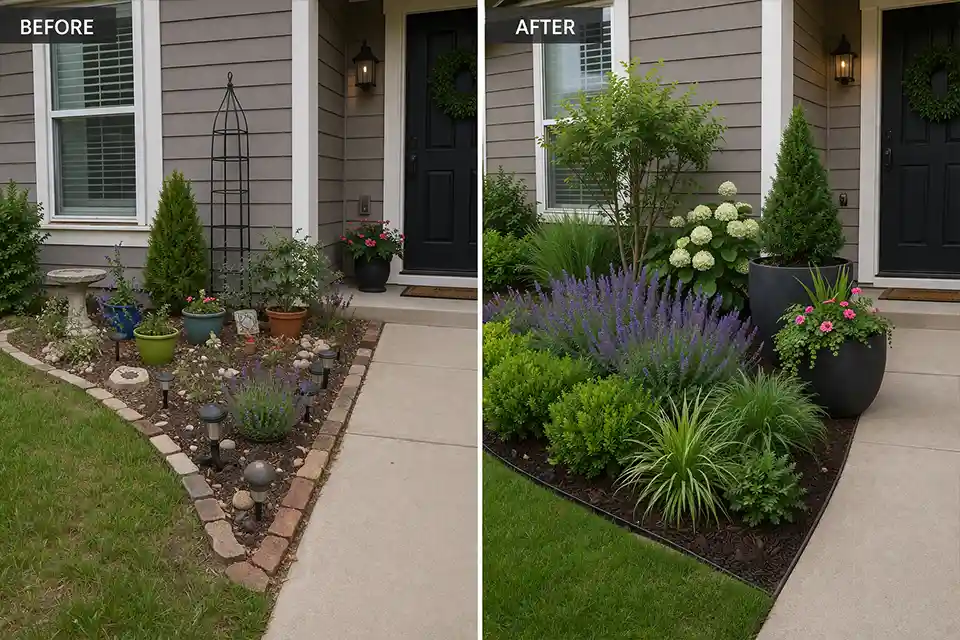
The second common mistake is treating plants like a collection. In a bed around 80 to 120 square feet, six or seven different plant identities often age worse than three stronger repeated groups. The install may feel interesting at first, but by year two the layout reads as scattered dots instead of one coherent design.
A healthier target is simple: by the second full growing season, planting should visually connect across roughly 70% to 85% of the intended bed area. In weaker beds, isolated plants still sit in islands of exposed mulch after 18 to 24 months. That is not immaturity. It is underplanting or weak composition.
Containers that look too small for the house
This gets missed constantly. Tiny pots near a standard 36-inch front door rarely look refined for long. They look temporary. Two undersized containers beside a wider facade can make the whole entrance feel visually underpowered, especially once summer heat dries them faster and foliage starts looking tired between waterings.
People usually overestimate charm here. What they underestimate is scale. In a small front garden, weak scale reads almost immediately.
What people usually misread first
Fresh mulch is not the real fix
When a small bed starts looking weak, many homeowners refresh mulch first. That improves color for a few weeks, but it rarely changes the design outcome. If the bed still shows broad exposed areas during active growing season after 18 to 24 months, the problem is not mulch color. It is usually low plant coverage, poor spacing, or no repeated mass.
Bare mulch is a symptom. The underlying mechanism is weak structure. Covering the symptom without correcting the structure can make the decline look slower, but it does not stop it.
This is also why small garden design mistakes that increase maintenance often become curb-appeal problems too. A design that never visually fills in keeps asking for cosmetic rescue.
“Low maintenance” can still look cheap
Gravel, black mulch, plastic edging, and a few accent grasses can look clean in a fresh install. In many small front gardens, they age into something harsher: thin gravel starts showing litter, edging starts drifting, and sparse upright plants start looking scratchy instead of structured.
This is one of the most overestimated ideas in small-space design. People assume fewer plant types and fewer materials automatically create simplicity. Sometimes they do. But when the layout is thin rather than deliberate, it starts reading unfinished by year two.
Shade is not always the main problem
Homeowners often blame shade when a small front garden looks weak. Shade can absolutely slow fill-in, but it is not usually the first thing to blame if the layout already depends on too many singles, too many accents, or too many mismatched materials. Weak design usually shows itself before light levels become the main issue.
If tree cover is keeping the bed sparse well into the second season, small garden problems in shade and the right fixes becomes the better diagnostic path.
The visual signals that weaken curb appeal first
The house starts looking less important
A small garden should support the facade, not compete with it. Once the bed starts pulling attention sideways with unrelated accents and broken lines, the house looks smaller, not the garden.
This is especially obvious around the front door, short walkway, porch line, and first window view. If the garden language feels fussier than the architecture, the entrance starts losing authority. The best small front gardens make the house look clearer, calmer, and more intentional. The weaker ones interrupt it.
The entry starts reading dated
This is not only about trends. It is about what visibly declines in 1 to 3 seasons:
- mixed materials fading at different rates
- tiny pots that never anchor the doorway
- novelty accents that stop feeling intentional
- thin gravel or mulch areas collecting visible debris
- edging that shifts even 1 to 2 inches and becomes obvious from the street
A design does not have to be neglected to look dated. In small gardens, something can look tired before it is actually ignored.
The garden starts signaling maintenance fatigue
This is where many front beds quietly lose appeal. Faded containers, repeated seasonal swaps, annual re-edging, re-mulching to hide gaps, and constant rearranging all send the same message: the structure is not carrying its own visual weight.
That is the point where routine fixes stop making sense. If the bed still needs correction every season after year two, redesign usually makes more sense than more touch-ups.
Pro Tip: A small garden often starts looking neglected before it is neglected. When the structure is weak, normal weathering reads like poor care.
Better choices versus fast-aging choices
| Fast-aging choice | What happens over time | Better long-term move | Why it holds up |
|---|---|---|---|
| Several small planters | Entry looks temporary and underscaled | One or two larger containers | Matches the scale of the facade |
| Many single specimen plants | Bed reads spotty and thin | Repeated plant groupings | Builds unity and fuller coverage |
| Mixed mulch, gravel, and edging | Visual breaks multiply | One ground treatment with a clean edge | Keeps the space calmer |
| Decorative add-ons for interest | Garden looks busy fast | Plant-led structure with one focal accent | Ages more quietly |
| Sparse accent grasses everywhere | Bed looks scratchy from the curb | Fuller base layer plus limited accents | Gives body before detail |
| Lightweight edging systems | Line drifts and cheapens the bed | Stable, simple edge line | Keeps the garden intentional |
What ages better in a small front garden
Bigger moves, fewer moves
Small gardens usually improve when you remove one-third of the ideas. Strong curb appeal comes more often from subtraction than addition.
A practical formula for many compact front spaces looks like this:
- 1 structural shrub layer or evergreen anchor
- 1 repeated filler or seasonal layer
- 1 low edge or groundcover layer
- no more than 2 visible surface finishes in the main bed
That kind of restraint tends to hold up better than a heavily accessorized layout, especially in front-of-house beds where every decision is exposed. Front yard small plant beds and upkeep fits naturally here because tight beds do not stay polished when the structure is too complicated.
Layering that matches the bed depth
A bed under about 24 inches deep is where many mixed-border ideas stop paying off. People keep trying to squeeze in a foreground, mid-layer, bloom accents, and decorative edging as if the bed were 5 feet deep. It usually ends in fussiness.
In very shallow beds, a simpler approach often ages better: one repeated low layer, or one structural layer with a disciplined ground plane. The point is not to do less because the space is small. It is to choose a structure the space can actually hold.
Pro Tip: Stand at the curb, about 25 feet from the bed, and half-close your eyes. If the space reads as dots, props, and separate color notes instead of 2 or 3 connected masses, it will almost always age worse than it photographs.
Quick diagnostic checklist
- More than 2 or 3 visible finishes in one small front bed
- Tiny pots or decor sitting beside a standard front door
- More than one-third of the bed still exposed after 2 growing seasons
- Edging already tilting or drifting within 12 to 18 months
- Planting reads as singles, not repeated groups, from the street
- The eye lands on ornaments before it lands on the house
When redesign makes more sense than tweaking
If the bed keeps needing fresh mulch, replacement annuals, extra decor, or seasonal rearranging just to stay attractive, simplify it. That does not mean making it bland. It means deciding what the space is supposed to do.
The most reliable reset is usually:
- remove the smallest and fussiest accents
- cut the material palette down to one primary ground treatment
- replace scattered singles with repeated groupings
- use containers large enough to hold visual weight through a full season
- keep the entry and facade as the focal point, not the accessories
In hot climates, this matters even more because small containers and underfilled beds decline faster between waterings. In colder climates, winter structure matters more because weak layouts stay visible longer.
If the bed is also struggling with runoff or soggy soil, small garden drainage problems becomes part of the answer, because a garden rarely looks polished for long when the base conditions are fighting the design.
A good small garden does not need to look expensive. It needs to stay coherent after weather, fading, litter, growth, and normal seasonal change have had 1 to 3 years to work on it. That is the real curb-appeal test.