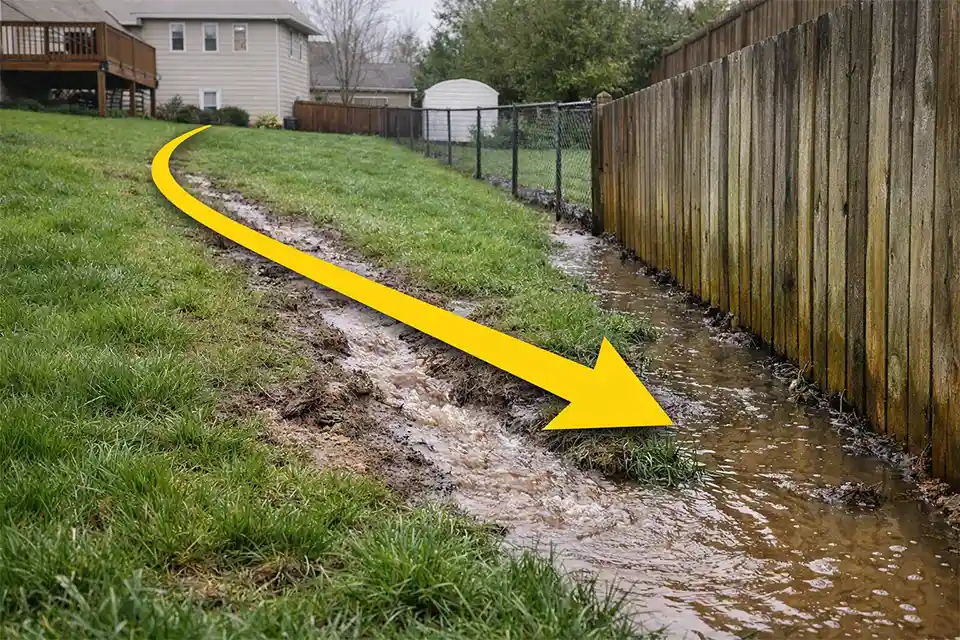
If water from your sloped backyard is ending up in a neighbor’s yard, the real issue is usually not that the yard is simply “wet.” It is that water is being collected, accelerated, or redirected before it reaches the property line.
The first checks are practical: see whether runoff reaches the boundary within 10–30 minutes of rainfall starting, whether it arrives as a thin sheet or a narrow channel, and whether mulch or sediment is moving with it.
That last sign matters more than people think. Once water is carrying material downhill, the problem has already moved beyond harmless surface wetness.
This also differs from a yard that merely stays soggy after rain. If water ponds in place for 24 hours or more, infiltration is weak. If the neighbor’s side gets hit during the storm and the surface dries later, the bigger problem is usually runoff routing, not just poor drainage.
What actually makes this a neighbor-yard runoff problem
A mild slope by itself is not the main story. The more useful distinction is between natural downhill movement and concentrated discharge.
Natural downhill flow versus water you are actively sending
Some water moving downhill after rain is normal on sloped lots. The trouble starts when one part of the yard behaves like a chute. A downspout outlet, hardscape edge, compacted dog run, bare strip, or misdirected swale can take a broad, slow movement of water and turn it into a narrow, faster stream.
That is the point many homeowners underestimate. They assume the whole yard drains badly when the real failure may be confined to one line only 4–8 inches wide.
The signs your yard is doing more than just shedding rain
If the same spot at the property line gets hit in repeated storms over roughly 0.5 inch, this is probably not a rare-weather problem. If runoff reaches the boundary quickly, leaves a muddy fan, strips mulch, or starts carving even a 1- to 2-inch groove, the yard is not just draining downhill. It is actively concentrating flow.
In that situation, the fence line is often only the symptom. Articles like Fence Line Erosion Problems on a Sloped Backyard matter because once water begins hugging a shared edge, the damage tends to become more visible there than at the actual source.
Before you fix anything, document the flow path
This is one of the few cases where watching the next storm is more useful than rushing into a drain install.
What to look for during the next rain
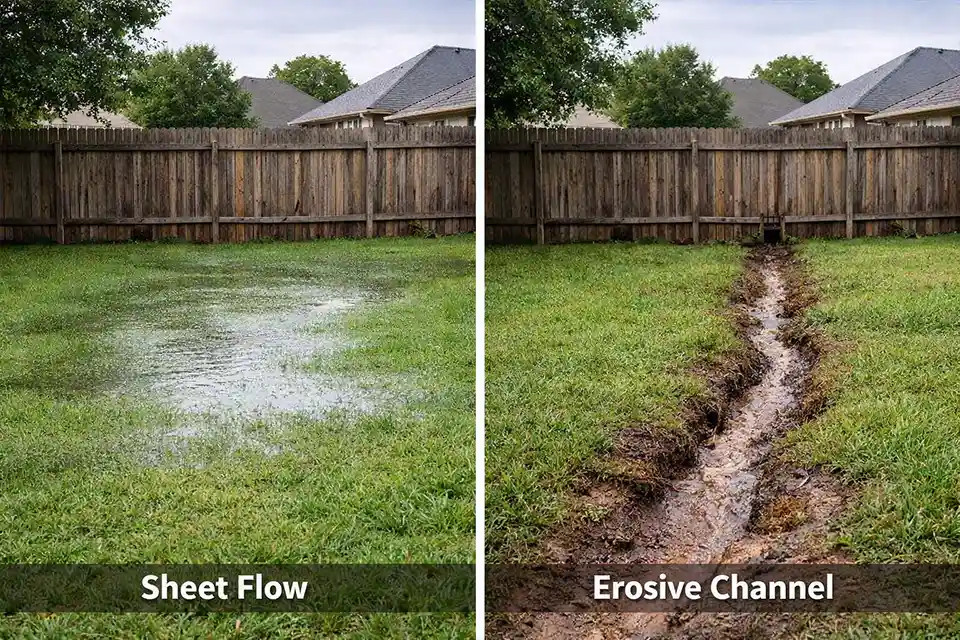
Track where the water begins to collect, how long it takes to reach the boundary, and whether it crosses as a wide shallow front or a focused stream. A simple phone video taken at 5-minute intervals during the first 20–30 minutes of rain is often more useful than a dry-weather guess. Also note whether the problem starts after roof runoff arrives, after a patio begins shedding water, or only once the soil is saturated.
If the visible path begins at a downspout outlet or hard edge, you already know the problem is at least partly man-made.
What your neighbor notices first
Your neighbor usually does not see “poor drainage.” They see one of three things: repeated muddy water, fresh sediment, or a soggy strip near the line that lasts longer than the surrounding ground. That is why a neat-looking mulch refresh often fails as a fix. It hides the route for a while without changing it.
A short real-world detail that changes outcomes: the first thing to fail is often not the lawn but the cover material. Once mulch, fine soil, or loose gravel starts shifting, the flow path becomes easier for the next storm to reuse.
Fix the cause in the order that actually matters
Most weak solutions fail because they start at the edge instead of upstream. The right order is to reduce concentration, slow the water, improve infiltration, and only then think about boundary containment.
First, reduce the concentrated water source
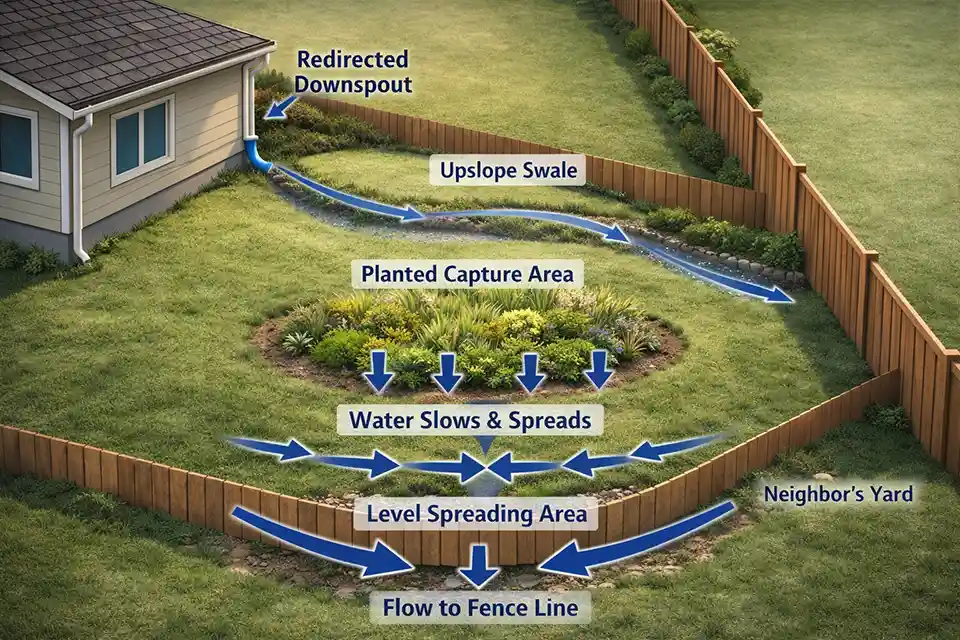
A single downspout discharging onto the back slope can turn a manageable grade into a neighbor problem. If the outlet lands within about 6–10 feet of the main fall line, it deserves suspicion immediately. Extending or redirecting that discharge 10–15 feet to a safer infiltration area can change the whole pattern.
The same logic applies to hardscape. A path, patio, pool surround, or compacted wear strip can quietly feed the runoff line. That is why a broader drainage read, like Backyard Drainage Problems Homeowners Ignore, often helps explain why the visible wet spot is not the real source.
Then, slow the flow before it reaches the boundary
This is where many people waste time. They build a small berm right at the fence and hope it will stop everything. On slopes above roughly 8–10%, or where runoff is already narrow and fast, that usually just pushes water sideways or creates a worse overflow point.
A better move is an upslope interception feature: a shallow vegetated swale, a level spreader strip, or a stone-lined trench placed before the water accelerates. The point is not to trap all water forever. It is to break the speed and shape of the flow so the boundary stops behaving like the exit point.
Pro Tip: If flattened grass, exposed roots, or a washed strip are visible even in dry weather, place the first interception feature above that scar, not directly on it.
Then, check whether the soil can actually absorb what you catch
If a simple test hole still has standing water 12–24 hours later, the problem is not only routing. Infiltration is weak too. In that case, a rain garden, amended capture bed, or larger basin may help, but only if sized for the site rather than treated like a decorative planting area.
This is where Bare Soil Washout on a Sloped Backyard becomes directly relevant. Bare patches are not just ugly. They reduce friction, expose the route, and make the next storm more destructive than the last one.
Quick diagnostic checklist
- Water reaches the property line within 10–30 minutes of rain starting
- The boundary gets hit in ordinary storms of about 0.5 inch or more
- Runoff arrives as a narrow path rather than broad shallow sheet flow
- Mulch, silt, or grass clippings collect near the shared line
- A downspout, patio edge, or worn track clearly feeds the path
- Water remains ponded longer than 24 hours after rainfall
Not every drain fix has a safe outlet
This is another place people commonly overestimate the fix. Catching water is not the same as solving the problem. If a French drain, trench drain, or buried line simply discharges to another low point near the same boundary, you may have hidden the path without reducing the impact.
A drain that moves the problem is not a fix
The useful question is not “Can I pipe this water away?” It is “Where does that outlet send it, and under what storm volume?” If the answer is another fence corner, a neighboring side yard, or a low strip that overflows during peak rain, the system is incomplete.
That is where routine DIY logic stops making sense. Once you are moving collected water under pressure or over distance, the outlet matters as much as the inlet.
When standard landscape fixes stop being enough
Surface-only solutions deserve less confidence when you see repeated sediment movement, undermining near fence posts, several failure points along the boundary, or a slope that is beginning to slump rather than just wash. If a retaining condition is involved, the drainage problem may be part of something bigger. Retaining Wall Failure Signs on a Sloped Backyard becomes important at that point because surface runoff and structural drainage failure often travel together.
What usually changes the outcome
| What you see at the property line | What it usually means | What changes the outcome | What wastes time |
|---|---|---|---|
| Thin wet strip, no sediment | Mild sheet flow | Small upslope spreader or planting strip | Rebuilding the fence edge first |
| Muddy narrow channel | Concentrated runoff path | Redirect source and intercept earlier | Fresh mulch over the same route |
| Water appears right after roof discharge | Downspout is feeding the slope | Extend or reroute discharge | Treating the lower edge only |
| Ponding lasts over 24 hours | Weak infiltration as well as runoff | Improve soil absorption and basin sizing | Assuming the problem is only slope |
| Multiple overflow spots | No defined capture and release path | Regrade logic or site-level drainage plan | One more random spot fix |
The practical line between DIY and bigger intervention
A homeowner can often solve this when the source is obvious, the slope is moderate, and the runoff can be intercepted before it turns fast. But the situation shifts when the same problem appears in multiple storms each season, when the line of damage gets longer, or when one repair lasts only 2–6 weeks before the next heavy rain exposes the same route again.
That is also the moment to stop treating it like a cosmetic landscape annoyance. At that stage, the yard is not just draining downhill. It is sending water across a boundary in a repeatable way.
Local drainage rules vary, and natural downhill flow is not always treated the same as runoff that has been increased or redirected by grading, hardscape, or discharge changes. That does not mean every case becomes a dispute, but it does mean documentation and a site-specific fix start mattering more than another quick patch.
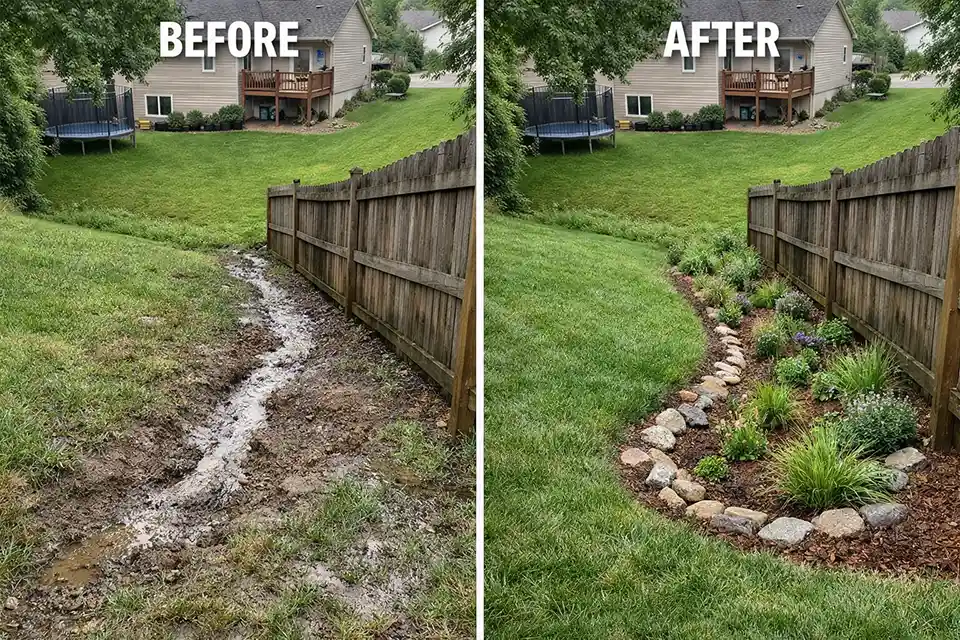
The best fix here is rarely the most obvious one. What changes the outcome is not making the boundary look cleaner.
It is breaking the runoff route before your yard sends it across the line.
For broader official guidance, see the University of Maryland Extension stormwater runoff guide.