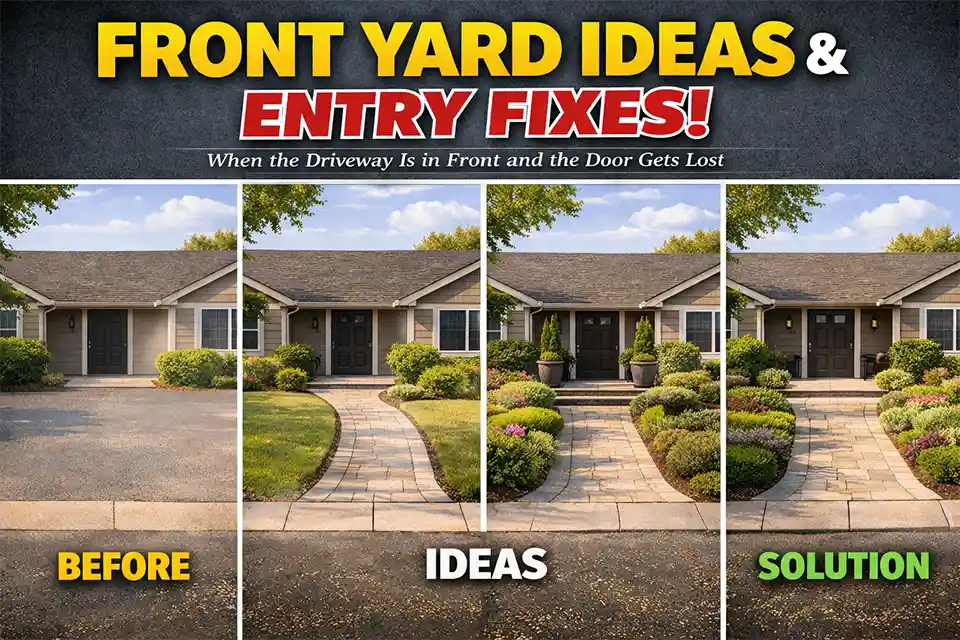
If your driveway sits in front of the house and the entrance is hard to spot, these landscaping ideas are designed to make the front door easier to find fast. In this kind of layout, the best fixes do not just make the yard prettier. They make the entry obvious.
Front Yard Landscaping Ideas That Make the Entrance Easier to Find
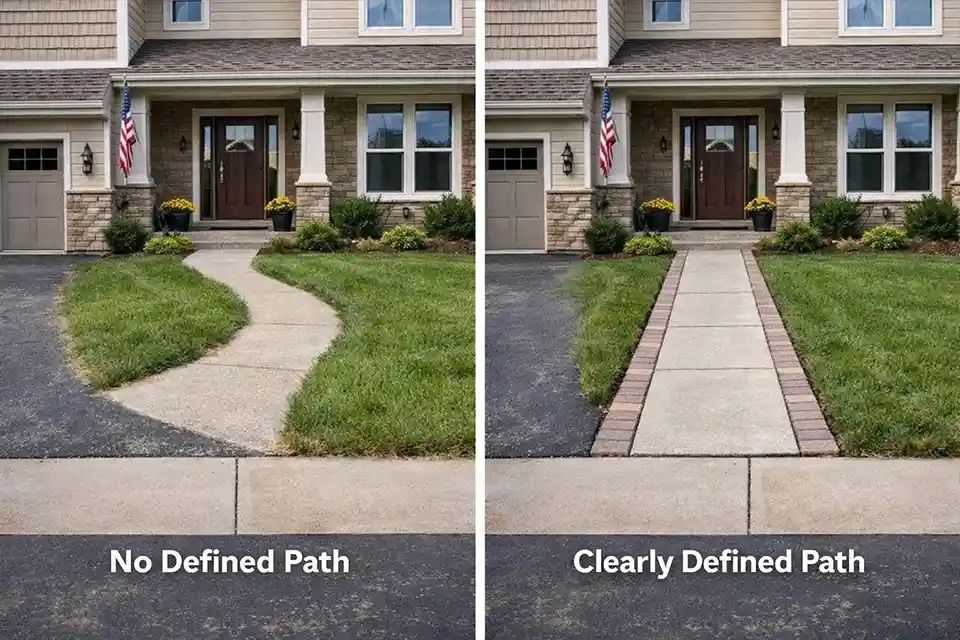
1. Create a clearly edged walkway that leads straight to the front door
In a front yard like this, the walkway has to do more than connect two points. It has to tell people where walking begins. If the path blends into the driveway or lawn, the entrance feels secondary even when the door is technically visible.
A walkway around 4 to 5 feet wide usually reads much more clearly than one under 3 feet, but width is not the only factor. Crisp edging, a border course, or a noticeable paving change can make even a narrower path easier to read from 25 to 40 feet away.
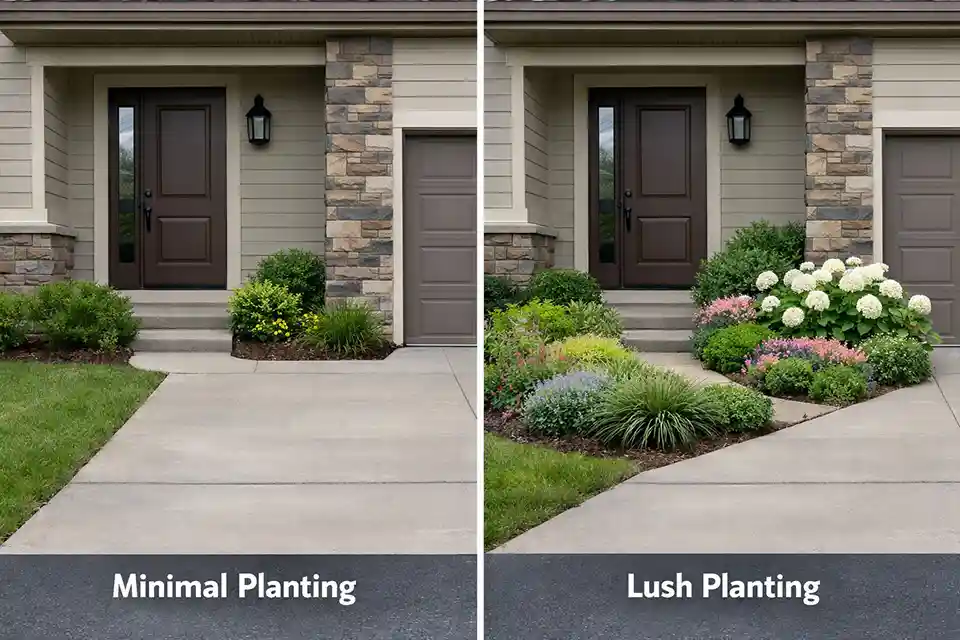
2. Build a wide planting bed that expands toward the front door
Thin foundation strips often look neat, but they do very little to make the entrance feel important. A wider bed near the front door gives the eye a destination and makes the entry zone feel intentional instead of leftover.
Beds in the 36- to 60-inch range near the door usually do far more than shallow 12- to 18-inch strips running evenly across the whole facade. The goal is not more plants. It is more visual weight in the right place.
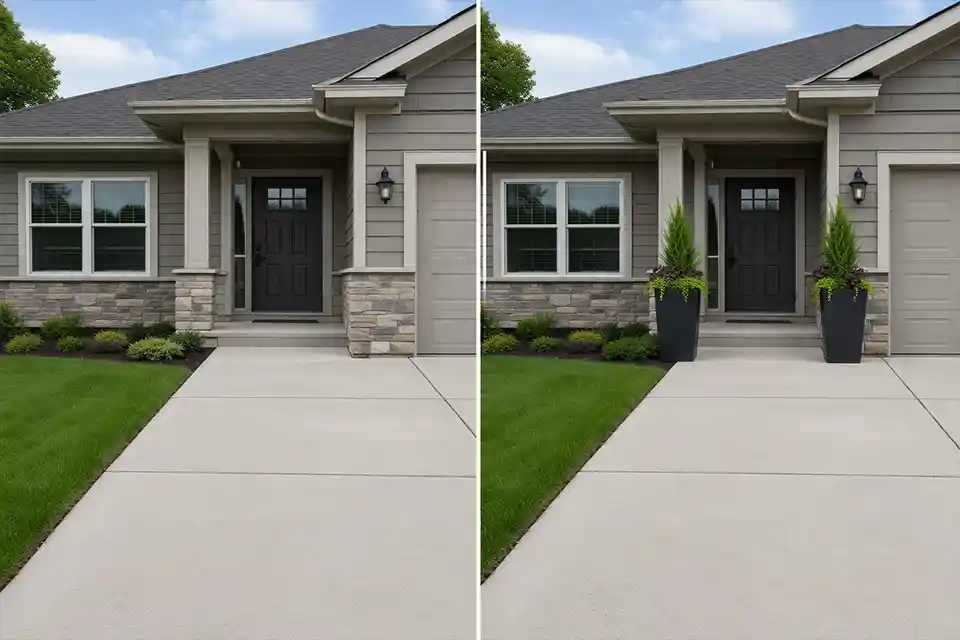
3. Frame the entrance with tall planters or upright plants
A flat yard makes the entrance easy to miss. Most homes in this layout need at least one upright feature near the door so the eye has a clear stopping point.
The most useful range is usually 5 to 7 feet tall. That can be a pair of tall planters, narrow columnar evergreens, or a slim trellis. Below that, the feature often reads as decoration. Above that, it can start competing with the house instead of helping the entrance.
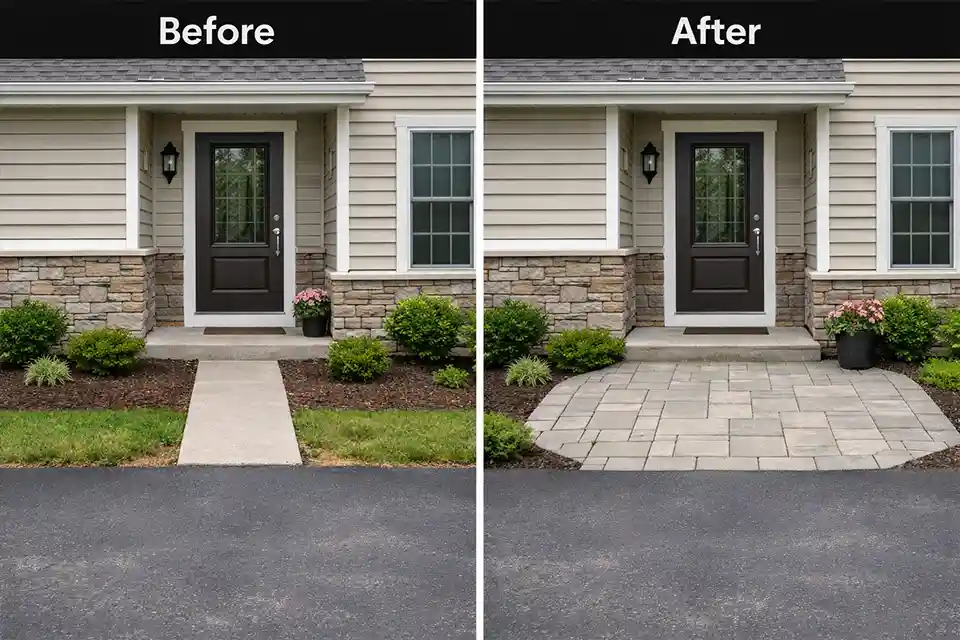
4. Widen the last section of the path into a small landing
The final steps to the front door matter more than people expect. If the last 8 to 12 feet feel narrow, pinched, or visually weak, the door still reads as secondary even when the rest of the yard is improved.
A widened section, a small paver landing, or a subtle threshold change helps the entrance feel like the destination rather than just the end of a path.
5. Use contrast so the walkway does not visually disappear into the driveway
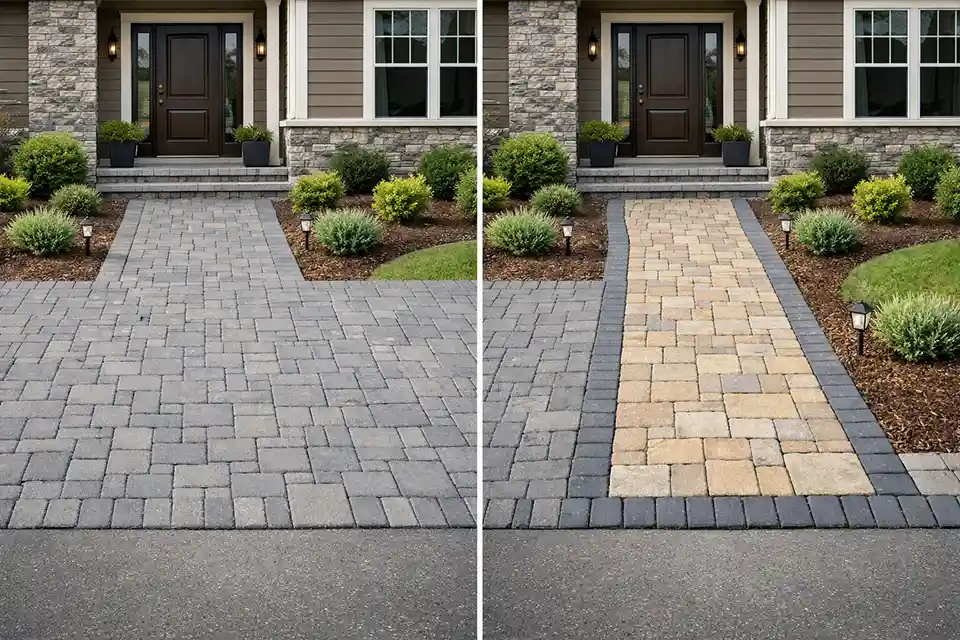
When the walking surface and the driving surface look too similar, the route to the door gets lost. This is one of the easiest problems to overlook because the yard can still look tidy while the entrance remains unclear.
A contrasting paver, brick border, gravel band, or edge strip is often enough to separate the path from the driveway and make the entrance easier to read at a glance.
Why This Layout Feels Confusing So Fast
When the driveway sits in front of the house, people look for three things first: where the path starts, where the eye stops, and what looks like the destination. If those three signals are weak, the entrance will always feel unclear.
That is why this is not just a curb appeal issue. A front yard can look clean, planted, and expensive and still fail if visitors need more than 2 to 3 seconds to find the front door from about 25 to 40 feet away. If they pause near the driveway, drift toward the garage, or scan the facade before moving, the entrance is visually weak.
The pattern is usually predictable. The path is too narrow or too quiet. The front door sits 4 to 8 feet back and loses priority. The strongest planting sits near the driveway instead of the entry. Or everything stays low enough that the eye never locks onto the door.
What to Fix First
Fix the route first, not the plant palette.
If the path is hard to read, nothing else works as well as it should. That is why Front Yard Walkway Ideas That Feel Inviting matters here. In this situation, the walkway is not just a style feature. It is the main directional cue.
Then strengthen the entry zone itself. Increase planting depth close to the door, not out by the curb. Add one upright marker near the entrance. Make the final approach feel more intentional than the driveway edge.
Only after that should you focus on plant selection and finishing details. How to Choose Plants for Front Yard Landscaping becomes much more useful once the entrance is already readable.
What Usually Wastes Time
The least effective move is decorating the whole front yard evenly.
That often means small flower pockets near the curb, extra mulch curves, low edging details, or a nice-looking bed along the driveway while the actual door zone stays weak. Those changes can make the yard look fuller without making the entrance easier to find.
Another common waste of effort is relying only on low plants. If everything stays below about 30 to 36 inches, the eye still has no strong signal near the door. Low planting can clean up the ground plane, but it rarely solves a hidden-entry problem on its own.
Pro Tip: In this kind of layout, one strong cue near the front door usually does more than three smaller accents scattered across the yard.
When Landscaping Alone Stops Being Enough
Sometimes the problem is no longer just landscaping. It is the entry itself.
If the landing is too small to register visually, if the door is tucked too tightly to one side, or if the final few feet before the entrance are squeezed against the wall, soft landscape fixes will only improve the edges of the problem.
| Condition | Landscaping usually works | Built change is usually better | Why |
|---|---|---|---|
| Weak path but visible door | Yes | — | Direction can still be clarified |
| Slightly recessed entry | Yes | — | Stronger cues can restore focus |
| Tiny or unclear landing | Limited | Yes | The entry lacks physical presence |
| Door hidden by facade layout | Limited | Yes | Architecture keeps overpowering the entrance |
| Visitors still hesitate after one full season of updates | No | Yes | Routine landscape fixes have reached their limit |
If that is the situation, a wider landing, porch extension, or stronger entry surround usually does more than another layer of plants. A related version of that same layout problem shows up in Front Yard Design With a Large Driveway, especially when the built frontage keeps overwhelming the entry sequence.
The Best Final Test
Stand at the curb and ask one simple question: can someone understand where to walk in 2 to 3 seconds from about 25 to 40 feet away?
If yes, the yard is doing its job. If not, the entrance still needs stronger cues.
The best version of this front yard is usually not the fullest one. It is the clearest one: one obvious route, one visible destination, and enough planting and structure near the door to make the entrance unmistakable.
For broader design guidance, see the Landscape Design and Plant Selection guide from University of Minnesota Extension.