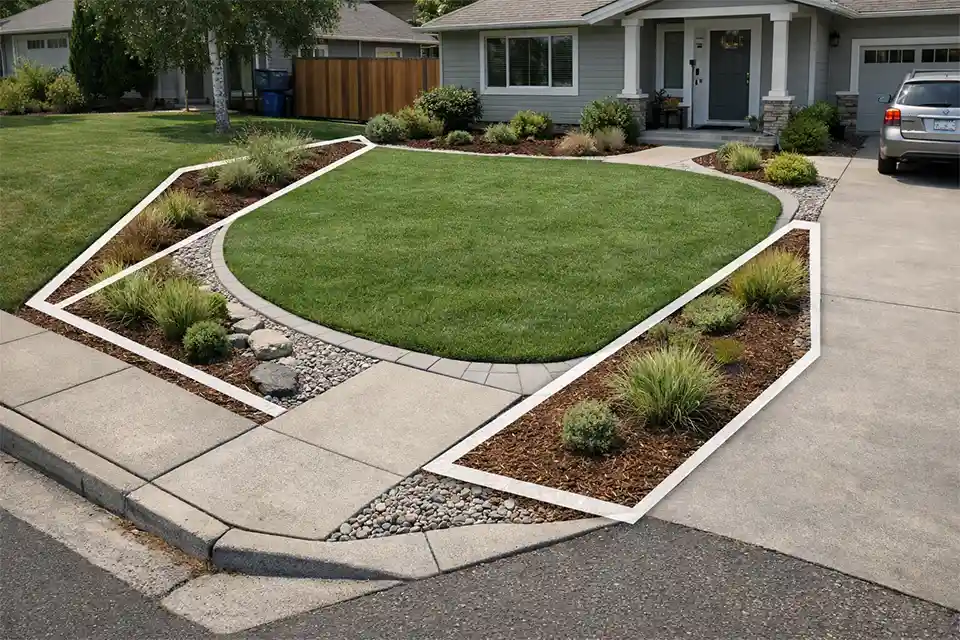
Most irregular front yards do not break down because the lot is too small. They break down because the design follows the property line too literally. That mistake usually creates three problems at once: planting beds that taper below about 30 inches, walkways that have to jog more than once in less than 18 feet, and leftover corner wedges that never read as intentional from the street.
If one odd corner keeps losing mulch after heavy rain, if edging needs touch-up every 4 to 6 weeks in the growing season, or if more than roughly one-quarter of the visible yard feels like leftover space, the boundary shape is already controlling the design too much.
That is different from a small setback yard. In a shallow yard, almost everything is constrained evenly. In an irregular yard, the space is unevenly constrained. You may have enough square footage on paper and still have less truly usable design area than a smaller but cleaner lot.
The decision that changes the outcome is simple: stop designing to the boundary first, and start by finding the part of the yard that can hold a calm, readable shape.
Quick Diagnostic Checklist
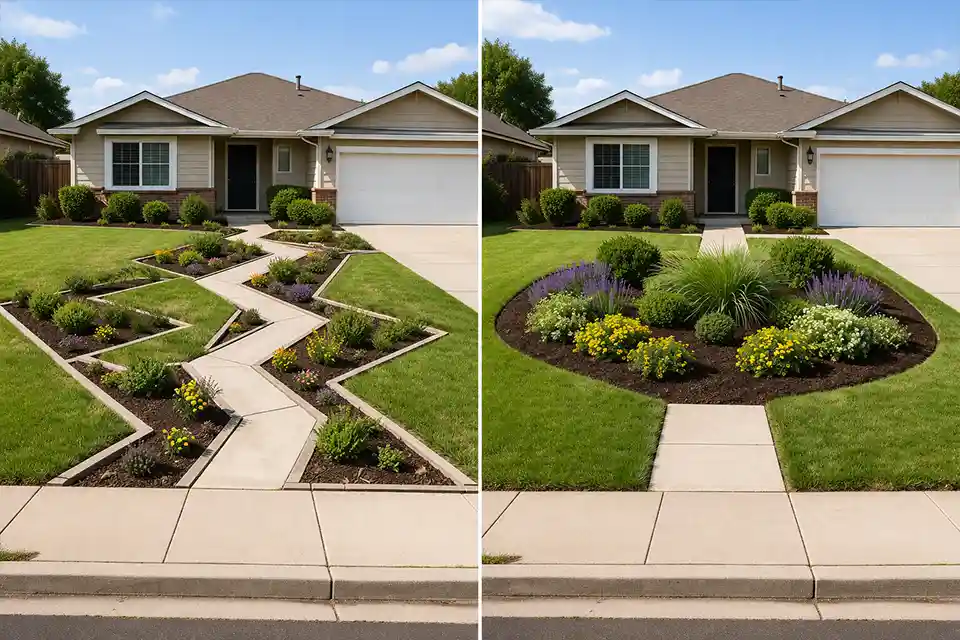
- One or more visible corners create an angle sharper than about 45 degrees.
- A planting bed pinches down below 30 inches for more than 4 feet.
- The front walk changes direction more than once between the driveway, porch, and street.
- The mower cannot pass through a turf section cleanly without trimming two or more narrow edge strips by hand.
- More than 20% to 25% of the visible front yard is made up of wedges, slivers, or leftover geometry.
- There are more than three edge-direction changes across the main front-yard view.
Those signals matter more than total square footage. People often overestimate how much the odd lot shape itself is the problem. What usually hurts more is what that shape forces you to build: narrow beds, broken circulation, too many edging transitions, and small leftover zones that need the same maintenance as real features without giving the yard any structure back.
What People Usually Misread First
The first bad assumption is that every inch of the boundary should be acknowledged. It should not. On irregular lots, the boundary is often the least useful design line on the site.
The second bad assumption is that curves automatically fix awkward geometry. They do not. A curve helps only when it reduces visual conflict. If it creates more edge length, more mulch migration, or more mowing friction, it is not softening the problem. It is multiplying it.
A good working rule is this: if the yard cannot be visually understood in 2 to 3 seconds from the street, the layout is probably carrying too many competing signals. House corners, driveway edges, the curb line, and the property boundary do not all need to be “answered” with a new bed line. Usually one strong line and one supporting line are enough.
That is why awkward circulation should be solved before plant selection. When the front path feels forced, the whole yard feels unresolved, even if the planting is attractive. The same pattern shows up in Front Yard Walkway Ideas for an Offset Door and Driveway: route clarity does more for curb appeal than another layer of shrubs.
The Constraint That Deserves More Weight
The most important constraint is not the strange corner. It is the narrow remainder space created after the main functions are placed. That is the part homeowners usually underestimate.
A triangular bed at the curb sounds manageable until it narrows to 18 or 24 inches at the point, heats up faster than the rest of the yard, dries out sooner, and starts growing weeds because the mulch layer thins and shifts. In humid climates, that can mean visible weed breakthrough in 2 to 4 weeks during peak growing weather. In dry climates, it often means irrigation overspray or plant stress because the root zone is too small to buffer heat.
Thin spaces are where maintenance gets expensive in time, not money. They require hand work, not broad easy maintenance. A 10-foot-wide planting bed can be simplified. A 20-inch wedge has to be fussed over.
This is also where readers sometimes choose the wrong fix. They swap plants when the real issue is bed geometry. Plant choice matters, but not before the layout stops producing failure zones. If the bed shape is wrong, better plants only fail more neatly.
The Layout Rule That Usually Works Best
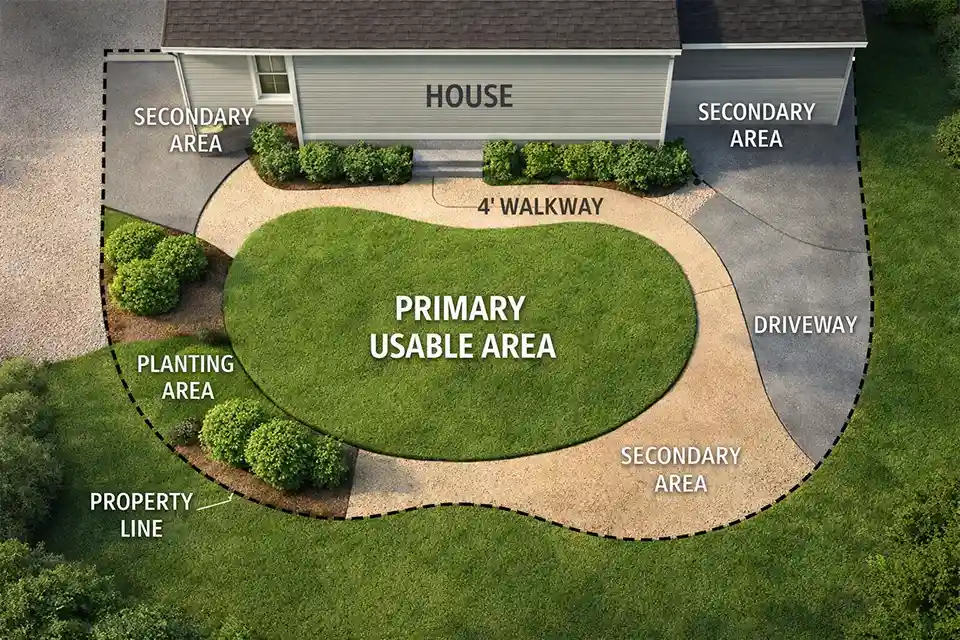
The safest approach is to create one primary shape first, then demote the odd leftovers into secondary zones. In most front yards, the primary shape should account for about 60% to 75% of the visible landscape area and should be readable as one lawn panel, one broad planting mass, or one clean mixed zone anchored to the house or walk.
The secondary zones do not need to perform equally. One wedge can become simple groundcover. Another can be gravel. Another can disappear into lawn continuation. The mistake is asking every fragment to function like a feature.
| Irregular Condition | Better Move | Decision Threshold |
|---|---|---|
| Sharp front corner | Use one low mass or groundcover, not layered planting | Angle sharper than 45 degrees |
| Long diagonal frontage | Hold one consistent edge line | Angled frontage longer than 12 feet |
| Thin side remainder | Convert to lawn, gravel, or a single material | Bed depth under 30 inches |
| Skewed entry route | Straighten the priority walk first | Main walk should stay at least 4 feet wide |
| Fragmented planting plan | Merge small beds into one dominant zone | More than 3 edge shifts in 20 feet |
The key distinction is between appearance and mechanism. “This yard looks awkward” is appearance. “The layout creates too many small edge conditions” is mechanism. Good redesign starts with the mechanism.
That is also why a driveway-heavy front yard gets less tolerance for decorative complexity. Once hardscape takes up 35% to 40% or more of the frontage, the remaining planting area has to be simpler, not more expressive, or the whole front elevation starts to feel chopped up. That same pressure shows up in Front Yard Design Constraints With a Large Driveway.
A Better Design Sequence
Start with what cannot move: porch steps, house corners, driveway edge, utilities, sight lines from the street, and any grade change. Then draw the largest calm shape that fits those realities without borrowing from the awkward corners. That shape becomes the organizing zone.
Next, decide what deserves visual emphasis. On most lots, that is only one of three things: the entry route, the planting mass nearest the house, or a central lawn shape. If you try to make all three dominant, the odd lot geometry gets louder.
After that, assign every leftover area a low-risk role. This is where the design gets sharper. If a space is under about 25 square feet and highly irregular, it usually should not become a mixed ornamental bed. If it sits beside pavement and is less than 2 feet deep at any point, it usually should not be layered with multiple plant heights. Once a small awkward space demands pruning from two sides, it has already stopped being efficient.
One detail that often gets missed is how the irregular lot shape interacts with the rest of the site. Mature roots, driveway flare, and hidden service areas can make a strange boundary much less flexible than it first appears. On sites where roots or underground constraints overlap the odd geometry, the real usable shape may shrink faster than expected, which is why articles like Front Yard Design Constraints Around Tree Root Zones matter more than they seem at first glance.
Pro Tip: Before drawing any bed lines, stake out the biggest simple shape you think can work and look at it from the street for 24 hours. If the yard already feels calmer with stakes alone, that is usually the right direction.
Why the Obvious Fix Often Fails
The obvious fix is to “fill the awkward spots.” That is exactly what makes many irregular front yards look busier and smaller.
Small accent beds, decorative boulders, extra shrubs in corners, and a second curve added to “balance” the first one usually fail for the same reason: they answer geometry with more geometry. Readers often think the yard needs more detail to feel intentional. Usually it needs fewer moves with stronger boundaries.
A related waste of time is over-correcting for asymmetry. Not every irregular front yard should be made to look symmetrical from the street. If the house massing, porch location, and drive placement are already off-center, forcing balanced beds can make the imbalance more obvious. A better goal is compositional stability, not mirror-image symmetry.
This is especially true when the lot shares traits with corner-lot frontage or split visual exposure. In those situations, the public-facing edges can pull the design in two directions at once, which is why Corner Lot Front Yard Constraints With Two Street Frontages is closely related in practice even when the property is not technically a corner lot.
When the Standard Fix Stops Making Sense
There is a clear point where trying to plant your way out of the shape problem stops making sense.
If the remainder strip stays under 24 inches deep, if the corner is too acute for a plant mass to read cleanly from the street, or if the edging line needs constant seasonal correction, stop treating that area as prime planting space. Use simpler materials. Let it become background.
This is where many front yards improve fast: not because more was added, but because one or two low-value zones were taken out of play. A narrow strip beside a driveway may do better as gravel with one repeated plant type. A curb wedge may perform better as lawn continuation than as a tiny showcase bed. Around utilities, trying to disguise everything with dense planting often creates access headaches and visual clutter; a simpler approach usually works better, especially in yards like those discussed in Front Yard Design Constraints With Utility Boxes in the Yard.
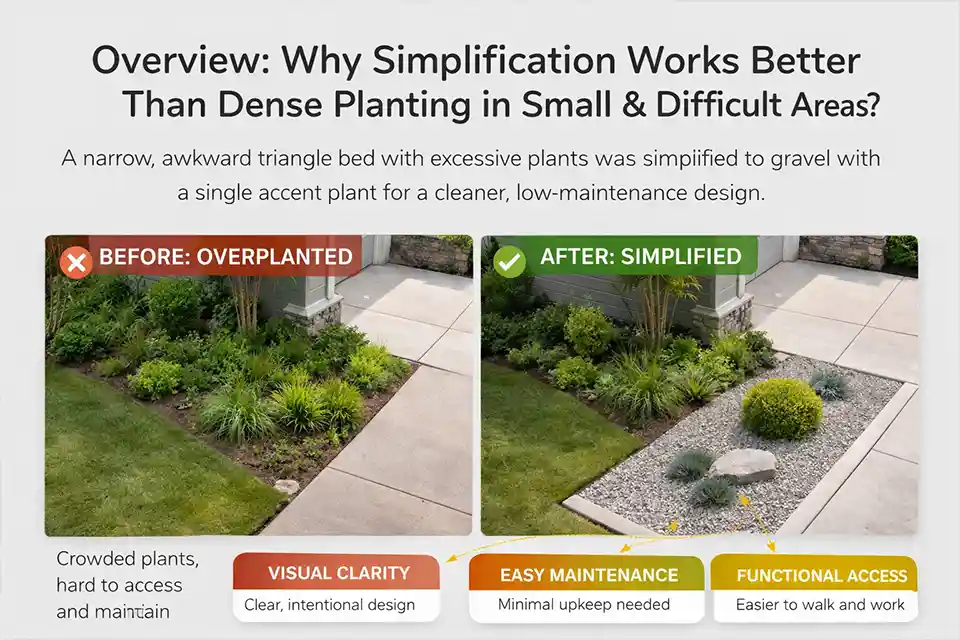
A well-designed irregular front yard does not try to honor every angle. It decides which angles matter, then quiets the rest. That is the difference between a yard that looks custom and one that looks like a standard layout forced onto a difficult shape. On these lots, editing is usually more valuable than adding.
For broader planning guidance, see the University of Minnesota Extension landscape design guide.