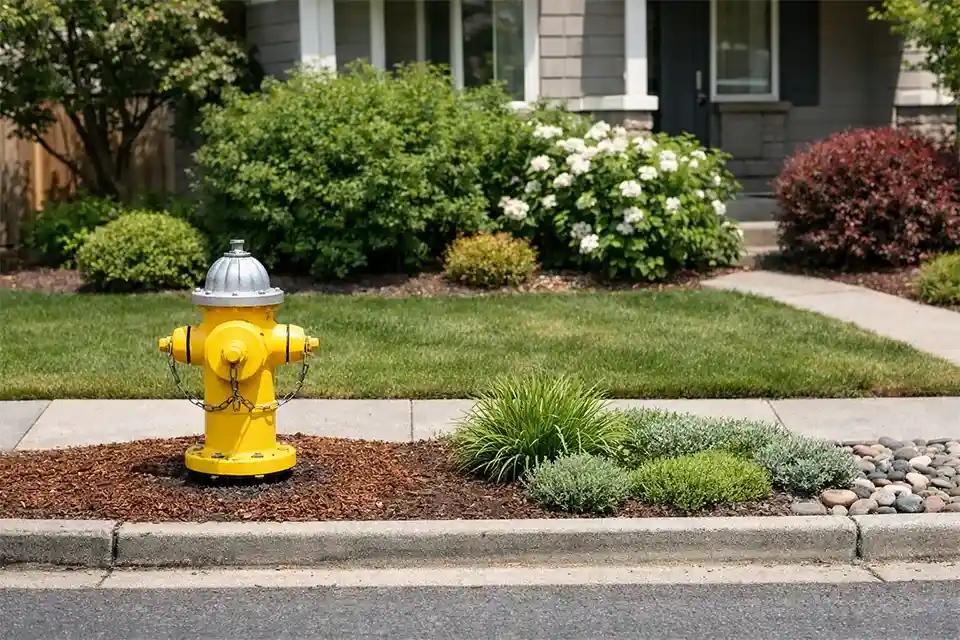
A front yard with a hydrant or street sign becomes difficult to design when the space around it stops acting like normal planting space.
Start with three checks: whether the hydrant needs a true 3-foot clear zone around it, whether anything near the sign will rise above roughly 18 to 24 inches in a sight-line area, and whether the layout will still look controlled after 12 to 24 months of normal growth. If the answer depends on pruning every 6 to 8 weeks, the design is too tight.
The key distinction is simple. A hydrant is mostly an access constraint. A street sign is mostly a visibility constraint. They can sit in the same narrow strip, but they do not ask for the same response. Around a hydrant, the priority is open working room. Around a sign, the priority is keeping the view clean from the driver’s angle, not just from the porch.
Most bad outcomes start with the same mistake: homeowners count all of the bed as usable, then try to solve the conflict with “compact” plants and extra trimming. That usually creates a yard that looks acceptable in spring and crowded by midsummer.
What Actually Controls the Layout
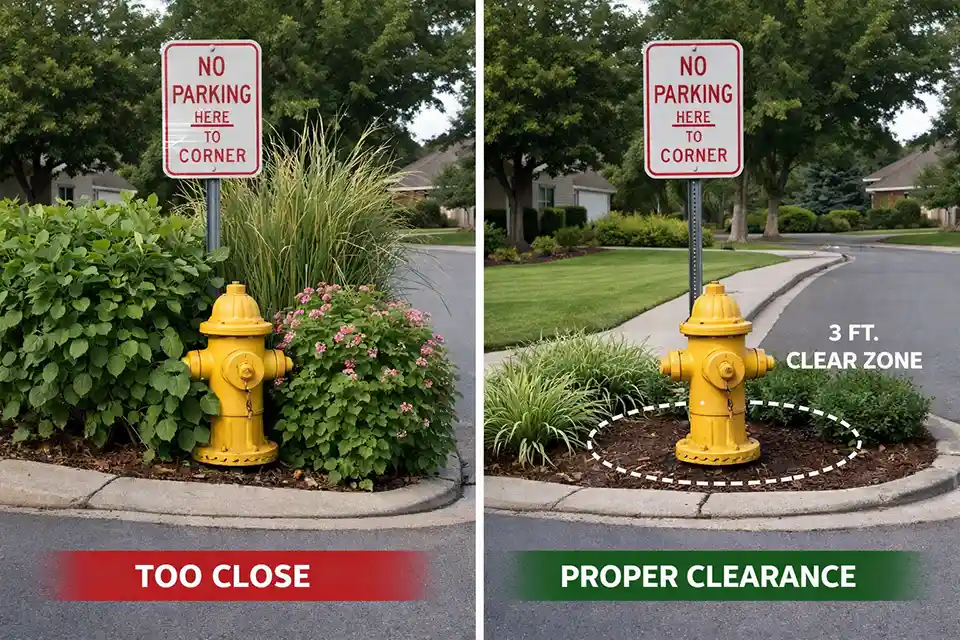
The most important number is not the bed width you see from the sidewalk. It is the width left after the protected zone is removed. If that remaining strip is under about 18 inches, you usually do not have a real planting bed. You have a surface zone that needs to stay quiet.
That is why this problem behaves more like front yard design around utility boxes than a normal ornamental border. The area nearest the obstruction is not where the design should do its hardest work.
People also overestimate how much concealment they need. A hydrant does not need to be disguised. A sign should not be softened with height. What improves curb appeal most is usually a calmer composition: open space where access or sight lines matter, then low planting, then the real visual mass farther back.
Four Layout Variations That Work
1) Narrow Curb Strip With a Hydrant
This is the version people overdesign. Keep the hydrant area open. If the strip beyond the clear zone is only 18 to 24 inches wide, use mulch, turf, or a very low groundcover that will not lean into the hydrant by midsummer.
The stronger move is to let the hydrant zone stay plain and build the composition farther down the frontage or closer to the house. If you only have room for one repeated low plant plus mulch, that is usually enough. Trying to make the hydrant itself part of the planting display is what creates the maintenance problem.
2) Corner Lot With a Street Sign
A corner sign needs a wedge-shaped response, not a full-depth bed pushed right into the intersection. Keep the corner nearest the sign visibly open, then start introducing height once you are 6 to 10 feet back from the tightest visibility point.
This is where sites begin to overlap with corner lot front yard constraints with two street frontages. The bed may look sparse from one angle and still be the right decision, because the real test is approach visibility, not fullness.
3) Hydrant Beside a Driveway Apron
Here, edging and hardscape often cause more trouble than plants. A curved planting ring around the hydrant may look intentional on paper, but beside a driveway it usually narrows step-in access and makes the strip feel fussier.
A better layout is linear: open ground nearest the hydrant, one low repeated plant parallel to the driveway, and the main shrub mass shifted back toward the walk or garage return. This same logic helps on front yard layouts with large driveway influence because long, simple lines usually perform better than small decorative islands.
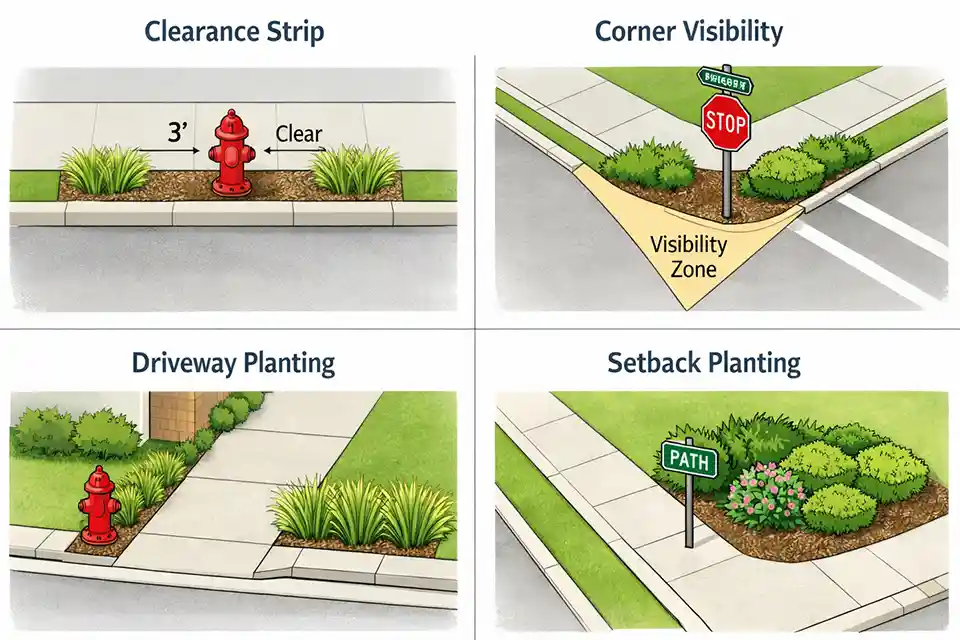
4) Street Sign Near the Walk or Entry Sequence
This version feels awkward because the sign interrupts how the yard leads you to the front door. The fix is not to build planting right up to the post. It is to leave the sign area calm and restart the composition where the eye should go next.
That is especially useful when the entry is offset or visually hidden. In those yards, the better move is often the one used in front yard walkway layouts with offset doors and driveways: keep the interruption quiet, then use stronger planting where it helps guide the approach.
| Site condition | Best layout move | Plant form that works best | Red flag |
|---|---|---|---|
| Hydrant in narrow strip | Keep hydrant zone open and shift design away from it | Very low groundcover or plain mulch | Usable width under 18 inches |
| Corner sign | Pull planting back into a low wedge | Low mounding plants with stable form | Anything taller than about 18 to 24 inches in the sight area |
| Hydrant by driveway | Use a linear bed, not a ring | Tight repeated edging plants | Hard edging that narrows access |
| Sign near walk | Keep the sign zone calm and rebuild mass near the entry cue | Repeated low plants near the post, taller plants farther back | The sign becomes the focal point |
What Usually Fails
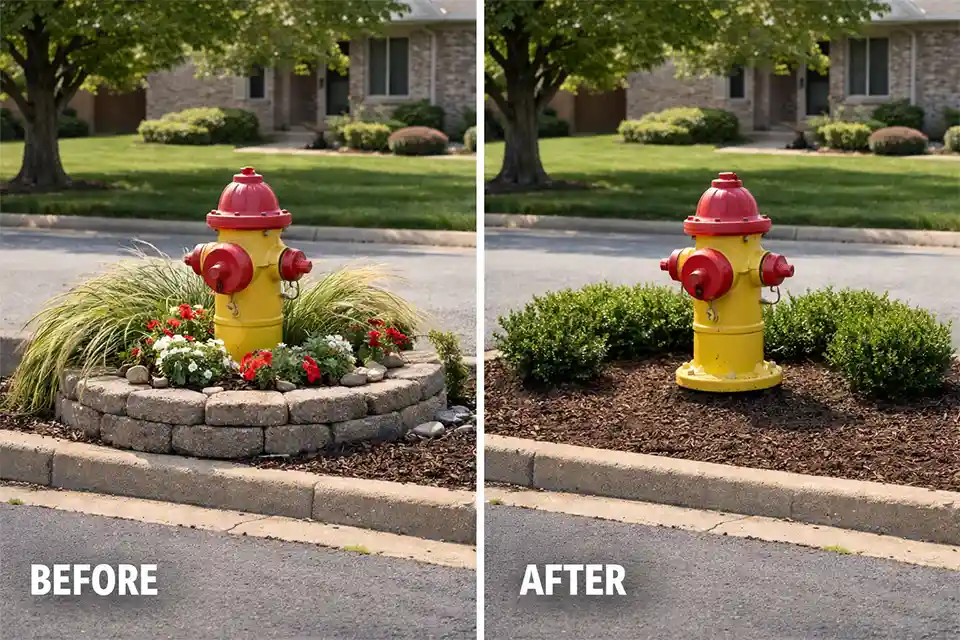
The decorative ring is the most common wasted fix. Shrubs, grasses, or stone wrapped around a hydrant nearly always look better on installation day than they do after one full growing season. By year two, the plants widen into the access area, the ring crowds the fixture, or the whole thing starts needing constant correction.
Street signs fail in a different way. One “small” shrub beside the post can stay technically alive and still be the wrong choice because it throws seasonal height exactly where the yard needs clarity. The problem is not only plant size on the label. It is spread, lean, bloom height, and how the plant behaves in July and August.
Pro Tip: Judge these beds from the driver’s angle and the sidewalk, not just from the house. Many weak layouts look fine from the porch and crowded from the street.
The Planting Formula That Usually Looks Best
The cleanest formula is also the most durable. Under about 18 inches of usable width, keep it plain. Between roughly 18 and 30 inches, use one repeated low plant plus mulch. Once you have more than 30 inches outside the protected zone, you can introduce a second layer farther back and let shrubs reach 30 to 48 inches where they are no longer competing with the hydrant or sign.
This is why odd leftover spaces often improve when they are treated with stronger geometry and fewer plant types, much like front yard design with irregular front yard boundaries does. Repetition looks deliberate. Mixed filler planting usually looks like compensation.
When to Keep It Plain
There is a point where adding more design in this exact spot stops helping. If the remaining bed is under about 18 inches wide, if the sight-line planting would need cutting more often than every 6 to 8 weeks, or if a raised edge would make hydrant access less direct, the better choice is to keep the area simple and move the main planting composition somewhere that can actually mature.
That is not giving up on curb appeal. It is choosing the part of the yard that can carry it.
For broader official guidance on traffic-control visibility and sign placement, see the Federal Highway Administration MUTCD.