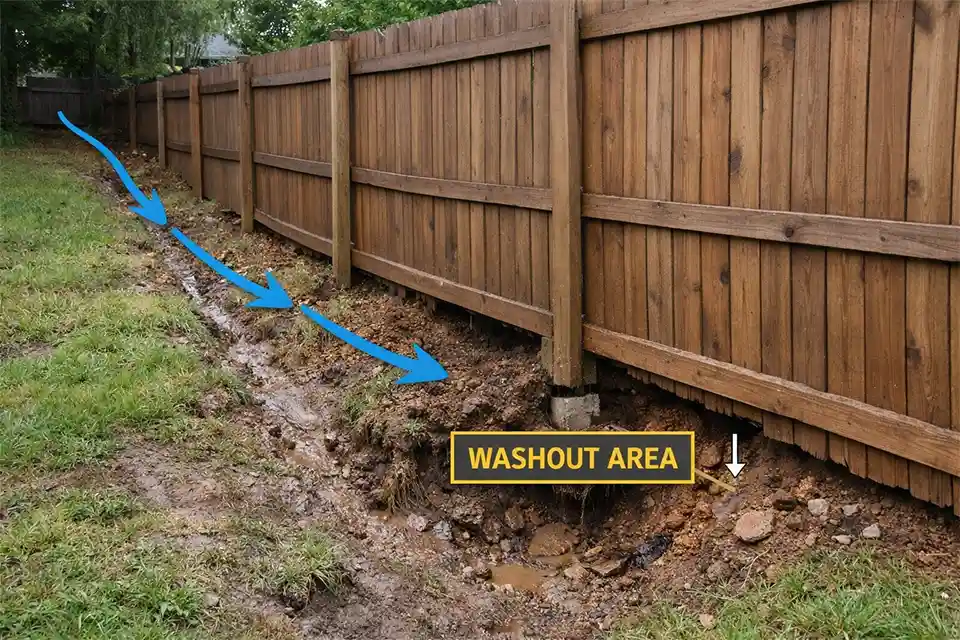
Fence line erosion on a sloped backyard usually starts as a runoff problem, not a fence problem. Water from the upper yard speeds up, finds the easiest path, and then uses the fence line as a weak edge, barrier, or channel.
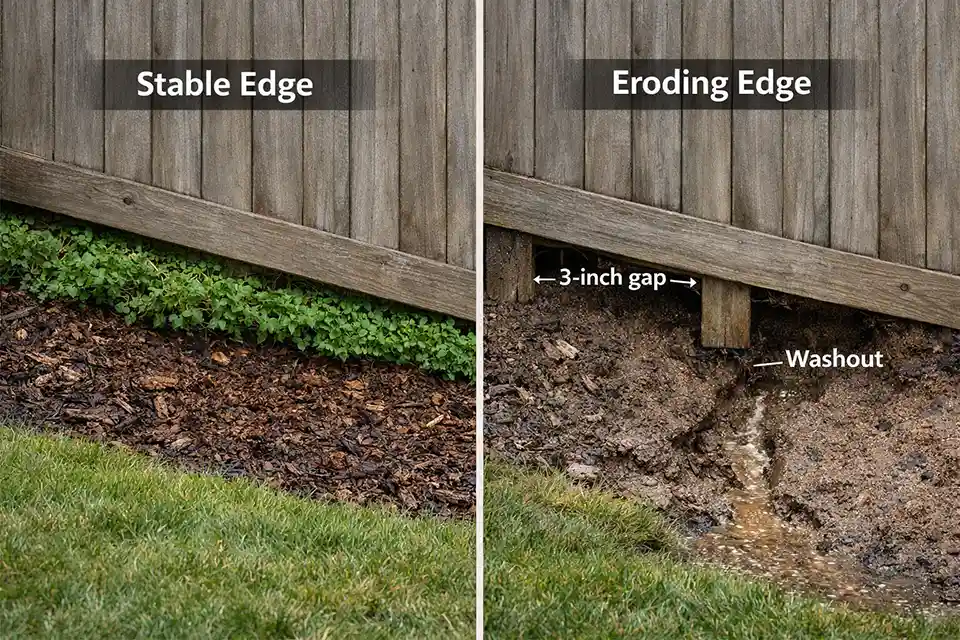
The first checks that matter are practical: a washout more than about 1 inch deep, a new gap under the fence wider than 2 to 3 inches, exposed post concrete, or soil that still feels soft 24 to 48 hours after rain.
If the same 6- to 10-foot section keeps washing out, this is no longer a cosmetic issue. It means water is being concentrated in the same place often enough to remove support.
That is where people lose time. They fill the gap, throw down fresh mulch, or reset one loose panel, and the area looks better for a week.
But if runoff still arrives with the same speed and angle, the fence line will keep failing. The real job is to interrupt the water path first, then rebuild and stabilize the edge.
Quick Diagnostic Checklist
- A narrow channel or scalloped void has formed under the fence.
- The downhill side is losing soil while the uphill side stays wetter.
- One or more posts have exposed footing or feel loose by hand.
- The gap under the fence keeps reopening after each storm.
- Water is arriving from an upper lawn, downspout, patio edge, or worn path.
- Mulch and loose soil keep disappearing while coarse gravel stays behind.
What People Usually Misread First
A loose fence is a symptom, not the mechanism
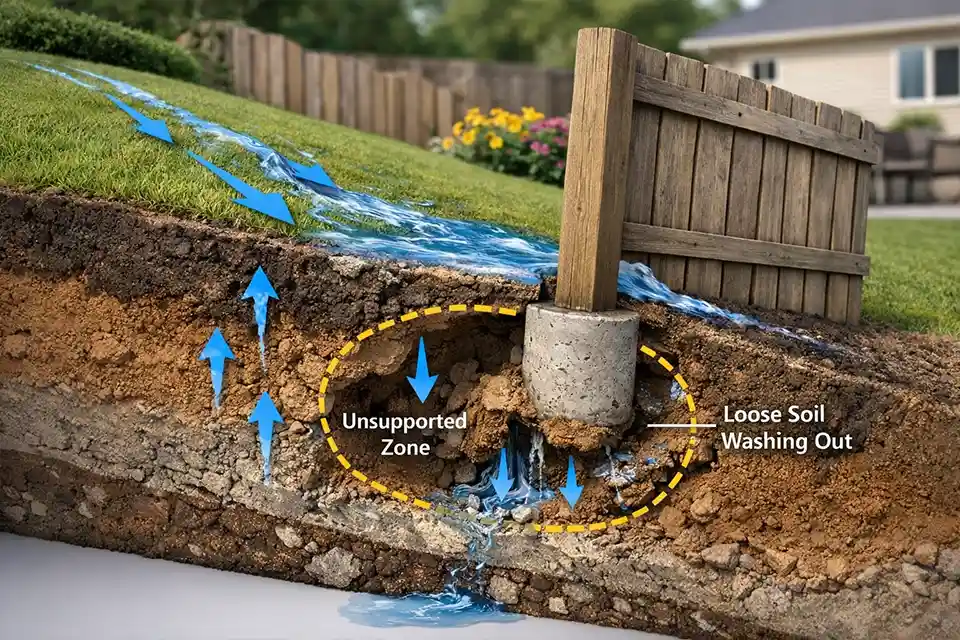
The leaning panel gets blamed first because it is obvious. But the panel usually moves after the soil holding the post starts disappearing. Fine particles wash out first.
Then the surface opens. Then the post loses side support. By the time the fence looks wrong, the erosion pattern is already established.
That is why the better question is not “How do I close the gap?” It is “What is sending water here?” In many yards, the answer is not dramatic.
It is compacted turf, a pet track, a downspout outlet, a worn shortcut, or a hard edge that dumps water into one narrow line. The fence just happens to be where the damage becomes visible.
Fence lines make runoff more organized
This is the part homeowners often underestimate. Water moving across an open slope may stay broad and relatively shallow.
Once it meets a fence line, bottom gap, post location, or slight grade change, it can start tracking in one preferred route. That route gets a little deeper with each storm.
A modest slope can still do this. You do not need a dramatic hillside. A yard with moderate grade, compacted soil, and repeated runoff can undermine a fence faster than a steeper yard with dense planting and slower water movement.
Why the Obvious Fix Fails
Filling the void is not a real repair
Fresh topsoil in the gap feels productive because it makes the failure disappear from view. It is also one of the most common wasted fixes.
Loose fill dropped into an active runoff path usually washes out first because it has no structure and no root hold. Mulch behaves the same way.
A 2- to 3-inch mulch layer can protect stable soil, but it does not anchor an edge that is already being cut by flowing water.
Gravel gets overused too. People notice the finer soil is gone and assume rock is the cure. Usually it is just what remained after erosion did its work.
Unless the gravel is part of an actual drainage design, it does not change the water path or rebuild support under the fence.
Replacing the fence first is backwards
If the post base keeps getting exposed, replacing the fence before correcting runoff usually means paying for the wrong phase first.
The fence is sitting in a failing edge condition. Until the water is intercepted, spread out, or slowed above the fence line, a new panel or reset post is inheriting the same geometry that caused the last failure.
There is an even more important boundary here: a fence is not a retaining wall. If one side has been backfilled so the fence is holding soil pressure, the problem is no longer just erosion under the fence.
It has become a small retaining issue, which is exactly where retaining wall failure signs on a sloped backyard becomes the more relevant comparison.
What Actually Fixes It
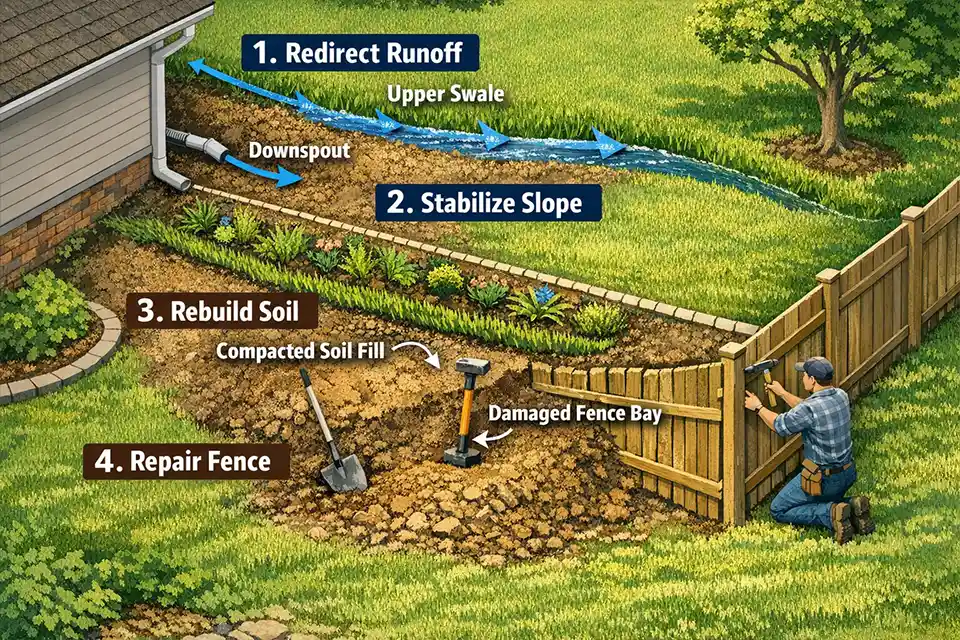
Step 1: Break the runoff path above the fence
The highest-value fix is usually upslope, not at the fence. If water is being delivered in one narrow stream, the first job is to spread it, slow it, or redirect it before it reaches the weak section.
That can mean extending or moving a downspout outlet, reshaping a worn path, correcting a hardscape discharge point, or adding a shallow swale above the fence line.
This is the decision that changes everything. If the same concentrated flow keeps reaching the same spot, surface repairs at the fence are just cleanup.
Step 2: Rebuild only the soil that was actually lost
Once the water path is corrected, rebuild the washed area rather than raising the whole fence line with loose fill. Shape the repair so water cannot immediately find a new low channel beside it.
If the washout is shallow, a compacted rebuild plus immediate cover may be enough. If the void is several inches deep around the post area, support needs to be evaluated before cosmetic grading means much.
Step 3: Separate temporary stabilization from permanent stabilization
Temporary stabilization protects exposed soil right away. This includes anchored straw, erosion-control blanket, pinned mesh, or another short-term cover that keeps the repaired surface from unraveling during the next storm cycle.
Permanent stabilization is what keeps the failure from returning. That usually means corrected runoff, a repaired grade, and rooted planting that can actually hold the slope.
This is where many people overestimate lawn grass. Turf can help, but concentrated runoff often outruns it. Dense-rooted grasses help knit the surface faster, spreading groundcovers help reduce surface exposure, and shrubs help create longer-term hold and friction along the slope.
This same runoff-first logic also shows up in backyard drainage problems most homeowners ignore, where surface fixes fail because the water path never really changed.
Pro Tip:
If you can visually trace the runoff from the upper yard to the washout, do not spend money on fence replacement first.
Which Fix Fits Which Failure Pattern
| What you see | What it usually means | Most sensible fix |
|---|---|---|
| About a 1-inch surface washout after one unusual storm | Minor surface loss | Light regrading, immediate cover, then monitor after the next rain |
| The same small trench returns after each storm | Concentrated runoff path | Intercept or redirect water upslope, then stabilize the edge |
| Gap under the fence reaches 2 to 3 inches or more | Ongoing soil migration | Correct drainage first, then rebuild the soil profile |
| Post concrete or footing is exposed | Structural support loss | Water control plus post and fence assessment |
| Soil is built up against one side of the fence | Fence acting like a retaining edge | Use a separate retaining solution, not just fence repair |
| Long bare slope feeds directly into the fence line | Too little friction and root hold | Add a planted stabilization band, blanket, or terrace logic |
When the Standard Fix Stops Working
Repeating the same repair in one season is the cutoff
If you have filled the same gap two or three times in one rainy season, the quick fix has already failed. The pattern is now repeatable. Water has chosen its route, and the fence line is not recovering between storms.
A second cutoff is structural movement. If a panel starts leaning, a post shifts noticeably by hand, or the washout depth gets into the 4- to 6-inch range around the support area, stop treating this like routine cleanup. At that point, water control and fence support need to be handled together.
Fence-line-specific damage that means the problem is escalating
A few signs matter more here than in general slope erosion:
- a pet-sized escape gap forming under one fence bay,
- one post beginning to stand out of line from the rest,
- repeated undermining under the same panel span,
- or a visible hollow under the fence even when the surface looks mostly intact.
Those are fence-line consequences, not just slope symptoms. They mean support is being lost in a way that will usually get more expensive, not less.
The same underlying pattern is common in sloped backyard problems with drainage, erosion, and safety, but along a fence line the damage gets noticed earlier because the boundary starts losing alignment.
Call for help sooner when the risk stops being cosmetic
Professional help makes more sense when the erosion is moving toward a patio, footing, or neighboring property line, when the fence is carrying backfilled soil, or when every heavy rain recreates the same washout.
One practical detail that often gets missed: some “fixes” only push runoff toward a neighbor. That can trade one problem for another very quickly.
The repair order that saves the most money
The right sequence is simple: redirect water, stabilize the slope, rebuild only the lost soil, then repair fence components that actually lost support. Reverse that order and the fence becomes the most expensive part of a drainage problem.
Fence line erosion looks small until the ground starts moving under a boundary that needs to stay straight and supported. Once that happens, this is no longer a “close the gap” task. It is a runoff-control problem with a fence attached to it.
For broader official homeowner guidance on capturing and slowing runoff, see the University of Minnesota Extension rain garden guide.