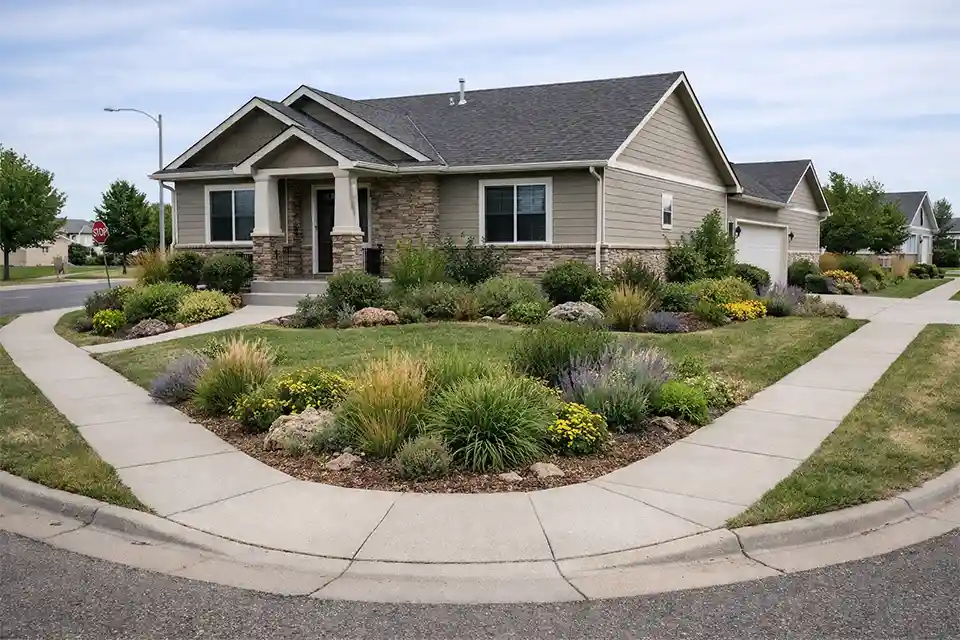
Most corner-lot front yards do not become difficult because they are too small. They become difficult because two street-facing sides create two different design jobs, and most layouts treat them as one.
One frontage usually needs to direct attention to the house. The other has to carry a longer public edge without turning into a second front entrance. When those roles get blurred, the yard starts feeling exposed, fragmented, and harder to control from the street.
Start with three checks before thinking about plants. First, stand about 20 to 35 feet away on both street approaches and see which side actually leads the eye to the front door.
Second, measure how much planting depth remains after sidewalks, curb strips, utility space, and corner visibility clearance are accounted for. On many corner lots, a bed that looks 7 to 9 feet deep on paper shrinks to 3 to 5 usable feet fast.
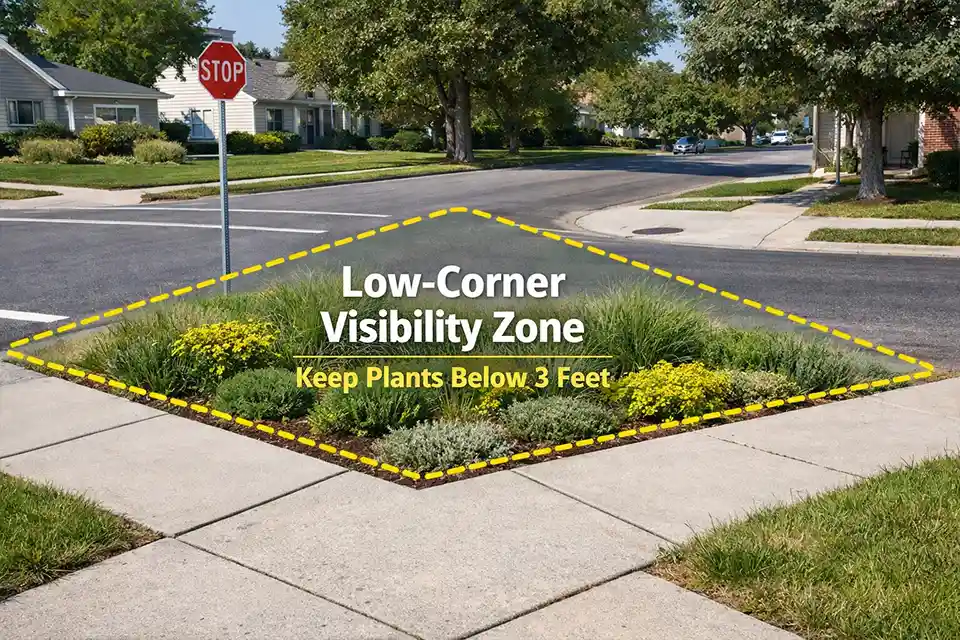
Third, identify the corner zone that usually needs to stay low, often around 24 to 30 inches in height, so the lot does not start working against intersection sightlines.
That is what separates this from a general curb-appeal problem. This is not mainly about adding more plants, and it is not mainly about privacy. It is about assigning different jobs to two visible frontages and refusing to let the wrong side dominate the lot.
Why Two Street Frontages Change the Whole Layout
A standard front yard usually has one obvious public face. A corner lot with two street frontages does not. It has an entry side, a side-street edge, and a corner zone that often sits under visibility pressure. Those spaces are connected, but they should not be treated as equals.
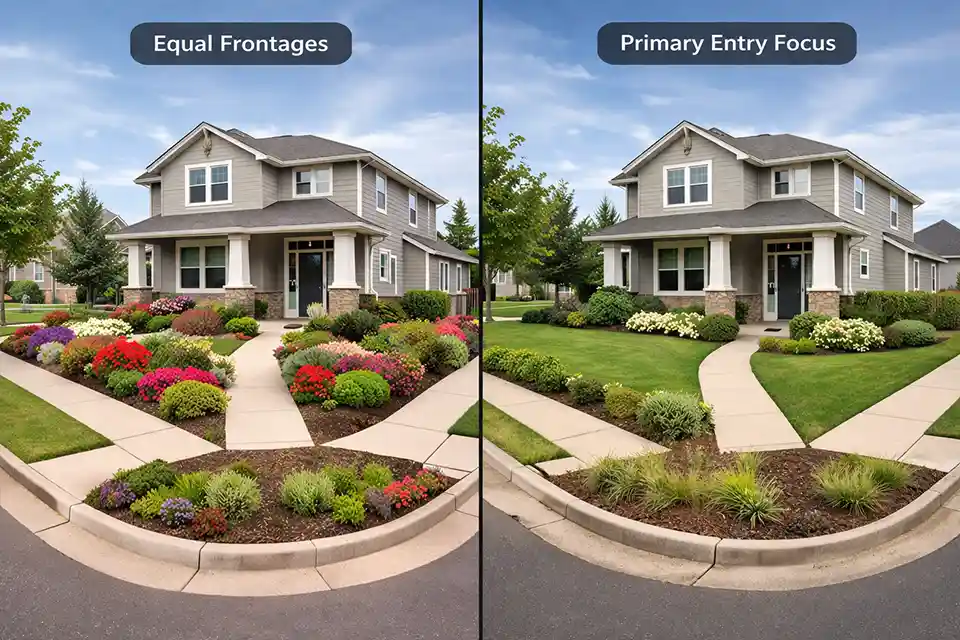
This is where many layouts start going wrong. Homeowners try to make both street sides feel equally “finished,” so they mirror beds, repeat focal shrubs, or spread decorative accents across both frontages. That sounds balanced. In practice, it usually weakens the house-facing side and overworks the side-street edge.
The more useful priority is not total square footage. It is public-facing edge length. A lot with 140 to 180 linear feet of street-facing perimeter behaves very differently from a lot with one main frontage. There is more exposed border to define, more bed line to hold, more lawn perimeter to mow, and more opportunity for one weak stretch to make the whole yard look unfinished. That overlap is part of why corner lot front yard maintenance problems appear earlier than people expect.
What readers often overestimate here is privacy. What they underestimate is hierarchy. A yard can feel too open even before screening is the right fix, simply because both street sides are visually flat and equally demanding. If the eye has nowhere clear to settle, the whole lot feels less intentional.
Which Frontage Should Do the Real Visual Work
The entry frontage should usually carry more compositional weight. This is the side that needs to make the house legible from the street and from the walk. If one side aligns more clearly with the front door, porch, or primary windows, that side deserves the deeper bed, the stronger plant layering, and the more deliberate vertical structure.
The side-street frontage has a different job. It should extend the site visually without acting like a second entrance composition. That usually means longer masses, fewer changes, and more repetition. When the side frontage is broken into short decorative moments every 6 to 8 feet, it stops reading as structure and starts reading as leftover effort.
One practical threshold helps here. If the first 25 feet of the side-street frontage contains more than three major changes in bed shape, material, or plant type, the layout is probably already too fragmented.
The same is true when the frontage relies on several narrow pockets only 2 to 3 feet deep. Those are not strong design moves. They are usually attempts to decorate around weak geometry.
This is also where hedge logic gets overused. Screening can help in the right place, but many corner lots do not have the bed depth or visibility freedom to support it where people want it.
If the usable bed depth is under about 4 feet, a hedge that matures to 4 to 6 feet wide is already a poor fit. On lots like that, broader screening advice from front yard landscaping for privacy without fences only works if the sightline pattern and available width are genuinely there.
What Usually Fails on the Side-Street Frontage
The side-street frontage usually breaks down in one of three ways.
The first is overdesign. People keep adding variety because the long visible edge still feels bare. They add ornamental grasses, flowering pockets, accent shrubs, maybe a stone change or another curve.
The frontage becomes busier, but not stronger. In most cases the long side needs fewer decisions, not more. Repeating one shrub or grass mass across 12 to 18 feet usually does more than mixing five plant types across the same run.
The second is underscaled bed depth. Once average planting depth falls below about 30 to 36 inches, the frontage often stops functioning as a real planting zone and starts functioning as a maintenance strip. It dries faster, shows mulch loss faster, and gives plants too little room to overlap into a stable mass.
That same pattern shows up in small front yard planting beds that are too small to stay low-maintenance, but it becomes harsher when the strip sits along a second street-facing side.
The third is weak off-season structure. A side frontage can look acceptable for 10 to 12 summer weeks and thin the rest of the year. Corner lots punish that mistake quickly because the yard is visible from more angles and for more of the day. If the side edge only works in peak growth, it is not doing enough.
Pro Tip: Photograph the side-street frontage from the sidewalk and from a car-height view about 25 to 40 feet away. If the planting dissolves into scattered dots at that distance, it needs larger repeated masses, not more species.
Why the Corner Visibility Zone Gets Overdesigned
The intersection-facing corner is where many homeowners try hardest to make the yard look interesting. It is also where restraint usually matters most.
This zone often needs to stay low for practical visibility reasons, especially near stop signs, driveways, or active intersections. That alone makes it a weak place for ambitious screening, dense shrubs, or tall ornamental grasses. If the corner planting wants to rise above roughly 24 to 30 inches, it may already be asking the site to do the wrong thing.
What gets misread here is the word “empty.” A low corner zone can feel sparse when it is first planted, so people keep adding height, texture, or decorative objects.
Most of those additions do not create structure. They create clutter. The reader passing by should not have to decode the corner. It should read quickly and cleanly.
A second mistake is giving the corner more visual energy than the entry side. Once that happens, the wrong part of the lot becomes the focal event. The house loses hierarchy, and the side frontage starts competing with the place people actually enter.
That is why the corner should usually be one of the quietest parts of the yard, not one of the most designed.
A Better Layout Logic for Entry Side vs. Side-Street Side
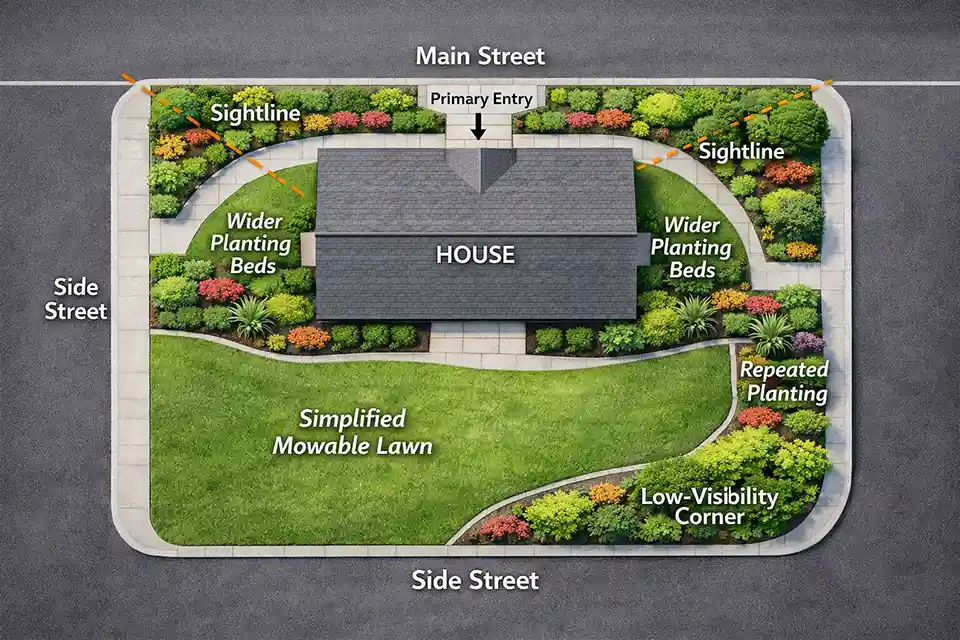
The cleanest corner-lot layouts usually divide the yard into four roles.
The entry frontage leads attention to the house. This is where deeper layering earns its place, where one vertical accent may help, and where the strongest composition should sit.
The side-street frontage carries the lot over distance. This is where repetition, wider simpler beds, and fewer ornamental decisions usually work best.
The visibility corner stays low, quiet, and legible. It should support clear sightlines rather than compete with them.
The residual zones absorb awkward geometry. These are the narrow strips near utilities, the leftover wedge between lawn and sidewalk, or the odd transition pieces that never benefit from becoming mini feature beds. They should be simplified, not showcased.
| Zone | Main job | Usually works better | Usually fails |
|---|---|---|---|
| Entry frontage | Organize the house visually | Deeper layered planting, 2 to 3 dominant groups, stronger walk emphasis | Trying to match the side frontage |
| Side-street frontage | Carry the lot over distance | Repetition, wider simpler beds, fewer changes | Small decorative pockets and too many accents |
| Visibility corner | Preserve clear sightlines | Low plants, calm ground plane, restrained detail | Dense shrubs, screening, tall grasses |
| Residual zones | Absorb awkward space | One quiet treatment or groundcover | Turning every leftover area into a feature |
This is also the point where symmetry stops helping. Symmetry sounds reasonable when both street sides are visible, but the two frontages are not doing the same work. Designing them as equals usually makes the house less clear, not more refined.
A related version of that problem appears in front yard design ideas for suburban homes, where visible frontage still needs stronger visual priority. Corner lots simply make the mistake easier to see.
Quick Diagnostic Checklist
Your layout likely needs simplification before it needs better plants if:
- both street frontages feel equally important
- the front door does not read clearly from both street approaches
- the side frontage breaks into many short bed segments
- the corner zone relies on plants that want to exceed 30 inches
- the lawn contains narrow wedges or sharp points that are awkward to mow
- the side-street frontage works only in peak season
If three or more of those are true, the issue is structural first.
What to Simplify First
Do not start by shopping for more plants. Start by removing layout pressure.
First, reduce fragmentation. Combining two or three shallow beds into one wider bed often improves the lot faster than replacing plant material ever will. Widening a bed from 2.5 feet to 5 feet creates room for overlap, repetition, and more stable mulch coverage.
Second, reduce lawn complexity. On corner lots, a slightly smaller lawn can be a better lawn if it becomes easier to mow and easier to read from the street. Losing 10% to 15% of lawn area is often worth it if what remains stops tapering into thin corners and points.
Third, protect edges early. With two public-facing sides, the yard has more exposed perimeter that can shift, wash out, or look ragged. If bed lines are unstable, the whole design will look tired even when the plant palette is fine. That is why front yard edging that keeps shifting matters more on exposed corner lots than many homeowners expect.
Fourth, resist the urge to “finish” the side frontage with detail. The side street usually improves when it becomes calmer, not fuller.
Pro Tip: When one side still feels empty after the layout is simplified, add mass before you add variety. A larger repeated block almost always reads better than another small accent.
Conclusion
The real challenge on a corner lot with two street frontages is not making both sides look equally finished. It is giving each side a different job and refusing to let the wrong one take over. When the entry frontage leads, the side frontage simplifies, and the corner stays restrained, the whole lot starts looking more intentional with less effort, not more.
For broader official guidance on residential corner visibility and street-edge safety, see the Federal Highway Administration.