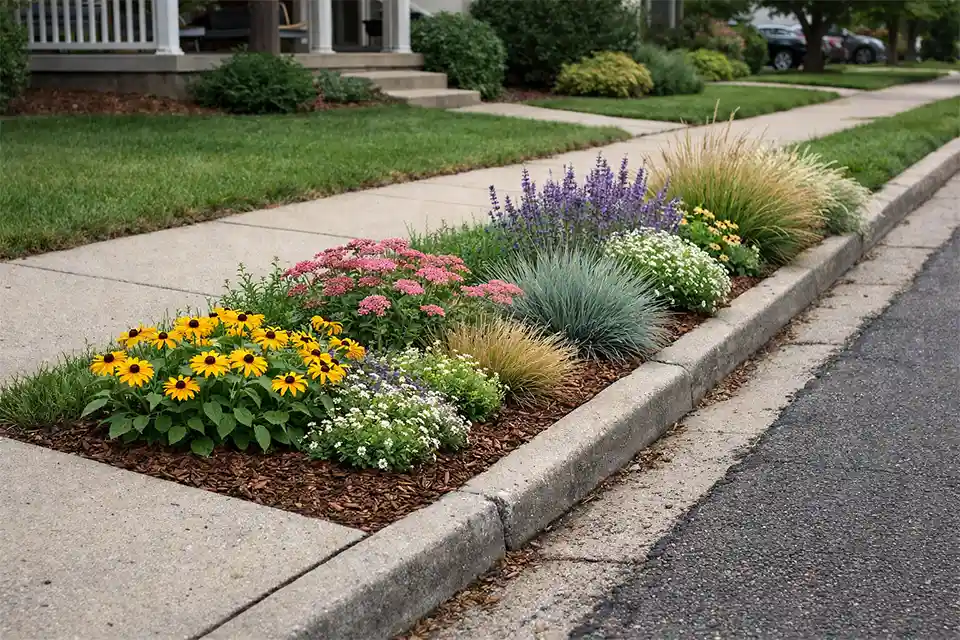
The best plants for a narrow strip between the sidewalk and street are compact plants that handle shallow soil, reflected pavement heat, and repeated edge stress without flopping into the path.
In most cases, the right answer is not a lush mixed border. It is a tight, durable planting that still fits in August.
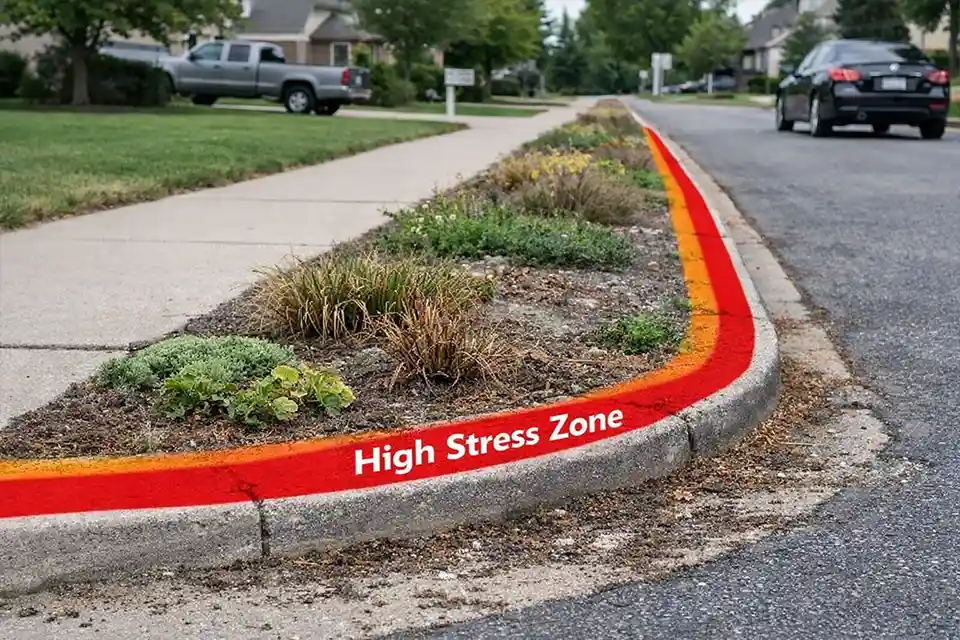
Start with three checks. Measure the strip at its narrowest point, not its average width. Watch whether the curb-facing edge gets blasted from about 2 to 5 p.m. by stored pavement heat.
Then check how fast the top 2 inches of soil dry after a deep watering. If that zone dries again within 24 to 36 hours in warm weather, treat the bed as a harsh roadside planting strip, not a normal sunny flower bed.
Best starting picks for most narrow strips
If you want the shortest useful answer, start with these five. They are the safest first choices for most narrow strips between sidewalk and street:
- creeping thyme
- low sedum
- blue fescue
- compact carex
- yarrow
These five work because they stay relatively compact, tolerate leaner conditions, and are less likely to turn a narrow strip into a trimming problem.
Five more good options when the strip is a little more forgiving
If the strip is closer to 18 to 36 inches wide, or the site is less punishing, these are strong supporting choices:
- hens-and-chicks
- dianthus
- catmint
- salvia
- hardy geranium
This second group is still useful, but it depends a bit more on width, heat load, and how much edge correction the site needs.
Match plant choice to strip width first
For strips under about 18 inches, the safest choices are creeping thyme, low sedum, hens-and-chicks, blue fescue, and compact carex. The goal here is not dramatic bloom. It is keeping the planting low, stable, and out of the sidewalk.
Once the strip reaches 18 to 36 inches, you get enough room for compact drifts. This is where catmint, salvia, yarrow, hardy geranium, dianthus, and sedum mixes usually outperform bigger, softer plants.
One helpful rule: if a plant’s mature width leaves less than about 6 inches of clearance from the curb or sidewalk edge, it is too big for the site.
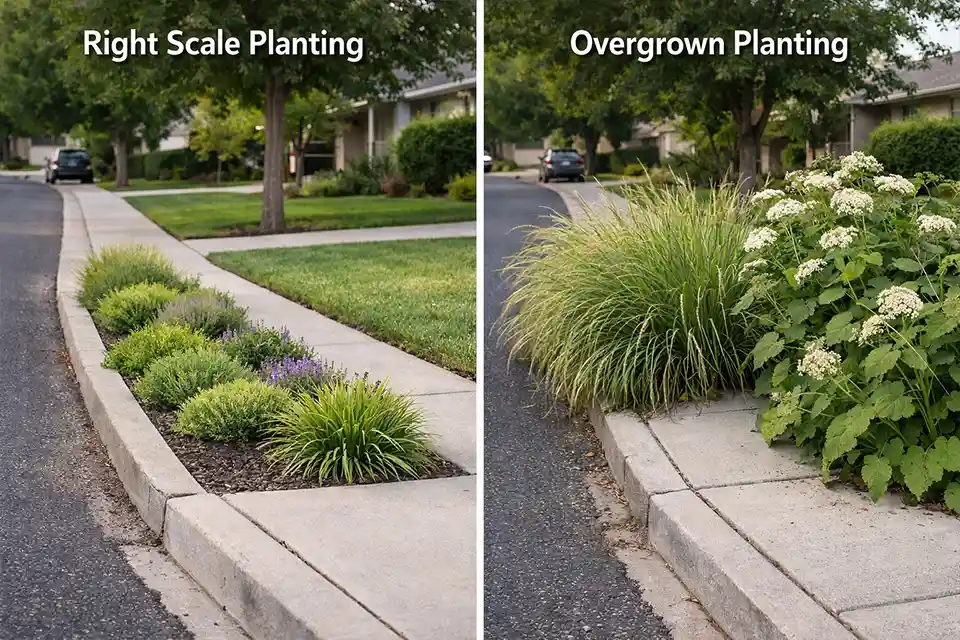
What usually fails first
Broad shrubs are often the wrong answer
This is where people lose time. Even small shrubs are often overestimated in narrow strips. They may fit on planting day, but by the second growing season they start pushing into the sidewalk, blocking sightlines, or needing constant shearing.
In a strip that may only be 2 to 3 feet wide, compact perennials, sedges, and dwarf grasses usually outperform woody plants because they recover better from heat, splash, and occasional physical damage.
That same logic overlaps with Best Front Yard Plants Around Tree Roots and in Little Soil, where root space matters more than people first assume.
Fast spreaders usually create the wrong kind of success
Plants that “fill the strip fast” are often the wrong winners. They solve the empty look for a few weeks, then create a maintenance problem for the rest of the season.
If a plant needs trimming every 2 to 3 weeks just to stay out of the sidewalk, the issue is not upkeep discipline. The plant was wrong for the strip.
Lawn is commonly overestimated
A lot of homeowners still try to make turf work in these spaces. It usually looks simple on paper, but narrow curbside turf often fails because the edges dry first, the soil stays compacted, and the grass takes repeated traffic and heat from both sides. In the tightest beds, lawn is often less durable than a restrained planting palette.
How to choose by real site conditions
If the strip gets intense afternoon heat
The curb-facing side is usually the first part to fail. Foliage can scorch there even when the rest of the plant still looks acceptable. In these strips, sedum, thyme, dianthus, yarrow, salvia, and blue fescue usually make more sense than broad, thirsty, soft-leaved perennials.
This is why the logic overlaps so closely with Best Plants for Front Walkways Next to Hot Concrete and How to Choose Front Yard Plants for Blazing Afternoon Sun. The shared issue is not just sun. It is stored hardscape heat.
If the strip takes foot traffic or shortcut damage
Plants near the edge need some physical resilience. Low tufting plants and tighter clumps usually hold up better than brittle stems or thorny forms.
Where people cut across the bed, clean spacing and tougher ground-hugging plants work better than soft ornamental drifts. That is also why Front Yard Plants for Sidewalk Shortcut Traffic is closely related to this topic.
If the strip is in a cold climate with salt splash
In northern states, winter road salt changes the plant list. Salt spray and snow pile stress can turn an otherwise workable perennial into a repeat failure. Tougher sedums, yarrow, and resilient grasses or sedges usually make more sense here than tender foliage plants.
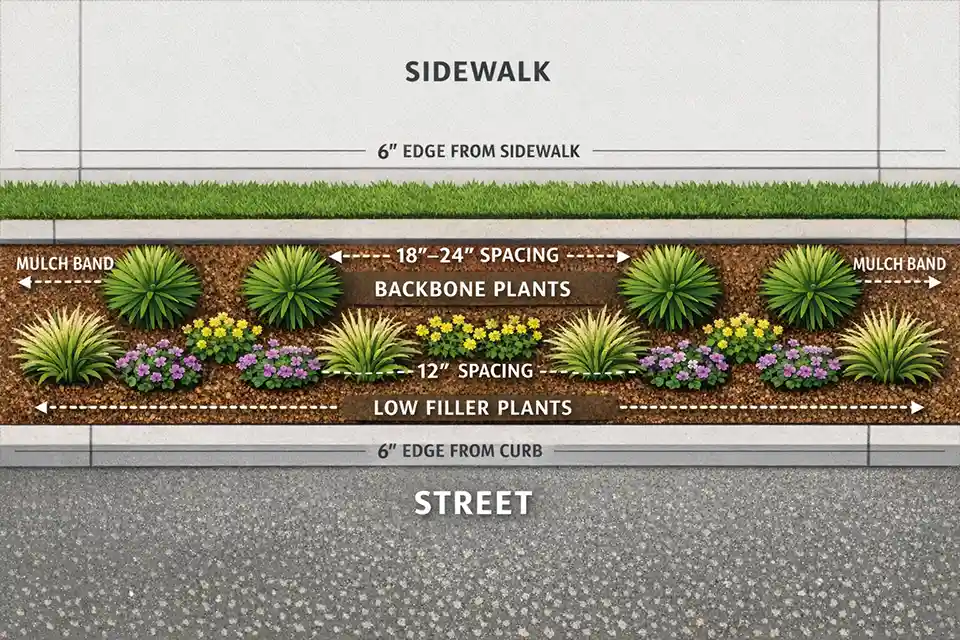
A planting layout that stays easier to manage
Repetition works better than variety
One of the most common mistakes is planting this strip like a miniature cottage garden. It looks generous at first, then the strip starts choosing winners and losers for you.
A better layout is usually:
- one backbone plant spaced 18 to 24 inches on center
- one lower filler spaced 12 to 18 inches on center
- 2 to 3 inches of mulch
- clear edge space along both hardscape sides
That structure fills in cleanly, stays readable from the street, and lowers correction work.
Pro Tip: In narrow strips, fewer plant varieties usually look better by July than a mixed planting that looked exciting in May.
Build for mid-summer, not planting day
Spring can mislead you. A strip that looks roomy in April can already feel crowded after 8 to 10 weeks of active growth.
Before planting, loosen the soil to about 8 to 10 inches where possible. Then water deeply 1 to 2 times per week for the first 6 to 8 weeks, adjusting for heat and rainfall. If the planting is already pressing hard into the sidewalk by early summer, the problem is scale, not watering.
| Strip condition | Best direction | Usually avoid | Why |
|---|---|---|---|
| Under 18 in. wide | Thyme, sedum, hens-and-chicks, fescue, carex | Broad shrubs, floppy perennials | Not enough lateral room |
| 18–36 in. wide | Catmint, salvia, yarrow, dianthus, hardy geranium | Fast spreaders, oversized mounds | Edge spill becomes constant |
| Intense afternoon heat | Sedum, thyme, yarrow, salvia, fescue | Soft thirsty foliage plants | Pavement heat compounds stress |
| Salt splash or snow pile zones | Sedum, yarrow, tougher grasses and sedges | Tender foliage plants | Winter damage repeats |
| High-visibility corners | Mostly keep plants under 18 to 24 in. | Tall masses and woody forms | Sightlines matter more than fullness |
What people usually misread first
They think it is just a watering problem
A true dry-down issue improves when the full root zone is rehydrated. A plant mismatch keeps repeating in the same pattern. The curb-facing edge scorches first. The same species fails again in the same band. The outer side declines before the inner side.
That is the point where “water more” stops being a real fix.
They underestimate code, utility, and sightline limits
This strip is not just a garden bed. In many areas it is also part of the right-of-way. That means local rules, buried utilities, and visibility constraints can matter as much as plant performance.
Near corners, driveways, hydrants, and street signs, lower plant heights are usually the smarter choice even before aesthetics enter the conversation.
If the site is extremely narrow, utility-prone, or constantly disturbed, simplify the planting instead of forcing a lush look.
A narrow front yard strip between sidewalk and street works best when you stop treating it like a miniature flower border.
The strongest plant choices are usually low, repeatable, heat-tolerant, and disciplined enough to stay inside the space without constant correction. That restraint is what makes the strip look better, not emptier.
For a practical guide to choosing and managing a true hellstrip garden, see Penn State Extension.