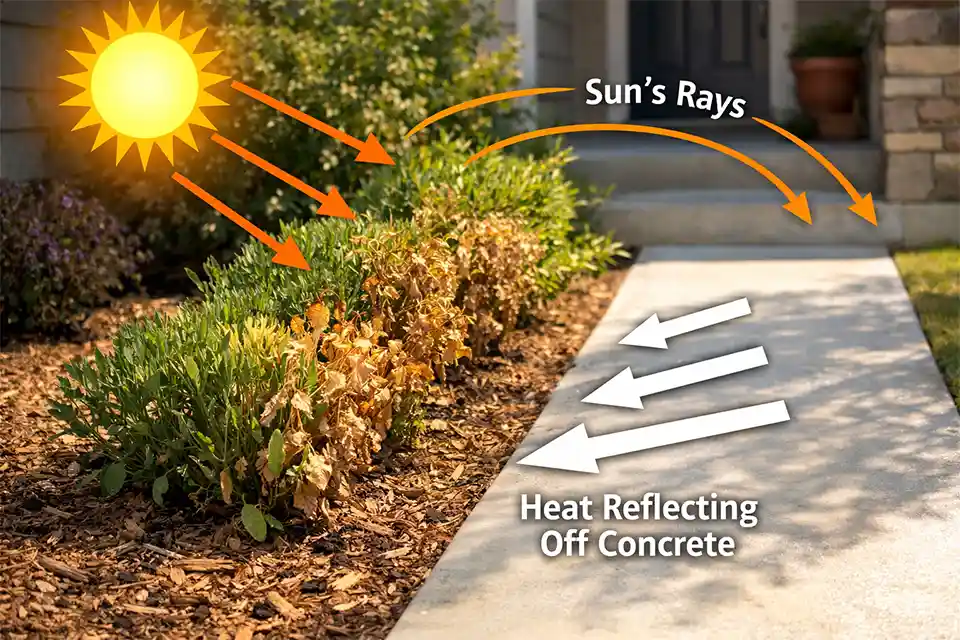
If plants keep burning out along a front walkway next to hot concrete, the problem usually is not ordinary full sun. It is reflected and stored heat.
Concrete, pavers, and masonry absorb sun for hours, then throw heat and glare back into a planting strip that is often too narrow to protect roots and foliage. That is why a plant that survives elsewhere in the yard can still scorch a few feet from the front door.
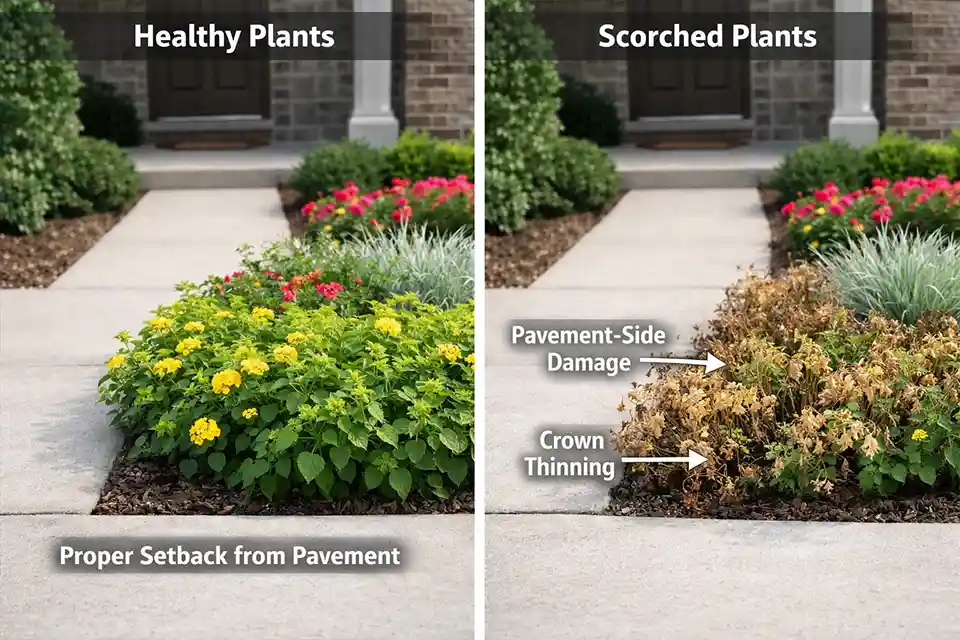
The first clues are usually consistent: damage is worse on the walkway-facing side, stress peaks around 2 to 5 p.m. instead of noon, and decline builds after 3 to 4 hot days in a row rather than after one missed watering.
That distinction matters because the wrong fix is usually more frequent watering. A drought problem improves when the full root zone gets rehydrated.
A reflected-heat problem often keeps repeating even when deeper soil still holds some moisture, because the real issue is site mismatch: the plant sits too close to heat-radiating hardscape, the bed is too tight, or the plant choice is softer than the location allows.
Best plants for reflected heat along a walkway
The best plants for this spot are not just drought tolerant. They also need to hold their shape near a path, tolerate radiant heat from the side, and stay functional in a root zone that heats and dries faster than a normal border.
The traits that matter most
Prioritize plants with small or narrow leaves, silver-gray or leathery foliage, compact mounded growth, and mature sizes that do not need constant shearing. Along a walkway, durable foliage matters more than flower power. In these beds, the first failure is usually leaf scorch and loss of tidy form, not lack of bloom.
Safer starting picks by climate
Use climate as a filter, not a side note. A plant that thrives beside hot paving in Arizona is not automatically the safest choice for humid summer conditions in the Southeast.
| Climate pattern | Safer starting picks | Usually less reliable in this setting |
|---|---|---|
| Hot-dry Southwest | autumn sage, lantana, damianita, trailing rosemary, compact yucca | hydrangea, impatiens, coleus |
| Hot-humid Southeast | dwarf lantana, society garlic, bulbine, gaura, compact muhly grass | lavender in wet clay, thirsty annuals |
| Mixed heat with colder winters | catmint, sedum, yarrow, coreopsis, blue fescue | moisture-hungry perennials near concrete |
| Very narrow edging strips | creeping thyme, low sedum, compact dianthus, santolina | floppy salvias, wide fillers |
“Heat tolerant” is not enough. The plant also has to tolerate reflected hardscape heat, tight root space, and the visual discipline a front walkway demands.
What people usually misread first
Most failed walkway beds get diagnosed as irrigation problems first. Sometimes that is true. Often it is only part of the story.
Symptom versus mechanism
Wilting is the symptom. Heat load is the mechanism.
If the soil is dry 3 to 4 inches down by early morning, watering clearly needs work. But if the top inch is dry, deeper soil still has some moisture, and leaves are crisping anyway, daily light watering usually wastes time. The plant is overheating in place, not simply running out of water.
A second common mistake is trusting “full sun” too literally. Full sun in an open bed is not the same as full sun next to pale paving that throws light and heat sideways for hours.
That is why plants that cope elsewhere in the yard still fail in exposures similar to How to Choose Front Yard Plants When Your Yard Gets Blazing Afternoon Sun.
Why some walkway beds keep failing
There is usually a site limit people underestimate before there is a plant limit.
Bed width changes the odds
Once the planting strip drops below about 18 inches wide, your options narrow quickly. At 12 inches or less, the bed behaves more like a hot edge than a real planting zone. At 24 inches or more, performance usually improves because crowns and upper roots sit farther from the hottest surface and mulch has room to buffer temperature swings.
Mature size matters more than extra bloom
A plant that matures 24 inches wide in a 14-inch bed creates two problems at once. It leans into the path, then gets repeatedly cut back. That repeated shearing pushes soft new growth, and soft new growth is often what scorches first. Along front walks, plants with a mature spread around 12 to 18 inches are often easier to keep both healthy and tidy unless the bed is unusually wide.
That same durability logic is why tougher, lower plants often outperform prettier but weaker choices in edge conditions like those discussed in What Plants Work Best in a Front Yard with Heavy Foot Traffic from Sidewalk Shortcuts.
The surface around the plant changes the outcome
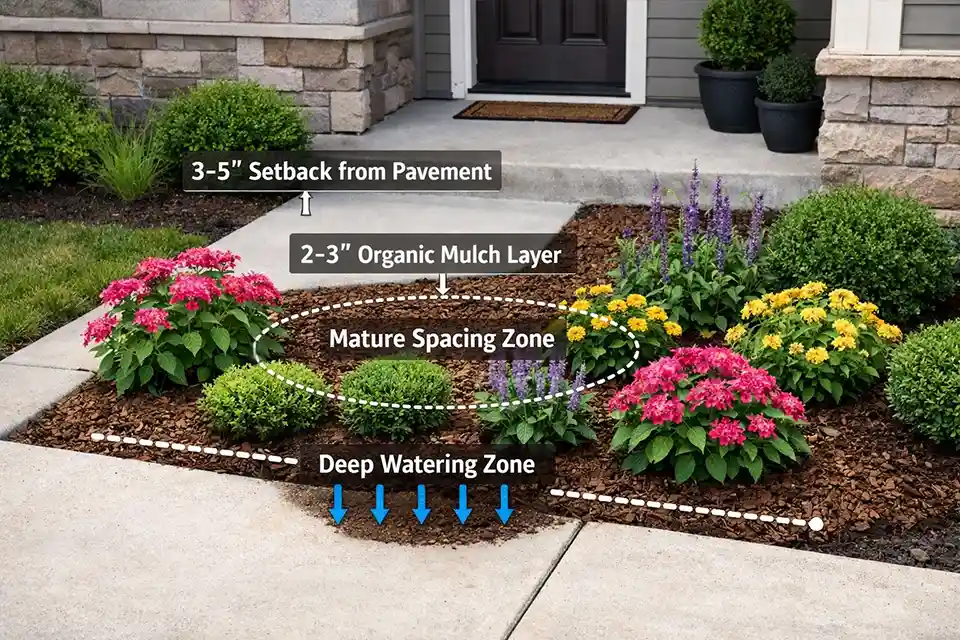
A 2- to 3-inch layer of organic mulch helps moderate soil temperature swings and slows evaporation. Decorative rock near already stressed plants often makes hot reflective zones harsher. People usually underestimate how much heat a bright walkway and a stony surface can keep cycling back toward tender foliage.
Pro Tip: The hottest walkway beds usually perform better when the first plant crown sits about 3 to 5 inches back from the pavement instead of being planted right against the edge.
The best categories for a front entry that still looks controlled in August
The strongest results usually come from a limited palette, not a mixed collection of whatever the garden center labeled “sun loving.”
Strongest categories for structure and survival
The most dependable categories are:
- compact shrubby salvias
- lantana in warm climates
- low sedums and stonecrops
- catmint in regions with colder winters
- yarrow where drainage is decent
- compact ornamental grasses such as blue fescue or dwarf muhly
- thyme and similar low aromatic edge plants for very lean sunny strips
These choices tend to hold up because they combine heat tolerance with disciplined shape.
Plants that often disappoint here
Hydrangeas, impatiens, coleus, soft annual fillers, and other moisture-hungry choices are usually the wrong bet unless the walkway gets meaningful afternoon shade. Lavender is also overrecommended. It can be excellent in hot, sharply drained soil, but it is not a blanket answer for humid climates or sticky clay beds.
If tree roots or shallow soil are also part of the problem, the site gets harsher again, which is why some walkway strips overlap with the same constraint pattern covered in How to Select Front Yard Plants When Tree Roots Make Digging and Soil Depth a Constant Problem.
How to plant so you stop repeating the same failure
Install for the site you have, not the picture you want
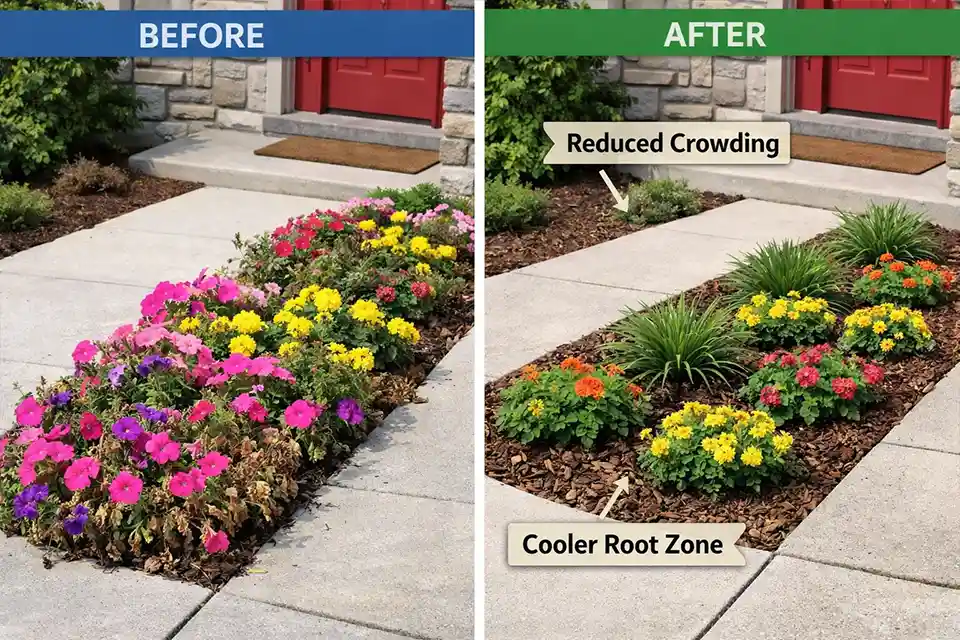
Use fewer plants than you think. Space for mature width, not nursery-pot fullness. Keep crowns off the hottest edge. Do not over-amend a narrow hot strip into a soft pocket that dries unpredictably. In these beds, restrained planting usually outperforms lush planting.
Water deeper, then back off
For the first 6 to 8 weeks after planting, deep soakings work better than light daily sprinkles. As a practical starting point, water when the top few inches have dried and soak deeply enough to move moisture farther into the root zone. After establishment, a plant that still collapses every hot afternoon despite proper watering and mulch is usually telling you the site match is wrong.
One of the most useful distinctions is recovery speed. If the plant rebounds by the next morning, stress may still be manageable. If leaf scorch keeps building and recovery slows week by week, stop treating it like a minor irrigation tweak.
When the standard fix stops making sense
Some walkway beds are simply too harsh for the lush look people keep trying to force.
Signs the site is harsher than it looks
If the bed is under 12 inches wide, faces west, gets more than about 6 hours of summer sun, sits next to pale concrete or masonry, and has already burned through plants over at least one full growing season, the better move is usually not better care. It is a different design expectation.
A restrained scheme of sedum, thyme, compact salvia, or dwarf grasses often looks modest at planting time but far better after a week of 95°F afternoons.
The point where replacement should become simplification
When even tougher perennials keep scorching, the answer may be fewer plants, wider mulch buffer, and less foliage close to the hardscape. That can feel like settling, but in reflected-heat beds, restraint usually outperforms lushness.
If your walkway is cooler and shaded for much of the day, the better comparison is the opposite condition covered in What to Plant in a Front Yard That Stays Shaded by the House Most of the Day.
Quick checklist before you replant
Replant only if most of these are true
- The bed is at least 18 inches wide
- Scorch is strongest on the walkway-facing side
- Damage builds after several hot days, not one dry day
- Mature plant width fits the bed without constant trimming
- You are using about 2 to 3 inches of organic mulch
- The first crown sits a few inches back from the paving
- The plant choice matches your climate, not just a generic full-sun tag
If fewer than four of those are true, fix the site logic before buying more plants.
The best planting for a front walkway next to hot concrete is usually the one that looks slightly restrained in spring and still looks controlled after the hardest stretch of summer. In this spot, toughness, mature size, and spacing discipline matter more than bloom count.
For mulch guidance that matters in hot, exposed planting beds, see Virginia Cooperative Extension’s mulching guide.