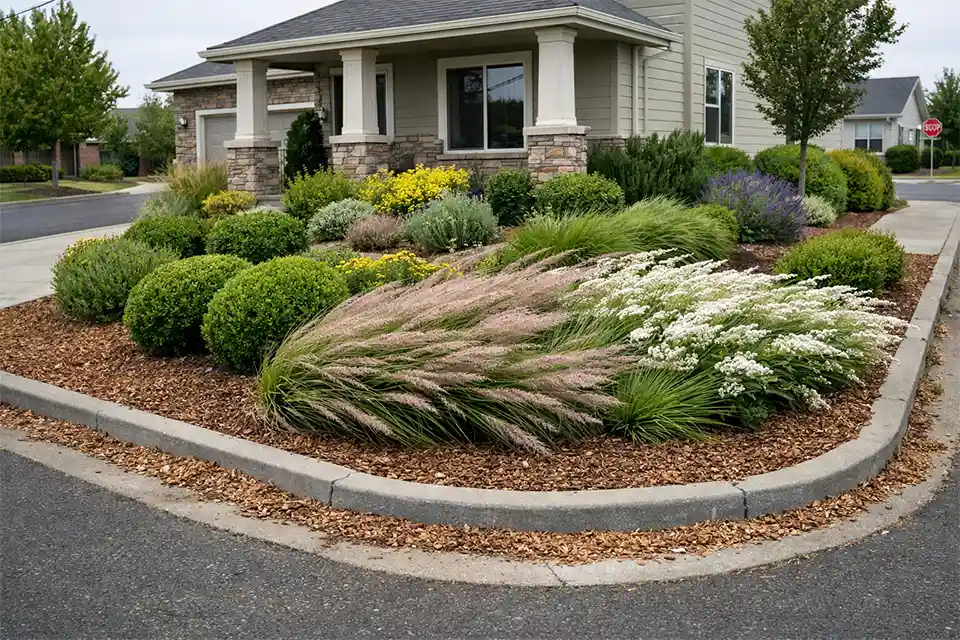
If plants keep leaning, shredding, or drying out on a corner lot, the problem usually is not one bad variety. It is repeated exposure from two open street sides, faster moisture loss, and a bed that is asking for lower, denser, tougher structure than most people first plant.
Start with three checks. First, does the outer edge dry out 24 to 48 hours faster than beds near the house? Second, is leaf damage heavier on the street-facing side instead of evenly across the plant?
Third, do plants over about 24 to 30 inches start looking ragged by midseason even when they are still alive? If yes, wind is acting as a constant site condition, not an occasional weather event.
That difference matters because wind damage often gets confused with simple heat stress. Heat scorch usually shows broader bleaching and browning. Wind stress is more likely to show torn foliage, one-sided wear, loose crowns, and plants that never seem to settle after the first 6 to 10 weeks.
On windy corner lots, the best front yard plants are usually compact shrubs, sturdy grasses, and dense perennials that keep their shape between bloom cycles, not tall soft-stemmed flowers that look good only when the weather cooperates.
What actually works better here
A good plant list for a windy corner lot has to do two jobs at once: survive exposure and still look tidy from the street. That is where many generic windy-garden articles fall short. Survival alone is too low a bar for a front yard.
The traits that matter more than the plant tag
Plants usually perform better here when they have smaller, narrower, leathery, waxy, or fuzzy leaves; flexible stems instead of brittle flower stalks; and dense branching from the base. In the most exposed sections, mature height around 12 to 36 inches is usually easier to manage than anything taller and softer.
What people often overestimate is flower power. What they underestimate is structure. A plant can technically tolerate wind and still look tired for 5 months of the year. On a front corner lot, form carries more weight than bloom count.
A shortlist that makes sense in real front yards
For evergreen structure, look first at compact junipers, dwarf hollies, tough low boxwood alternatives, and other dense shrubs with predictable size.
For movement without collapse, clump-forming grasses such as switchgrass, blue fescue, and smaller feather reed grass selections usually make more sense than oversized grasses that splay open.
For color, plants such as nepeta, salvia nemorosa, stachys, yarrow, and eryngium tend to hold up better than floppy cottage-style bloomers.
The common thread is not that these plants are glamorous. It is that they recover their shape after wind, look decent between maintenance cycles, and do not force you into rescue staking every other week.
A corner lot is also a geometry problem, not just a plant problem. That is why the logic overlaps with Corner Lot Front Yard Constraints With Two Street Frontages. More exposure usually means less forgiveness.
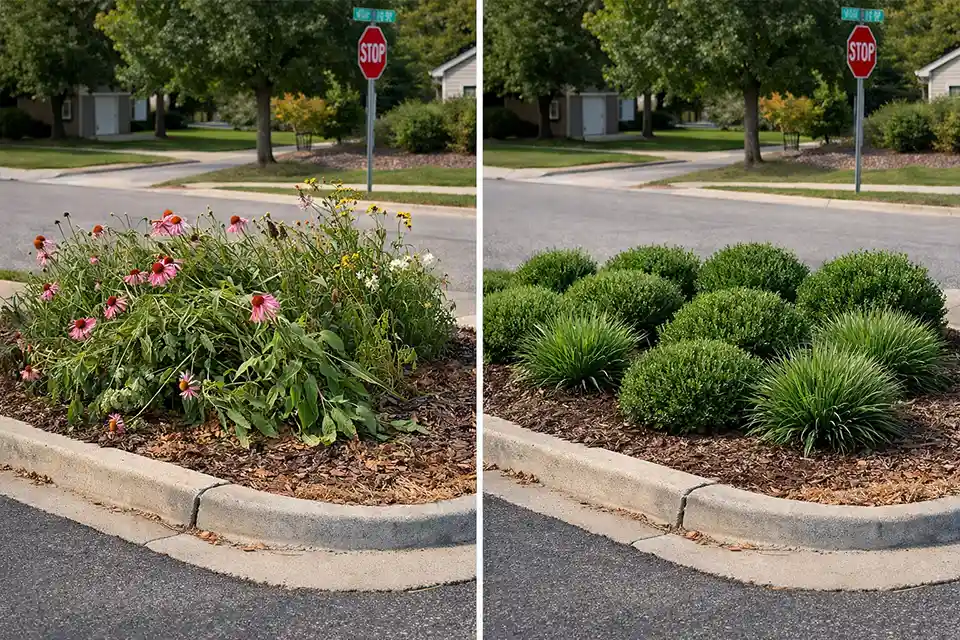
Best plant choices by exposure zone
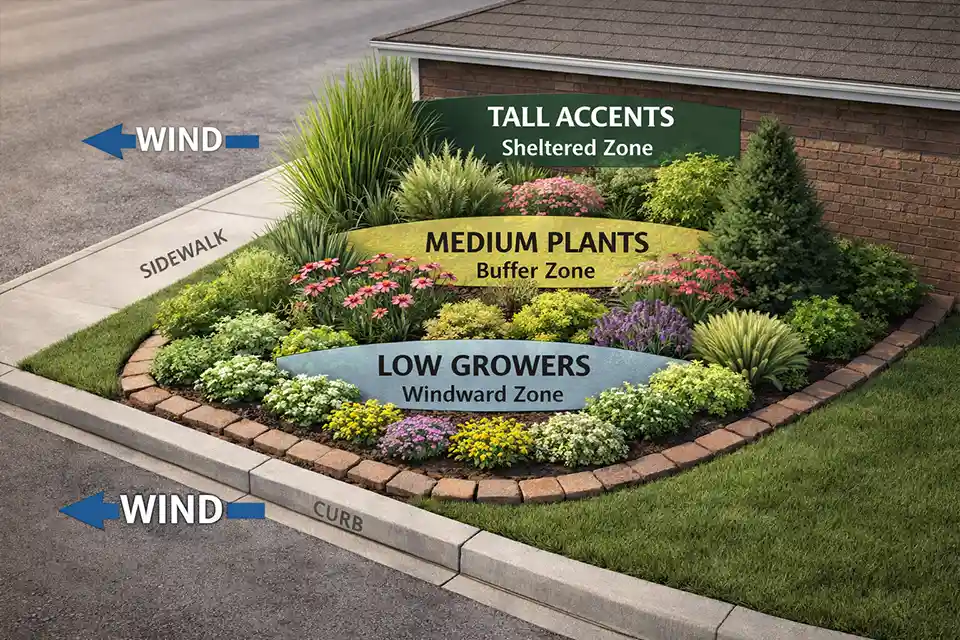
The smartest way to plant a windy corner lot is not with one flat “best plants” list. It is by assigning plants to the part of the bed that matches their tolerance.
Outer edge: keep it low and stable
The first 3 to 5 feet nearest the curb or sidewalk usually takes the most punishment. Keep this band low, usually around 12 to 24 inches. This is where compact junipers, dwarf hollies, blue fescue, low mounding evergreens, and dense low perennials earn their place.
This is also where people waste the most time. They put the showiest plant in the highest-visibility strip, then keep trying to save it. If a plant at the outer edge needs staking, tying, or constant trimming to stop it from looking blown apart, that is not maintenance. That is a mismatch.
Middle zone: add movement, but keep the bones strong
The center of the bed is where 24- to 36-inch plants usually make the most sense. This is the best place for switchgrass, shorter feather reed grass selections, salvia, nepeta, yarrow, and other mounding or clumping plants that move without breaking apart.
A good rule here is that the plant should still look intentional after a week of wind, not just right after planting. If the middle zone is already failing, it is often because the exposed edge is too porous and not doing enough to slow conditions for what sits behind it.
Sheltered zone near the house: use your taller accents here
The back third of the bed, especially within about 4 to 8 feet of the house, is where looser or taller accents finally make sense. This is the right place for taller grasses, larger flowering perennials, or statement shrubs that would look rough at the street edge.
That same “put the right plant where the condition softens” logic is similar to How to Choose Front Yard Plants When Your Yard Gets Blazing Afternoon Sun and Everything Keeps Burning Out. When the site is harsh, placement matters almost as much as plant selection.
| Bed zone | Best plant types | Useful height range | What usually fails first |
|---|---|---|---|
| Outer edge | compact evergreens, low grasses, dense low perennials | 12–24 inches | tall floppy bloomers |
| Middle zone | clump-forming grasses, sturdy mounding perennials | 24–36 inches | brittle stems and open centers |
| Sheltered back zone | taller accents, larger shrubs, looser bloomers | 36–60 inches | exposed specimen plants used too far forward |
| Windward corner | repeating low masses | 12–24 inches | one-off focal plants |
| Transition areas | dense fillers that cover soil | 18–30 inches | sparse planting with exposed mulch |
What people usually misread first
Windy corner lots are rarely ruined by one dramatic gust. They are worn down by repeated drying, abrasion, and movement over time.
Symptom vs. mechanism
Shredded leaves are a symptom. Faster evaporation, slight crown rocking, and chronic stress are the mechanism.
That is why replacing one struggling perennial with another similar perennial often changes almost nothing. The flower color changes. The outcome does not. If several plants fail in the same strip within 1 to 2 growing seasons, the strip itself is the message.
Why the obvious fix often fails
The most common wasted fix is trying to rescue bad placement with extra watering. Water helps establishment, but it does not turn a soft, tall plant into a structurally suitable one. On exposed beds, soil can dry an inch or two down much faster than expected, but the answer still is not to keep feeding the wrong palette.
The second wasted fix is choosing plants only by “wind tolerant” labels without thinking about mature form. A plant may survive windy conditions and still look messy, oversized, or permanently off-balance in a front bed.
This is also why Small Garden Choices That Age Poorly is relevant. Some plants do not fail fast. They just age into constant maintenance.
When the standard fix stops making sense
There is a point where another round of plant replacement is just expensive optimism. If the same front strip keeps thinning out, mulch blows open after windy periods, and anything above about 30 inches looks tired by midsummer, the issue has moved beyond plant choice alone.
Signs the site needs more structure
If three or more of the following are true, simplify the bed before you keep shopping for more plants:
- exposed sections dry out within 24 to 48 hours in hot weather
- replacements fail in the same band within 1 to 2 seasons
- mulch shifts or exposes roots after repeated wind
- plants at the edge lean toward one direction or open at the center
- the bed looks sparse first at the windward corner, then farther inward
At that point, a denser evergreen mass, a lower hedge, or a simpler repeated planting pattern often does more good than adding new varieties.
What to do instead
Reduce the number of species. Repeat stronger performers in groups of three or five. Keep the exposed edge lower. Move showier plants inward. Use denser shrubs or grasses to create a visual and physical buffer before you ask the bed to carry delicate color.
Pro Tip: On windy corner lots, a narrower plant palette usually looks more expensive, not less. Repetition reads as intentional. Mixed failure reads as chaos.
This is one place where What Plants Work Best in a Front Yard with Heavy Foot Traffic from Sidewalk Shortcuts is a useful companion topic. Front-yard planting succeeds when it is built for stress patterns, not against them.
What makes these beds look good long term
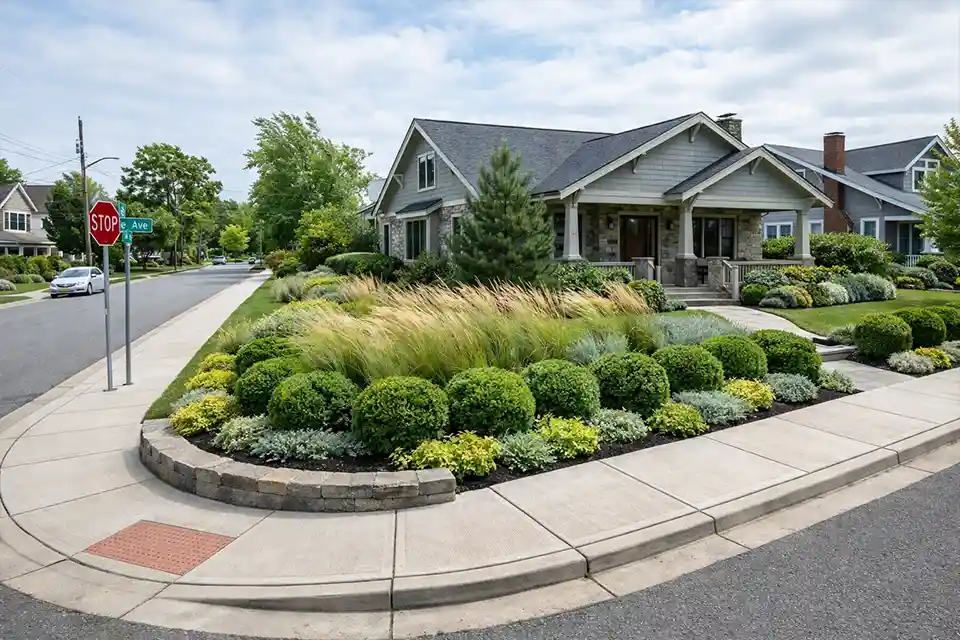
The best windy corner lots rarely look busy. They look settled. They rely on clear height control, sturdy year-round structure, and enough density that exposed soil does not become the visual focus after every windy spell.
That is the real threshold most people miss. A good windy-lot planting is not the one that looks lush for 2 weeks in spring. It is the one that still looks composed in August, still reads clearly from the street, and still makes sense after a few seasons of weather. On these lots, lower and tougher is not a compromise. It is usually the reason the design works at all.
If your corner lot stays exposed year-round, the University of Minnesota Extension windbreak guide adds useful detail on structure and plant selection.