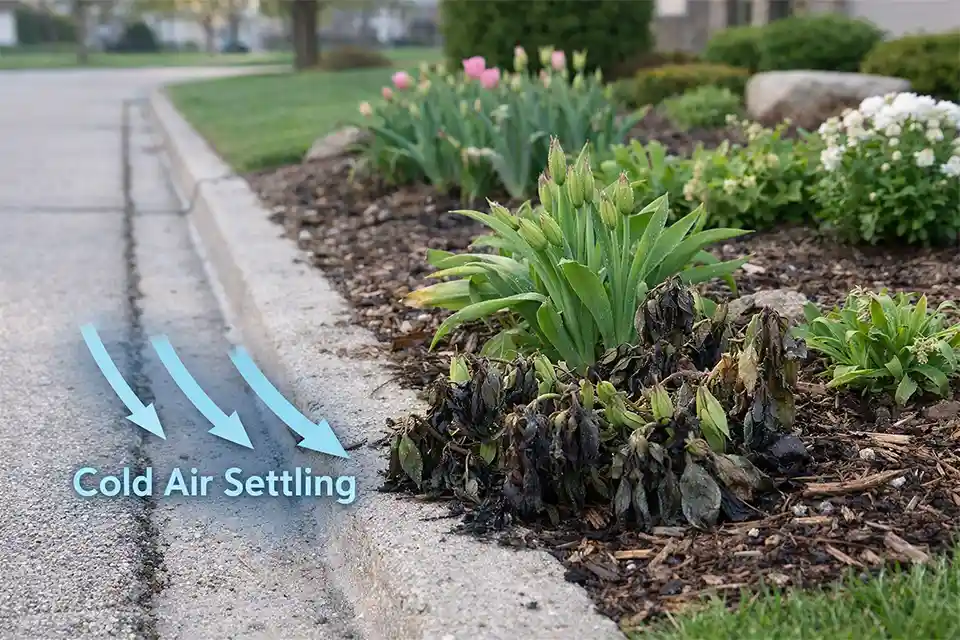
Late spring frost is usually not a winter-hardiness problem first. It is a timing problem. The plants that disappoint most are often hardy enough for January, but they wake too early for your front yard in April or May.
Start with three checks before you choose anything: how early the plant leafs out or blooms, where cold air settles overnight, and whether the plant still looks good if it loses buds or soft tips for a few weeks.
That last point matters more than people expect. A shrub that survives -20°F in winter can still lose fresh spring growth after a calm night at 32°F, and tender buds often take heavier damage once temperatures slip into the upper 20s°F.
The biggest mistake is choosing by USDA zone alone. Zone tells you whether a plant can live through winter. It does not tell you whether it will stay attractive after a warm spell is followed by a late freeze.
Choose front yard plants in this order
If your area gets repeat late frost, do not begin with a wishlist of pretty spring bloomers. Begin with the traits that decide whether the planting still works after a rough spring.
1) Favor later wake-up over early excitement
Early bloomers are the highest-risk category. That includes shrubs grown mainly for an early flower show, especially if they break bud quickly after a few warm days.
Magnolia, forsythia, azalea, rhododendron, ornamental cherry, and crabapple are beautiful, but they are not the plants to trust in the coldest part of a frost-prone front yard.
Safer choices are usually plants that either leaf out later or still earn their place without one fragile spring display.
Viburnums, summersweet, ninebark, smooth hydrangeas, panicle hydrangeas, inkberry holly, and many spireas tend to make more reliable front-yard anchors because the design does not collapse if spring turns erratic.
The same is true for foliage-first perennials and ornamental grasses that build value over the full season instead of peaking in one exposed bloom window.
2) Read the yard before you read the tag
A plant tag cannot tell you where cold air pools in your front yard. Your site can.
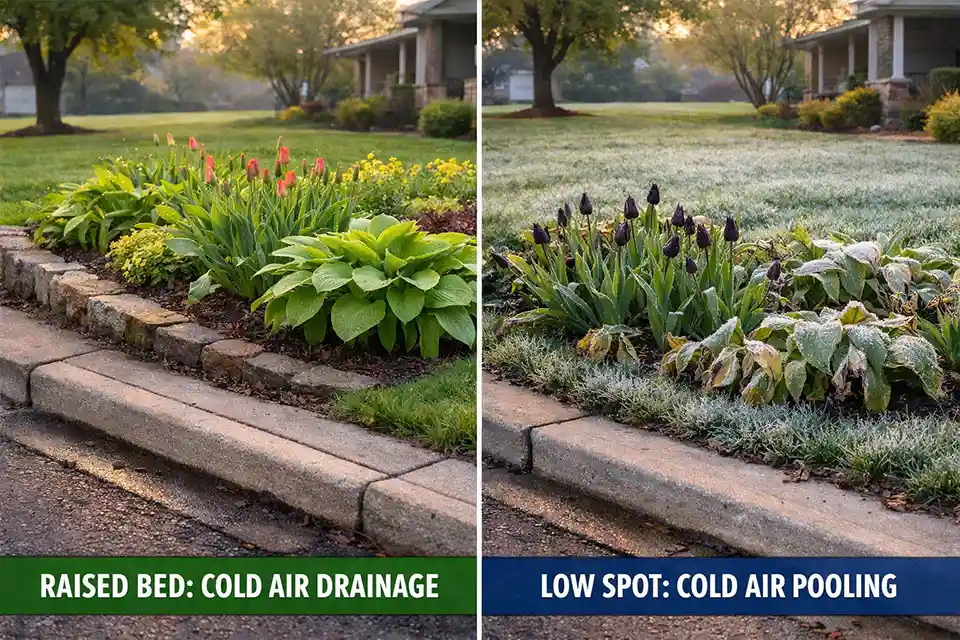
On calm nights, cold air moves downhill and settles in the lowest available space. In front yards, that often means the basin beside the sidewalk, the dip near the driveway edge, the inside corner of a front walk, or the flat strip below a short retaining edge.
Even a subtle drop of 6 to 12 inches can make one bed colder than another only a few feet away.
The spots people trust most are often the ones that betray them. A south-facing foundation bed beside brick or stone can warm early, push growth ahead by 5 to 7 days, then get hit when a late frost arrives. That is not a safe spot just because it looks sunny. It is often a fast-waking spot.
The best position for your riskiest plants is usually the upper shoulder of a gentle slope, a bed with open air drainage, or a slightly raised planting zone that does not trap cold air at the curb line.
3) Decide whether the value is in flowers or in structure
This is the filter that saves the most frustration.
If a plant is there mainly for a 2- to 3-week spring bloom, late frost can erase most of its value for the year. If the plant earns its place through foliage color, branching, shape, texture, berries, or a long summer bloom period, a little spring damage is much easier to accept.
That is why frost-prone front yards are usually stronger when they are built around structure first. Use shrubs with dependable form, layered foliage plants, and long-season performers as the backbone. Then add a smaller number of higher-risk spring bloomers only where the site genuinely supports them.
If your frontage also has punishing summer exposure, it makes more sense to choose plants that can handle both stresses rather than solving only one half of the problem, as in How to Choose Front Yard Plants for Blazing Afternoon Sun.
4) Judge the recovery, not just the damage
A late frost can look worse than it is. Blackened tips, limp leaves, and failed flowers do not automatically mean the whole plant is lost. But recovery still needs to be judged honestly.
Some plants lose early soft growth and look fine again within 2 to 4 weeks. Others survive technically but look ragged, bloomless, or uneven for most of the season.
That is the point where “survives here” stops being a useful standard. In a front yard, appearance matters. A plant that lives but routinely disappoints is often still the wrong choice.
What people usually misread first
Late spring frost creates the same three bad decisions over and over.
USDA zone is enough
It is not. A plant can be fully winter-hardy in your region and still be too eager for your spring pattern. Hardiness answers one question: can it survive deep winter cold? It does not answer the more important front-yard question: will it stay attractive if March or April warms up early and May turns cold again?
Full sun is always safer
Not necessarily. A warm wall, dark mulch, reflected driveway heat, or stone edging can wake a plant too soon. In frost-prone areas, the safest place is often not the hottest place. It is the place that warms steadily without racing ahead.
Blackened leaves mean the plant is dead
Usually not. Frost damage often shows up first on the newest tissue, because that tissue is soft and active. Older wood may be fine. That is why rushing to prune everything immediately is usually a waste of time. Wait a bit, let the real line between living and dead tissue declare itself, and then clean up what truly failed.
Higher-risk choices vs safer bets
| Front-yard plant profile | Risk in late spring frost | Why it struggles or succeeds | Better use |
|---|---|---|---|
| Early spring bloomers prized mainly for flowers | Higher | Buds and open flowers are exposed early | Use only in the best-draining, slightly elevated spots |
| Shrubs that bloom on old wood | Higher | Losing formed buds often means losing the season’s display | Keep out of sidewalk basins and warm-wall pockets |
| Very early leaf-out shrubs | Higher | Soft growth appears during the late-frost window | Avoid the lowest or most accelerated microclimates |
| Later-leafing shrubs like viburnum, ninebark, inkberry | Safer | More likely to miss the worst frost timing | Strong structural base for frost-prone front yards |
| New-wood bloomers like panicle and smooth hydrangea | Often safer | A spring setback is less likely to erase the whole show | Good for reliable summer performance |
| Foliage-first perennials and ornamental grasses | Safer | Design value does not depend on one exposed bloom period | Best for bed edges, low spots, and repeat-risk zones |
That same logic applies when the site has multiple overlapping constraints. If your front yard also deals with exposed corners and steady wind, combine frost logic with broader plant toughness, as in Best Front Yard Plants for Windy Corner Lots.
What changes across US regions
Late spring frost does not behave the same way everywhere, so plant choice should not be region-blind.
Upper Midwest and Interior Northeast
These are the yards where frost risk stays visible later into spring, sometimes well into May. The common mistake is putting early bloomers in low front beds or in warm foundation pockets that speed them up too soon. In these regions, later wake-up is one of the safest traits you can buy.
Mountain West and higher-elevation suburbs
Here the issue is often stronger day-night swings. A warm sunny day can be followed by a sharp overnight drop, and small grade changes matter more than people expect. If your front yard slopes toward the street, or if a wall and edging trap a quiet pocket of air, placement becomes just as important as species choice.
Mid-Atlantic and inland South
The danger here is not always the coldest winter. It is the early warm spell. Plants may break dormancy fast in late winter or early spring, then get hit when frost risk has not truly passed. In these areas, long-season shrubs and foliage-driven plantings usually hold up better than front yards built around fragile early flowers.
Milder coastal climates
Coastal moderation helps, but it does not erase microclimates. Enclosed courtyards, low strips beside sidewalks, and oddly sheltered foundation beds can still trap enough cold air to damage early growth. In these regions, people often underestimate the site and over-credit the climate.
If part of your frontage naturally stays cooler and slower to wake, that can actually be useful, especially when it is handled as a planting advantage rather than treated like a flaw, as in Front Yard Plants for House Shade.
Where to put your riskiest plants if you still want them
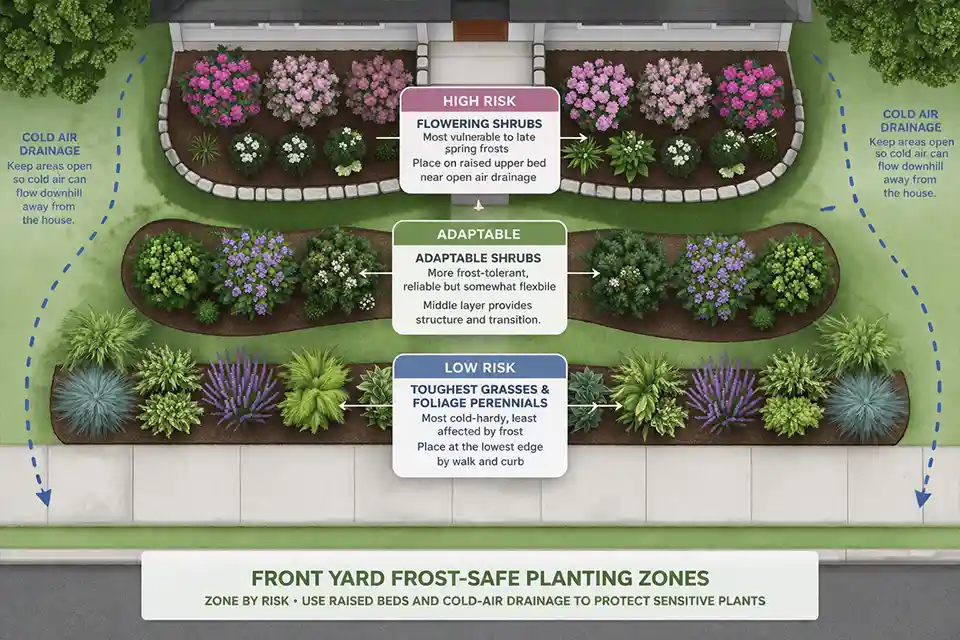
You do not need to ban every frost-sensitive shrub from the front yard. You just need to stop giving it the worst seat in the house.
Put higher-risk bloomers:
- on slightly raised ground
- in the upper half of a gentle slope
- where cold air can drain past rather than settle
- away from the lowest curb-adjacent strip
- away from enclosed corners formed by walls, steps, hedges, or hard edging
Put your tougher plants:
- along the lowest bed edge
- near the sidewalk basin
- in narrow strips that cool fast overnight
- where repeated spring damage would be hardest to hide
Pro Tip: In a frost-prone front yard, let the lowest 20% to 30% of the bed carry the most forgiving plants. Save the higher-risk bloomers for the upper, freer-draining part of the planting.
When the standard fix stops making sense
This is where many homeowners lose a season, then another.
Covering plants once in a while can help with tender annuals or a short-lived cold event. But it is not a strong long-term strategy for the main front-yard planting. If the same shrub keeps losing buds, flowers, or fresh growth every second or third spring, that is usually not just weather bad luck anymore. It is a selection problem or a placement problem.
The other common waste of time is pruning too early. Frost damage often spreads visually over several days, and early pruning can remove tissue that would have recovered or trigger new growth before conditions settle.
There is also a point where patience stops being honest. If a plant shows no meaningful recovery by late May to early June in a climate where it should be growing well, replacement becomes a reasonable decision. That matters even more in yards with shallow soil, tree-root competition, or dry summer stress, where weak recovery is harder to hide, as in Front Yard Plants for Tree Roots and Little Soil.
A front-yard rule that actually holds up
Choose for late spring frost by asking four questions in order: does it wake late enough, is it going into the safest microclimate, does it still look good if flowers fail, and will you still like it after a rough May? That sequence is more useful than choosing the prettiest spring shrub and hoping the weather behaves.
The best frost-prone front yards are not built around rescue. They are built around reliability, with a few carefully placed risks instead of a whole border full of them. If water stress is also part of the site, combine frost strategy with drought strategy so the planting stays resilient in more than one season, as in How to Choose Front Yard Plants with Water Restrictions.
For broader official guidance, see Iowa State University Extension and Outreach.