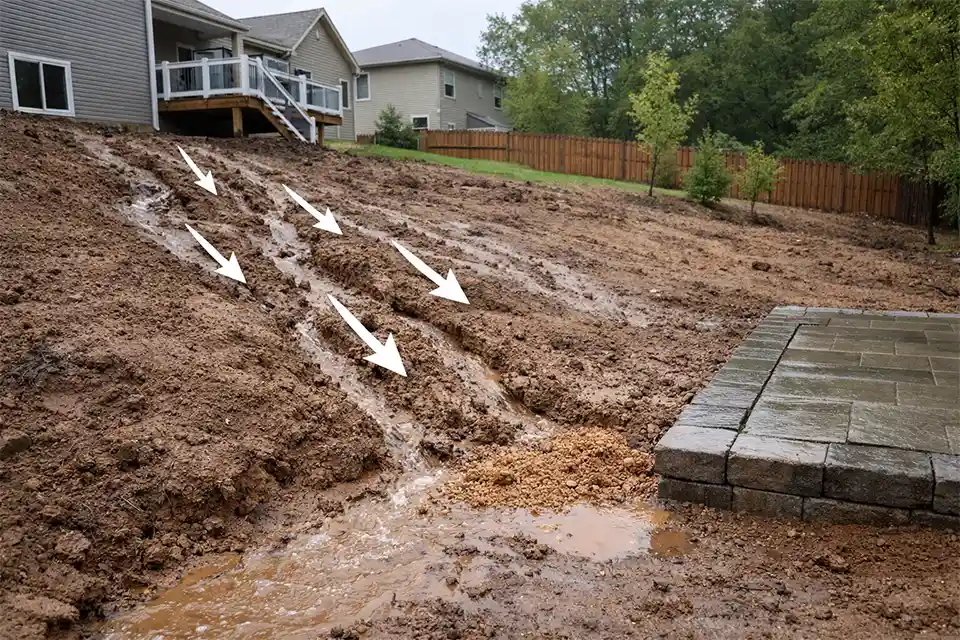
Bare soil washout after new construction is usually not a grass-seed problem first. It is usually a water-path problem: fresh grading, compacted subsoil, and too much exposed slope during the first few storms.
The first checks that matter are simple and useful. Look for a repeated runoff path after each rain, erosion channels deeper than about 1 inch, and muddy runoff still visible 24 hours after the storm. Those are signs of active soil loss, not just a messy surface.
That distinction matters because washout can look like poor drainage while behaving very differently. Poor drainage leaves water sitting in place. Washout means water is moving across the surface fast enough to detach and carry soil downhill.
On a newly disturbed slope with a 20- to 30-foot uninterrupted run, that can start before seed has had even 2 to 4 weeks to root. If roof water or irrigation is feeding the slope, failure comes even faster.
Identify the washout pattern first
Most homeowners lose time here. They see bare soil and jump straight to seed, straw, or mulch. But the better question is: what kind of washout is this?
Light surface wash
If the surface looks crusted, mulch shifted, or seed moved a little, but there are no clear channels deeper than about 1 inch, the slope is still in the early failure stage. The surface needs protection while roots establish, but the water has not fully cut a route yet.
Repeated sheet flow
If a broad band of water keeps sliding over the same part of the slope after every storm, you are beyond a simple cover problem. Water is not fully concentrated into one trench, but it is already moving with enough consistency to reopen weak spots.
Point-source discharge
If damage starts below a downspout, hardscape edge, sump outlet, or one fixed release point, treat it as a discharge problem first. This is the pattern people misread most. The washed area is visible downhill, but the useful fix is usually uphill at the source.
Recurring gullies
If the same channels keep reopening after repairs, especially after two repair cycles, the slope geometry is usually part of the problem now. At that point, another cosmetic patch rarely changes the outcome.
This is why sloped backyard problems with drainage, erosion, and safety tend to escalate quickly after new construction. The issue is not just bare dirt. It is a young slope with no resilience yet and a water route that is already teaching itself where to go.
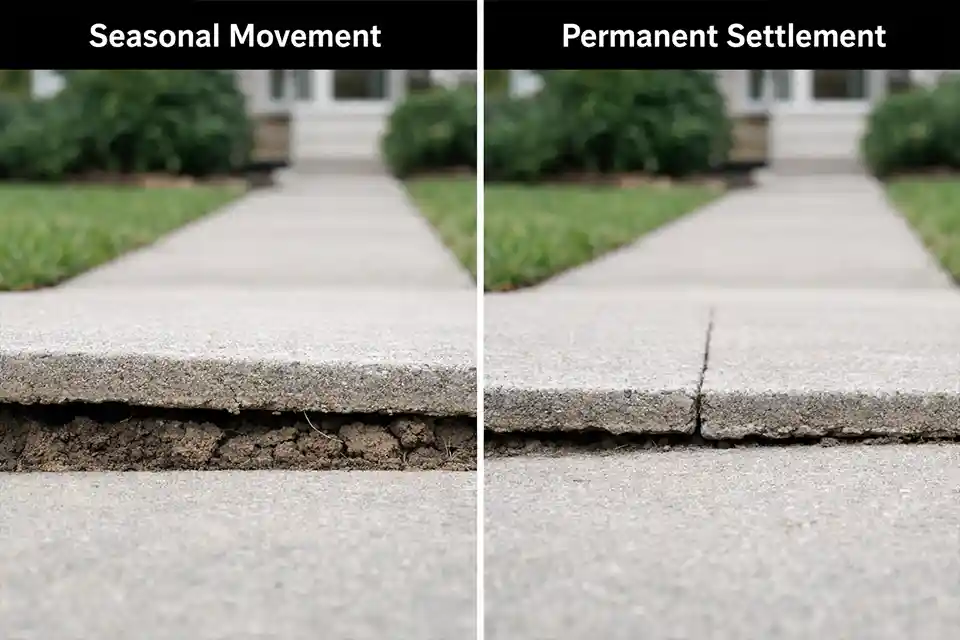
What is actually causing it
The slope itself is not usually the whole story. The more likely problem is how the site was left after construction.
Fresh grading over compacted fill
A lot of new backyards are finished with only 1 to 2 inches of workable topsoil over dense subsoil compacted by equipment. That looks tidy but performs badly. The surface loosens easily, but water does not infiltrate deeply enough to slow runoff. If a screwdriver pushes into the top few inches and then suddenly hits a dense layer below, that is a strong field sign of shallow finish soil over compacted fill.
Too much uninterrupted slope length
People often overestimate steepness and underestimate slope length. A backyard does not need to look extreme to erode. If water can travel 20 feet or more over bare disturbed soil without a grade break, swale, terrace, or dense cover, it has enough room to build speed.
Water entering from above
Roof discharge, splash zones, irrigation overspray, and water spilling off a patio edge all matter more than many homeowners expect. If one section of the slope always fails first, assume water is being added there before you assume the whole yard was seeded badly.
One thing that gets missed in real yards: the surface can look smooth and almost finished, but a smooth slope is often exactly what lets water accelerate.
Match the fix to the failure pattern
This is where most erosion articles get too generic. The right repair depends less on the product name and more on what the water is doing.
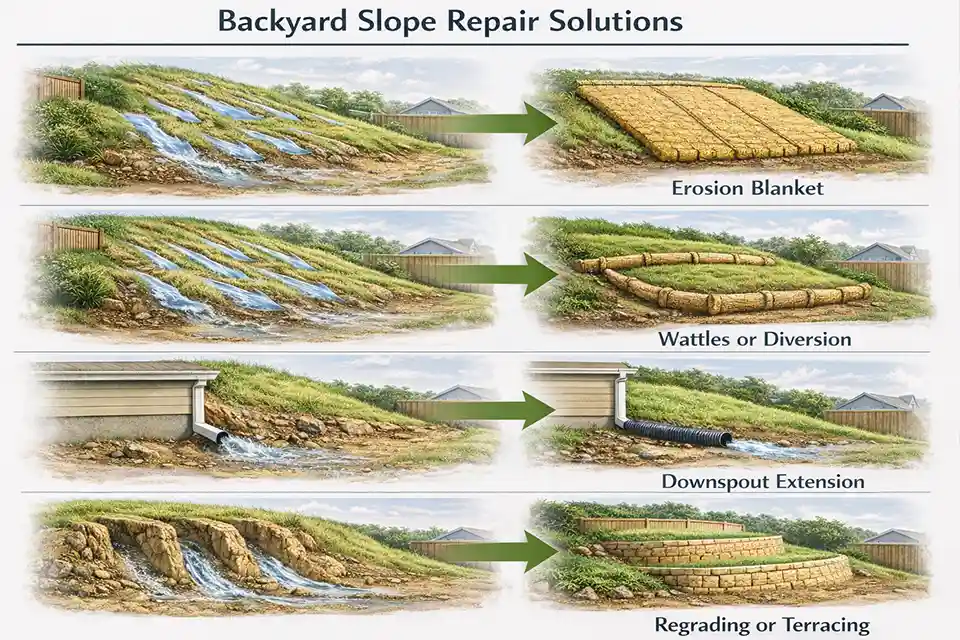
For light surface wash: protect and establish
If the surface is only starting to loosen, anchored straw mulch, hydromulch, or an erosion-control blanket can be enough. The key is contact and anchoring. Loose material tossed on top often shifts downhill. Surface protection should go in immediately, especially if rain is expected within 48 hours.
For repeated sheet flow: shorten the runoff path
If water keeps sheeting over the same section, blanket alone often disappoints. The better fix is usually a combination: interrupt the flow, then protect the soil. That can mean wattles, a shallow diversion near the top, or a grade break that stops water from crossing the full length of the slope unchecked.
For point-source discharge: fix the source first
If a downspout, outlet, or hard edge is feeding the damage, do not repair the scar first and hope it holds. Redirect the outlet, extend it, or carry the water safely to a place that can receive it. In this pattern, the source matters more than the surface finish.
For recurring gullies: stop patching and reassess the grade
Once the same channels reopen after two repair cycles, or more than about 20% of the repaired area keeps failing after each significant storm, the problem has usually moved beyond seed-and-cover territory. Regrading, terracing, or rebuilding the water path starts making more sense than another round of blanket and mulch.
That same escalation pattern shows up in backyard drainage problems homeowners ignore. Surface failure keeps returning because the slope is still being asked to carry water in the same damaging way.
What usually wastes time
The most common mistake is not choosing a bad product. It is using the right-looking product for the wrong failure pattern.
More seed on unstable soil
Seed is not flow control. If watering or light rain starts runoff within 5 to 10 minutes, the surface is not ready to hold seed well. More seed may change the color of the slope for a few days, but it does not slow the water that is stripping the soil.
Loose mulch on active erosion
Loose mulch can help on mild exposure, but once rills are cutting, it often moves with the flow or piles up at the bottom. At that stage, anchoring matters more than volume.
Treating sediment control like water control
This is the practical distinction many homeowners miss. Catching soil at the bottom is not the same as controlling the water that is creating erosion higher up. If the flow path is still intact, cleanup measures simply collect evidence of failure.
Pro Tip: If the washed area always reopens in the same line, repair the line’s water source before you repair the scar. The scar is usually the symptom, not the starting point.
What is feeding the washout
The yard may be bare, but bare soil is rarely the whole reason it keeps failing.
Roof and downspout discharge
A downspout dumping onto fresh grade can undo a repair very quickly. If the washed area starts below a roof outlet, solve that before evaluating anything else.
Irrigation runoff
This is common after new construction. Slopes do not tolerate long, fast spray cycles well when roots are shallow and the surface is still loose. Shorter watering cycles with soak time between them are usually safer than heavy applications that trigger runoff.
Thin topsoil over dense subsoil
This condition is easy to underestimate because the yard can look nearly finished. But healthier establishment usually starts around 4 to 6 inches of decent topsoil, not a skim coat over compacted fill. That difference changes rooting depth, water absorption, and how fast the slope can recover after rain.
This is one reason costly backyard landscaping mistakes often start with finish materials being installed before the grade is truly stable.
When a standard fix stops making sense
Not every washed slope needs a major build-out. But some do, and delaying that call usually costs more.
Signs a simple repair still makes sense
If erosion is shallow, limited to one small section, and the area stays intact through 2 to 3 storms after runoff is redirected and the surface is protected, you are probably still in manageable territory.
Signs you are past the simple-fix stage
If channels deeper than 1 inch keep returning, the toe of the slope is slumping, runoff is heading toward a patio or foundation, or the repair repeatedly fails over a broad area, stop thinking in terms of touch-ups. That is when the site starts acting less like a planting problem and more like a grading problem.
The practical DIY boundary
The common overestimate is that every washed slope needs a retaining wall. The common underestimate is how often repeated washout means the yard geometry is still wrong. If you are considering a terrace, wall, or rebuilt drainage path because basic stabilization has already failed twice, that is usually the point to reassess the grade itself.
That is where backyard landscaping problems that get worse over time stop being maintenance issues and start becoming site-design issues.
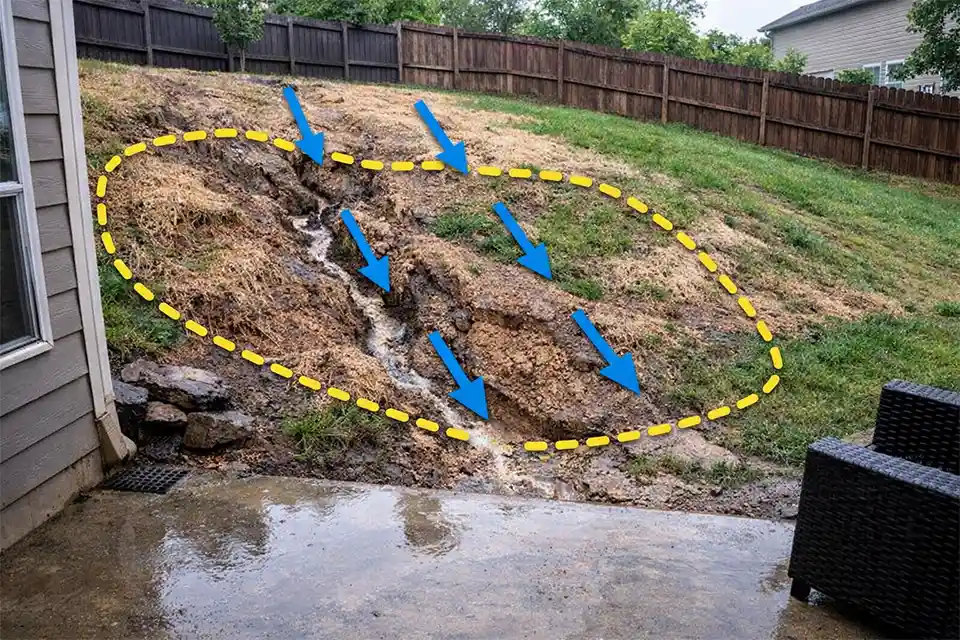
Quick diagnostic checklist
| Check | Healthier condition | Failing condition | What it tells you |
|---|---|---|---|
| Runoff pattern | No repeated path | Same path every storm | Water has established a route |
| Channel depth | Surface scuffing only | Rills deeper than 1 inch | Active erosion, not minor disturbance |
| Water after rain | Clears within hours | Muddy runoff after 24 hours | Ongoing sediment movement |
| Watering response | Soaks in for 10+ minutes | Runs off within 5–10 minutes | Infiltration is too weak |
| Repair performance | Holds through 2–3 storms | Reopens after each storm | Geometry or water source still unresolved |
The repair sequence that usually holds
The durable order is simple even if the exact products vary: control the incoming water, shorten or redirect the runoff path, stabilize the exposed surface, then plant into a protected grade. That sequence is what changes outcomes.
Trying to skip straight to the finish layer is where many homeowners get burned. Decorative stone, quick mulch cover, or rushed reseeding can make the yard look more finished, but they do not correct flow direction on their own. In some yards, they simply move the mess downhill.
Trying to skip straight to the finish layer is where many homeowners get burned. Decorative stone, quick mulch cover, or rushed reseeding can make the yard look more finished, but they do not correct flow direction on their own. In some yards, they simply move the mess downhill.
For broader official guidance, see the EPA National Menu of Best Management Practices for Construction Stormwater.