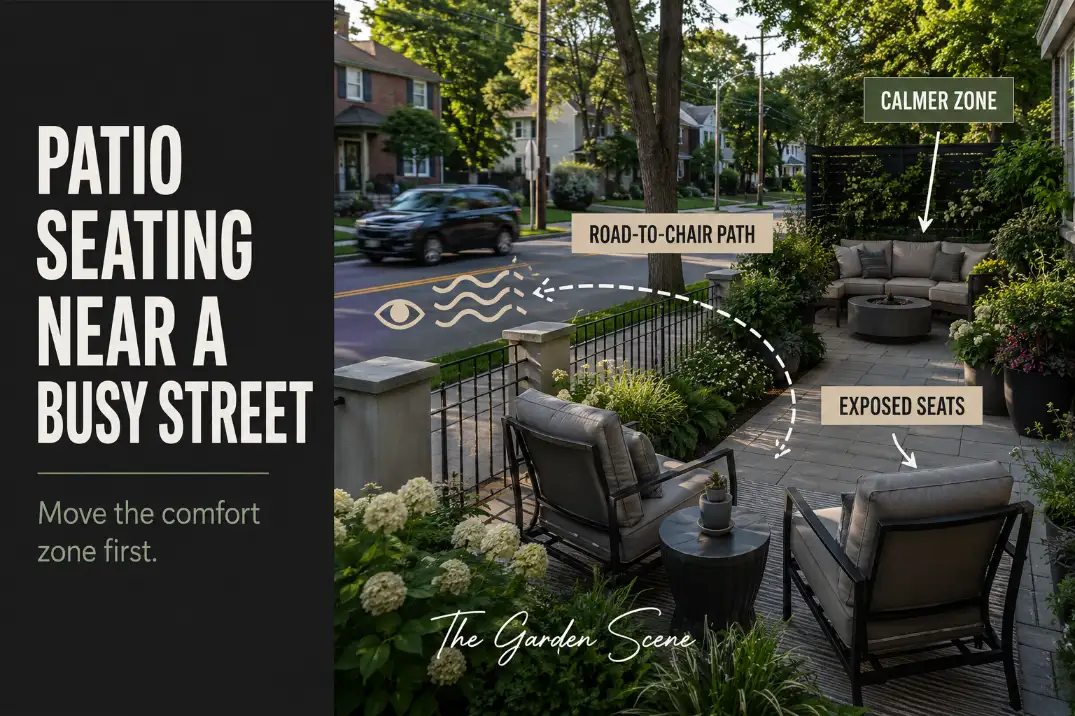
The best fix for patio seating near a busy street is to move the seating out of the direct road-to-chair path first, then add partial privacy, dense planting, and sound masking only where they support the new comfort zone.
The chair is the receiver. If the receiver stays in the open line between the street and the patio, a taller screen may hide the road but still leave the seating loud, tense, or too visible.
Start with three checks: how close the nearest chair sits to the street-facing edge, whether people face the traffic while seated, and whether conversation needs a raised voice every 30 to 60 seconds during normal traffic.
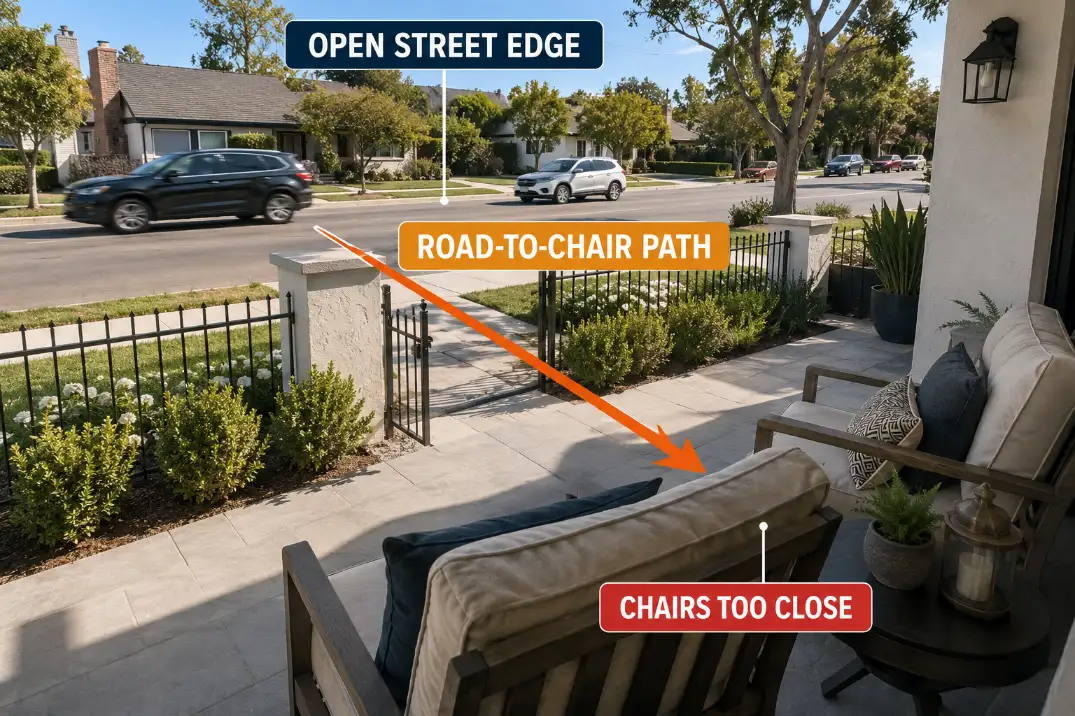
Seating within about 6 feet of an open street edge is often hard to make comfortable. Pulling chairs back 4 to 8 feet, or turning them 45 to 90 degrees away from the road, can do more than adding a decorative screen in the wrong place.
The Exposed Seating Problem
The road-to-chair line matters most
A patio feels exposed when the street has a direct path to the seat. That path can carry noise, headlights, movement, and the feeling that every passerby can see where people are sitting. The mistake is assuming the street edge alone is the problem. In many patios, the real problem is the position of the chair.
If a chair sits near the open side of the patio and faces the road, the screen has to solve everything at once. It has to hide people, soften noise, block movement, and make the space feel calmer. That is too much to ask from one fence panel, hedge, or row of planters.
Visibility is not the same as comfort
A patio can look more private and still feel uncomfortable. A tall panel may remove the view of traffic, but if the chairs still sit close to the road-facing side, sound may continue to arrive sharply. The symptom is loudness. The mechanism is exposure.
A useful test is to sit in the loudest chair for 10 minutes during the time you normally use the patio. If passing traffic interrupts conversation every minute or two, the layout needs correction before styling. If the same chair also catches headlights, sidewalk movement, or direct views from cars, privacy and noise should be fixed together.
Noise and Privacy Work Together
Privacy hides the patio; comfort protects the seat
Privacy and noise are related, but they are not the same job. Privacy controls sightlines; comfort depends on whether the road still reaches the seat. Near a busy street, the stronger solution usually starts with the receiver: move the chair, turn the chair, or shield the chair from the most direct path.
This is why a thin hedge often disappoints. It can soften the look of the street without changing the listening position. A better sequence is distance first, angle second, then layered screening. Even moving the seating 8 to 12 feet farther from the street-facing edge can make the rest of the fix easier because the screen no longer has to do all the work.
If the same road or neighbor noise also affects the wider yard, the planning logic overlaps with Backyard Neighbor Noise Solutions, especially when the problem is a repeated sound path rather than one isolated loud event.
The goal is a calmer pocket, not silence
A residential patio near traffic should not be planned as if it can become soundproof. Outdoor barriers reduce and redirect sound; they do not erase a busy road. This matters because the best design target is not silence. It is a calmer seating pocket where conversation feels normal, the road is less visually dominant, and the patio no longer feels like part of the street.
Pro Tip: Fix the seat position before choosing plants or panels. If the chair stays in the direct road-to-chair line, every later upgrade has to work harder.
Move Seating Before Adding Screens
Shift the comfort zone first
Before buying panels, planters, or hedge plants, test the furniture in a new position for one evening. Pull chairs back 4 feet, rotate the main seating group inward, or place the quietest seats behind an existing house corner, planter, masonry return, or planting bed. If the patio immediately feels better, the future screen should support that new zone instead of defending the old one.
This is where many patio fixes either become efficient or expensive. If the seating remains tight against the noisy edge, the screen usually needs to be taller, denser, and more visually heavy. If the seating moves first, a lower partial screen and planting layer can often feel more natural.
For patios where the seating also competes with the back door route, Patio Layouts for Back Door Seating helps solve the same basic conflict: the best seat is not useful if it blocks the way people move through the space.
Keep the route open
A quieter layout still has to function. Keep about 36 inches open on the main walking route between the house, patio door, grill, dining area, or side gate. In a tight patio, 30 inches can work as a short pinch point, but it should not be the everyday path behind dining chairs.
This is a common place where homeowners overcorrect. They move furniture into a quieter corner, then accidentally block the door, the grill path, or the route to the yard. The seating improves, but the patio becomes harder to use.
Use Layers, Not One Wall
One wall rarely solves both sound and comfort
The better fix is not one taller wall. It is a protected seating pocket built from distance, angle, partial screening, planting mass, and softer patio surfaces.
A single tall screen at the street edge may block the view, but it can also make a small patio feel boxed in while the seating still receives traffic noise.
A good layered setup might include a 4- to 6-foot privacy panel near the worst view angle, a deep planter with shrubs or grasses in front of it, and seating turned inward around a table or fire feature. The point is not to erase the street. The point is to stop the seating from feeling exposed to it.
For a broader buffer strategy, Outdoor Noise Buffer Ideas is useful when the patio needs a planned edge rather than a single privacy object.
Hard surfaces can make traffic sound sharper
Busy-street patios often feel louder when sound bounces between hard materials. Concrete slabs, stucco walls, glass doors, solid fences, and covered patio ceilings can make traffic feel sharper than it does in an open lawn area. The road may not be louder, but the patio may receive and reflect it more harshly.
Soft layers help after the layout is corrected. Outdoor cushions, a weather-safe rug, fabric shade, dense planters, and leafy planting near the seating can reduce the hard, empty feel of the space. These are not substitutes for moving the seat out of the direct line, but they make the new comfort zone feel more settled.
| Patio condition | First priority | What helps most | What often disappoints |
|---|---|---|---|
| Chairs face the street | Rotate seating inward | Angled seating plus partial screen | Tall screen while chairs still face traffic |
| Seating is under 6 ft from edge | Pull chairs back first | 4–8 ft shift plus planting | Thin hedge alone |
| Dining sits near traffic | Give dining the calmer spot | Inward table layout | Long table parallel to road |
| Patio feels boxed in | Screen only the worst side | One protected corner | Full enclosure on every side |
| Traffic remains noticeable | Add sound near seats | Nearby water feature or soft layers | Distant decorative fountain |

Dining Needs More Quiet
Give dining the protected position first
If one patio zone gets the most protected spot, give it to dining first. Lounge seating can tolerate more background movement than a table conversation can. Dining needs a quieter pocket because people are facing each other, serving food, moving chairs, and trying to talk at the same time.
A dining table placed directly in the road-facing path may look functional but feel restless after 15 to 20 minutes. The problem is not the table itself. The problem is that the table turns every seat into a receiver for traffic noise and passing views.
If the patio has to support both dining and lounging, Outdoor Seating for Dining and Lounging helps decide which activity deserves the most protected spot instead of forcing both into the same exposed line.
Table shape can reduce exposure
A long rectangular table placed parallel to the street can expose every seat along one side. A round or square table often works better near a noisy edge because people face inward and sit closer together. A 42- to 48-inch round table can feel calmer than a long table in the same footprint because conversation does not have to travel across a traffic-facing line.
This is a small layout decision, but it changes how the patio feels. Furniture should help people face each other, not the street.
Comfort Without Closing the Patio
Protect the core and leave one side open
The best busy-street patio usually protects the seating core without sealing the whole perimeter. That might mean one screened corner, one planted edge, and one open side toward the house or garden. Full enclosure is often the wrong goal because it can block airflow, trap heat, and make the patio feel smaller.
In hot summer regions, especially where afternoon sun hits the street-facing side, a solid barrier can create a different comfort problem.
If a screened patio corner feels 5 to 10 degrees warmer or loses its breeze, people may stop using it even though it looks more private.
A water feature can help when the layout is already improved but traffic remains noticeable. The sound should sit near the people, not far away as decoration. The category logic in Outdoor Water Features for Softening Yard Noise applies best when water supports a seating pocket instead of trying to cover the whole street.
Use the heaviest screen only where it earns its place
One open side makes the patio feel less defensive. If the street edge is the stressful side, the house-facing or garden-facing side should stay visually relaxed. That open side gives the seating area a place to breathe.
Use the heaviest screen only where the view and sound are worst. Use lower planting, open-backed furniture, or a softer edge where privacy is less important. This usually works better than wrapping the entire patio with the same material.
Quick Decision Checklist
- Break the road-to-chair path by moving seating 4 to 8 feet back before buying a taller screen.
- Keep at least 36 inches open on the main walking route.
- Treat repeated raised-voice conversation as a layout problem, not just a plant problem.
- Give dining the quieter position before lounge seating.
- Use one strong protected edge instead of enclosing every side.
- Add soft layers after the seating is out of the direct road-to-chair path.
- Place water sound near the seats, not at the far edge of the patio.
Questions People Usually Ask
Should the screen go near the road or near the seating?
Use the road edge when you have enough depth for planting and a buffer. Use a screen closer to the seating when the patio is small and the main goal is protecting the people in the chairs. The best location is the one that breaks the road-to-chair path without blocking movement.
Can a fountain cover busy street noise?
A fountain can soften steady background traffic, but it will not cover horns, motorcycles, trucks, or sudden acceleration. It works best near the seating after the patio layout has already been improved.
What if the patio is too small to move the seating?
Rotate the seating first. Then use a partial corner screen, a deep planter, soft furnishings, and a smaller table shape. In a very tight patio, changing the seat angle may matter more than adding another object.
For broader official context on near-road exposure and mitigation strategies, see the U.S. Environmental Protection Agency.