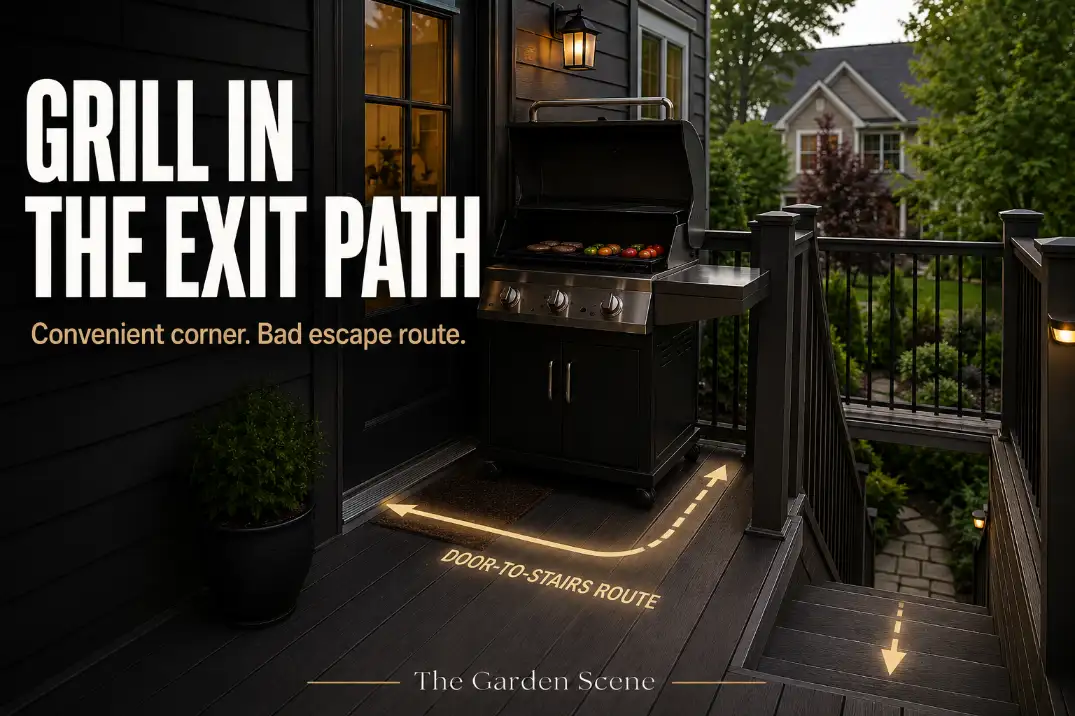
A grill on a small deck is not just a space-planning problem. It is a hot appliance sitting near an exit route, a stair opening, and often a combustible railing or house wall.
The first checks are simple: keep at least a 36-inch clear path from the door to the stairs, preserve a 3-foot kid-and-pet buffer around the grill, and confirm the manufacturer’s required clearance from siding, railings, eaves, and overhanging branches.
The common mistake is judging the grill while it is closed and cold. That tells you almost nothing. A deck grill has to work with the lid open, the cook standing in front, a tray in hand, smoke moving, and someone else trying to reach the stairs. If the route only works when nobody is cooking, the grill is in the wrong place.
When the Grill Takes Over
A grill takes over a small deck when it stops being a cooking station and starts controlling the whole traffic pattern. The earliest warning sign is usually not a dramatic safety issue. It is the pause: someone opens the back door, sees the cook in the way, and waits.
The footprint is bigger than the grill
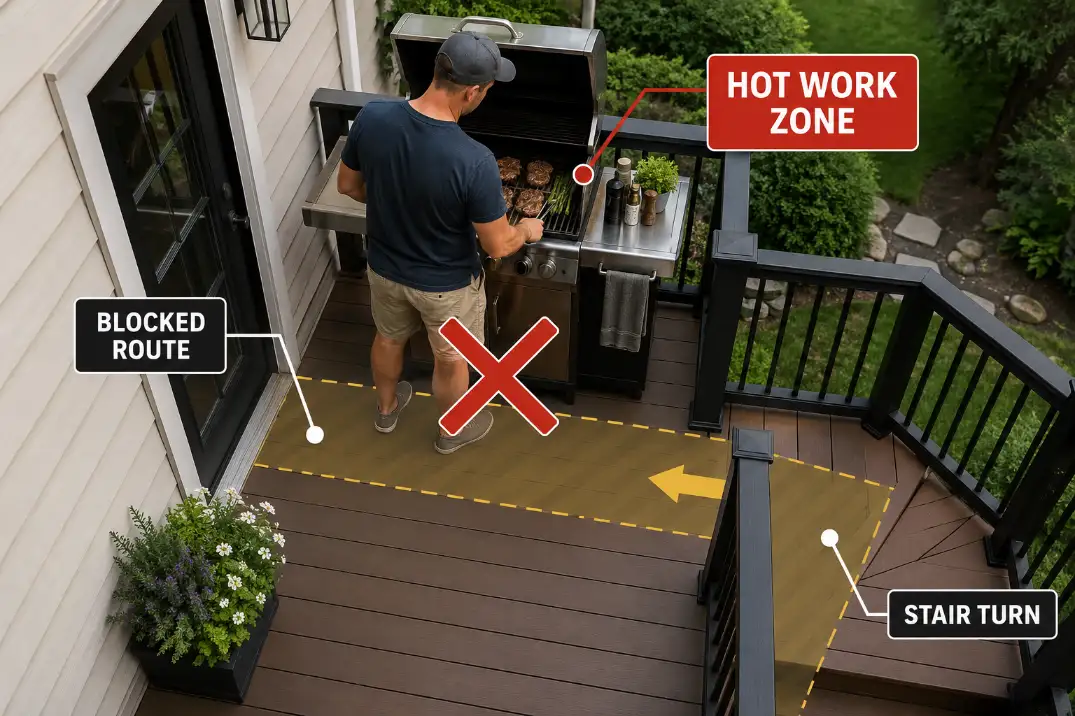
A 24- to 30-inch-deep grill can easily create a 5-foot active zone once the lid opens, the cook steps in front, a side shelf folds out, and a propane tank or grease tray needs access. That zone cannot sit inside the same strip people use to leave the house or reach the stairs.
Trace the route from the back door to the stair opening. Then imagine the grill is hot and the cook cannot simply step backward. If the narrowest point drops below 36 inches, the grill is not occupying leftover space. It is occupying circulation space.
That same logic matters on any tight raised landing. If the back door, stair turn, and furniture already compete, the clearance thinking in Deck Landing Space Between Door, Stairs, and Furniture applies even more strongly when the object in the way is hot.
The Convenient Wrong Corner
The most tempting grill location is often the corner closest to the kitchen. It feels efficient because plates, tools, and food are nearby. On a small deck, that “efficient” corner often steals the one space that must stay open.
Closed-fit is a misleading test
A grill that fits neatly while closed may still fail during use. The useful test is whether the door opens cleanly, the cook can stand safely, the lid can lift, and another person can move to the stairs without turning sideways.
This is where many fixes waste money. A smaller grill does not fix a bad route. A grill mat does not fix bad clearance. A prep cart does not fix a stair opening that is already crowded.
Those products can help after the location is right, but they cannot make a blocked exit safe.
The mat is not the safety plan
A grill mat may reduce grease stains and protect part of the deck surface. It does not create air clearance from a railing, move heat away from siding, or keep kids and pets out of the cooking zone.
Treat it as surface protection, not permission to place the grill in a risky corner.
If the grill has to sit beside the door because every other area is occupied by furniture, the furniture plan may be the real problem.
A better small-deck layout usually protects the route first, then fits the grill and seating around it. That is the same priority behind Small Deck Layout for a Clear Route.
Door, Stair, and Railing Clearance
The important clearances are not equal. Door and stair clearance protect movement. Railing, siding, eave, and branch clearance protect against heat, smoke, and flare-up risk. A layout can look balanced and still fail one of those tests.
Start with the exit route
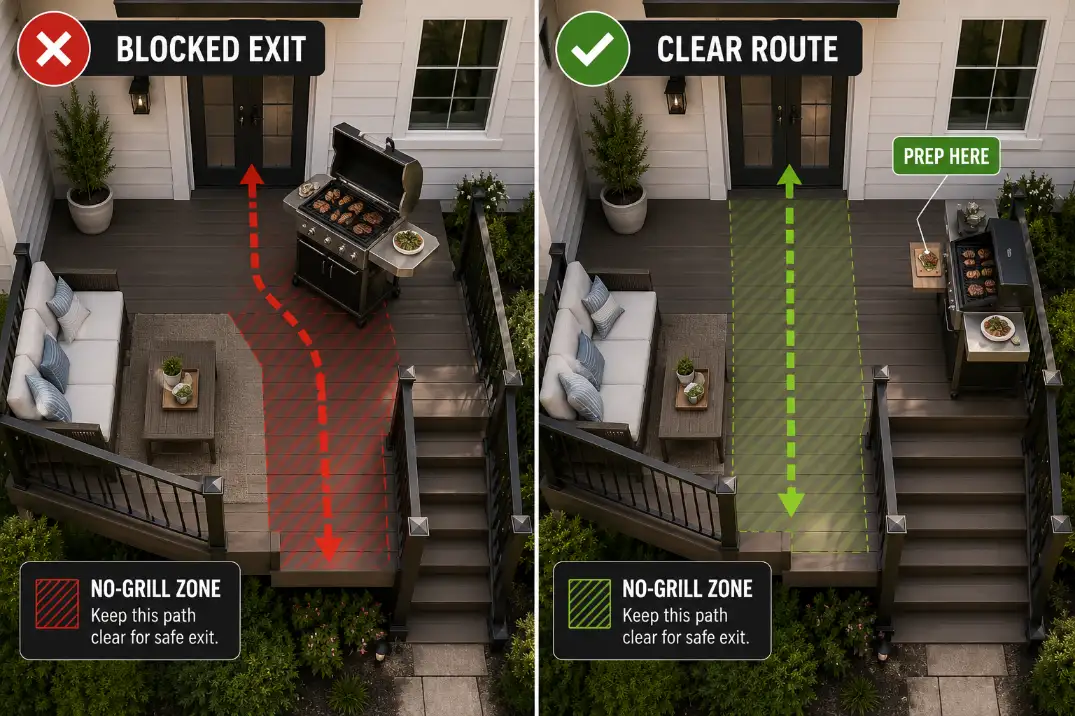
The route from the door to the stairs should stay open before, during, and after cooking. Use 36 inches as the practical minimum, but treat 42 to 48 inches as better where people carry trays, kids move through, or the stair turn is tight.
If a person carrying a platter has to rotate their shoulders to pass the grill, the route is too narrow. If the cook has to step toward the stair opening every time someone exits the house, the grill is too close to the traffic path.
Do not use the railing as a back wall
Railings make grills feel contained, but they are not kitchen walls. Heat, grease, smoke, and flare-ups need space. Manufacturer instructions control the final clearance, and local rules may be stricter, especially for multi-family buildings, covered decks, balconies, or decks with limited exits.
A practical warning sign is heat or smoke collecting against the railing after 10 to 15 minutes of cooking. Another is the cook standing between the hot grill and the stair opening.
That is not just uncomfortable; it means the grill zone and exit zone are occupying the same footprint.
| Placement Check | Acceptable Signal | Move the Grill If |
|---|---|---|
| Door route | 36 inches clear minimum | People turn sideways to pass |
| Stair top | Open turn remains usable | Cook stands beside stair opening |
| Railing or siding | Manufacturer clearance is met | Heat or smoke crowds combustibles |
| Overhead space | Open air above the grill | Eave, roof, cover, or branches sit above it |
| Smoke behavior | Smoke drifts away from entry | Smoke returns to the door within 5 minutes |
Build a Cooking Zone
A good small-deck grill layout is not about hiding the grill in the emptiest corner. It is about building one compact cooking zone that does not interrupt the exit path.
Keep the zone small but complete
A workable cooking zone needs the grill, a safe standing area, and one landing surface. That landing surface does not need to be large. A 16- to 24-inch side shelf or compact prep cart can be enough for tongs, a tray, and cooked food if it stays outside the route.
What fails is scattering the cooking task across the deck: grill in one corner, plates by the door, tools on the dining table, trash near the stairs. That creates repeated crossings and makes the deck feel smaller than it is.
Pro Tip: Test the placement with the grill lid open, not closed. Then carry a tray from the door to the stairs. If either action breaks the route, move the grill before buying accessories.
For larger cooking layouts, Patio Layout for Grill, Prep, and Dining shows why cooking flow and seating flow should not collapse into the same few feet.
Wind and Smoke
Wind is the condition people underestimate most. A grill can look fine on a calm afternoon and become miserable at dinner when the breeze pushes smoke toward the back door, dining seats, or neighbor-facing side.
Smoke direction matters more than visual neatness
If smoke drifts into the open back door within the first 5 minutes of cooking, the grill is too aligned with the doorway or trapped in a dead-air pocket. Moving it 2 to 4 feet can make more difference than changing the grill.
Covered or partially enclosed decks make this worse because eaves, side walls, and privacy screens can hold smoke where people stand.
In humid Florida evenings, smoke may hang longer. In dry, windy areas of Arizona or inland California, gusts can push heat and ash sideways before the cook has time to react.
A screen is not always the fix. It may calm wind, but it can also trap heat and smoke closer to the deck. If wind repeatedly ruins the cooking zone, Wind Ruins Backyard Cooking is the more useful problem to solve before adding more objects around the grill.
Gas, charcoal, and pellet grills change the risk
Gas grills need clear access to the tank, controls, and grease tray, and the lid should be open before lighting. Charcoal grills add ash, sparks, and coal disposal. Pellet grills add cord routing and fan-driven smoke direction.
Those differences matter, but they do not override the basic rule: the grill still needs clearance, ventilation, and an exit route that remains open while cooking.
When the Grill Should Leave the Deck
Sometimes the best small-deck grill placement is not on the deck at all. That sounds inconvenient until you compare it with a deck where the grill blocks the door, crowds the stairs, and sits too close to railings or siding.
The standard fix stops working here
Move the grill off the deck if you cannot keep the route open, meet the grill manufacturer’s clearance requirements, avoid overhead cover, and preserve a safe standing zone. Also move it if the cook is repeatedly pinned near the stair opening or smoke keeps returning to the door.
A nearby ground-level grill pad can work better than forcing the grill onto a raised platform. A simple noncombustible pad with a short walking connection to the deck often gives the grill more air, more working room, and less conflict with the exit.
That choice is not a downgrade. On very small decks, separating cooking from the door-stair route can make the deck feel larger because the deck no longer has to function as landing, kitchen, hallway, and dining room at the same time.
For homeowners still deciding how much room a grill area really needs, Grill Area Space Needs gives a more realistic footprint before the layout becomes crowded.
Key Takeaway
The safest small deck grill placement is not the nearest corner to the kitchen. It is the location that keeps the door-to-stair route open, respects clearance from railings and siding, avoids overhead obstructions, and gives the cook a small but complete work zone.
If the grill only works when the lid is closed, nobody is walking through, and the wind is perfect, the placement is too fragile.
Move the grill before adding mats, carts, screens, or smaller accessories. On a small deck, the exit route is the layout. Everything else has to earn space around it.
For broader official fire-safety guidance, see the U.S. Fire Administration grilling safety guidance.