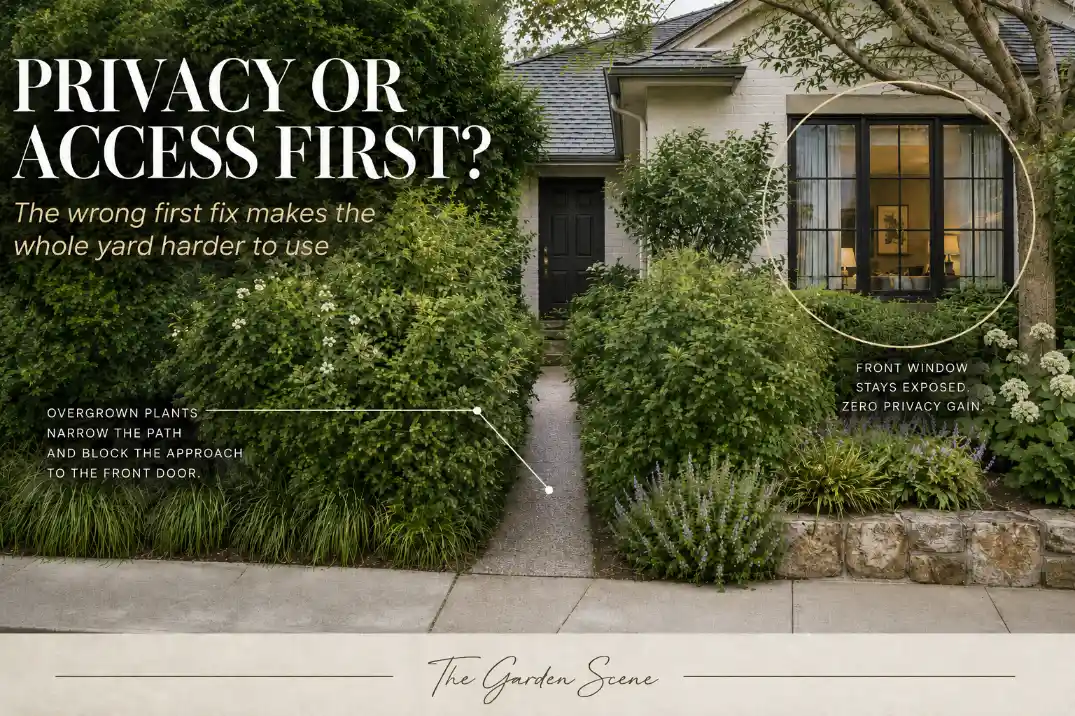
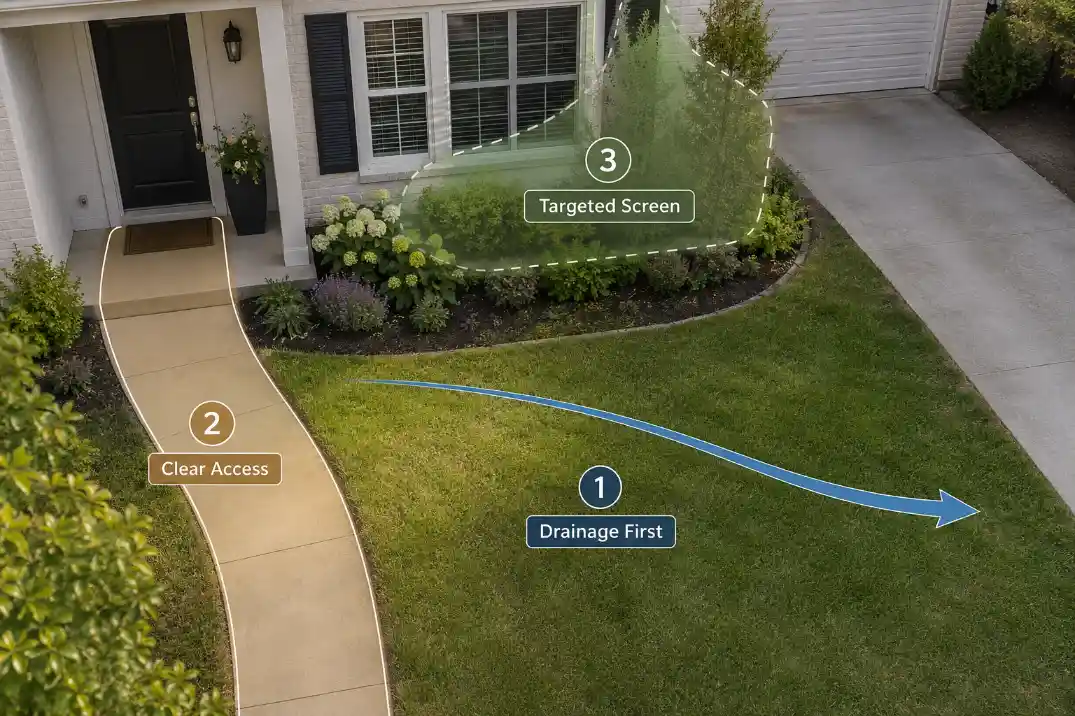
Fix front yard problems in this order: drainage, access, privacy sightlines, soil and root space, then decorative planting.
That order matters because plants are easy to buy, but expensive to keep correcting when the path is too narrow, water moves the mulch, or the real privacy problem comes from the wrong angle.
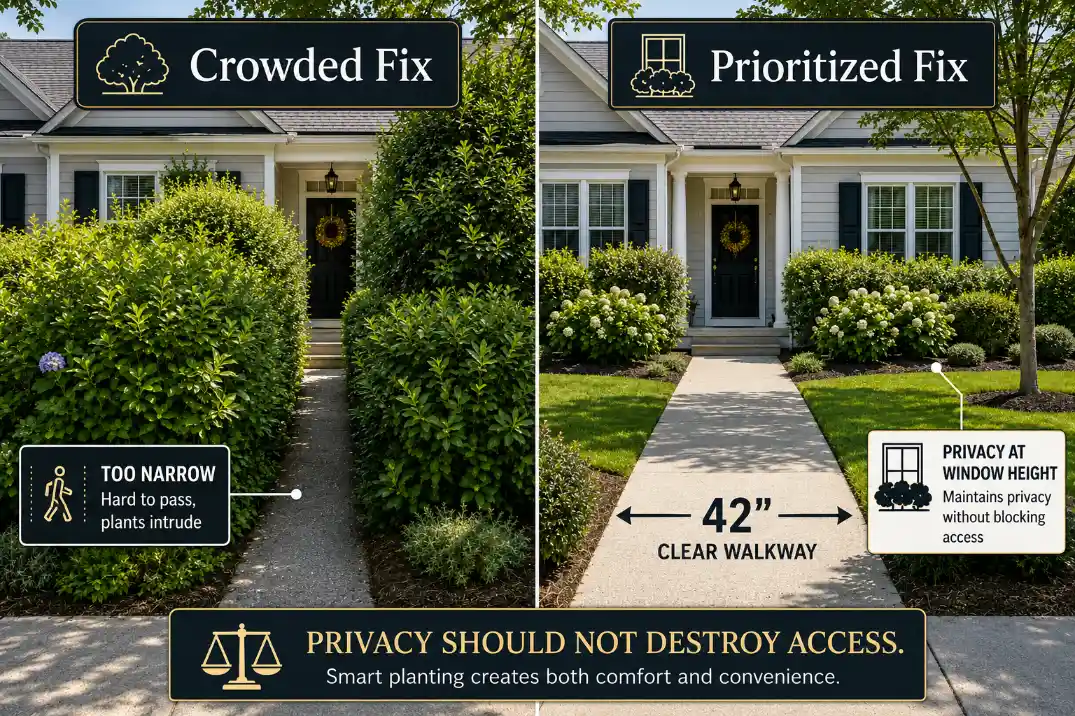
Start with three checks. The main route to the door should have at least 36 inches of clear walking width, and 42 to 48 inches feels much better near the entry.
Water should not sit on walks, bed edges, or near the foundation for more than 24 to 48 hours after ordinary rain. The privacy problem should be identified as sidewalk views, headlights, driveway exposure, or upper-window sightlines before a single shrub is chosen.
A visible yard is not always a privacy failure. The symptom may be exposure, but the underlying mechanism is usually misplaced space: the wrong screen in the wrong spot, too little access width, or planting that cannot survive the site.
The Front Yard Priority Matrix
Use this matrix before spending money. It separates what looks urgent from what actually controls the outcome.
| What You Notice | What It Usually Means | Fix First | Do Not Buy Yet |
|---|---|---|---|
| People step off the walk | The route is too narrow or unclear | Walkway width and entry flow | Border shrubs beside the path |
| Mulch or gravel moves after rain | Runoff is crossing the bed | Drainage, edging, or grading | More mulch or decorative stone |
| Front window feels exposed | The sightline is specific, not yard-wide | Targeted privacy filter | Full-width hedge |
| Plants keep failing in one strip | Soil, heat, drainage, or roots are limiting growth | Soil/root-zone correction | Replacement shrubs of the same type |
| Yard feels closed off but still not private | Screening is in the wrong place | Sightline mapping | Taller plants near the door |
Drainage Outranks Planting
Drainage is the first priority when water crosses the main walk, pools near the foundation, washes mulch into the sidewalk, or leaves soil soft after the rest of the yard has dried.
If puddles remain for 48 hours after typical rain, the problem is no longer cosmetic. It affects roots, hardscape stability, and entry safety.
This is especially important in Midwest and northern states, where wet walks can become icy after freeze-thaw cycles. In humid parts of the Southeast, soggy foundation beds can also keep shrub roots oxygen-starved and increase disease pressure.
A planting bed cannot compensate for water moving the wrong way. If downspouts, driveway runoff, or a low front bed are feeding the problem, plant selection should wait.
For yards where standing water is part of the pattern, Front Yard Water Pooling Near House Causes is the better diagnostic step before redesigning the bed.
Access Outranks Privacy Shrubs
The route from driveway or sidewalk to front door should be obvious, durable, and wide enough for real use. A 30-inch path may look acceptable in a plan, but it often feels tight once shrubs lean over the edge or guests carry bags, strollers, or delivery boxes.
This is where many front yards start to fail. A homeowner adds screening to soften street exposure, then the shrubs mature 3 to 5 feet wide and squeeze the only practical route to the door. The privacy plant becomes the access problem.
If the driveway dominates the front yard or guests cut across the lawn because the entry route is unclear, solve that before planting. Front Yard Design for Driveway and Front Door Access fits this situation better than another list of shrubs.
Most Front Yards Need a Privacy Filter, Not a Wall
A full privacy wall is rarely the right first move in a front yard. Most front yards need a filter: something that interrupts the uncomfortable view while keeping the house, entry, and driveway readable.
Filter, Screen, or Wall?
A privacy filter softens or breaks a view without fully blocking the yard. This might be a staggered shrub layer, a small tree, tall planters, ornamental grasses, or a partial evergreen screen.
A privacy screen blocks a more specific view, such as a living room window facing a sidewalk or a porch exposed to a neighbor’s driveway.
A privacy wall tries to shut down the whole frontage. That can work on some lots, but it often creates a closed-off, high-maintenance yard. It can also make the front door harder to find and reduce visibility near driveways or street corners.
The fix people often overestimate is the full hedge. It feels decisive, but if only one window is exposed, a full hedge adds maintenance without solving the yard more intelligently.
Sidewalk Views Need the 3-to-6-Foot Band
If pedestrians can see into a front room, the useful privacy zone is usually 3 to 6 feet high. That is the height of passing views, porch views, and most eye-level exposure. A taller hedge may not add much value if the window problem is already solved in that band.
For small setbacks, the best solution is usually layered partial screening rather than a dense wall at the sidewalk. Front Yard Privacy for Small Yards Without a Fence is a useful companion when the yard has very little room between the house and street.
Headlights Need Angled Screening
Headlights are directional. A straight row of shrubs across the front may miss the actual beam path from a stop sign, driveway, or intersection. One angled screen, a small tree, or a planter placed on the diagonal can outperform a long hedge.
This is one of the easiest privacy problems to overbuild. If the nuisance happens from one direction after dark, do not sacrifice the entire entry sequence to block every view from the street.
Upper Views Need Height, Not More Low Shrubs
If the issue is a neighbor’s upper window, balcony, or elevated porch, a 4-foot shrub border will disappoint. The screen needs vertical structure: a small ornamental tree, narrow evergreen, or layered planting that breaks the line of sight higher up.
This fix takes time. Many small trees need 3 to 5 years before they provide meaningful canopy filtering, and longer if the soil is compacted or irrigation is inconsistent. That is not a reason to avoid them; it is a reason to avoid pretending low foundation shrubs will solve an upper-window problem.
Check Rules, Safety, and Service Access Before Planting
Front yard privacy is not only a design issue. In many US neighborhoods, the best-looking screen still has to respect HOA rules, municipal visibility standards, utility access, and basic safety.
Driveways and Corners Need Sight Clearance
If the screen sits near a driveway, street corner, or sidewalk crossing, visibility matters. Tall shrubs placed too close to the driveway can make backing out feel blind. On corner lots, screening near the intersection may also conflict with local sight-triangle requirements.
A good rule is simple: if a plant makes drivers, cyclists, or pedestrians harder to see, it belongs somewhere else or should stay lower.
Utilities, Mailboxes, and Snow Zones Need Working Room
Mailboxes, hydrants, utility boxes, meters, cleanouts, and hose bibs need access. Planting around them may look better for a few months, but the yard becomes frustrating when service work, meter reading, or routine maintenance requires cutting through shrubs.
In northern climates, snow storage also matters. A planting bed beside a driveway may be buried under plowed snow for weeks. Salt, compaction, and broken stems can turn that bed into a yearly repair zone.
Pro Tip: Keep the most expensive shrubs away from snow piles, utility boxes, and tight driveway edges. Those are damage zones, not showcase planting areas.
Choose Plant Forms After the Space Passes the Checks
Once water, access, and rules are handled, plant selection becomes more reliable. The goal is not to choose the “best privacy plant” in general. The goal is to choose the form that matches the problem.
Match the Plant Shape to the Job
Narrow upright evergreens work best where privacy is needed but bed depth is limited. They are useful near driveways or side boundaries, but only if their mature width fits without constant shearing.
Small multi-stem trees are better for upper views, diagonal exposure, and front yards that need privacy without feeling boxed in. They lift the screen above the walking zone.
Medium shrubs are good for eye-level filtering near windows, but they need enough bed depth. A shrub that matures at 4 feet wide should not be planted 18 inches from a walkway.
Ornamental grasses can create seasonal privacy and movement, especially where winter screening is not critical. They are not the right answer if year-round privacy is the main need.
Large planters can work near paved areas, rentals, or tight entries where digging is limited. They are useful for testing a privacy location before committing to permanent planting.
Soil and Root Space Decide Whether Plants Last
Planting success depends more on root conditions than on how healthy the plant looks at the nursery. If a shovel hits dense, compacted soil after 3 or 4 inches, shrubs may struggle no matter how carefully they are watered.
Most front-yard shrubs perform better with at least 12 inches of workable soil, and small trees need far more usable root area than the planting hole alone.
Tree roots are another common limit. A bed under mature maples, oaks, or street trees may be dry, shaded, and competitive. In that setting, replacing dead shrubs with larger shrubs is usually a waste of money.
The site needs shade-tolerant, root-tolerant planting or a different design approach.
Heat and Reflected Light Change the Planting Plan
A front bed next to concrete, asphalt, brick, stucco, or light-colored stone can be hotter than the rest of the yard. In Arizona and inland California, reflected heat can stress plants that technically match the USDA zone.
In Florida and other humid regions, dense planting near walls can trap moisture and reduce airflow.
The healthier condition is spacing that allows mature plants to hold their shape without touching the wall, the path, and each other at the same time. The failing condition is a bed where pruning is required just to keep the walkway open.
Where to Spend First and Where to Wait
Spend first on problems that are expensive to undo: grading, drainage, walkway layout, bed containment, soil improvement, and irrigation coverage. These choices set the shape of the yard.
Spend second on one targeted privacy element. That might be a small tree, a staggered shrub group, a pair of planters, or a partial screen near the window that matters most.
Wait on full plant palettes, decorative gravel, annual color, and expensive specimen shrubs until the working structure is settled. A $60 shrub in the wrong place can become a much larger correction if it forces repeated pruning, irrigation changes, bed rebuilding, or walkway widening later.
This is also where decorative fixes often waste time. Annuals can make a weak bed look better for 6 to 10 weeks, but they will not solve exposed windows, washed-out mulch, compacted soil, or a bad walking route.
Quick Diagnostic Checklist
Before buying plants or materials, confirm these points:
- The main entry route has at least 36 inches of clear width, not counting plant overhang.
- Water leaves walks, bed edges, and the foundation area within 24 to 48 hours after typical rain.
- The privacy issue is identified as sidewalk view, headlights, driveway exposure, or upper-window view.
- Mature plant widths fit the bed with 12 to 18 inches of clearance from paths or siding.
- Soil is workable beyond the planting hole, not just amended in a small pocket.
- Mailboxes, utilities, meters, hose bibs, and snow storage areas remain accessible.
- The front door is still visible and the yard does not feel sealed off from the street.
The Better Rule for Front Yard Priorities
A strong front yard plan should answer three questions before it answers what to plant: can people move through it comfortably, can water leave without damage, and can the right views be filtered without hiding the house?
Only after those answers are clear should the planting style lead the design. That does not make plants unimportant. It makes them better placed, easier to maintain, and more likely to survive.
The best sequence is usually plain but effective: correct the water path, protect a comfortable route to the door, identify the exact sightline, prepare the soil, then plant for mature size rather than instant fullness.
That sequence prevents the most common front yard regret: a yard that looks more planted but works worse.
For broader official guidance on matching landscape design, plant placement, and site conditions, see the University of Minnesota Extension.