Last updated: July 1, 2026
A privacy hedge feels like the respectable answer for a front yard. It is green, permanent, softer than a fence, and easy to imagine as “landscaping” instead of a barrier.
That is exactly why it gets chosen too early.
The front-yard hedge decision should not start with “Which hedge should I plant?” It should start with a sharper question: is the privacy problem broad enough to deserve a living wall, or is one narrow sightline being treated like the whole frontage has failed?
A hedge is not wrong because hedges are bad. It is wrong when one exposed window, one porch angle, or one sidewalk view gets answered with a continuous line of plant mass.
That line may create privacy, but it also changes how the house reads from the curb, how the entry feels to guests, how much light reaches the windows, and how much maintenance the homeowner has quietly accepted.
The useful test is simple: a front-yard hedge has to solve the view without becoming the first thing the house says.
Why a Hedge Feels Like the Obvious Fix
A hedge has a strong emotional advantage. It feels established before it has actually earned that role. Compared with a fence, it sounds softer. Compared with an open lawn, it promises control. Compared with a single shrub or planter, it feels more complete.
That is why a hedge often wins the first design conversation. It seems like privacy without harshness.
But in a front yard, the same permanence that makes a hedge appealing can become the problem. A hedge does not just block a view. It draws a new edge across the property. It tells the street where the yard ends and where the house begins.
If that edge is too tall, too long, too close to the walkway, or too continuous across the facade, it can make the home feel defended instead of settled.
This is where the decision needs to slow down. The homeowner is not only choosing plants. They are choosing how much of the front of the house will still be visible, legible, and welcoming after the hedge matures.
A hedge deserves consideration only when the privacy need is broad enough to justify that kind of permanent frontage change.
The Front Yard Problem: A Hedge Solves Too Much at Once
The first hedge test is scale: does the privacy problem match the size of the solution?
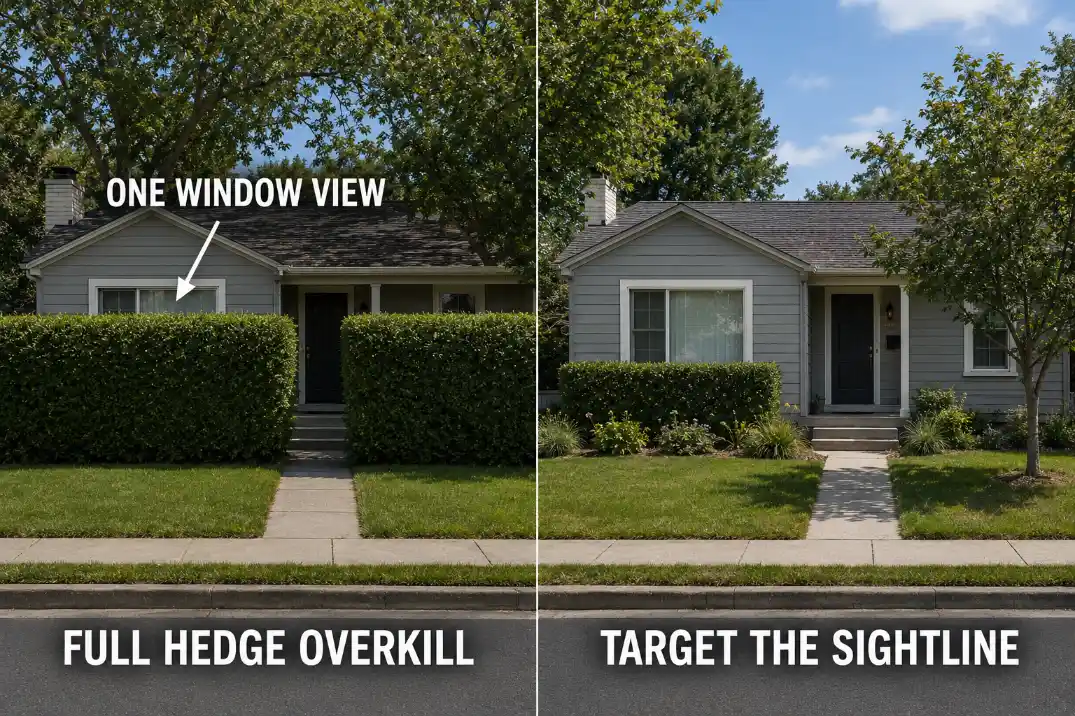
A lot of front-yard privacy problems are narrower than they feel. One street-facing window feels exposed. A porch chair faces the sidewalk. A passing pedestrian can see into the lower part of a room. A neighbor’s driveway creates an awkward angle into the entry.
Those are real problems, but they are not always hedge-sized problems.
A continuous hedge often responds as if the whole frontage is failing. It covers the window, then the area beside the window, then the space under the porch, then the approach to the front door. The yard may gain privacy, but it loses selectivity.
Narrow view, wide solution
If the uncomfortable view comes from one sidewalk angle, a full hedge may be too blunt. The better move is often to interrupt that angle, not erase the entire front yard. A staggered shrub, a small ornamental tree, a short trellis panel, or a pair of planters can change the view path without creating a wall.
This is especially important when the house already sits close to the street. In shallow front yards, a hedge does not have much room to settle into the landscape. It can quickly read as a green barricade pressed against the home. A deeper yard can absorb plant mass more gracefully; a shallow yard often cannot.
For broader sightline planning, a full front yard landscaping for privacy page can help map exposure zones. This hedge-specific decision is narrower: do not let one exposed view convince you to screen every part of the frontage.
Field Note: The hedge is usually chosen at the wrong scale.
A front-yard hedge often feels like a privacy upgrade because it gives the homeowner control. But the real test is whether the hedge matches the size of the exposure. If the problem is one window, one porch chair, or one sidewalk angle, a full hedge is usually doing more work than the yard asked for.
When the Hedge Makes the House Look Smaller
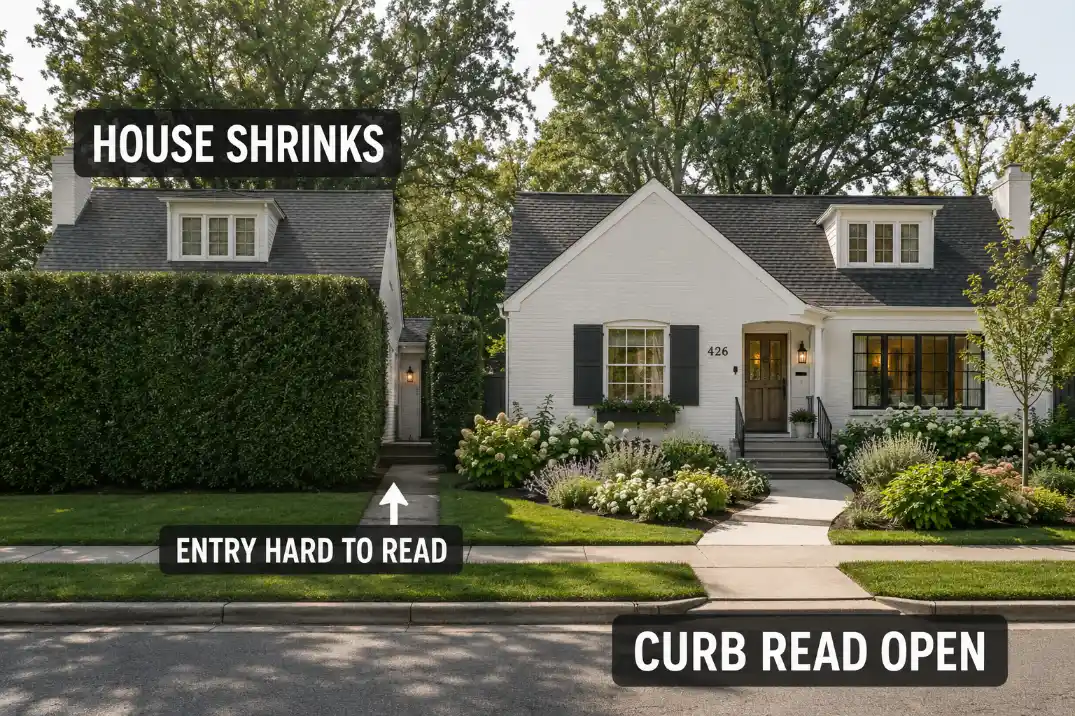
A front-yard hedge becomes curb-hostile when it protects the window but weakens the house.
The front yard has a public job. It introduces the home. The door, walkway, porch light, house number area, steps, and lower facade all help a visitor understand where to go and how the house is meant to be approached.
A dense hedge can interfere with that job even when it is healthy and well trimmed. It can hide the lower facade, cut across window proportions, or swallow the route to the door. The house may still be visible above the hedge, but it reads differently. The roofline floats. The porch feels tucked away. The door cue becomes weaker.
That is the curb-weight problem: not an ugly hedge, but a hedge that takes over the visual job of the front yard.
The green wall effect
A hedge can be neat and still wrong. Sometimes the problem is that the hedge is doing exactly what it was asked to do: becoming dense, continuous, and tall enough to block views.
In a backyard, that may be welcome. In a front yard, density has to be balanced against readability. A hedge that crosses the lower window line or runs uninterrupted across the front can make the house feel shorter and darker. It may also make the entry feel less approachable, even if the walkway is technically open.
This is different from the broader issue of front yard privacy that becomes too much. Here, the specific culprit is the hedge’s continuous mass: one plant line acting like architecture.
The Time Problem: Privacy Arrives Later Than the Decision
A hedge is a slow answer to a problem that often feels immediate.
That delay matters. In the first season, the plants may not block much. The exposed window is still exposed. The porch still feels open. The homeowner has paid for a hedge, watered a hedge, and planned around a hedge, but the privacy may not yet exist.
That gap between decision day and privacy day creates a second mistake: planting too tightly because the young plants look too small. Tight spacing can make the installation feel more satisfying on day one, but it can punish the yard later.
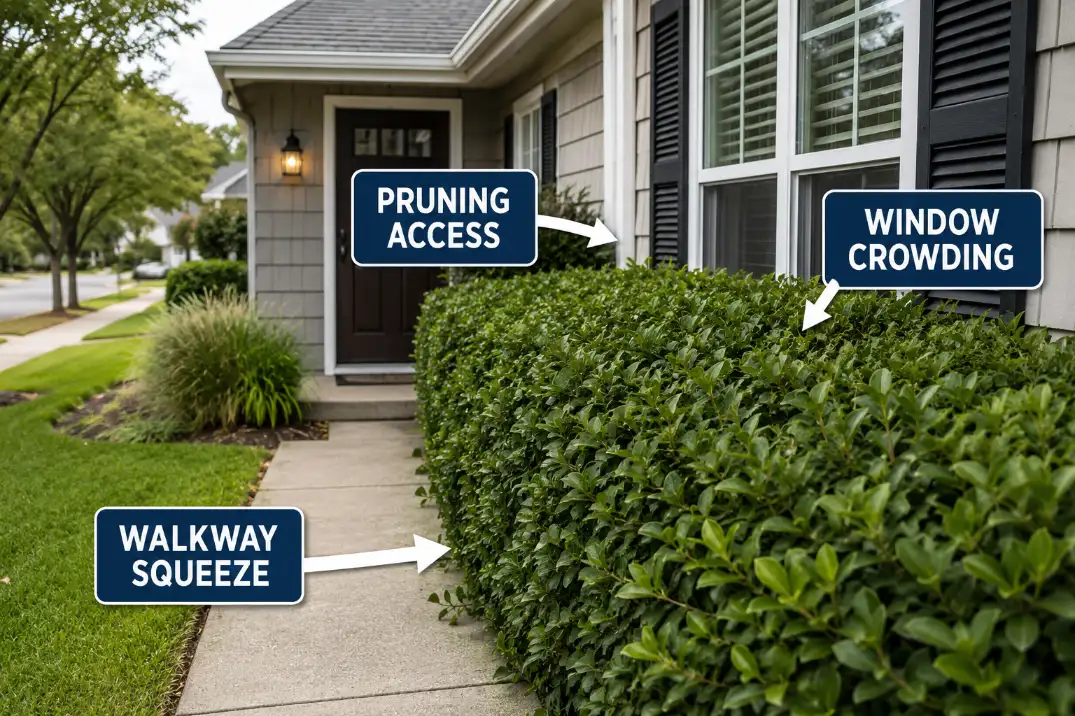
As the hedge fills in, mature spread becomes the real design size. The walkway narrows. The window gets crowded. The front bed becomes harder to access. The hedge that once looked thin starts asking for constant correction.
A front-yard hedge should be judged by its mature edge, not its nursery size. The plant line has to work when it is full, not just when it is newly installed.
This is why hedges are a poor fit when the privacy problem is urgent but narrow. If the homeowner needs immediate relief from a direct view, a partial screen, privacy planter, or offset planting may solve the angle faster without committing the entire front yard to a long-term hedge line.
The Maintenance Problem: A Hedge Is Not a One-Time Screen
A hedge is not a privacy object. It is a recurring shape.
That distinction matters more in the front yard than almost anywhere else. The hedge sits near the most visible part of the property. When it grows unevenly, browns out, bulges into the walkway, or develops gaps, the privacy screen becomes the curb appeal problem.
The edge has to be managed
The practical work is not only pruning the top. The sides matter. The base matters. The corners near the walkway matter. The space around windows matters. The hedge has to stay dense enough to screen, but not so wide that it squeezes guests, hides steps, blocks address visibility, or crowds the driveway edge.
Once a hedge becomes the main privacy structure, maintenance is no longer decorative. It is structural. If it is not shaped, it changes the route. If it is not watered consistently, it can develop weak sections. If one plant dies, the replacement may not match the size, density, or color of the rest of the line for a long time.
That is the hidden contract of a front-yard hedge: the privacy only stays attractive if the hedge stays controlled.
This is why some yards are better served by layered, less continuous screening. A broken planting rhythm can tolerate variation. A continuous hedge exposes every gap and uneven section.
Where a Hedge Still Makes Sense
The right correction is not “never plant a hedge.” It is “make the hedge prove it belongs.”
A hedge can make sense when the front yard has enough depth to hold the mature spread, the privacy need extends across a broad edge, and the entry can remain clearly visible. It also works better when the homeowner accepts the long-term maintenance instead of treating the hedge as a one-time installation.
The best front-yard hedge situations usually have room for the plant line to breathe. The hedge does not press directly against the walkway. It does not sit so close to the windows that every pruning decision affects light. It does not cross the visual route from curb to door. It screens the uncomfortable view while still letting the house read as a house.
A hedge also makes more sense when the exposure is continuous. If the entire street edge feels open, a carefully scaled hedge may be appropriate. If the issue is one window, one porch corner, or one awkward pedestrian angle, the hedge may be solving too much.
The mature size is the deciding point. If the hedge needs constant cutting just to avoid the walkway, the driveway, the porch, or the lower windows, the plant choice is probably too heavy for the front yard.
For yards where privacy must stay friendly from the street, it is worth studying how front yard privacy can still look welcoming before committing to a continuous hedge.
Better Hedge Alternatives When the Problem Is Narrow
A hedge alternative should not be chosen because it is another attractive idea. It should be chosen because it avoids the specific failure the hedge would create.
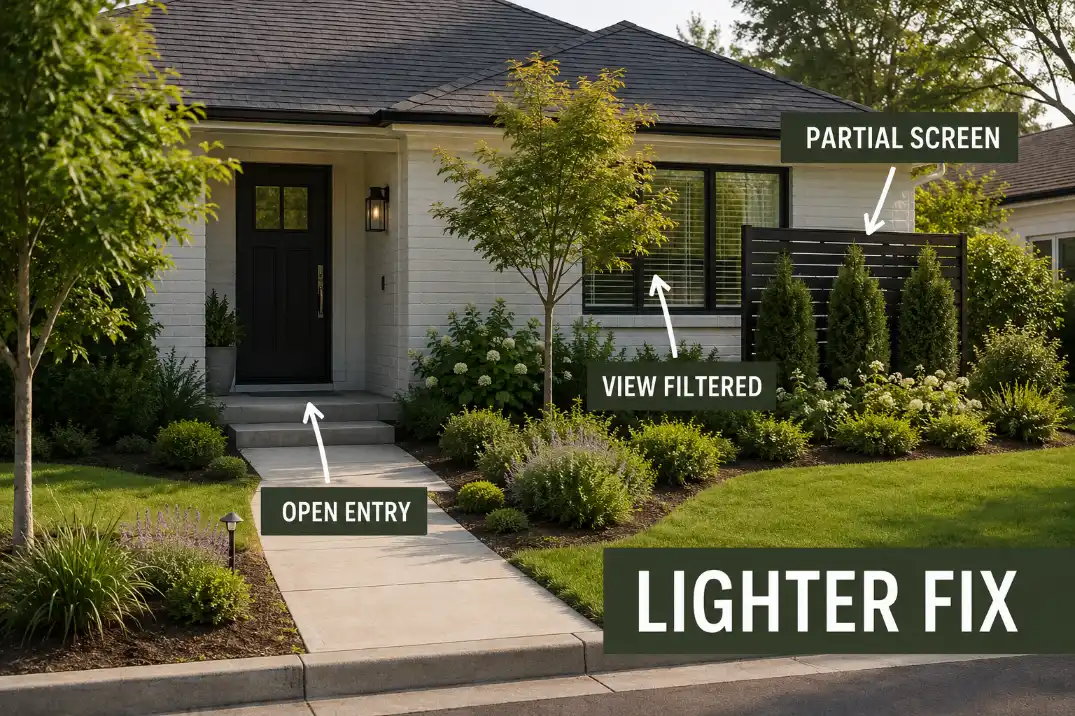
If the hedge is too wide, choose a targeted interruption. If the hedge is too slow, use something that works before year three. If the hedge is too permanent, test the view with something movable. If the hedge would hide the entry, use a partial screen that protects the personal view while leaving the arrival route open.
Use targeted shrubs when the view is low and direct
A small group of shrubs can interrupt a street-to-window view without creating a formal wall. This works best when the uncomfortable view is low, direct, and limited to one part of the frontage.
The advantage is selectivity. The planting can sit where the view crosses the yard, not across every open space. It can also be staggered so the house still has depth from the curb.
Use a small ornamental tree when the view comes from an angle
A small ornamental tree can soften a diagonal view toward a porch or window without blocking the entire lower facade. The canopy and trunk create interruption, not total closure.
This is often better than a hedge when the view problem comes from a sidewalk angle or a neighboring driveway. The goal is not to create a solid screen. The goal is to make the view less direct.
Use planters when permanence is the risk
Privacy planters are not a replacement for every hedge, but they are useful when the homeowner is not sure the screening line belongs there forever. They can test a sightline, protect a porch side, or soften one window without committing the whole front bed to a living wall.
For narrow or changeable exposures, privacy planters for front yards and patios can be a smarter first move than planting a hedge that will take years to prove or disprove.
Use a partial screen when the entry must stay open
A low screen, short trellis panel, or layered planting edge can block the most uncomfortable view while leaving the front door readable. This is especially useful when the hedge would sit near the guest route.
The screen does not need to hide the yard. It only needs to interrupt the line of sight. That distinction is what keeps a front yard from feeling closed off.
For homes with limited depth, a hedge alternative may need to be even more selective. A compact front yard often benefits from the sharper constraints covered in small front yard privacy ideas, where every plant mass has to protect privacy without stealing usable frontage.
Use layering when a single line feels too hard
Layering is the opposite of a hedge wall. Instead of one continuous green edge, it uses staggered height, open gaps, and overlapping shapes to soften views. That can be more forgiving in the front yard because the house remains visible through and around the planting.
This works when the view problem is real but full concealment would make the home feel withdrawn. A layered edge can give privacy in pieces, which is often exactly what the front yard needs.
For no-fence conditions, the deeper strategy belongs with front yard privacy layering without a fence, but the hedge lesson is simple: a broken layer often protects the view better than a single dense line.
Make the Hedge Decision From the Curb, Not the Nursery
The nursery view flatters hedges. The plants are separate, tidy, and full of promise. The curb view is more honest.
Stand where a passerby, guest, or delivery driver would first see the house. Look at the front door, not just the window you want to protect. Check whether the walkway still feels obvious. Notice whether the porch light, house number area, and steps are still part of the arrival picture. Then imagine the hedge at mature width, not purchase size.
The question is not whether the hedge will create privacy. It probably will. The question is what else it will create at the same time.
If it blocks one bad view while keeping the entry open, preserving light, and fitting the mature space, it may be a good front-yard tool. If it turns a narrow sightline problem into a heavy green edge that needs constant correction, it is the wrong fix.
The right front-yard privacy solution should make the uncomfortable view less direct without making the house feel smaller, slower to read, or harder to maintain.
When a hedge cannot pass that curb test, the lighter screen is not the compromise. It is the better design decision.
For broader shrub and hedge care principles, University of Maryland Extension explains how pruning and shearing affect shrubs used as hedges in the home landscape: Pruning Shrubs and Hedges in the Home Garden