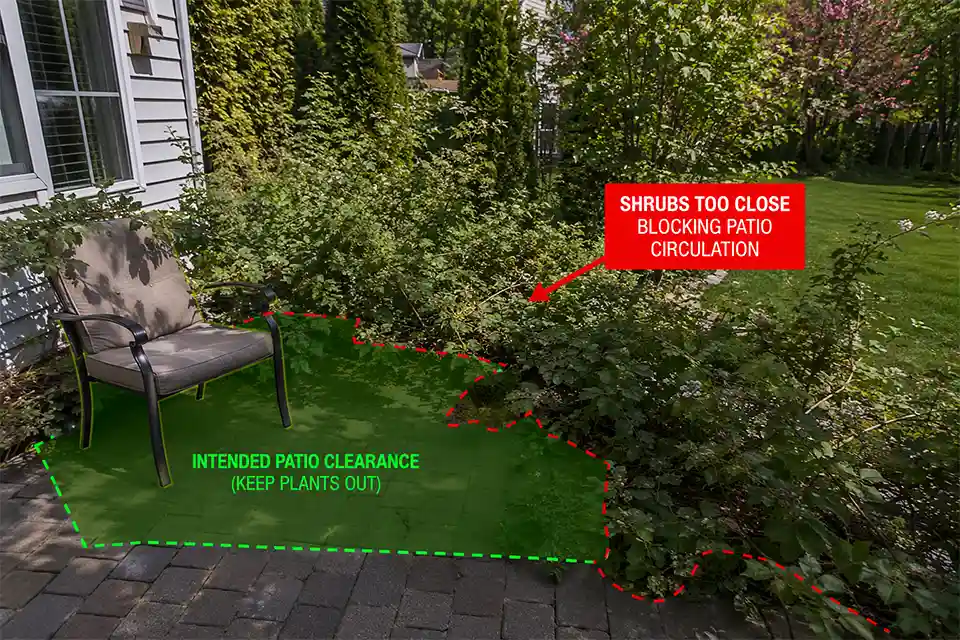
If shrubs are taking over the patio, the problem is usually not that they “grew too well.” The problem is that the patio edge was planted as if nursery size were permanent.
In most cases, one of three things went wrong: the shrub’s mature width was ignored, the plant’s natural habit was wrong for a hard edge, or the patio’s heat and reflected light made an already borderline choice grow more aggressively than expected.
Start with two checks. First, measure usable clearance. If you have less than about 18 to 24 inches of real working space where people walk, pull out chairs, or pass a grill, the shrub is now taking function, not just adding greenery.
Second, look at pruning frequency. If it needs cutting back more than twice a growing season just to keep the patio usable, this is usually a plant-fit problem, not a simple maintenance problem.
That distinction matters. A neglected shrub can look messy and still belong there. A shrub that keeps reclaiming patio square footage after repeated trimming is usually telling you it never matched the space in the first place.
What usually failed first
Mature width never got translated into patio clearance
This is the biggest cause by far. Homeowners often space shrubs by pot size, not mature size. That mistake is easy to miss in year one because everything still looks tidy and proportional.
By year three to five, the patio edge starts disappearing.
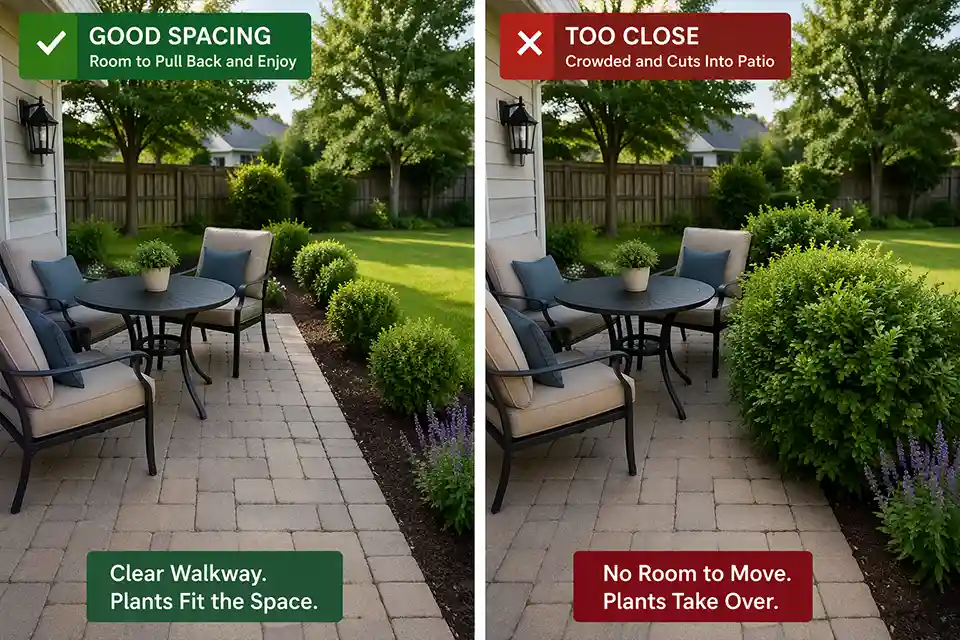
On a patio, every extra 8 to 12 inches of spread matters more than it does in an open bed. That lost space affects chair pull-back, walking lanes, grill access, and the simple feeling that the patio still works.
If a shrub will mature to 4 feet wide, planting its center only 18 inches from the patio edge was almost guaranteed to create conflict.
What people usually overestimate is how manageable future pruning will feel. What they underestimate is the geometry of a mature shrub beside fixed hardscape.
The plant was chosen for fast fill, not long-term fit
This is the second major failure. The shrub that fills a blank patio border quickly often becomes the shrub that demands constant control later.
That is the same trap behind Why Low-Maintenance Gardens Never Stay That Way: the design solves emptiness fast, then sends the maintenance bill later.
The wrong shrub is not always the tallest one. More often, it is the one with the wrong habit — arching, broadening, suckering, or always pushing soft outer growth toward open space. That matters more than the word compact on the tag.
What people usually misread
They treat shearing as the fix when it is usually the trap
This is the most common waste of effort. Surface shearing can make a shrub look smaller for a few weeks, but it often creates denser outer growth and a woodier, emptier interior. That makes the patio side blunter, thicker, and harder to manage over time.
The important distinction is simple: patio crowding is the symptom. Wrong siting followed by the wrong pruning response is the cause.
If the goal is to keep a natural-looking shrub near a patio, selective reduction and thinning are usually more useful than repeatedly shaving the outer shell.
They assume every overgrown shrub can be cut back hard
This is where generic advice falls apart. Some multi-stemmed deciduous shrubs can be renovated over time. Others cannot be pushed back hard without ruining their shape or creating a long recovery period.
Many evergreen shrubs are even less forgiving. If restoring the patio edge would require cutting deep into bare interior wood, recovery becomes much less reliable.
That is where many homeowners lose time. They keep asking how hard they can prune when the better question is whether the shrub can ever live there gracefully again.
They underestimate the patio microclimate
Patios are not neutral planting zones. Hard surfaces store heat, reflect light, and change how quickly soil and foliage dry out.
In some cases that pushes more top growth. In others it creates stress that leads to awkward, imbalanced growth and more frequent intervention.
This overlap is one reason Patio Shade Problems in Afternoon Sun and patio shrub crowding often show up together. The plant is not only dealing with soil and water. It is also reacting to heat load and reflected exposure from the patio itself.
Quick diagnostic checklist
- The shrub reaches within 12 inches of the chair pull-back zone.
- You are pruning it 2 or more times per growing season just to protect usability.
- The plant was set too close to the patio for its mature spread.
- The outside looks dense, but the inside is woody or bare.
- Regaining clearance would require cutting into brown, leafless interior wood.
- The patio feels smaller each year even when the shrub is “kept trimmed.”
The real decision: prune, renovate, or replace
Prune lightly when the shrub is only slightly over the line
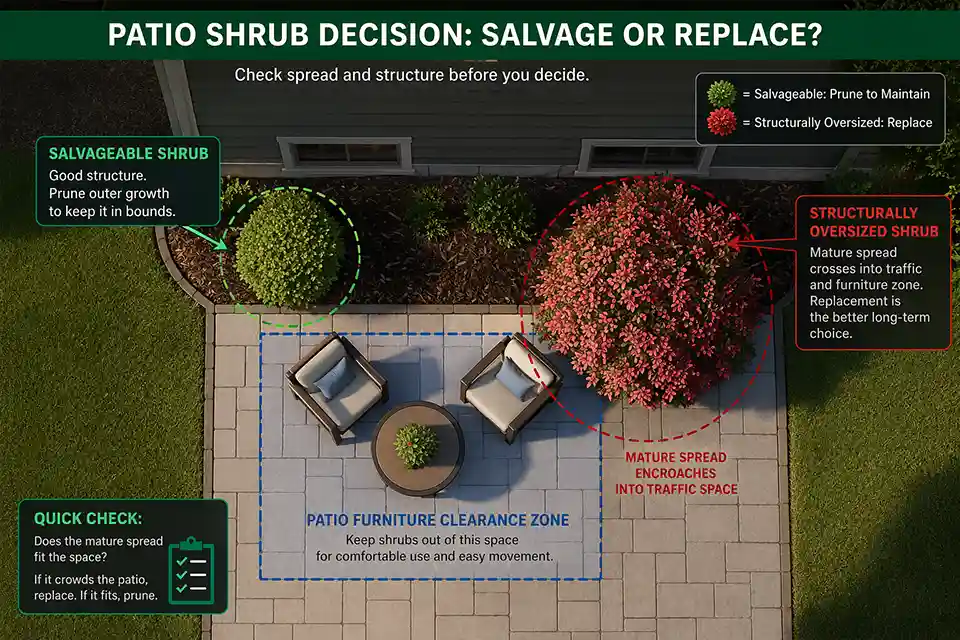
If the shrub is only 6 to 10 inches beyond where it should be, and there is still green growth well inside the canopy, selective reduction may be enough. Remove a few of the longest stems back to a branch junction rather than shaving the whole surface.
This works best when the problem is moderate spread, not structural mismatch.
Renovate when the species can actually recover
If the shrub is 1 to 2 feet into usable patio space but is the kind of shrub that responds well to staged renewal, renovation can still make sense. The key is not trying to force a full reset in one weekend. A gradual reset over 2 to 3 seasons is often more realistic and less damaging than one severe cut.
This is also where Step-by-Step Guide to a Patio That Stays Low-Maintenance becomes relevant. If the border only works when corrective pruning stays on a schedule, it is not truly low maintenance.
Replace when the shrub is structurally incompatible with the patio
Replacement makes sense earlier than many homeowners want to admit. If the shrub needs repeated size control, blocks the only practical traffic lane, or would have to be cut deep into bare interior wood to regain the patio line, the design has already crossed from maintenance issue into fit issue.
That is the point where routine pruning stops making sense. A smaller, slower, naturally mounded shrub will usually outperform a “rescued” oversized shrub in the long run because it restores function without demanding constant restraint.
Pro Tip: One correctly sized shrub usually gives a patio edge more long-term value than three “small for now” shrubs planted tightly together.
The shrub type changes the answer
| Shrub type | What usually works | Where the limit shows up |
|---|---|---|
| Multi-stemmed deciduous shrub | Staged renewal pruning | Only worth it if the patio still works after recovery |
| Broadleaf evergreen kept near natural size | Selective thinning or minor reduction | Deep cuts may leave lasting gaps |
| Conifer-type evergreen | Light correction only | Severe size reduction is often unrealistic once the interior is bare |
| Any shrub needing heavy pruning every season | Replacement | The maintenance pattern itself shows the fit is wrong |
This is one of the most important distinctions in the whole topic. Weak advice treats all shrubs as if they respond to the same rescue plan. They do not. Some patio shrubs can be brought back into proportion. Others keep turning into disappointment projects because the wrong answer is being repeated.
When the standard fix stops making sense
If you cannot maintain about 18 inches of honest usable clearance on the working edge of the patio after a realistic prune, the shrub and the patio are competing for the same square footage.
From that point on, this is no longer mainly a pruning topic. It is a design-correction topic.
That is where Patio Layout Problems That Make Spaces Hard to Use fits naturally. Once shrubs start stealing circulation and furniture clearance, the issue is not just that the planting looks overgrown. The patio is becoming harder to use.
The sharpest takeaway is also the simplest one: the shrub that looked generous in year one often becomes the shrub that steals the most patio function by year four.
When that happens, the real mistake was usually made before the first pruning cut ever happened.
For broader official guidance, see NC State Extension’s landscape design guidance.