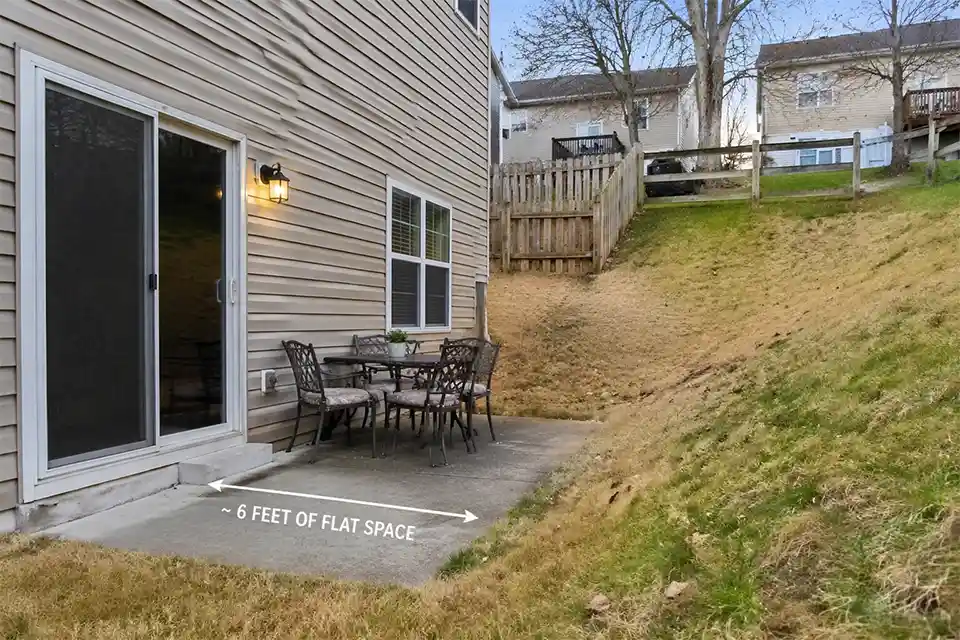
When a sloped backyard feels too small to use, the real problem is usually not lot size. It is the amount of stable, level ground that can support everyday use. Once the usable flat zone drops below about 10 to 12 feet deep, a backyard starts losing the ability to hold more than one clear function.
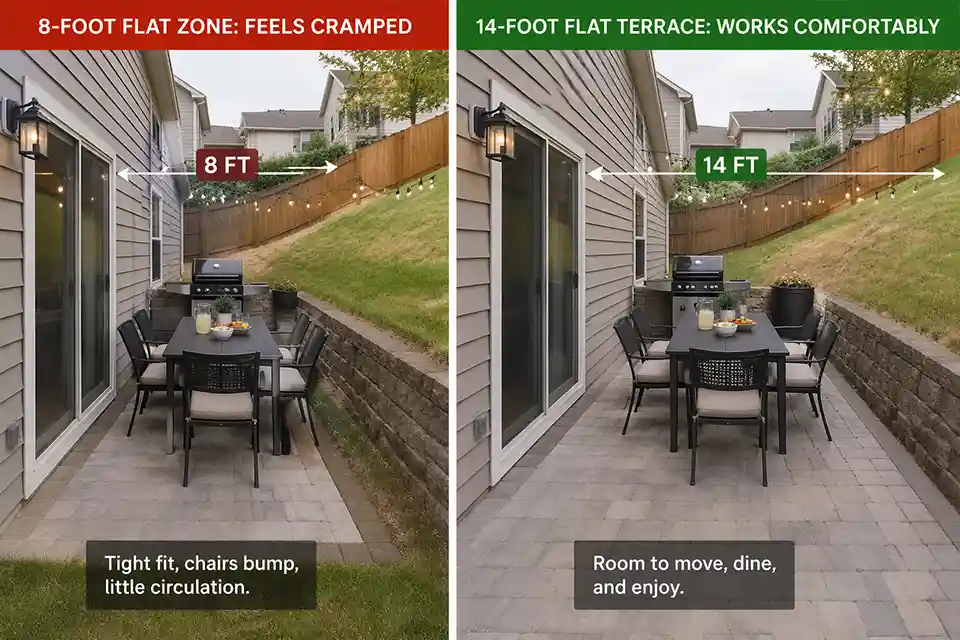
At around 8 feet or less, even a simple table-and-chair setup can feel cramped if people still need 30 to 36 inches of walking clearance around it.
The first checks are practical. Measure the flat depth from the house or patio edge to the point where the slope begins.
Check whether the “flat” area is actually close to level or already pitched enough to make seating awkward; for most everyday use, a surface pitch around 1 to 2 percent is workable, but beyond that furniture and circulation start feeling off.
Then watch what happens after rain. If water sits at the flat-to-slope transition for more than 24 to 48 hours, you are not just looking at a tight layout. You are looking at a cramped area that is also likely to lose edge quality over time.
Why this problem feels worse than the measurements suggest
A sloped backyard with a small level area usually fails because one zone is trying to do too many jobs. The yard may look decent from inside the house, but the usable plane is too shallow to absorb real movement.
The flat zone gets overloaded fast
A dining area alone often wants a footprint close to 10 by 10 feet once chairs are actually pulled out. Add a grill, a path of travel, or a place for kids and pets to move, and a small terrace stops functioning like an outdoor room. This is the point many homeowners underestimate. They assume a modest patio can multitask if the furniture is compact enough. Usually it cannot.
Total yard depth is not the same as usable yard depth
This is where the scenario gets misread. A backyard can run 35 or 40 feet to the fence and still behave like a tiny outdoor space if only the first 8 or 9 feet are truly level. The slope behind it still counts visually, but it does not automatically count as living space.
That is why this issue often overlaps with the same structural logic behind tiered backyard problems on a steep slope. The yard may not look dramatic enough to seem like a major grading problem, but the geometry is already deciding how the space can and cannot be used.
What people usually misread first
The most common mistake is treating this as a décor problem. It is a footprint problem first.
Symptom versus mechanism
The symptom is, “We do not have enough room.”
The mechanism is, “The level plane is too shallow to support real use.”
That distinction matters because cosmetic upgrades do not fix geometric limits. Smaller chairs, lighter pavers, prettier edging, and narrow planter strips may make the space look more intentional, but they rarely change whether the yard works.
The obvious fix that wastes time
The most common time-waster is trying to visually extend the backyard onto the slope without structurally improving it. Loose gravel, mulch, and decorative stepping routes can make the space look larger for a short time, but they do not create reliable living area. In wet periods, they often accelerate edge wear and maintenance. Similar surface-first fixes tend to unravel quickly in conditions like bare soil washout on a sloped backyard, where the slope keeps reclaiming the edge.
Quick diagnostic checklist
- The flat area is less than 10 feet deep before the grade change starts.
- Walking clearance around furniture drops below about 30 inches.
- The usable yard effectively ends within 2 to 4 steps of the back door.
- Water lingers at the terrace edge longer than 24 hours after a normal rain.
- The transition line keeps softening, shifting, or eroding downhill.
- The backyard can support only one activity at a time without conflict.
The main causes, in order
Not every yard in this scenario failed because of a bad design choice. But the cause ranking still matters because it changes the right fix.
The original flat zone was undersized
This is the most likely cause. Many homes are built with a shallow rear patio or small pad that looks acceptable until the space is used daily. The backyard seems fine during move-in and disappointing by the first full season.
The slope change is too abrupt
Some yards are not especially steep overall, but the transition from flat to slope is too compressed. That matters more than people expect. A moderate slope stretched over enough distance can still support decent use. A shorter, sharper transition makes the flat zone feel clipped off almost immediately.
Edge stability got worse over time
A marginal flat zone becomes more frustrating when runoff, settling, or erosion reduce its usable edge. In those cases, the layout issue and the site issue start feeding each other. That is one reason this scenario can drift toward sloped backyard drainage, erosion, and safety problems if it is ignored.
Which fix actually makes sense for your yard?
This is where the useful decision usually gets made. Not every small flat zone needs a rebuild, but not every cramped yard can be saved with smaller furniture either.
When layout changes are enough
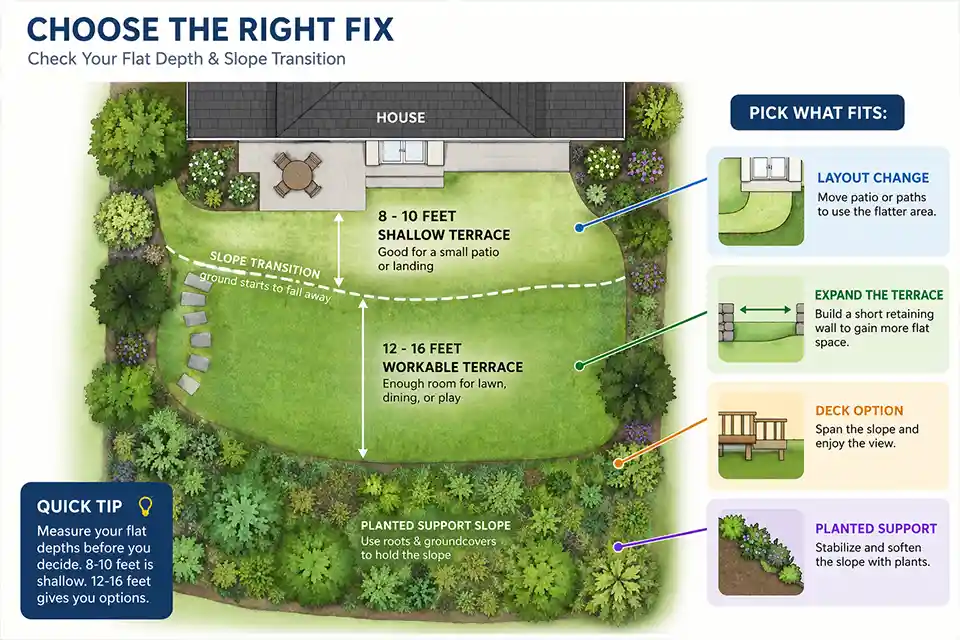
If the level area is roughly 12 to 16 feet deep and the main frustration is crowding rather than true lack of space, layout changes may be enough. In that range, one strong use zone often works well. A built-in bench, one clear circulation line, and fewer movable pieces can recover more function than people expect.
When a wider terrace is the real answer
If the usable depth is closer to 8 to 10 feet and the slope starts almost immediately after, layout improvements usually stop making sense. This is the threshold many homeowners underestimate. Once the yard cannot support one anchored activity plus basic circulation, the solution is usually to create more flat ground, not to keep shrinking the program.
When a deck works better than more grading
This is the option people often miss. If the grade transition is too abrupt, access is awkward, or expanding the terrace would require too much cut-and-fill, a deck may make more sense than forcing more earthwork. A deck can create usable sitting space efficiently, but it does not solve runoff, unstable edges, or slope stabilization by itself. It is a space-making move, not a full site correction.
When the slope should stay a support zone
Not every slope should become living space. Sometimes the smartest move is to improve one flat zone near the house and let the remaining slope work as planted support space, erosion control, or visual backdrop. This is one of the most overestimated parts of sloped-yard planning: people assume the whole yard has to be activated. Usually it does not.
Pro Tip: Mark furniture footprints and walking paths on the ground before planning construction. Ten minutes of field layout often reveals whether you need a better arrangement or a bigger terrace.
Comparison guide: what fits which condition?
| Site condition | Best-fit solution | Primary benefit | Common mistake |
|---|---|---|---|
| Flat zone is 12–16 feet deep but cluttered | Rework layout and reduce program overlap | Improves circulation without major construction | Treating a layout problem like a grading problem |
| Flat zone is only 8–10 feet deep and ends abruptly | Expand one main terrace | Creates real usable square footage | Buying smaller furniture instead of fixing the footprint |
| Grade change is too sharp for easy terrace expansion | Use a deck or raised platform | Gains sitting space with less aggressive earthwork | Assuming a deck will also solve drainage and slope stability |
| Slope behind the terrace is steep and secondary | Keep slope planted and stabilized | Preserves one strong use zone with less maintenance | Trying to turn every part of the yard into activity space |
When the standard fix stops making sense
Adding more little landings, more steps, or more decorative transitions often feels safer than building one proper terrace. But this is where the standard fix often stops making sense.
More zones can make the yard less usable
A 4-foot-deep mini landing may look intentional, but it is rarely large enough for meaningful daily use. Instead of solving the small-flat-space problem, it divides the backyard into fragments that are too shallow to function.
Retaining helps only when it adds real usable depth
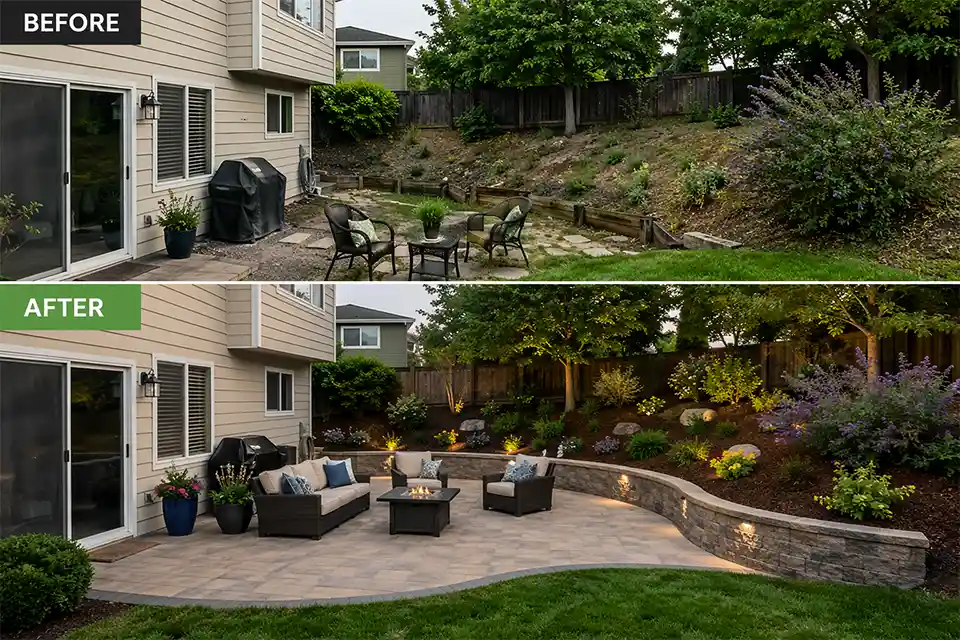
A low retaining edge can be a smart move when it creates measurable additional flat space near the house. But once wall heights move into roughly 3 to 4 feet or more, the job often shifts from landscape adjustment to structural intervention. At that point, drainage detailing, engineering, and local permit requirements usually matter more than finish choices. If movement, leaning, or cracking are already visible, the issue is no longer just spatial. It overlaps with retaining wall failure signs in sloped backyards.
Do not overbuild a modest problem
This matters too. If the backyard already has enough flat depth for one good use zone and the frustration comes mostly from clutter or overlap, overspending on walls and grading may solve the wrong problem. At some point you are not comparing patio options anymore. You are comparing construction strategies.
What actually improves daily use
Most successful fixes come back to one principle: protect and strengthen the flat area people use most.
A single level terrace near the house is usually more valuable than several smaller platforms scattered up the slope. A terrace around 12 to 16 feet deep gives a much better chance of supporting seating, dining, and movement without constant compromise.
That does not mean every yard needs major reconstruction. It means the main usable zone should be strong enough to work without daily workaround behavior.
Drainage should be treated as part of that usable zone, not as a separate technical issue. A terrace that stays soggy, sheds poorly, or keeps losing its edge after storms is not truly usable even if it measures well.
In wetter regions, water that remains longer than 24 to 48 hours after a typical rain is a practical warning sign. In drier climates, the mistake is often assuming runoff does not matter until one intense storm exposes the weak edge.
Questions people usually ask
Can planting solve this by itself?
No, not if the core issue is lack of level living space. Planting can stabilize and soften the slope, but it does not create real usable square footage.
How much flat space is enough for a small backyard setup?
For one modest function, around 10 to 12 feet of usable depth can begin to work. For a more comfortable everyday setup with circulation, 12 to 16 feet is usually a more realistic target.
Is the slope itself the problem?
Not always. The real issue is usually the relationship between the slope and the terrace. A sloped backyard can work well if the level zone is large enough and the transition is handled correctly.
For broader official guidance, see the University of Minnesota Extension.