Last updated: April 14, 2026
Most retaining walls in sloped backyards do not fail all at once. They fail in stages: water lingers where it should drain, the soil behind the wall gets heavier, the toe begins to soften or wash out, and the wall moves a little farther after each storm.
Unlike slower garden wear, retaining wall failure can speed up after repeated heavy rain. The first checks that matter are not decorative ones.
Look for outward lean, a bulge in one section, seepage that is still visible 24 to 48 hours after rain stops, and a soil crack opening 2 to 6 feet behind the top of the wall. Those signs usually tell you more than surface staining or one loose cap block.
That distinction matters because people often misread the wrong clues first. Efflorescence, dark staining, or moss can make a wall look worse than it is.
A small but growing lean is the opposite: it can look modest while the wall is already losing ground. If the wall has shifted about 1 inch or more out of plane over a 4-foot section, if one part bows while adjacent sections stay straight, or if a crack widens beyond 1/8 inch over a few weeks, you are past a cosmetic issue.
The most useful warning signs are movement, water, and loss of support
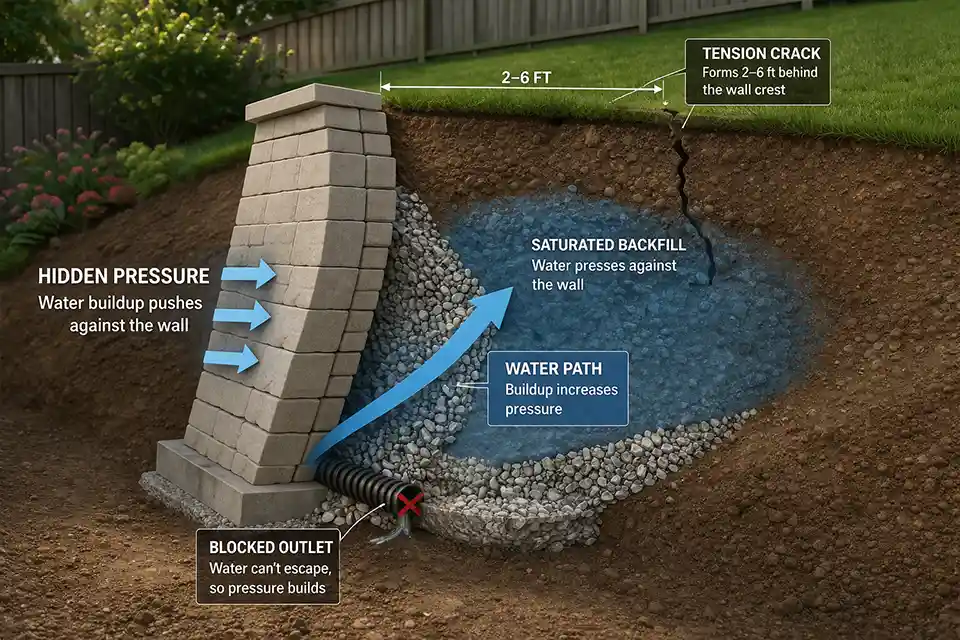
A retaining wall in a sloped backyard usually fails because the wall is carrying more lateral pressure than it was designed to resist. After heavy rain, that extra load often comes from saturated backfill, hydrostatic pressure, runoff being directed toward the wall, or erosion at the toe that removes support from below.
Outward lean matters more than a stained face
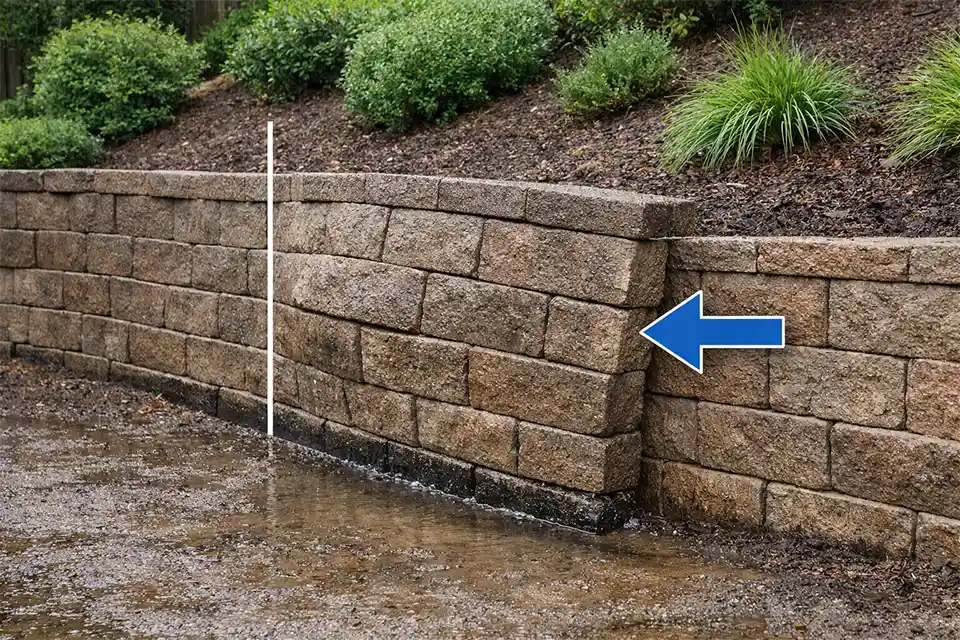
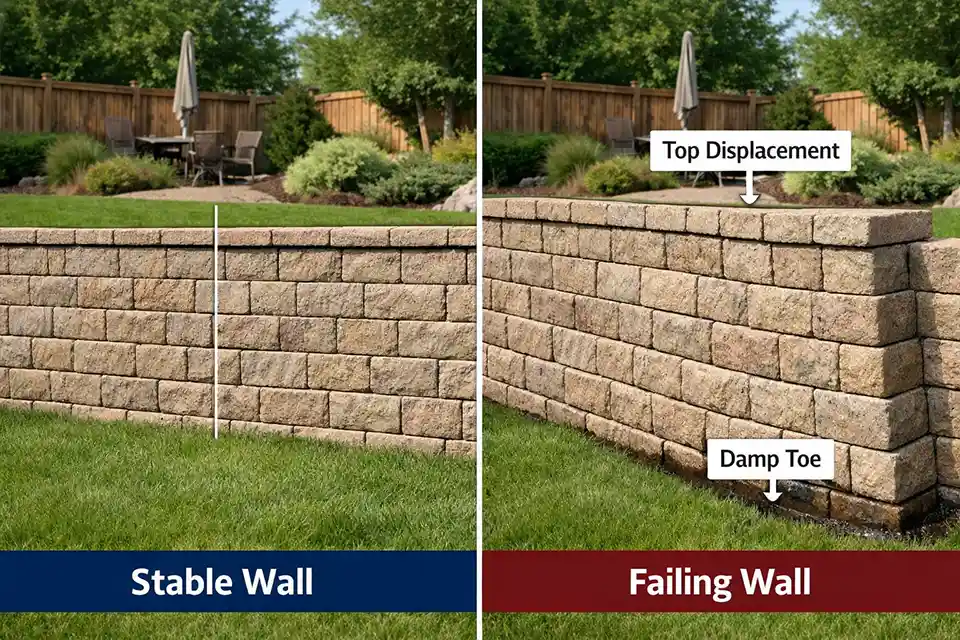
A wall that leans outward, rotates at the top, or bows through the middle is showing structural response to load. A stained wall may only be showing moisture movement. A leaning wall is showing movement. That is the distinction that should guide the rest of the inspection.
A practical field check is simple: hold a straight board or 4-foot level against the wall face. If a section is visibly proud of the line by around 1 inch or more, or if the top has moved farther out than the base, the wall is not just weathered. It is changing shape.
Seepage after the storm is more important than runoff during it
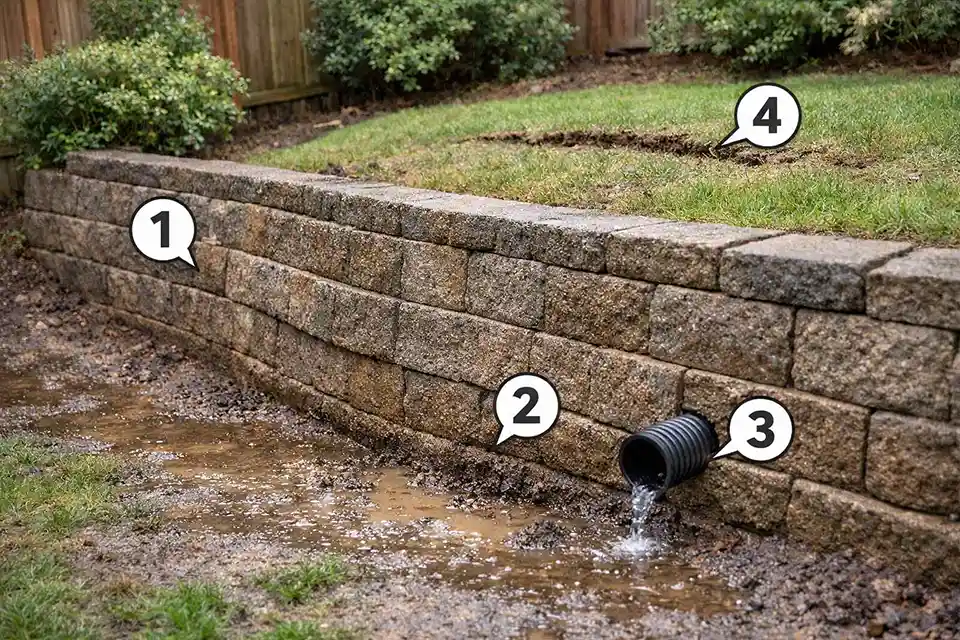
Water flowing across the yard during a storm is expected. Water still coming out of wall joints, weep holes, or the base 24 to 48 hours later is more telling. That usually points to slow drainage, trapped water, or a saturated zone behind the wall that stays loaded well after the rain ends.
If weep holes or outlet points stay blocked, or water keeps daylighting under the wall bottom instead of clearing cleanly, the drainage system is not doing its job. In many yards, the real culprit is not the wall material but the site pattern around it.
Downslope movement, roof discharge, compacted lawn, patio runoff, or upper-slope grading often keeps feeding the same area. That is why retaining wall problems frequently overlap with broader backyard drainage problems homeowners ignore.
Soil separation above the wall is easy to underestimate
A tension crack or shallow depression behind the wall can be one of the most useful warning signs on the property. If the ground opens 2 to 6 feet back from the wall crest, the failure zone may already be extending into the retained soil mass. That matters more than a chipped block or surface wear on the face.
If that crack deepens after the next rain, or if the lawn above the wall settles unevenly, the mechanism is progressing. People tend to underestimate this because the wall itself still looks mostly intact.
Check the wall face first, then the toe, then the drainage exit points, then the soil 2 to 6 feet behind the crest. That order catches the signs that change the decision fastest.
What people usually misread first
Most homeowners do not miss the ugly signs. They miss the useful ones. The common error is giving too much weight to what looks dramatic and too little weight to what shows the wall is moving.
If the issue still looks like surface erosion rather than full structural failure, this breakdown of the best products for a sloped backyard erosion problem helps separate washout, channel erosion, and traffic damage.
Efflorescence is a moisture clue, not a failure verdict
White mineral staining tells you water is passing through masonry. It does not automatically mean the wall is structurally failing. If the wall remains plumb, joints stay tight, and no measurable displacement appears over 30 to 60 days, staining is a lower-priority issue than a bulge, a lean, or persistent seepage.
One loose cap block is not the same as wall-body movement
Cap units can loosen from adhesive failure, freeze-thaw cycles, or minor seasonal movement. That is worth fixing, but it is not the same as the lower courses shifting.
In northern climates, a wall can lose a cap without losing structural alignment. The more important question is whether the wall face below it is still straight after winter and spring rains.
A small bulge beats a big stain in the risk ranking
A slight bulge in one section is often more serious than heavy discoloration across the whole face. Once one area starts moving differently from the adjacent wall, load is no longer being shared evenly.
That is where people often lose time on surface repairs instead of addressing the drainage or support issue that actually changed the wall geometry.
What the crack pattern usually means
Not every crack tells the same story. The direction, location, and speed of change matter more than the fact that a crack exists.
Horizontal cracks usually point to lateral pressure
A horizontal crack, especially in the middle third of a wall face, often lines up with outward pressure from saturated soil or trapped water. If that crack appears with bowing, seepage, or a visible lean, the more likely story is pressure behind the wall rather than simple shrinkage or cosmetic aging.
Vertical or stair-step cracks more often suggest settlement or base movement
A vertical crack, stepped crack, or offset joint is more often tied to differential settlement, toe erosion, or uneven support below the wall. In other words, the wall may not just be getting pushed. It may also be losing its footing.
This is one of the most useful distinctions in the whole inspection. People often assume every crack means the same thing, but a pressure crack and a settlement crack do not point to the same fix.
Fast-changing cracks matter more than old stable ones
An old hairline crack that has not moved through multiple seasons can be lower priority than a newer crack that opens after one wet month. Marking both sides of a crack with pencil or taking two photos from the same angle 2 weeks apart often tells you more than staring at it once.
Pro Tip: Put a small piece of painter’s tape across a suspect crack and date it. If it tears, wrinkles, or pulls away after the next heavy rain, movement is active.
Quick Diagnostic Checklist
- The wall leans outward by about 1 inch or more over a 4-foot span
- One section bulges while the rest of the wall stays relatively straight
- Water is still seeping from joints or the base 24 to 48 hours after rain
- A soil crack or depression has opened 2 to 6 feet behind the wall top
- Vertical offset, stair-step cracking, or settlement appears at one section
- The toe stays muddy, eroded, hollowed out, or visibly washed after storms
The overlooked problem at the bottom: toe erosion and loss of support
Many readers focus only on the wall face. That is understandable, but incomplete. Some walls fail less because they are being pushed too hard and more because the support at the bottom is being undermined.
A washed-out toe changes the wall geometry
If runoff keeps eroding soil at the base, the wall can lose support where it most needs it. That can show up as settlement, tilted lower courses, gaps beneath timbers, or one side dropping more than the other. Once the toe begins to wash out, the wall may lean even if the drainage behind it is only moderately poor.
Nearby hardscape movement can be a clue
When the wall support changes, nearby surfaces often give it away. A step may settle, a patio edge may separate slightly, or a fence post near the wall may begin to tilt. Those are not always separate problems. They can be collateral evidence that the soil mass around the wall is shifting, much like the ground behavior that shows up in patios that feel unstable on sloped ground.
This is where many DIY fixes stop making sense
Once the base is washing out or settling unevenly, surface patching becomes even less useful. Re-gluing caps, replacing a few face blocks, or coating the wall does not restore support under the structure.
At that point, the question is no longer how to make the wall look finished again. It is how to restore drainage and bearing where the wall is actually failing.
Why the obvious fix often fails
The usual wasted fix is cosmetic repair before drainage and load are addressed. That includes patching cracks, re-setting a few blocks, coating the face, or trying to make the wall look straight enough from a distance.
Cosmetic repair does not relieve pressure
If the soil behind the wall is saturated, the wall is carrying more weight and more lateral force than usual. A tidier face does nothing to reduce that.
The same is true if the drainage outlet is blocked, if a downspout discharges toward the retained area, or if the upper yard keeps feeding water into the same section.
Small grading tweaks are often overestimated
People often overestimate how much a shallow swale, a little added mulch, or slight regrading above the wall will accomplish. Those steps help only if water is genuinely redirected away from the failure zone.
If patio runoff, roof water, or the upper slope still feeds the same area, the wall keeps seeing the same load. That is why these failures often overlap with broader sloped backyard drainage, erosion, and safety problems.
Material is usually less important than drainage history
Timber walls, block walls, and poured concrete walls all fail when drainage is poor enough and movement continues long enough.
Older timber walls do deserve a little more suspicion, especially once they reach roughly 20 to 25 years and begin showing lean, rot, or toe loss. But age alone is not the verdict. Age plus movement plus water problems is what pushes the decision toward replacement.
Spalling concrete, rotting timber, or visible corrosion matter most when they appear alongside lean, cracking, or base movement—not as stand-alone cosmetic wear.
When to stop watching and call a pro
There is a point where “monitor it for a while” stops being a sensible plan.
Call promptly if movement is active after a storm
Do not sit on it if the wall leans more after successive rains, if a crack widens noticeably over 2 to 4 weeks, if the soil behind the wall opens up, or if one section is moving independently from the rest. Those are not maintenance clues. They are progression clues.
Call sooner if the wall is near people or hardscape
Risk is higher when the wall supports a walkway, patio, stairs, play area, fence line, or storage area. A modest residential wall can still create a real hazard if falling blocks, sliding soil, or sudden settlement affects a space people use every day.
Do not try improvised pressure relief
Do not drill random holes in the wall, pull out units, remove stones from the face, or stack more weight at the top. Those are exactly the kinds of homeowner fixes that can make a compromised wall less predictable.
If the wall is already leaning, keep people away from the immediate area and avoid loading the crest with planters, stone, soil, or equipment.
Pro Tip: After any storm that drops several inches of rain in a day or two, inspect the same three points every time: the wall face, the toe, and the soil 2 to 6 feet behind the crest.
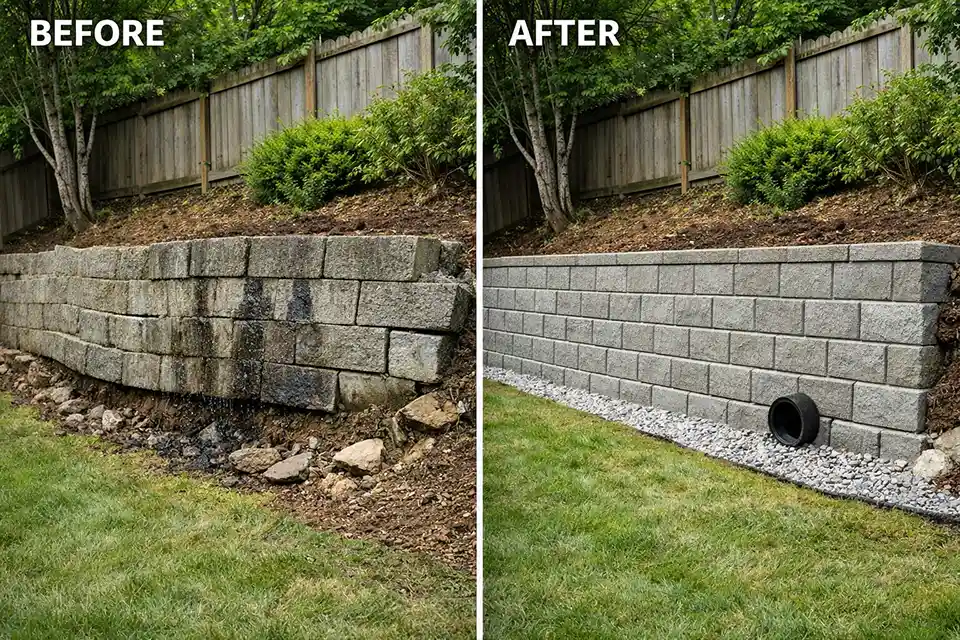
When repair stops making sense
Repair still makes sense when the movement is limited, localized, and stable enough that drainage correction and selective reconstruction can realistically solve the problem.
That usually means one smaller section, limited displacement, no rapidly advancing soil crack, and no broad toe washout.
Replacement becomes more rational when the wall is moving in several places, when the geometry has already changed across the run, when drainage failure appears chronic, or when the base is no longer reliable.
Once you have multiple bulges, recurring seepage, displaced sections, and visible loss of support, repairs often turn into a series of temporary resets.
That is the point where the wall behaves less like an isolated defect and more like the kind of site problem that becomes more expensive over time in backyard landscaping problems that get worse over time.
What actually changes the outcome
The best diagnosis is not about guessing the wall material or reacting to the ugliest-looking mark. It is about tracking movement, reading the crack pattern correctly, checking whether the toe is staying intact, and asking whether water is leaving the area fast enough after rain.
A healthy retaining wall may get wet during a storm. A failing one stays loaded after the storm, separates from the soil behind it, or loses support at the bottom. That is the difference worth acting on.
For broader official guidance, see TxDOT retaining walls guidance.