Last updated: June 19, 2026
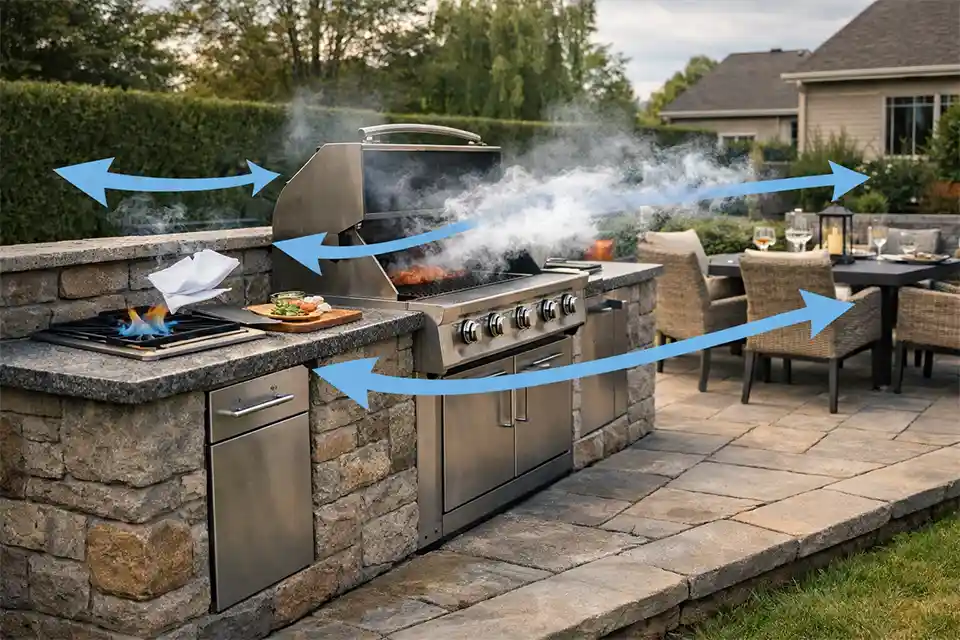
In windy backyards, the biggest design mistake is usually not the grill, the hood, or the furniture. It is placing the cooking zone in the part of the yard where wind pressure is already strongest, then trying to solve the fallout with accessories.
If smoke regularly blows across the cook or dining table, if burner flames flutter once gusts get into the 12 to 15 mph range, or if the prep counter is dusty again within 24 hours, the design is underperforming before appliance quality even becomes the main question.
The first checks are simple: where wind usually enters the yard, whether the grill sits on an exposed patio edge or side-yard corridor, and whether the seating zone sits directly downwind.
This often gets misread as a ventilation problem when the deeper issue is exposure and placement. Even a covered kitchen can fail badly if it sits in the wrong pressure pocket.
The layouts that perform best in wind are usually not the ones with the most equipment. They are the ones where the smoke path, prep side, and seating position were tested before anything permanent was built.
The mistake that creates most windy-backyard failures
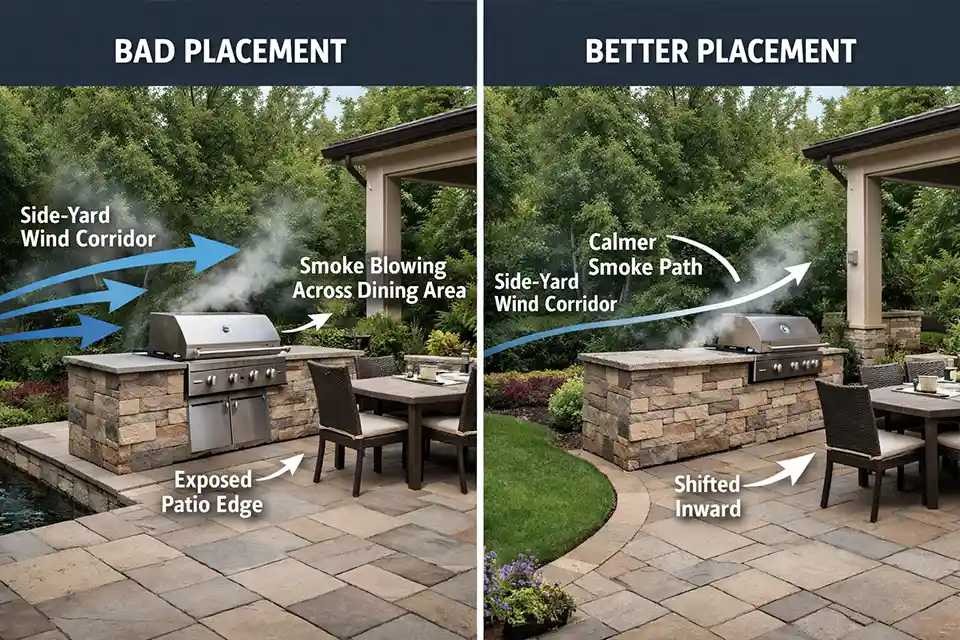
The highest-value decision is where the cooking line sits relative to prevailing wind. In most exposed yards, the worst placement is at the patio perimeter, the end of a long hardscape run, or directly beside an opening that funnels air toward the grill face.
Wind corridors matter more than backyard size
A moderate-size backyard can behave worse than a large one if wind is being accelerated through a side yard, a gate opening, a fence return, or the gap between the house and a boundary wall. Once air is compressed through a 4- to 8-foot opening, the grill station starts behaving like it sits in a draft channel.
What people commonly overestimate here is equipment power. A stronger grill does not fix bad siting. What they usually underestimate is how much a modest change in orientation or a better-protected location changes real performance.
This is also why windy kitchens often overlap with broader backyard zoning mistakes that hurt outdoor flow. On paper the layout may look clean, but once wind, smoke, traffic, and heat all enter the picture, the yard stops working like the plan suggested.
What people usually misread first
Homeowners usually focus on smoke because it is visible. But smoke is only the symptom. The underlying mechanism is unstable airflow around flame, hot surfaces, and people standing in the working zone.
Smoke drift is the clue, not the full diagnosis
If smoke crosses the seating area for 10 to 20 minutes during ordinary cooking, the design is already telling you the cook zone and dining zone are in conflict. But smoke alone does not tell you whether the right answer is reorientation, a screen, better separation, or relocation.
Burner behavior is the better signal
Flame behavior is more useful than smoke alone. If flames visibly lean, flutter, or fail to heat evenly from side to side, the problem is not minor. The healthier condition is a mostly steady flame and predictable preheat. The failing condition is hot-spotting, delayed preheat, or repeated flare disturbance once gusts build.
As a practical threshold, if preheat takes more than 5 to 7 extra minutes on breezy days, or if you are constantly shifting food to escape one unstable zone, the layout is already costing performance. At that point, this is no longer just a comfort complaint.
That is also why “just add a roof” often disappoints. The same logic shows up in covered patio ventilation mistakes: a cover can make the space feel more controlled while actually trapping smoke and turbulence in the wrong zone.
The obvious fixes that waste time
Windy-backyard kitchens attract a lot of patch fixes that sound sensible and solve very little.
Bigger hoods are not the first answer
A larger hood only helps after the kitchen is in a workable location and the installation follows the appliance manufacturer’s clearance and ventilation requirements. If the wind is striking the grill face directly or rolling under a roofline, the hood may pull inconsistently or miss the smoke stream entirely. Spending more on overhead capture before fixing exposure is one of the most common budget-wasting moves in this category.
Small freestanding screens often create messy air
A short solid panel placed too close to the grill often creates turbulence instead of calm. This is where people overestimate “blocking wind” and underestimate air behavior. The goal is usually not zero wind. It is slower, less disruptive wind at cook height. Wind guards can help at the margins on an already decent layout, but they are a supporting fix, not a rescue fix for a badly exposed kitchen.
Soft furnishings tell the truth faster than plans do
Napkins blowing, cushions shifting, ash on the prep zone, and grit collecting on serving surfaces are not trivial cosmetic signs. They usually show that the site is too exposed for an open cooking layout. In real use, those clues appear earlier than most homeowners expect.
A related pattern appears in patio design problems in hot climates, where comfort add-ons get overvalued before the site itself is corrected.
What actually changes the outcome
The best-performing windy-backyard kitchens usually do three things at once: they reduce direct wind strike, separate cooking from lounging, and slow air rather than fighting it head-on.
Rotate the cook line before rebuilding everything
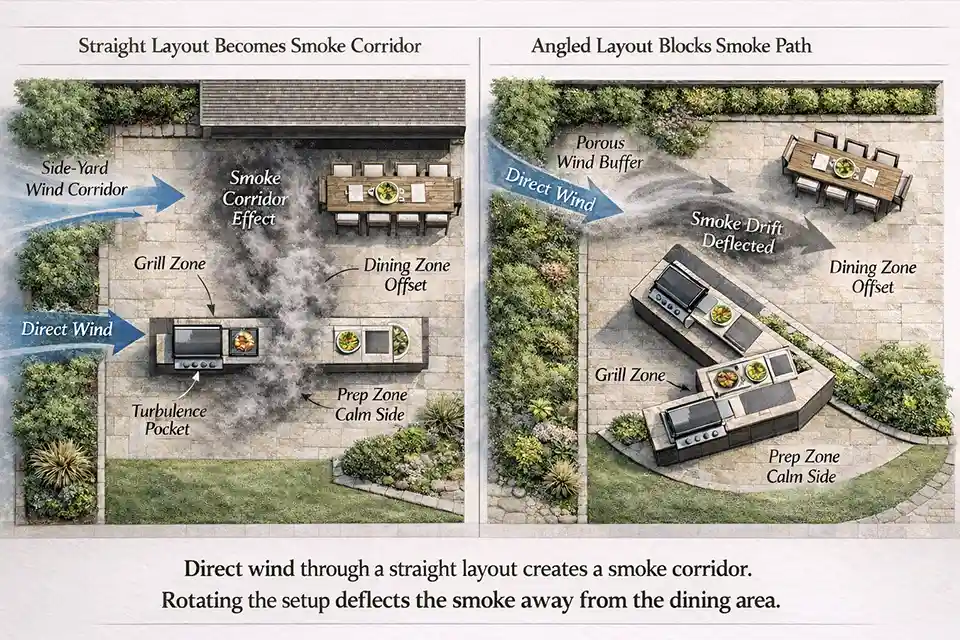
Even a 15- to 30-degree rotation can change how smoke leaves the grill and how wind hits the flame zone. That is a much more meaningful adjustment than people tend to assume. Direct frontal exposure is one of the most damaging alignments.
Offset the dining area from the smoke path
The dining zone should not sit directly downwind of the cook line in the season when the yard is used most. A separation of about 8 to 12 feet is often enough if the two zones are offset rather than lined up in a straight path. When the table sits immediately beyond the grill island, every gust turns dinner into a smoke test.
Keep the main prep and landing space on the calmer side of the grill, not on the edge that takes the strongest direct wind. A layout can look balanced on paper and still fail if the serving side is the side that keeps catching smoke, ash, and grit.
Use porous wind control instead of reflexively building a wall
Layered wind control usually works better than a single hard barrier. Slatted screens, fence returns, planting bands, and partial masonry tend to calm air more effectively than a small solid panel dropped beside the grill. A fully solid barrier can work in the right location, but when placed badly it often causes pressure drop and edge turbulence.
Pro Tip: Watch wind behavior at roughly 3 to 4 feet above grade, not just at standing height. That is closer to the level where grill performance, prep comfort, and smoke transition actually reveal whether the design works.
A simple site test before you build
One important thing many articles skip: you do not need expensive equipment to catch a bad layout early.
Test wind in the actual yard, not just in your head
Before finalizing the kitchen location, tie a few strips of survey ribbon or light tape in 3 to 4 likely kitchen spots and check them at different times over 2 to 3 ordinary days. Watch morning, late afternoon, and early evening if possible. You are not looking for perfect consistency. You are looking for the spot where the wind is least direct and least concentrated.
Test during normal-use hours
A backyard that feels manageable at noon can behave very differently at 6 p.m. when many people actually cook. This is one place where homeowners lose accuracy by testing casually instead of testing during the hours that matter.
If one candidate location shows steadier ribbon movement, less funneling, and less direct push toward the house or dining space, that is usually the better starting point.
The three layout patterns that fail most often in wind
The exposed edge layout
This is the classic mistake: the kitchen sits on the outer edge of the patio because it feels open and social, but that usually puts the grill directly in the strongest air path.
The straight-line smoke layout
The grill, prep counter, and dining table sit in one clean line. It looks organized, but in wind it turns the whole entertaining zone into one smoke corridor.
The covered-but-open-side layout
This one is easy to misjudge. The roof makes the kitchen feel protected, but one open side can still pull smoke sideways, trap it overhead, or push it back toward the cook.
Covered and semi-covered kitchens fail in their own way
Adding a roof does not erase a windy site. In some layouts, it makes the problem more complicated.
Roofed kitchens can trap turbulence
If the grill sits under a cover and wind rolls in from the side, smoke can pool, stall, or reverse under the structure instead of dispersing cleanly. This is where a hood may be necessary, but only if the installation is sized and mounted correctly for the appliance and the outdoor setting.
Ventilation does not overrule clearance rules
This is a good place to stay disciplined: any hood, enclosure, or screen decision has to remain secondary to the grill manufacturer’s minimum clearances and combustible-surface requirements.
Wind fixes that ignore those limits stop being smart design and become a safety problem. The same goes for rear and side clearance, lid swing space, and service access.
If the grill needs room to open fully, vent safely, and be cleaned without crowding nearby finishes, that space still has to be protected even when you are trying to tuck the kitchen into a calmer corner.
Doors and windows deserve more attention than people give them
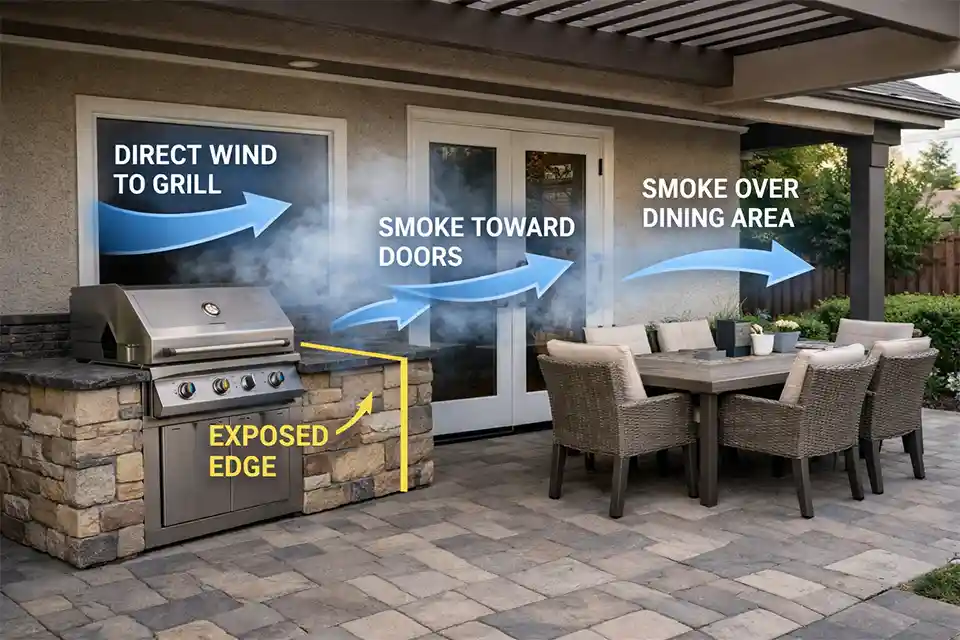
One commonly underestimated problem is smoke returning toward patio doors, kitchen windows, or back entries. Even when the dining zone is safe, the house may still sit directly in the drift path. If ordinary cooking sends smoke toward open doors or windows for long stretches, the kitchen is still poorly positioned.
Quick diagnostic checklist
Use this before blaming the appliance:
- Smoke reaches the seating area during ordinary cooking for more than 10 minutes
- Burner flames visibly lean or flutter in gusts around 12 to 15 mph
- Preheat takes 5 to 7 minutes longer on breezy days
- Prep surfaces collect dust, ash, or debris within 24 to 48 hours
- The grill sits at a patio edge, side-yard gap, or other wind corridor
- The dining zone is directly downwind and less than about 10 feet from the cook line
- Smoke also drifts back toward doors or windows during normal use
If four or more are true, the design is probably underperforming because of exposure and placement, not because you chose the wrong accessories.
When partial fixes are enough and when they are not
Not every windy kitchen needs full relocation, but some do.
Partial fixes can work when the layout is already close
If the grill is near a protected wall, the seating zone can shift, and the wind issue is more seasonal than constant, smaller interventions may be enough. That might mean a slatted screen, a short extension wall, or a planting layer that breaks up the wind path before it reaches the island.
Relocation is smarter when the site keeps fighting back
If the kitchen sits on the exposed edge of the patio, at the end of a long hardscape run, or under a cover that traps swirling smoke, relocation becomes the more rational fix. This is the point where more accessories stop making sense.
That is also why windy-backyard kitchens often connect with backyard design mistakes that ruin outdoor spaces. A finished installation can still be in the wrong part of the yard.
Compare the healthier setup with the failing one
| Design condition | Usually healthier | Usually failing | Why it matters |
|---|---|---|---|
| Grill orientation | Angled away from prevailing wind | Faces directly into wind path | Reduces flame disruption and smoke blowback |
| Dining placement | Offset 8–12 feet from cook line | Directly downwind and close behind grill | Prevents smoke conflict during normal use |
| Prep and landing side | On the calmer side of the grill | On the wind-facing edge | Keeps serving surfaces cleaner and easier to use |
| Wind control | Porous layered buffer | Small solid panel beside grill | Slows air without creating messy eddies |
| Patio position | Interior or partly sheltered zone | Outer exposed edge or side gap | Cuts direct wind strike |
| Upgrade priority | Layout first, hardware second | Hood and gadgets first | Fixes the cause instead of chasing symptoms |
The bottom line
For windy backyards, the smartest outdoor kitchen decision is rarely an accessory decision first.
It is a siting decision. If smoke blows back, flames stay unstable, preheat drags, and debris keeps settling on the work zone, the yard is telling you the kitchen is in the wrong air pattern.
Solve that first. Once the location, angle, prep side, and zone spacing are right, the rest of the design starts making sense.
For broader official guidance, see the US Forest Service overview of windbreaks.