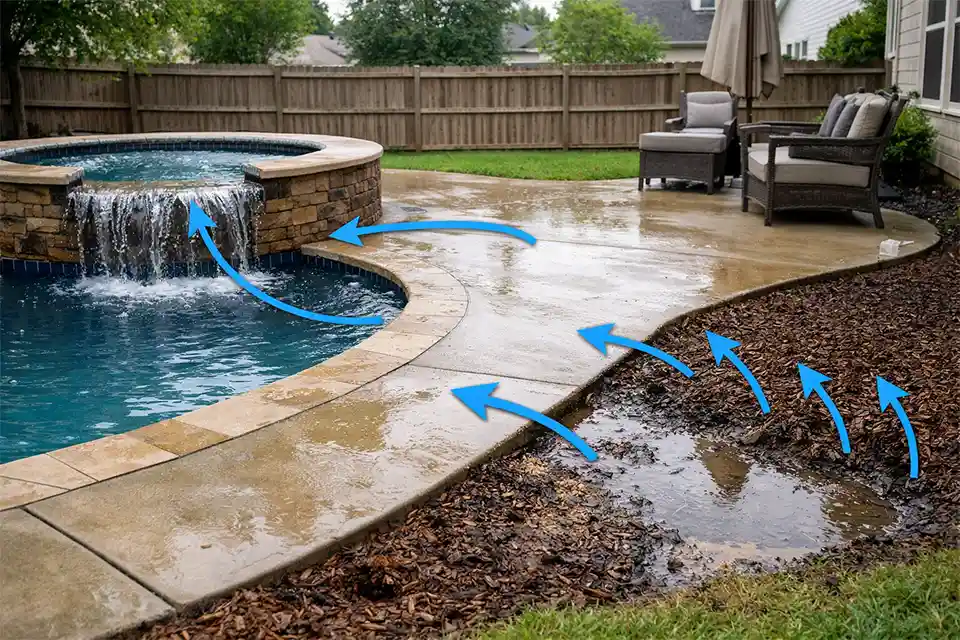
Most drainage problems around pools and hot tubs are not random yard issues. They usually begin with a design-stage mistake: the project adds a concentrated water event, but the backyard is still treated like an ordinary lawn-and-patio setup.
The first checks are simple and telling. Does water remain along the pool edge or spa side for more than 24 to 48 hours after rain? Does the deck shed runoff into mulch, turf, or a side yard instead of into a controlled collection path? Does the same small area get wet from more than one source, such as rainfall, splash-out, and spa overflow?
That last distinction matters most. A normal backyard low spot gets wet during storms. A pool-related drainage failure gets loaded repeatedly. Rain is only part of the problem.
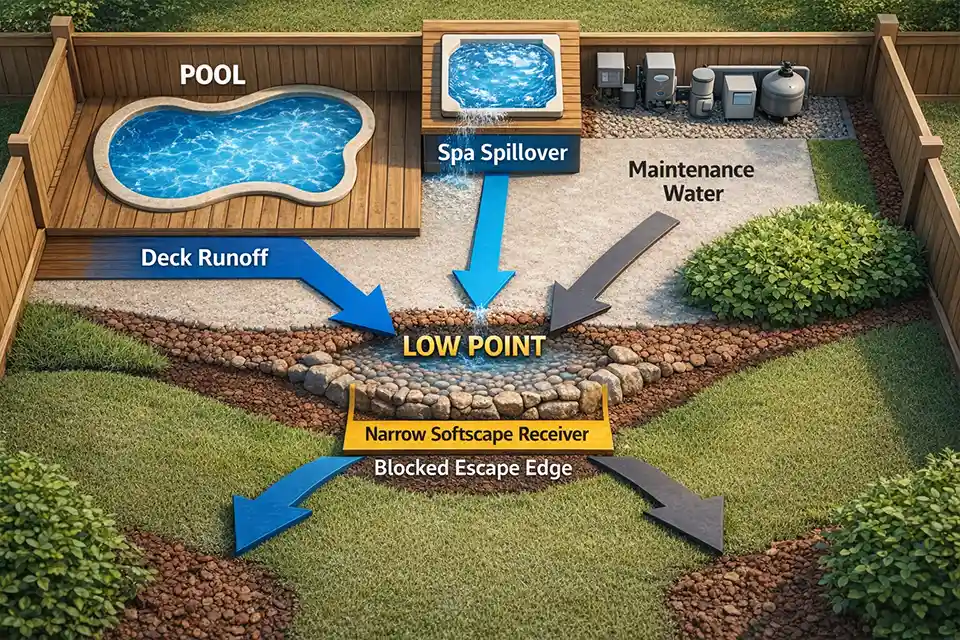
Add deck runoff, spillover, washdown, and maintenance water, and one soft zone can stay stressed several times a week. When that happens, the visible puddle is not the real diagnosis. The layout is.
The biggest mistake: designing the pool, but not the backyard water map
The pool shell gets planned. The finish materials get planned. The sightlines get planned. But the water path often gets handled too late, which is where expensive mistakes begin.
This was a layout error, not a drainage surprise
Once you add a pool, hot tub, deck, coping, and equipment pad, the backyard stops functioning like it did before. Hard surfaces speed up runoff, reduce absorption, and send water farther, faster. A yard that handled ordinary storms can start failing once runoff is concentrated and pushed toward one edge.
This is why broader site logic matters more than homeowners expect. Many recurring backyard failures begin with invisible routing mistakes rather than dramatic structural defects, a pattern that also shows up in Backyard Drainage Problems Most Homeowners Ignore.
The yard is not a backup drain
One of the most common design errors is assuming the grass strip or mulch bed around the pool will “take care of” excess water. That only works when the receiving area is generous, lightly used, and not already overloaded. In many suburban yards, the soft area receiving runoff is only 20 to 50 square feet. That is not much margin.
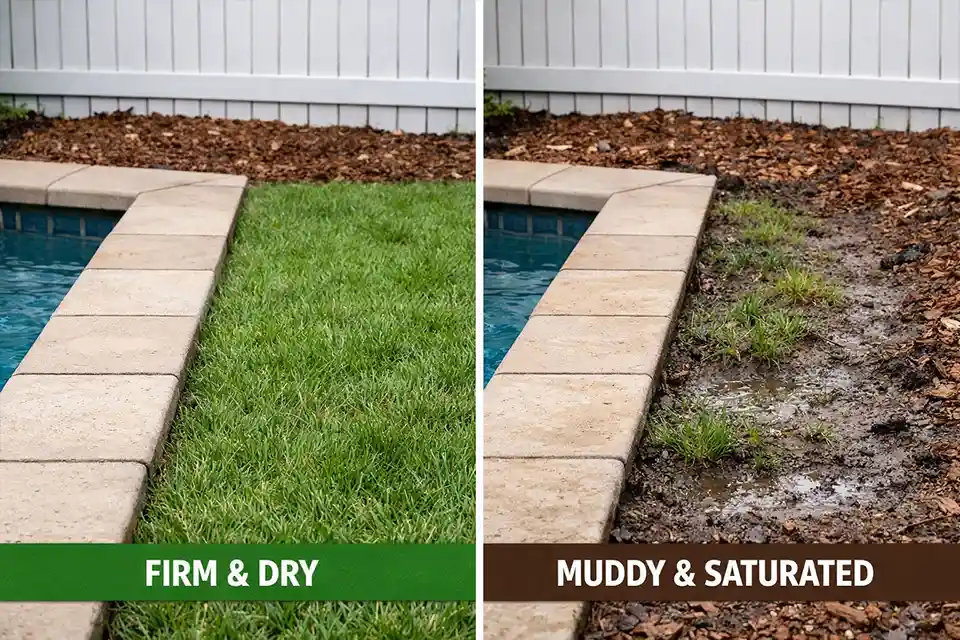
If that edge stays soft underfoot for more than two days after a storm, loses mulch after every heavy rain, or keeps showing algae, settlement, or washout, it is no longer acting like a buffer. It is acting like a basin.
The design-stage mistakes that cause the worst drainage failures
Not every mistake deserves equal weight. These are the ones that most often turn a usable backyard into a recurring wet-zone problem.
Deck slope that moves water away, but not to the right place
A deck should slope so water does not sit on the surface. The problem is not slope itself. The problem is slope without a plan. As a practical benchmark, runoff often moves effectively at about 1/4 inch per foot. But if that slope sends water off the deck and straight into turf, mulch, or a tight side passage, the project has simply relocated the failure.
Healthy condition: water leaves the deck and enters a controlled drainage route.
Failing condition: water sheets off the edge and saturates the same receiving zone after every storm or heavy use.
Raised hot tubs that keep wetting one small zone
Hot tubs create a different kind of drainage pressure because the water pattern is repetitive. A raised spa spillway or splash zone may not look dramatic in one moment, but the frequency is what causes the damage. A bed, step corner, or narrow turf edge getting extra water three or four times a week can fail faster than an area that only sees one heavy storm.
This is one of the most underestimated mistakes in backyard design. Homeowners tend to overestimate volume and underestimate repetition.
Hot tub drain-down planned as an afterthought
This is where many projects quietly go wrong. People think about where the hot tub will sit, but not where maintenance water will go when the unit is drained, cleaned, or serviced. If that water is allowed to dump into a planting bed, side yard, or low corner, it can overload an already vulnerable zone.
The mistake is not just poor drainage. It is assigning maintenance water to the same area that already receives runoff.
Equipment pads placed in natural runoff paths
Equipment pads often get pushed into leftover corners. That sounds harmless until the leftover corner also happens to be the site’s collection point. When runoff gets trapped around pumps, heaters, or disconnects, the service area stays wet longer than it should.
If the pad area holds water for 24 hours or more after a storm, or feels soft every time routine maintenance happens, the location is wrong or the surrounding grading is unfinished.
Hardscape ratios that remove the yard’s forgiveness
Wide decks, synthetic turf borders, narrow side setbacks, and decorative stone bands can make a backyard look clean and low-maintenance. But they also reduce the site’s ability to absorb and slow water. The more polished the hardscape composition becomes, the less room the yard has to forgive routing errors.
That same “looks efficient but performs badly later” pattern also appears in Backyard Landscaping Without Grass Problems.
Mild slopes that don’t look dangerous, but still accelerate runoff
Backyards do not need to feel steep to create drainage trouble. Once smooth deck runoff is released onto grade, even a modest slope can push water quickly toward fences, side yards, or low corners. On sloped sites, a small routing mistake gets amplified.
That is why drainage problems around pools tend to escalate faster in yards already vulnerable to runoff and erosion, similar to the site conditions covered in Sloped Backyard Problems: Drainage, Erosion, and Safety.
What people usually misread first
The wet spot gets blamed. Then the surface material gets blamed. Both are often downstream symptoms rather than the cause.
The puddle is the receiver, not the diagnosis
If one lawn strip or mulch bed keeps failing, it is easy to assume the soil is bad or the plant choice is wrong. Sometimes that is true. More often, the area is simply receiving too much concentrated water from nearby hardscape and features. Replacing turf or replanting beds before fixing the incoming water path usually wastes time.
Compaction matters, but it is often overblamed
Compaction does reduce infiltration, especially where pool traffic is heavy. But it usually makes a bad routing pattern worse rather than creating it from nothing. If the exact same edge or corner keeps taking the hit, the first question should be why water is being delivered there so consistently.
A bigger drain is not the first answer
This is where many repairs go off course. Adding one more drain can sound logical, but it often solves very little if the surrounding grades do not actually move water toward that point. When the water map is wrong, the first fix is usually earlier interception, better routing, or separating overlapping water sources.
Pro Tip: When one backyard corner keeps failing, count the water sources before you count the drains. Stormwater, deck runoff, spa wetting, and maintenance water often overlap in the same place.
Quick diagnostic checklist
| Check | Healthier condition | Problem condition |
|---|---|---|
| Water after rain | Clears in under 24 hours | Still pooled at 24–48 hours |
| Deck runoff | Directed into controlled drainage | Sheets into mulch, turf, or side yard |
| Spa wetting | Dispersed safely or captured | Repeats in one small receiving zone |
| Hot tub maintenance water | Routed away from softscape | Dumps into already wet edge or low point |
| Equipment area | Dry footing within a day | Standing water or chronic soft ground |
| Softscape border | Firm footing and stable mulch line | Washout, algae, settlement, or mud |
Why the obvious fixes often fail
The obvious fixes usually improve the surface, not the water logic. That is why they look better briefly and disappoint later.
Regrading the visible puddle is often too late
Homeowners often try to reshape the final wet spot without addressing where runoff starts concentrating. The result is predictable: the puddle shifts a little, but the flow pattern survives. Once that happens, the same zone fails again or the problem simply moves a few feet.
Fresh mulch, extra soil, and re-sodding are maintenance theater
These are the classic “looks fixed” moves. Fresh mulch covers the washout. New soil raises the area slightly. New sod resets the surface. But if the same location still receives repeated water loading, the repair is temporary.
That is the same trap many homeowners fall into with Patio Drainage Problems Most Homeowners Notice Too Late: the finish gets repaired while the water route stays intact.
One extra grate rarely beats a bad layout
A single added drain can help at the margin, but it is not a substitute for correct slope, interception, and discharge planning. If water bypasses the drain, the issue is still upstream.
Hot tub mistakes that create drainage trouble even when the pool is fine
This deserves its own category because hot tubs create a different failure pattern from pools.
Wrong location beside narrow side yards
A hot tub installed next to a tight side yard can turn that corridor into a wet utility lane. Water from splash, service, and cleanup has nowhere to spread, so it loads the same narrow path over and over.
No clear service-side dry zone
Hot tubs need access. If the service side is also the side taking runoff or maintenance discharge, the area becomes harder to use and harder to keep stable. The result is not just soggy ground. It is a wet work zone that never really recovers.
Pairing spa overflow with the yard’s lowest edge
This is the design version of stacking problems. If the spa’s natural wet side is already the lowest part of the backyard, repeated wetting becomes almost inevitable. At that point, surface fixes stop making sense quickly.
When patching stops making sense
There is a point where the problem is no longer a wet patch. It is a layout failure.
Signs you are past the easy-fix stage
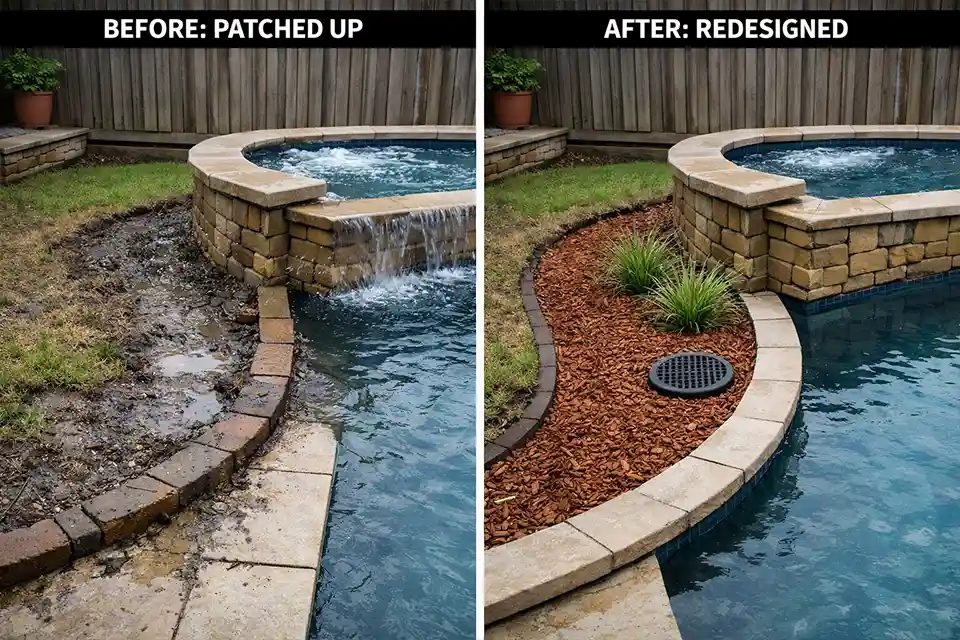
If you have replaced washed mulch more than once, regraded the same edge, or lost turf repeatedly over one season to one year, the site is already telling you the issue is structural. If pavers begin settling, the border beside the deck stays damp, or the same low area keeps softening after every major rain, the repair threshold has changed.
What actually changes the outcome
The most effective fix usually happens at the first concentration point, not the final puddle. That may mean intercepting deck runoff earlier, changing where spa water is directed, separating maintenance discharge from stormwater flow, or reducing how much hardscape drains into one side of the yard.
This is also why some outdoor projects start creating usability and maintenance issues long before they look “broken,” a broader pattern reflected in Backyard Problems That Lower Value.
The bottom line
The biggest drainage mistake is not simply forgetting a drain. It is designing the pool and hot tub as attractive backyard features without designing how repeated water loading will move across the site.
Once stormwater, deck runoff, spa wetting, and maintenance water start stacking onto the same small area, the wet spot is only the symptom. The design is the problem.
For broader official guidance, see University of Illinois Extension.