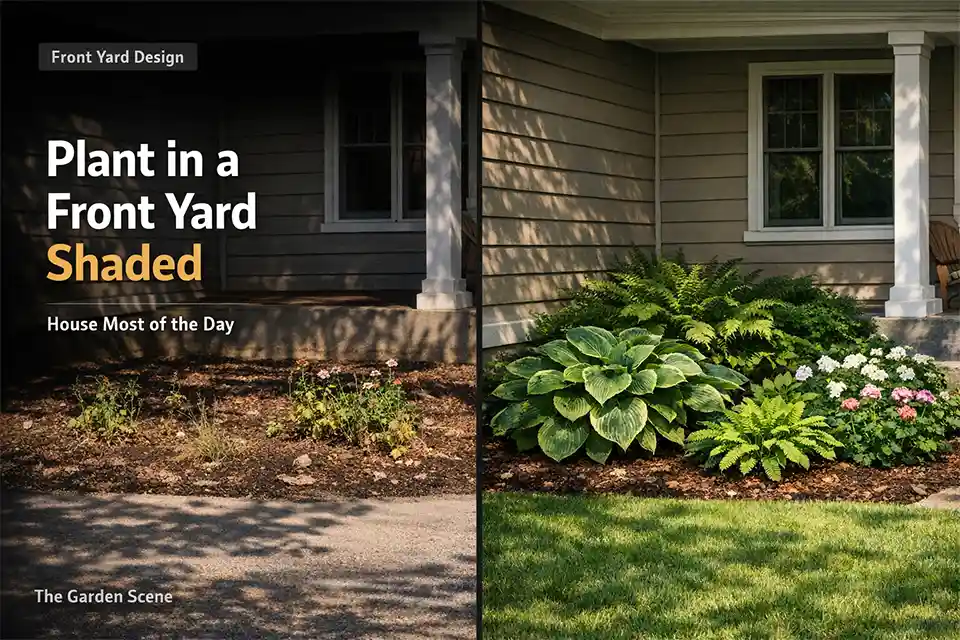
A front yard shaded by the house most of the day usually goes wrong for one reason before any other: the planting plan is based on “front yard color” instead of the actual light pattern. If the bed gets under 2 hours of direct sun, it should not be planted like a flower border.
If it gets 2 to 4 hours of soft morning sun, you have more flexibility, but still not enough for most full-sun performers to look right by midsummer.
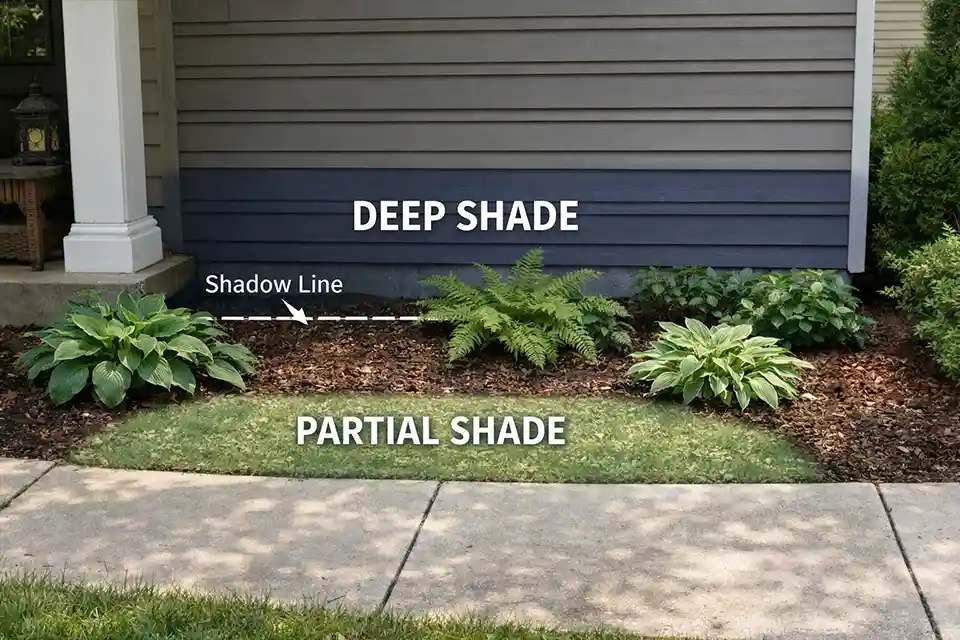
Before you buy anything, check three things on a clear day: how many hours of direct sun reach the bed, whether the top 3 inches of soil dry within 24 to 48 hours after rain, and how much of the bed sits under roof overhangs that block rainfall.
In many front yards, the real problem is not shade alone. It is dry shade near the foundation. That is why fertilizer often disappoints and why plants labeled “part shade” still fail. The fix is usually not more feeding or more flowers. It is choosing plants that fit the light reality early.
Read the site before you read the plant tag
Most disappointing shade plantings start with a bad category. “Shade” is too broad to be useful by itself.
Under 2 hours of direct sun means foliage should lead
Once a front bed drops below 2 hours of direct sun in summer, treat it as a foliage-first space. That is the point where many flowering perennials survive but stop performing well enough to justify the effort. They stretch, bloom lightly, and often open in the center after 6 to 8 weeks of active growth.
In this range, hostas, ferns, heuchera, brunnera, epimedium, and sedges usually do more for curb appeal than a rotating cast of struggling bloomers. A shaded front yard does not have to look flat. It just needs contrast through leaf shape, texture, and repeated masses instead of depending on flowers to carry the whole bed.
Two to four hours of morning sun is the useful middle zone
A bed with 2 to 4 hours of morning sun is still shade-dominant, but it can support a more mixed planting. This is where hellebores, astilbe, Japanese forest grass, brunnera, and oakleaf hydrangea start to make sense, especially if the soil stays evenly moist for at least 2 to 3 days after rain.
What homeowners often overestimate here is brightness. A front bed can look bright without receiving enough direct energy to support full-sun plants. That is why “it feels sunny in the morning” is not a reliable planting test.
Dry shade near the foundation is often the bigger problem
If the bed sits below eaves or close to the house, reduced rainfall can matter as much as reduced light. When the top 3 inches of soil are dry again within 24 to 48 hours after moderate rain, plant selection should shift toward tougher, lower-thirst shade plants.
This is also why Front Yard Design with Mature Trees That Block Sunlight overlaps with this topic more than it first appears. The visible source of shade may differ, but the planting decisions are still driven by light shortage, moisture competition, and limited recovery room.
What actually works in a front yard like this
The best plant list for this site is usually shorter than people want and more reliable than they expect.
Anchor plants that hold the bed together
Use structural plants sparingly. In brighter shade, oakleaf hydrangea can anchor a bed without looking forced. Inkberry holly works where evergreen form matters. Hellebores hold a low, steady presence in protected beds. Aucuba and cast iron plant can work in milder regions where winter exposure is less severe.
In a bed 6 to 10 feet deep, smaller anchors generally need about 24 to 36 inches of spacing, while larger mature shrubs may need 36 to 60 inches. That spacing matters more in shade because crowded plants dry slowly, lean harder toward light, and become harder to keep clean.
Mid-layer plants that do the real visual work
This layer usually determines whether the yard looks intentional or tired. Hostas, Japanese painted fern, autumn fern, heuchera, brunnera, epimedium, and pulmonaria are dependable choices for most house-shaded fronts. Astilbe belongs only where the soil stays consistently moist. It is a good plant, but not for dry foundation shade.
That distinction matters. People often underestimate moisture needs and overestimate shade tolerance as if all shade plants handle the same stress. They do not. A plant can like low light and still hate dry soil.
Better front-edge fillers than struggling grass
When direct sun drops below about 4 hours a day, front lawn edges and narrow strips near foundation beds often start thinning. At that point, carex, liriope in the right climate, epimedium, or controlled patches of ajuga usually outperform repeated grass repair.
That is one reason Front Yard Shade Trees and Grass Not Growing connects so well here. Once light falls below lawn-supporting levels, the smarter move is often to stop trying to preserve turf in the wrong place.
A comparison that helps you choose faster
| Site condition | Plants that usually work | Plants that often waste time | Best design direction |
|---|---|---|---|
| Under 2 hours direct sun | Hostas, ferns, heuchera, epimedium, carex | Lavender, coneflowers, salvia, sun-loving annual mixes | Foliage-led layered planting |
| 2–4 hours morning sun | Hellebores, brunnera, astilbe, oakleaf hydrangea, hakonechloa | Plants needing all-day bloom energy | Selective flowers over a foliage base |
| Dry shade near foundation | Epimedium, hellebores, cast iron plant, carex | Moisture-hungry shade bloomers | Tough low-thirst planting groups |
| Shade with slow drainage | Ferns, moisture-tolerant sedges, selected wet-tolerant shade plants | Crown-rot-prone perennials in heavy mulch | Improve drainage before replanting |
| Bed under 4 feet deep | Compact repeated plants, small anchors, simple groupings | Large mixed collections and annual-heavy color | Simplified repeat planting |
What people usually misread first
The most common wrong conclusion is that the bed needs more color. Usually it needs a clearer structure and a more honest plant list.
More flowers is often the wrong fix
In a house-shaded front yard, bloom-heavy planting is usually overvalued. Once the bed is under 2 hours of direct sun or stays dry under eaves, forcing flowering plants stops making sense. They may survive, but that is not the standard that matters. The standard is whether they still look composed and full by midsummer.
That is where a lot of front yards quietly fail. The plants are technically alive, but visually weak. That is not success.
Fertilizer is usually solving the wrong problem
If plants are blooming lightly, leaning, or staying half their expected size, low light is usually the main limitation. Fertilizer can push growth, but it does not create 2 extra hours of sun or correct the dry-shade pattern next to the foundation.
This is one of the most common time-wasting fixes in shaded front beds. What people overestimate is feeding. What they underestimate is how quickly limited light and inconsistent moisture narrow the plant list.
Build the layout so it reads clearly from the street
A shaded front yard usually looks best when the design is simpler than the plant shopper first imagines.
Use three visible layers
In a bed 6 to 10 feet deep, keep taller anchors near the house at roughly 24 to 48 inches, mid-layer plants in the middle band at 12 to 24 inches, and low fillers under 12 inches at the front. In shade, this matters more than in sun because shape has to do more of the design work.
Repeat fewer plants more often
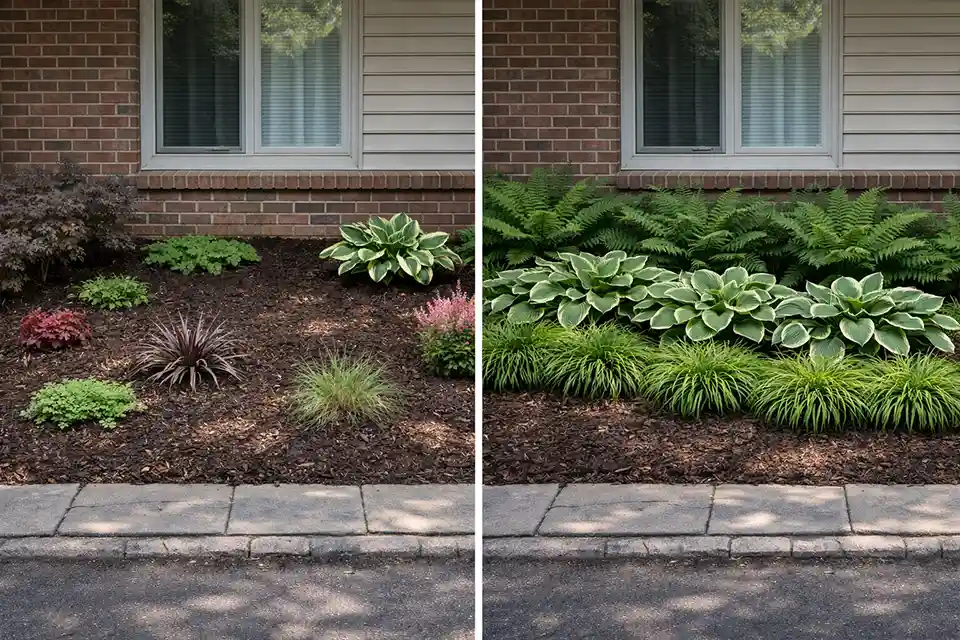
Three drifts of the same hosta, fern, or sedge usually look stronger than seven different plants used once each. In a front yard, repetition improves legibility from 20 to 40 feet away. Mixed collections often feel busy up close and thin from the curb.
This is also why Small Garden Choices That Age Poorly matters here. A small shaded bed usually ages better when the palette is edited early instead of expanded every season.
Pro Tip: In deep shade, choose one deliberate foliage contrast, such as broad hostas against fine ferns. That usually gives the bed more visual definition than adding another weak bloomer.
When the standard fix stops making sense
Sometimes the right answer is not testing tougher plants one by one. It is changing the expectation and the site strategy.
Very narrow beds need stricter restraint
If the bed is under 4 feet deep and heavily shaded, it is a poor place for ambitious mixed planting. Soil volume is limited, rainfall is uneven, and roots compete faster than most homeowners expect. In that setting, fewer plant types and stronger repetition usually outperform a wider plant list.
Soggy shade should not be replanted blindly
If the bed stays wet for more than 72 hours after rain, the issue is no longer just plant choice. At that point, drainage or compaction needs attention before replanting. Otherwise the next round of plants often fails for a different reason than the first one.
That is where Small Garden Drainage Problems becomes more useful than another generic shade plant list.
Root-heavy sites need a different expectation
When you hit woody roots every few inches while digging, the front yard is not only shaded by the house. It is competing below grade too. Then smaller starter plants, wider spacing, and slower fill-in are usually the smarter path. Front Yard Design for Tree Root Zones is the better framework when that is the real limitation.
Pro Tip: Check the bed at 9 a.m., noon, and 3 p.m. on the same clear day. That single habit gives a better planting signal than most labels.
A front yard shaded by the house can still look polished, calm, and finished. The best results usually come from accepting one hard truth early: when the bed lives in shade most of the day, structure, foliage, and site fit matter more than chasing extra flowers.
For broader official guidance, see the University of Minnesota Extension.