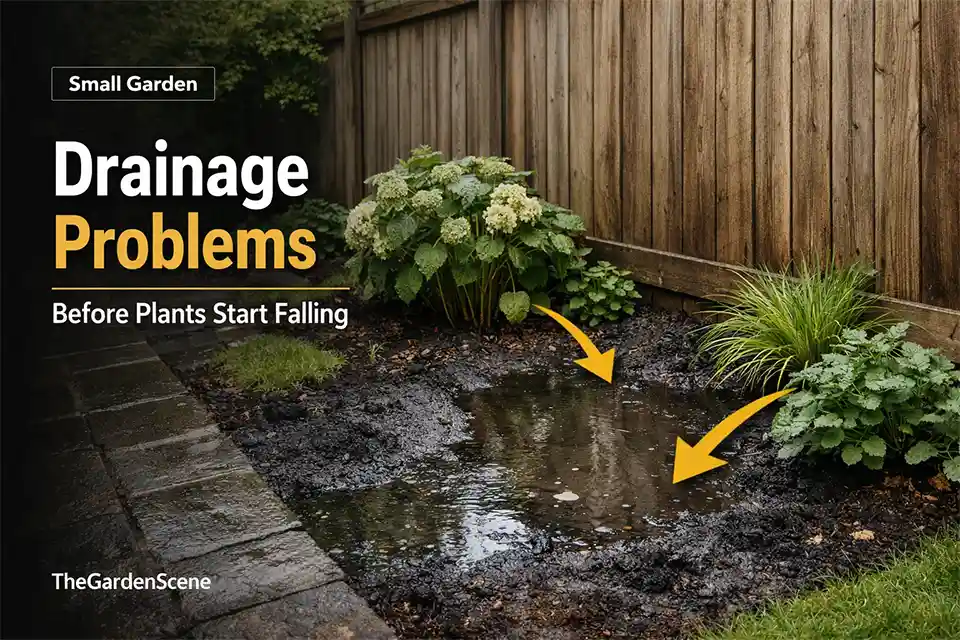
Small garden drainage problems usually show up before the garden looks obviously waterlogged. The first pattern is usually simple: one part of the bed stays wetter than the rest, roots lose oxygen, and the symptoms get mistaken for thirst, poor soil, or a weak plant. Start with three checks.
Watch whether the same 2- to 4-foot section stays darker or tackier 12 to 24 hours after rain. Dig a 12-inch test hole and see how quickly water drops; roughly 1 to 3 inches per hour is workable, while slower than 1 inch per hour points to poor drainage.
Then compare what happens after rainfall versus a 10- to 20-minute irrigation cycle. That one distinction often tells you whether the real problem is runoff, overwatering, compaction, or a low spot in the bed.
What makes this easy to miss is that surface signals are misleading. A dry-looking top layer can sit over saturated soil just 4 to 6 inches down. In a small garden, a 1-inch grade error, a repeated foot-traffic strip, or runoff from one hard edge can control the whole planting area.
A fast way to tell whether drainage is the real problem
Check what lingers, not what glistens
Fresh rain on mulch does not tell you much. What matters is what lingers. If the paving nearby dries and one section of the bed still looks glossy, smeary, or unusually dark by the next day, water is probably stalling there.
In small gardens, this often happens along patios, fence lines, edging, and the downhill side of a shallow raised border. Tight spaces magnify small layout mistakes. What looks like a harmless dip can become the receiving corner for the entire bed.
Compare rain response with irrigation response
This is one of the fastest ways to narrow the problem down. If the area turns soggy only after storms, start with runoff entry and grading. If it gets worse after normal irrigation, start with timing, emitter placement, or oversaturated soil.
People often spend money in the wrong order here. They replace plants, switch fertilizers, or refresh mulch before asking whether water is entering from a patio edge or being applied too frequently in the first place.
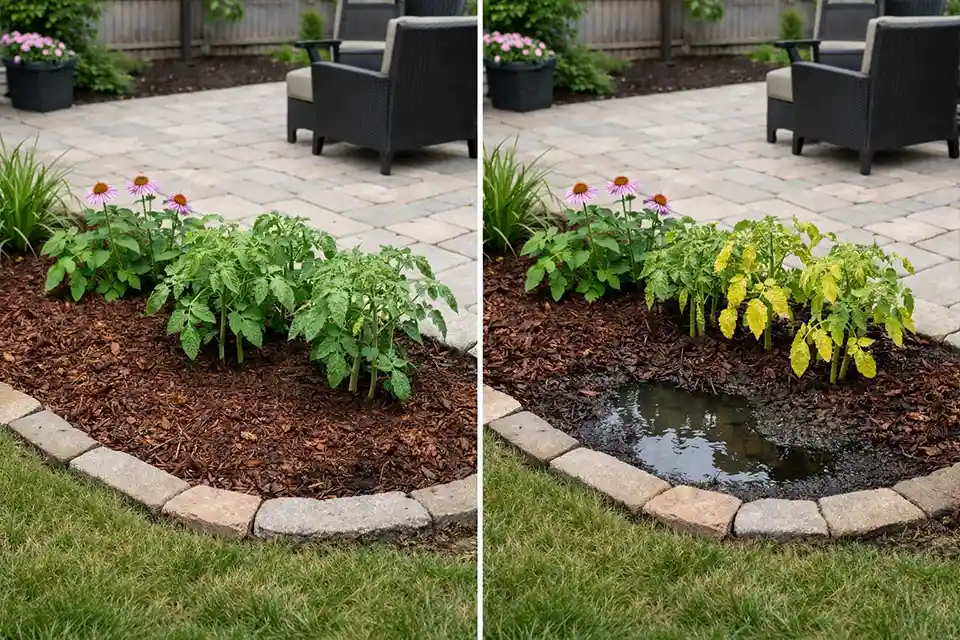
Use a simple percolation test, then stop guessing
Dig a hole about 12 inches deep and fill it with water. If it drains almost immediately, refill it once so you are testing the soil rather than the first dry fill. A bed that drains around 1 to 3 inches per hour is usually workable. Below that, drainage is poor. If water is still sitting in the hole after 24 hours, roots are spending too much time in low-oxygen conditions.
That threshold is more useful than casual impressions like “the top looks dry.” In drainage work, the surface is often the least honest part of the bed.
What people usually misread first
Wilting does not always mean the garden is dry
This is the mistake that causes the most avoidable damage. Roots in saturated soil cannot function normally because oxygen drops long before the plant fully collapses.
So the plant droops, growth slows, and leaves yellow, which many people read as a watering or feeding issue. The symptom looks like drought. The mechanism is usually root stress from staying wet too long.
That is why a small garden can fool people for weeks. More water can make the real problem worse.
Shade gets blamed too often
Shade can slow drying, but shade is not the same thing as poor drainage. A shaded bed can drain perfectly well, and a sunny bed can stay waterlogged because the subsoil is compacted or runoff keeps feeding the same low pocket.
Readers dealing with light-related issues may also want to see Small Garden Problems in Shady Areas and What Actually Fixes Them, but if the same patch stays wet after both rain and watering, drainage is the more useful starting point.
Sand is usually the wrong quick fix
This gets overestimated all the time. In a small clay-heavy bed, adding a little sand to the top few inches rarely solves anything because it does not change the deeper structure where water is hanging up.
A 2- to 4-inch layer of compost worked into the top 6 to 12 inches does far more to improve aggregation and pore space than casual sand topdressing.
Pro Tip: If a downspout, splash block, or patio edge is feeding the wet area, correct that first. Soil amendments do very little while the same water source keeps hitting the same spot.
Why small gardens develop hidden drainage trouble faster
Repeated traffic quietly compacts the root zone
Small gardens usually have limited access. People step in the same strip, lean from the same edge, and work the same corner over and over. Wet soil compacts especially easily, and once pore space closes up, both infiltration and drainage slow down.
This is one of the most underestimated causes in compact gardens. People look for a dramatic failure when the actual issue often built gradually over a season of repeated traffic.
Soil layers can trap water even when the top looks good
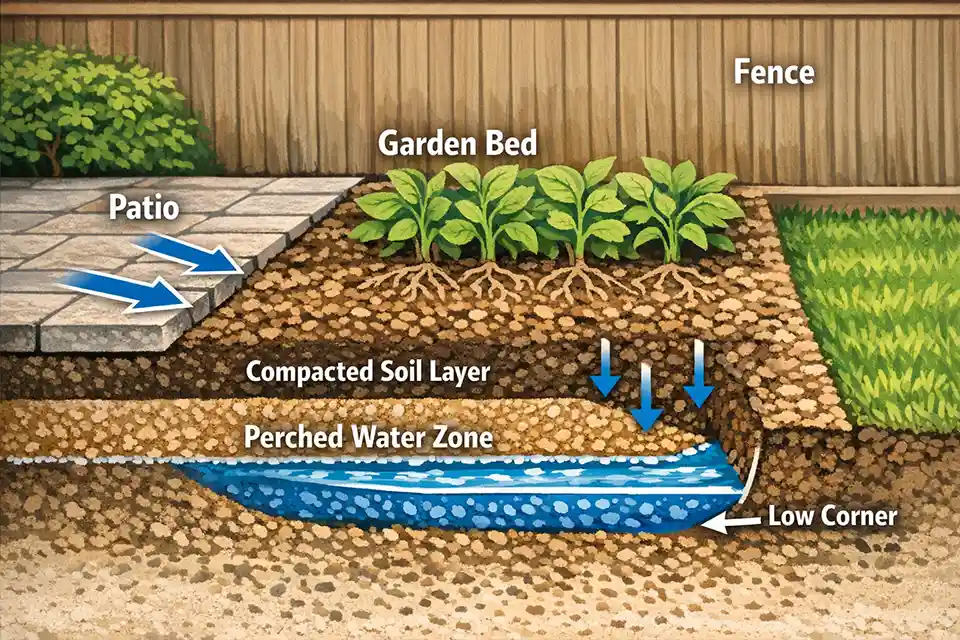
Another easy-to-miss problem is the interface between soil layers. Small beds often get topped up with fresh mix, edged into shallow raised sections, or partially rebuilt without blending old and new soil well. Water does not always move smoothly through abrupt texture changes. It can perch above a denser layer instead of draining through it.
That means a bed can look loose and healthy in the top few inches and still behave badly underneath.
Nearby hardscape changes more than most people expect
A 4- to 6-foot patio, stepping-stone path, edging strip, or narrow side-yard wall can send enough runoff into a compact bed to overwhelm it. The same drainage logic that shows up in Backyard Drainage Problems Most Homeowners Ignore applies here too, but small gardens are easier to misread because the first visible failure usually looks like a plant problem, not a site problem.
Quick diagnostic checklist
- The same patch stays wet longer than 24 hours after rain
- A 12-inch test hole drains slower than 1 inch per hour
- The top looks dry, but soil 4 to 6 inches down feels sticky and airless
- The problem gets worse after a normal irrigation cycle
- Plant decline follows a low corner, hard edge, path, or downspout line
If four or more of those are true, this is probably not just a plant-choice problem.
What to fix first, and what usually wastes time
First priority: control water entry
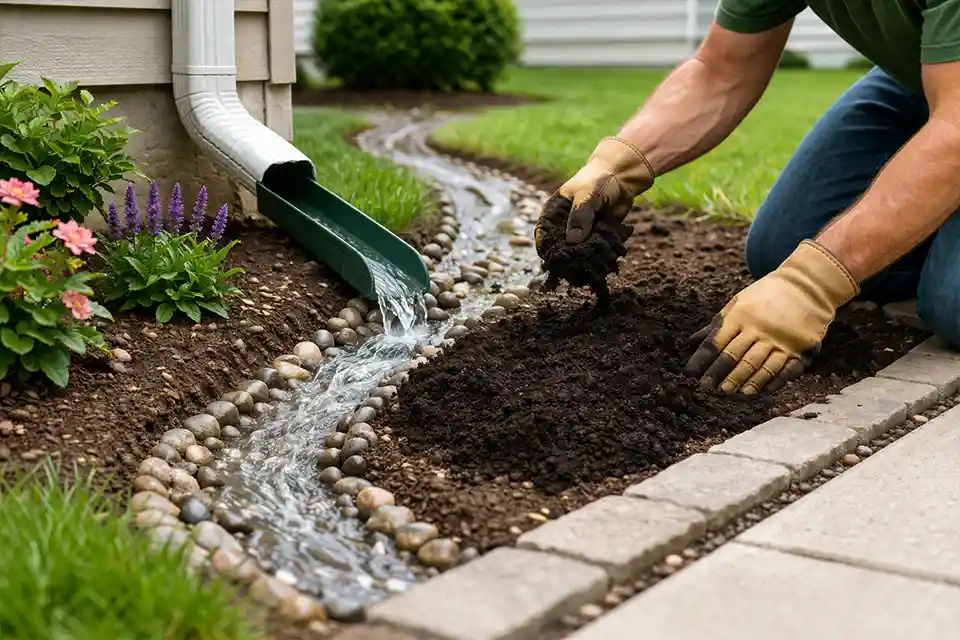
If extra water is entering from a roof edge, patio runoff, walkway, or emitter cluster, deal with that before replacing plants or rebuilding the whole bed. This is where many people overestimate the value of cosmetic fixes. Fresh mulch, new flowers, and fertilizer do not correct a bad water path.
Sometimes the best fix is small: move a downspout outlet, redirect a splash block, shorten irrigation run time, or stop one corner from acting as the collection point.
Second priority: improve the root zone, not just the surface
Once excess water entry is under control, improve the structure where roots actually live. Compost incorporated into the top 6 to 12 inches can help restore pore space. Working the soil while it is still wet usually backfires because it smears and tightens the profile further.
This is also where Small Garden Design Mistakes That Increase Maintenance becomes relevant. Some easy-care layouts quietly create the compacted, layered, hard-to-drain conditions that become expensive later.
When the standard fix stops making sense
There is a point where better watering and more compost are no longer enough. If water still sits after 24 hours, the test hole repeatedly drains slower than 1 inch per hour, or the bed is the receiving low spot with no practical outlet, you are no longer dealing with minor maintenance. You are dealing with site function.
At that point, a raised planting zone, light regrading, or a new runoff path usually makes more sense than repeated plant replacement. A drain can help too, but only if there is a real outlet and enough slope to move water where it needs to go. Buried gravel without a working exit is usually just a more expensive way to keep the problem hidden.
| Condition | More likely cause | Best next step | What often wastes time |
|---|---|---|---|
| Wet mainly after irrigation | Overwatering or emitter concentration | Shorten cycles and check soil at 4–6 inches | Replacing plants first |
| Wet after every storm in one corner | Runoff concentration or grading issue | Redirect inflow and correct the low pocket | Adding fertilizer |
| Dry crust on top, sticky soil below | Compaction or layered soil | Amend the root zone with compost when dry enough to work | Watering more |
| Whole bed stays soggy for days after both rain and irrigation | Poor subsoil drainage or a persistent low spot | Raised planting zone or drainage redesign | Thin sand topdressing |
| Strip beside a path keeps failing | Repeated traffic compaction | Reduce traffic and loosen soil only when dry | Mulch alone |
The best next step if you are standing in the garden right now
Do not start by buying plants. Watch the bed after the next rain or irrigation cycle, test one 12-inch hole, and check whether the wet area follows a water source or a low spot.
If the bed drains in the 1 to 3 inch per hour range, you are probably dealing with a manageable irrigation or compaction issue. If it drains slower than 1 inch per hour or stays wet beyond 24 hours, treat it as a drainage design problem before it turns into a repeated plant-replacement cycle.
For broader official guidance, see Colorado State University Extension’s soil drainage guide.