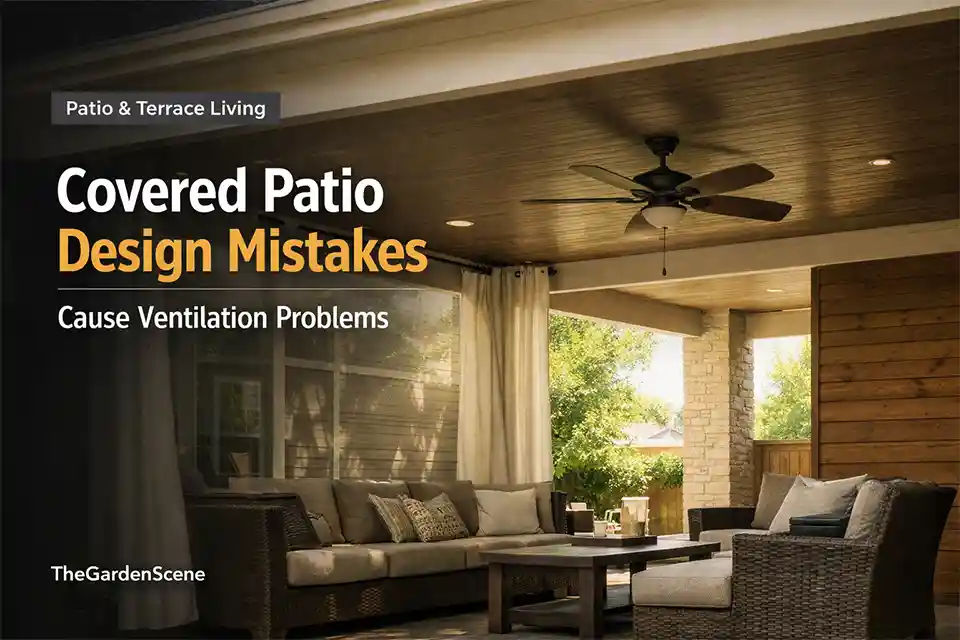
Most covered patio ventilation problems are created early, not solved later. The usual cause is not “not enough fan.” It is a patio cover that behaves like a lid: too deep for its openings, too enclosed on the breeze side, or too low over the seating zone.
Start with three checks. If the patio feels about 8°F to 12°F warmer than a nearby open shaded area, if cushions stay damp longer than 10 to 12 hours after a humid night, or if air movement disappears more than 4 to 6 feet away from the fan, the problem is usually airflow path, not equipment.
That is different from a patio that is simply sunny. A hot patio in direct sun often needs better shade. A shaded patio that still feels stale usually has weak air exchange.
That distinction matters because the wrong fix is common: people add more cover, more curtains, or a bigger fan and make a barely workable patio even harder to use.
The real decision is not whether to add airflow. It is whether the patio design still allows air to move through it at all.
The mistakes that create dead air fastest
Roof depth that outruns the openings
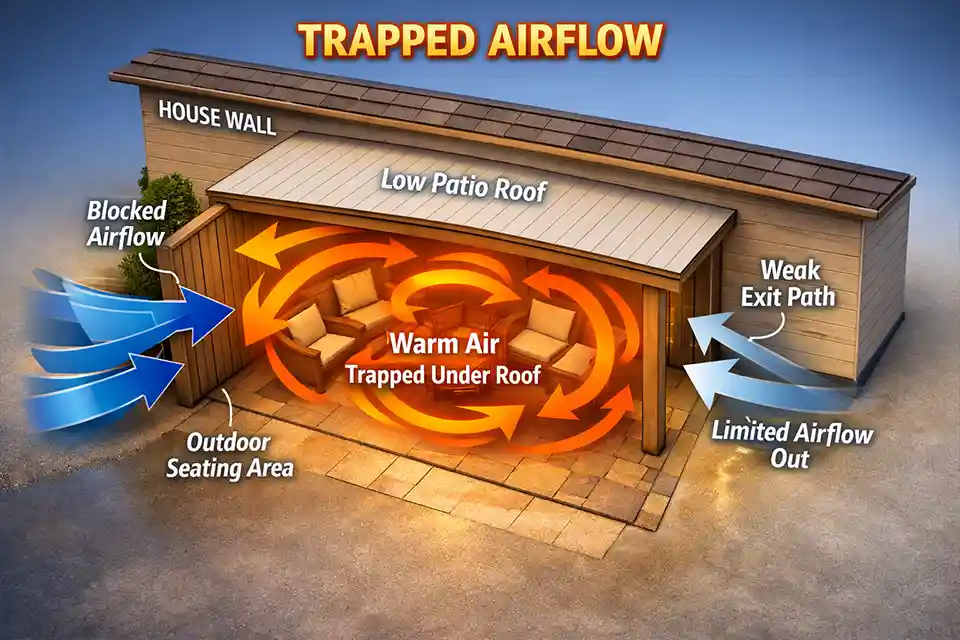
This is the most common design miss. A patio cover that projects 12 to 16 feet from the house but has limited side openings usually traps more heat than homeowners expect. The deeper the roof gets, the more the space depends on cross-ventilation instead of just being exposed to outdoor air.
A shallower 8- to 10-foot cover with open sides can often feel decent even in warm weather. Stretch that same cover deeper without widening the intake and exit paths, and the middle or back half of the patio starts feeling noticeably more stagnant. This is where people often misread the problem as “summer heat” instead of a design ratio issue.
That confusion gets worse on patios already struggling with late-day solar exposure, which is part of why some readers dealing with both comfort and shade may also relate to patio shade problems in afternoon sun.
Breeze-side closures in the wrong place
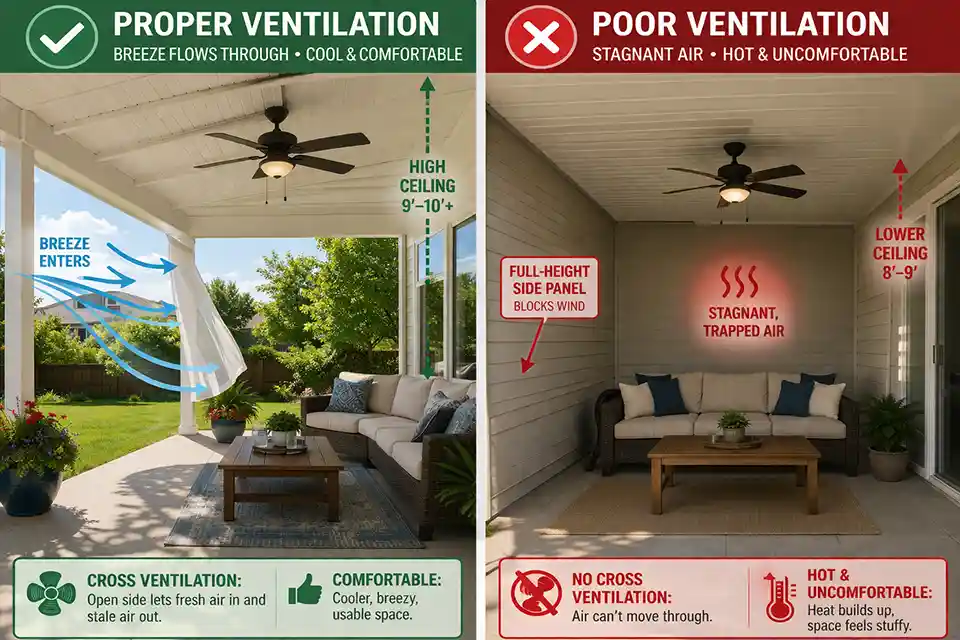
Privacy walls, curtains, slatted panels, and decorative screens can all work. The mistake is putting them where the patio gets its best air intake. The windward side matters much more than most homeowners think. Block that side too aggressively and the fan ends up recirculating already trapped air.
This is one of those mistakes people underestimate because the patio still looks open from the yard. In real use, though, even one badly placed full-height panel can turn a breezy patio into a warm pocket.
Low ceiling volume over the occupied zone
An 8-foot ceiling is not automatically wrong. But paired with a deep roof and partial side closure, it becomes a real performance problem. Low overhead volume keeps warmth and humidity closer to people instead of letting it rise higher above the seating zone.
That is why two covered patios with similar square footage can feel completely different. The better one is not always the larger one. It is the one that gives warm air somewhere to go and outdoor air a path to replace it.
What people usually misread first
“It feels hot” is a symptom, not a diagnosis
A covered patio can be uncomfortable for two very different reasons. One is heat load: too much sun, reflective hardscape, dark surfaces, or afternoon exposure. The other is poor air exchange: the patio is already shaded, but air moves poorly and moisture lingers. Those are not the same problem, and they should not get the same fix.
Damp fabrics tell you more than air temperature does
If cushions, rugs, or dining chairs stay damp 10 to 12 hours after dew or a humid night, that is one of the strongest real-world signals that ventilation is weak. People often overestimate fabric quality as the cause. In most patios, slow drying is a design clue before it is a materials clue.
The fan test is usually decisive
If comfort improves only directly below the fan and nowhere else, that is not proof the patio needs a bigger fan. It is usually proof the patio lacks a real intake-and-exit path. At that point, adding more fan capacity often becomes a time-wasting fix.
The same “looks fine but works poorly” pattern shows up in other patio planning issues too, especially when form and function drift apart, as in patio design mistakes that cause long-term problems.
Quick diagnostic checklist
- Patio feels about 8°F or more warmer than a nearby open shaded spot
- Roof projects more than roughly 12 feet from the house
- Ceiling height is about 8 feet over the main seating area
- The windward side is blocked by curtains, panels, or screening
- Cushions or rugs stay damp longer than 10 to 12 hours
- Air movement is noticeable only in the fan’s immediate circle
The decision thresholds that actually matter
A fan upgrade still makes sense when…
A larger or better-placed fan is still a reasonable move when the patio is open on at least two sides, the roof depth is moderate, and the space dries within about 6 to 8 hours after overnight moisture. That usually means the patio already has an airflow path and just needs better circulation support.
The problem is no longer a fan problem when…
Once the patio stays stale for most warm afternoons, dries slowly into the next day, or feels usable only directly under the blades, stop treating it as a fan issue. That is the line where the airflow path is weak enough that hardware is no longer first priority.
Structural revision becomes the honest answer when…
If the patio combines three conditions at once — deep solid roof, low ceiling, and blocked breeze side — the design itself is the problem. That is the clearest threshold in this whole topic. At that point, incremental upgrades usually underperform.
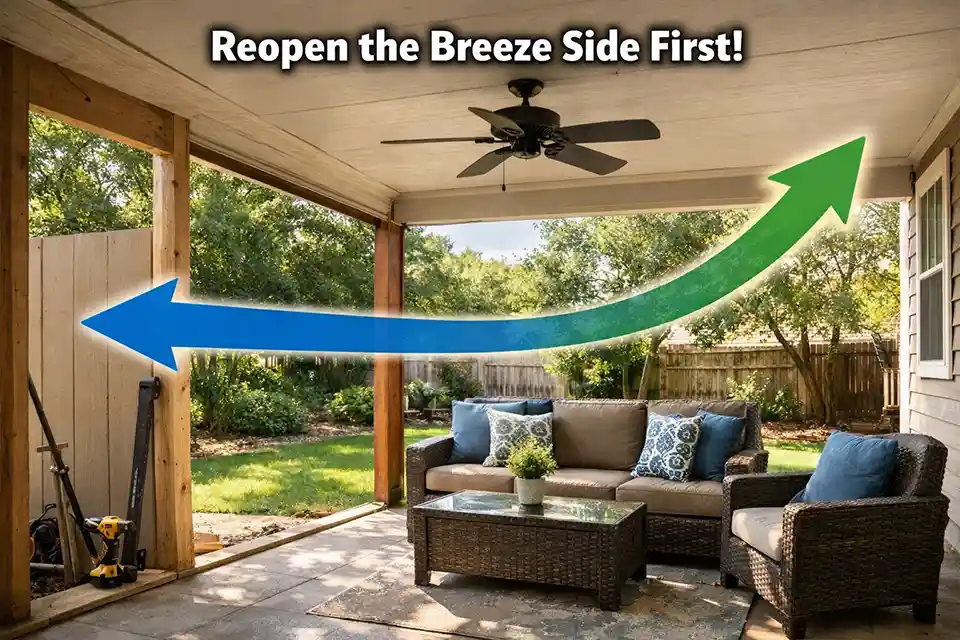
Pro Tip: If opening one removable curtain or panel for 2 to 3 hours changes comfort more than any fan adjustment ever did, the patio is telling you where the real problem is.
Ventilation problem or heat-load problem?
This is the comparison many articles skip, and it is where bad decisions start.
| What you notice | More likely ventilation issue | More likely heat-load issue | Better first move |
|---|---|---|---|
| Shaded patio still feels stale | Yes | Sometimes | Reopen airflow path |
| Patio only feels bad in direct late sun | Less likely | Yes | Adjust shade direction and surface heat |
| Cushions stay damp into next day | Yes | No | Improve cross-ventilation |
| Fan helps only beneath blades | Yes | Less likely | Fix layout before buying equipment |
| Patio is bright, reflective, and sun-exposed | Sometimes | Yes | Reduce solar gain first |
That distinction matters more in hot-climate yards where a covered patio may be fighting both trapped air and accumulated radiant heat, which overlaps with patio design problems in hot climates.
Better fixes, in the order they deserve
1. Restore the breeze-side intake
This is the highest-value move in many patios. Reduce or break up the full-height closure on the windward side first. A partial privacy solution that preserves the main air path usually performs better than a cleaner-looking full enclosure.
2. Judge the roof shape honestly
This is where the biggest “that explains it” moment usually happens. A gable-type cover or higher ridge can give warm air a more forgiving path upward. A flatter or single-slope cover depends more heavily on side openings because it behaves more like a cap. When those openings are weak, the roof shape starts working against comfort.
3. Use the right retrofit for the patio type
For a moderately deep but mostly open patio, better fan placement may be enough. For a patio with partial enclosure, selective panel reduction or more breathable screening often does more than a stronger fan. For a deep, low, heavily enclosed patio, the right answer is usually not another accessory. It is reworking the enclosure or roof geometry.
4. Stop solving exposure with more enclosure
This is a common overcorrection. A patio can be visually exposed yet thermally comfortable, or visually private yet unpleasant to sit in. Heavier curtains, denser screens, and added side walls often improve one problem by creating another.
That tradeoff becomes even more important if the patio also includes heat-producing features or tighter clearances, where enclosure decisions have broader consequences, similar to issues discussed in patio design mistakes and safety fire hazards.
The retrofit hierarchy that saves the most time
Best use of money first
Open the air path, then reassess.
Best use of design flexibility second
Raise or reshape the cover if the geometry is the trap.
Best use of equipment third
Use fans to support a good patio, not rescue a bad one.
What usually wastes time
Replacing cushions, upsizing the fan again, or layering in more curtains because the patio “still doesn’t feel right.”
Pro Tip: When one corner always feels worse than the rest, do not center every fix for symmetry. Fix the dead zone, not the drawing.
Covered patio ventilation problems are easy to soften with language and harder to solve with honesty. The useful rule is simple: if the patio is shaded, the fan is on, and the space still feels stale or slow to dry, stop shopping for comfort add-ons. The airflow route is broken, and the design has to do more of the work.
For broader building-science guidance on airflow and passive cooling, see the U.S. Department of Energy guide to natural ventilation.