The main problem on curved or angled streets is usually not curb appeal. It is misaligned geometry. The curb, driveway, front walk, and house facade stop reinforcing each other, so a layout that looks balanced on a straight lot starts producing blind spots, pinched beds, and awkward approach lines.
Start with three checks: whether anything taller than about 24 to 30 inches blocks the view at the driveway exit, whether the main walk keeps at least 4 feet of clear width where people actually turn, and whether any planting strip narrows below 24 inches. When those three conditions show up together, the yard is being organized around the wrong reference line.
This is different from a simple small-yard problem. A compact front yard can still work if its edges are consistent. On a curved street, the outside edge usually fails first because runoff, road exposure, and visibility pressure concentrate there.
On an angled frontage, the bigger mistake is compositional: the yard gets organized around the curb instead of the real approach to the house. If mulch or runoff keeps drifting to the same outer corner after 1 or 2 hard storms, stop treating it as a planting issue. The geometry is already in charge.
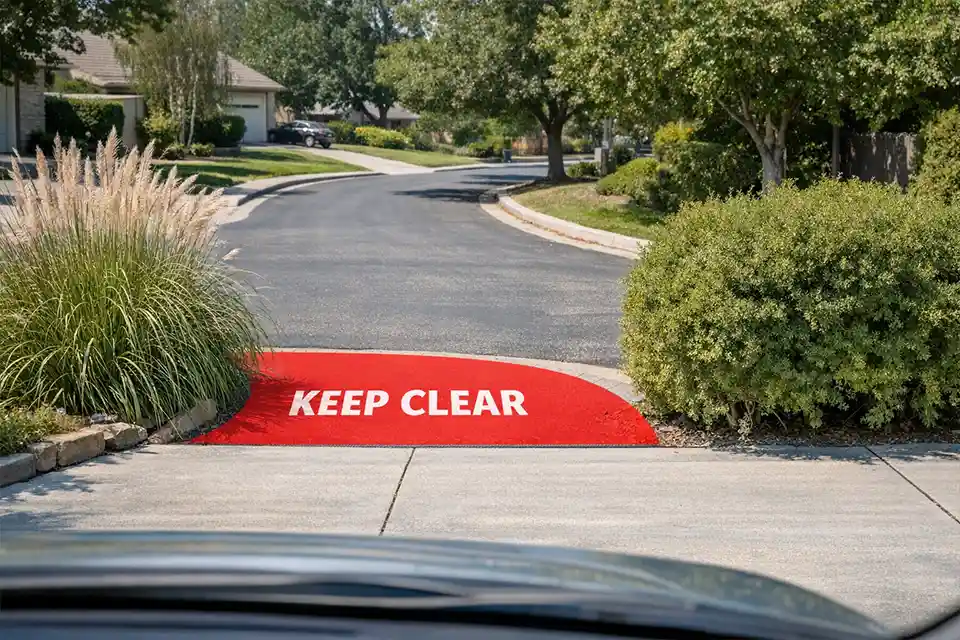
Quick Diagnostic Checklist
- A shrub, wall, mailbox cluster, or ornamental grass over about 24 to 30 inches tall sits near the driveway exit and forces you to creep forward to see traffic.
- The main front walk pinches below 4 feet wide or requires a sharp turn within the first 12 to 20 feet.
- One or more planting-bed tips narrow below 24 inches and repeatedly dry out, weed out, or erode.
- Water stands longer than 24 hours in the same outer corner, or mulch shifts there after 1 or 2 hard storms.
- The outer edge facing the street declines 2 to 4 weeks before the rest of the yard, whether from heat, salt, or splash.
- You have to edge into the sidewalk or street to see oncoming traffic from the driveway.
What People Usually Misread First
Most homeowners misread this as a symmetry problem. It is usually a visibility-and-approach problem first. The crooked-looking bed line is the symptom, not the cause. What looks crooked is often the first honest sign that the lot should not be designed like a straight frontage.
That is why these sites behave more like front yard layouts with irregular front yard boundaries than like standard suburban rectangles.
Once the curb stops running roughly parallel to the house, the front edge of the yard stops being a reliable organizing line. Homeowners who keep designing to the curb instead of the approach path usually end up with beds that look tidy on paper and fussy in real life.
People also overestimate how much a privacy hedge will solve. On a curve, curbside screening often makes the driveway less safe before it makes the house feel calmer, and a 3-gallon shrub will not create meaningful screening for 18 to 36 months anyway.
What gets underestimated is stress on the exposed outer edge. In northern states, the outside curve often collects more plowed snow, splash, and de-icing salt. In hot climates, pavement heat can make that strip noticeably harsher by late afternoon than the bed closer to the house.
Layout Moves That Actually Work
The better approach is to organize the yard around two paths: the driver’s sight line and the visitor’s walking line. Those are not always the same line, and forcing them onto one straight axis is where many front yards on angled streets start to feel strained.
Best layout pattern by lot behavior
On a curved street, keep the outside edge low and let the stronger planting mass move inward. On an angled frontage, stop composing to the curb and build balance around the real approach to the front door. If the driveway dominates the facade, spend your visual weight near the entry sequence, not at the street edge.
In practical terms, keep the outside curve low and visually quiet. Use the calmer area closer to the house or on the inside of the curve for the anchor bed, small tree, or strongest focal planting.
If the front door is visually offset from the driveway or partly hidden from the street, the logic in front yard walkway ideas for offset doors and driveways is usually more useful than trying to center the whole composition on the lot itself.
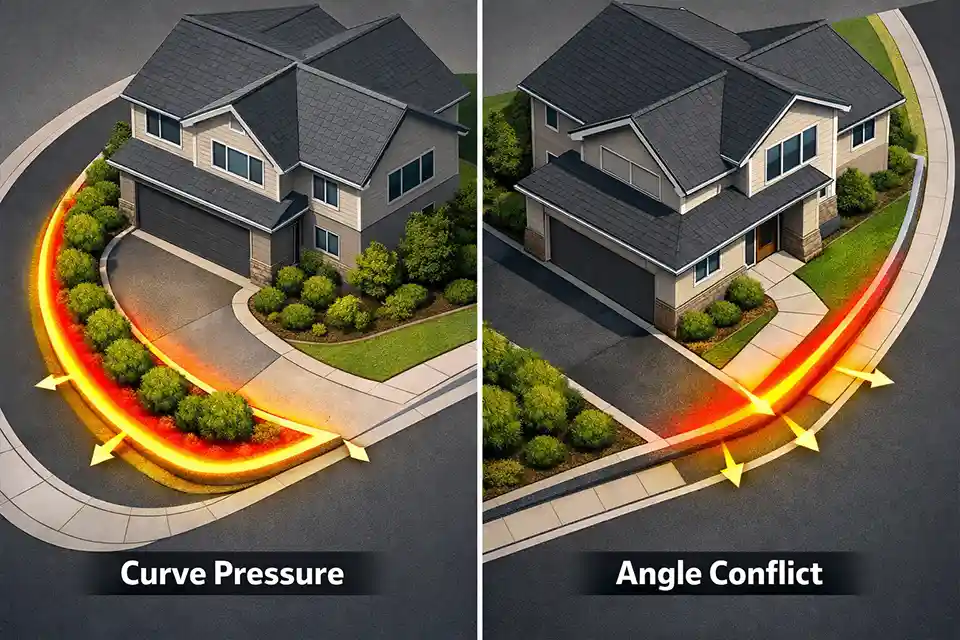
The pattern is usually the same: a reasonable-looking design move improves the appearance of the yard while making the site function worse.
| Common move | What usually happens | Better move | Useful threshold |
|---|---|---|---|
| Force matching beds on both sides | One side pinches into a maintenance strip | Let bed sizes differ and balance by mass, not outline | Avoid bed tips narrower than 24 inches |
| Plant a hedge along the curb | Sight lines tighten and road stress hits plants first | Keep curbside planting low and screen closer to the house | Keep most curbside growth under 24 to 30 inches near driveway exits |
| Run a dead-straight walk from curb to door | Visitors cut across lawn or clip bed edges | Angle or curve the walk to match the real approach | Maintain at least 4 feet of clear width |
| Keep every small lawn wedge | Mowing scalps edges and irrigation gets inefficient | Convert tiny lawn slices into planting | Lawn strips under about 5 feet wide often underperform |
| Ignore a drifting grade | Mulch, runoff, and edge erosion keep returning to one corner | Step the grade, terrace early, or stop trying to hold loose mulch there | Rework grade if it drops more than 18 to 24 inches across the frontage |
A center island bed is another common time-waster here. It can look like a fix because it fills empty space, but it rarely corrects the actual approach problem. More often it adds a second awkward shape, complicates mowing, and leaves the driveway sight-line problem untouched.
Pro Tip: Mark proposed walk and bed edges with a hose, then check them from the driver’s seat before you dig. If the layout only works from the sidewalk, it is probably solving the wrong problem.
What Should Stay Low, What Should Carry the Visual Weight
Plant selection should follow exposure zones, not just sun zones. The strip closest to the road often deals with reflected heat, wind, splash, compacted soil, and seasonal snow storage all at once.
That is why the outside edge often fails first. A shrub can be technically hardy and still perform poorly there if it is absorbing road stress within 3 to 6 feet of the curb.
If the front door is already hard to read from the street, do not spend your best plant mass along the roadway. Use it to clarify the entry, especially where the driveway visually dominates the facade.
The design logic behind landscaping a front yard with a driveway in front of a hidden entrance becomes even more relevant on curved streets because the approach angle naturally pulls attention toward pavement first and the house second.
The privacy question needs the same discipline. Homeowners often overestimate curbside screening and underestimate how much privacy can be created 8 to 15 feet closer to the house with layered planting, a small ornamental tree, or a seat-height wall placed away from the driveway exit. Screening belongs where it calms views without stealing driver reaction time.
A detail that gets missed in real yards is maintenance reach. A wedge-shaped curb bed can look fine on installation day and become annoying by midsummer because edging, pruning, and mulch control all stack up in the same cramped tip.
If a bed needs hand-tidying every 2 to 3 weeks while the rest of the yard stays stable, the shape is usually wrong for the site.
When the Standard Fix Stops Working
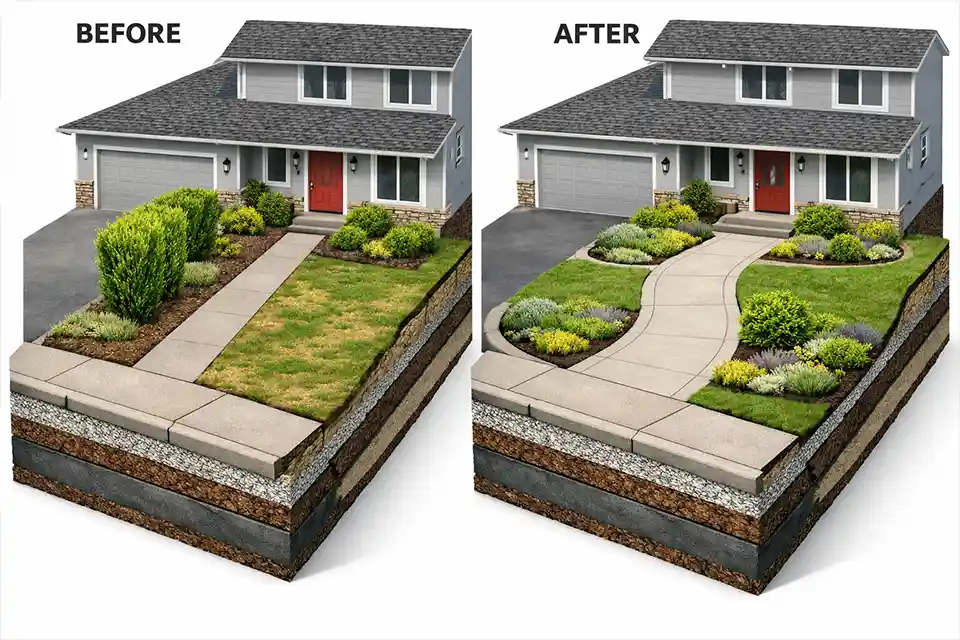
There is a point where routine bed reshaping stops making sense. If the grade is repeatedly pulling mulch downhill, if the front walk needs an awkward twist to stay comfortable, or if the usable planting zones keep collapsing into thin fragments, the problem is no longer cosmetic. A standard foundation-bed refresh will not fix a site that needs grade control.
That is when terracing, level changes, or a small wall stop feeling optional and become practical. If the front yard falls more than about 18 to 24 inches across the visible frontage, the ideas in front yard design with retaining walls and levels usually make more sense than re-edging the same failing slope every spring.
The same boundary shows up with circulation. If you still have to edge into the sidewalk or street to see oncoming traffic after lowering plants and simplifying the curbside bed, the yard needs a different spatial arrangement, not a better shrub choice.
Pro Tip: On these lots, plant choice should usually come after layout, height control, and grade logic. Getting that order backward is one of the fastest ways to spend money twice.
A good final test is simple: the yard should read clearly from a moving car, feel safe at the driveway, and remain manageable for a full season. If one of those fails, the design is still solving the wrong problem.
For broader official guidance on managing runoff around home landscapes, see the EPA rain garden guidance.