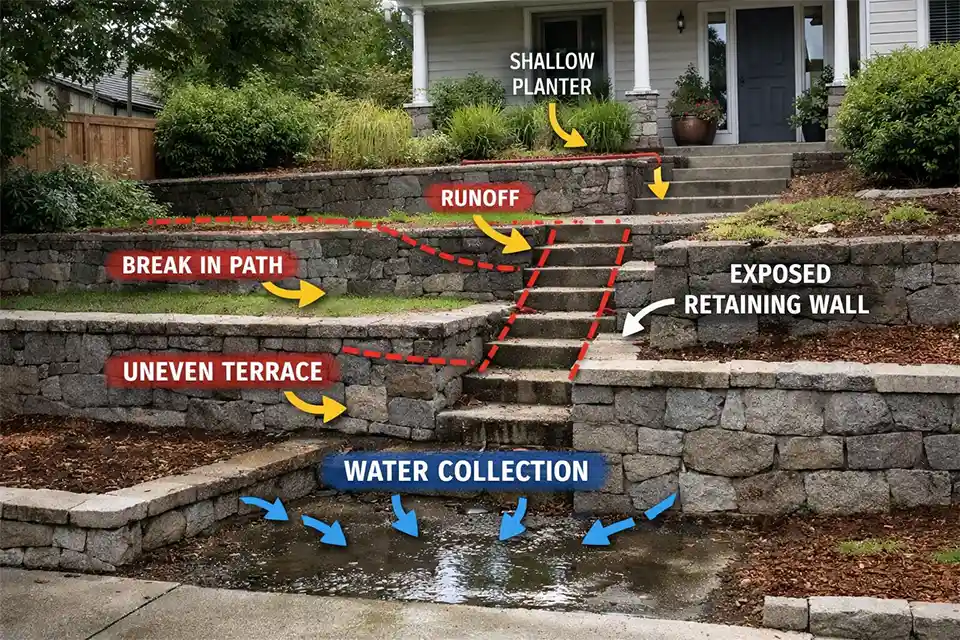
When retaining walls divide a front yard into levels, the design problem is usually not the wall itself. It is what the wall leaves behind.
Start with three checks before thinking about plants: whether each terrace has enough horizontal depth to function, whether the route from curb or driveway to the front door stays comfortably walkable at about 36 inches or wider, and whether the lowest tier still holds water 24 hours after a moderate rain.
If those three things are weak, the yard will feel fragmented no matter how good the planting looks for the first season.
This is why split-level front yards are different from ordinary sloped yards. A slope gives you one continuous grade problem. Retaining walls create multiple small decisions at once: where people turn, where water lands, where roots can actually fit, and which levels deserve visual weight.
Homeowners often think the yard looks unfinished because it needs more planting. More often, it looks unresolved because too many tiers were created for too little purpose.
Quick Diagnostic Checklist
- One or more terraces are under 3 feet deep and behave more like leftover strips than real planting zones.
- The main route to the front door pinches below roughly 36 inches or requires too many tight transitions.
- The upper tier dries noticeably faster than the lower tier within 2 to 3 summer days.
- The bottom level stays wet or soft for 24 to 48 hours after rain.
- Wall faces dominate the view because the level above them is too weak to visually support them.
- Routine upkeep means carrying tools, mulch, or a hose across repeated stairs and landings.
- At least one level exists only because the grade was split, not because that level has a clear job.
The Real Constraint Is Usually Terrace Depth, Not Wall Height
People commonly blame wall height first. That is often the wrong priority. A retaining wall that stands 24 to 36 inches high can work very well if the terrace behind it is 5 or 6 feet deep and supports one clear use.
A lower wall can be much more limiting if it leaves only an 18-inch or 24-inch strip behind it. That is the more useful distinction: not “How tall is the wall?” but “What did the wall buy me in usable space?”
That is also where many front yards get overdesigned. Readers see several levels and assume each one should carry planting, color, and detail. In reality, shallow tiers rarely improve because of more decoration.
They improve when they are simplified, widened, or given a lighter role. The same pattern appears in Front Yard Design Constraints for Homes With Irregularly Shaped Front Yard Boundaries, where leftover spaces tempt homeowners to fill every gap rather than decide which areas are structurally worth using.
A good rule is blunt but useful: if a terrace cannot support roots, access, and a readable edge at the same time, it is a constraint first and a planting zone second.
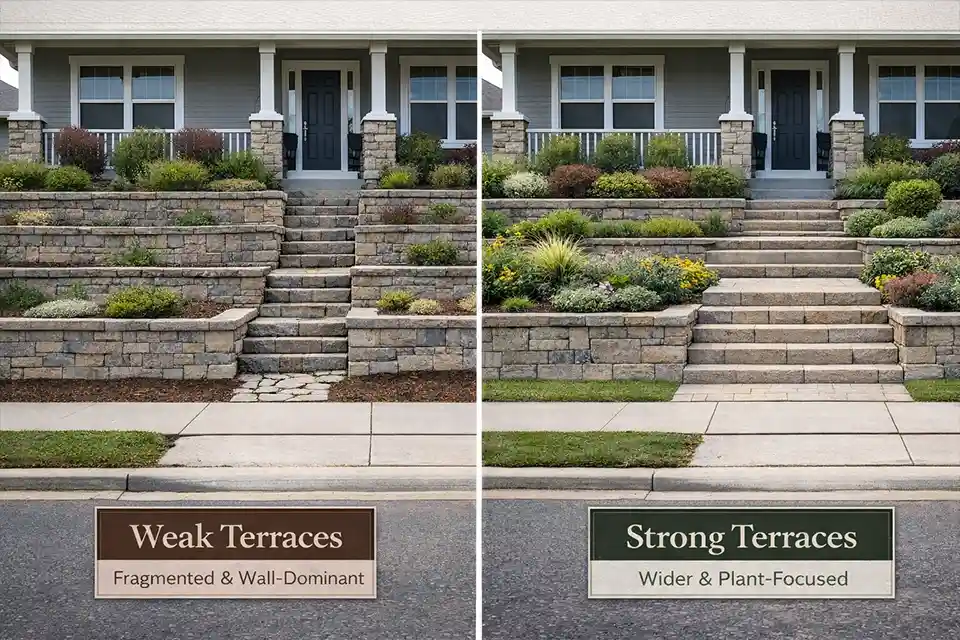
What People Usually Misread First
The visible issue is not always the real issue. Bare wall face, thin planting, or an empty-looking tier are often symptoms. The underlying mechanism is usually one of three things: the terrace is too shallow for the intended plants, the entry sequence is broken into too many small transitions, or the moisture pattern changes sharply from one level to the next.
That matters because the wrong fixes are extremely common here. Taller shrubs do not solve weak proportions. Decorative rock does not solve a lower tier that stays saturated. Seasonal color does not make a 2-foot ledge function like a garden bed. Homeowners often overestimate wall visibility and underestimate circulation. A wall that shows is not automatically a design failure. A broken arrival path usually is.
What gets missed most often is that split-level front yards are judged while moving through them, not just while viewing them from the street. If the entry route zigzags, compresses, or feels fussy, the yard reads as cluttered even when the planting is technically attractive.
Give Each Level One Job, or Reduce the Number of Levels
The strongest front yards like this are not the ones with the most going on. They are the ones where each level does one thing clearly. When a terrace tries to handle screening, drainage correction, foundation softening, and seasonal color at the same time, it usually ends up doing none of them well.
| Terrace condition | Best role | What usually wastes time | Useful threshold |
|---|---|---|---|
| Upper level near house | Foundation structure and the most permanent planting | Overmixing shrubs and perennials in tight depth | 4 to 6 feet of depth usually gives shrubs room to read cleanly |
| Middle level with moderate depth | Main visual layer or transition planting | Treating it like a tiny showcase bed | Under 3 feet deep is usually too tight for layered planting |
| Lower level near walk or curb | Low planting, clean edge, drainage-tolerant massing | Forcing tall screening into the lowest terrace | Keep this tier visually lighter and easier to maintain |
| Very shallow leftover strip | Minimal groundcover or hardscape support role | Trying to make it carry focal planting | Around 18 to 24 inches is rarely enough for shrub logic |
The more useful question is not whether every level can be planted. It is whether every level deserves design emphasis. Usually one terrace should carry the visual load, one should support it, and one may need to stay intentionally quiet. That design discipline also matters in Front Yard Design With Minimal Setback Space, where every foot has to justify itself instead of being filled by habit.
Pro Tip: When one terrace is obviously the strongest, let it lead. Repeating calm planting on weaker levels usually looks more deliberate than giving every tier its own personality.
The Layout Usually Breaks at the Entry Sequence Before It Breaks Anywhere Else
This is the part many people underweight. A front yard divided by retaining walls is not only a planting problem. It is a movement problem. The yard has to read as one approach, not a stack of unrelated scenes. If the path from street or driveway to the front door requires too many turns, narrow landings, or short stair runs, the composition starts to feel over-segmented even if the materials are attractive.
A useful threshold is complexity, not just size. One clean set of steps with a readable landing can work beautifully. Three short changes in level across a small frontage often feel busier than homeowners expect. In real front yards, too many small transitions usually do more damage than one larger, well-resolved one.
That is why decorative upgrades often disappoint here. New mulch, lighting, or fresh plant color can improve details, but they do not solve a front walk that still feels indirect. The same logic shows up in Front Yard Walkway Design for an Offset Front Door and Driveway, where circulation errors continue to control the experience long after cosmetic fixes are added.
The sharper design move is usually one of these: strengthen one direct route and let the terraces support it, or reduce the number of transitions until the path feels obvious again. Once the path starts competing with the terraces, the terraces are winning the wrong argument.
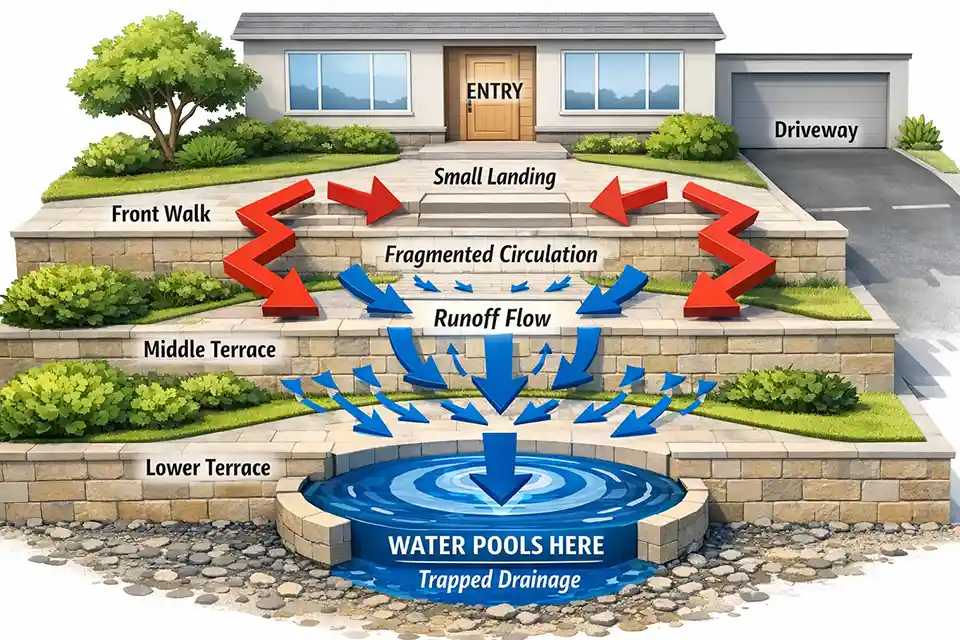
Water Is a Multiplier Here, Not Usually the First Cause
Drainage matters, but it should not swallow the diagnosis. In many split-level front yards, water exposes a weak layout rather than creating it from scratch. Upper tiers dry faster. Stair edges wash first. Lower beds collect runoff. By midsummer, plant performance separates level by level because the yard was divided into moisture zones that were never designed to behave similarly.
The useful threshold is duration. Damp soil after rain is normal. Saturated soil or standing water still present after 24 hours is a design warning. In heavier clay, slower drain-down is expected, but pooling that remains after 48 hours usually points to a grading, outlet, or terrace-layout problem rather than a simple plant-choice mistake.
That is where Front Yard Design on Steep Sloped Yards overlaps with this issue: once water starts concentrating at breaks in grade, surface beauty stops mattering much.
What usually wastes time is trying to solve that visually. More gravel, more mulch, or replacing stressed plants one by one may hide the symptom briefly, but none of that changes where the water is being held or funneled.
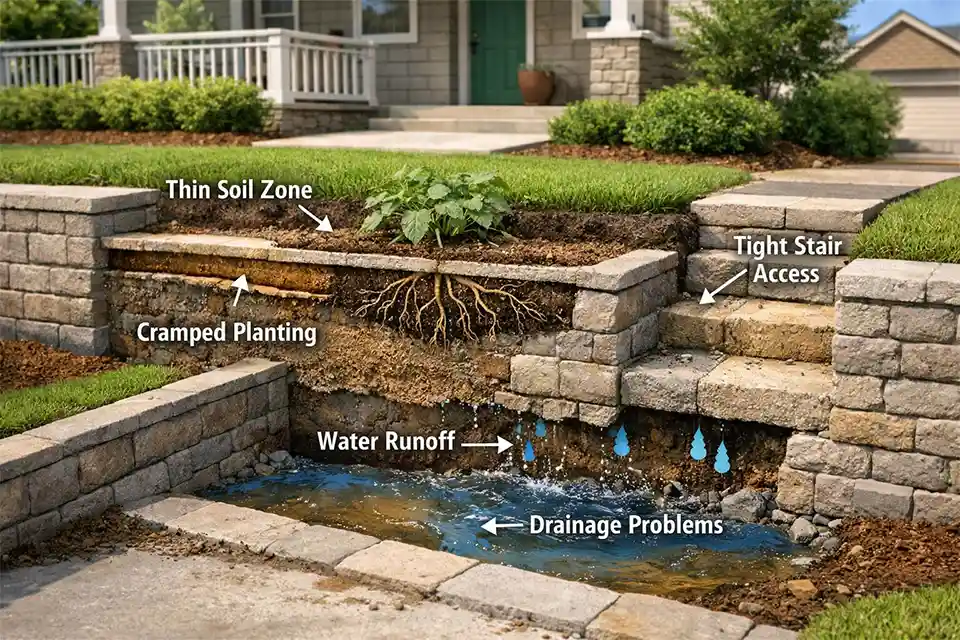
When the Standard Fix Stops Making Sense
There is a point where decorating around the walls stops being rational. That point usually arrives when two or more weak conditions overlap: multiple terraces remain under 3 feet deep, the entry route still feels cramped after cosmetic improvements, lower levels stay wet for more than 24 to 48 hours, or the wall faces still dominate because the terraces above them lack enough mass and depth to justify them.
At that stage, preserving every existing level often becomes the expensive mistake. Combining two weak terraces into one stronger usable level can do more than upgrading all the planting separately. This is the boundary homeowners tend to avoid because keeping all the walls feels cheaper. Sometimes it is cheaper upfront. It is rarely cheaper in outcome.
Many front yards with retaining walls are not underdesigned. They are over-divided. A weak terrace does not become useful because it is planted.
If a level cannot support depth, access, drainage logic, and visual purpose at the same time, the better design move is usually subtraction, not embellishment.
The best front yards like this do not hide every retaining wall. They make the levels readable, proportionate, and worth keeping. That is the real constraint: every wall needs enough usable depth and enough design purpose to justify the space it creates.
For broader site and drainage guidance, see the USDA Natural Resources Conservation Service.