Last updated: June 19, 2026
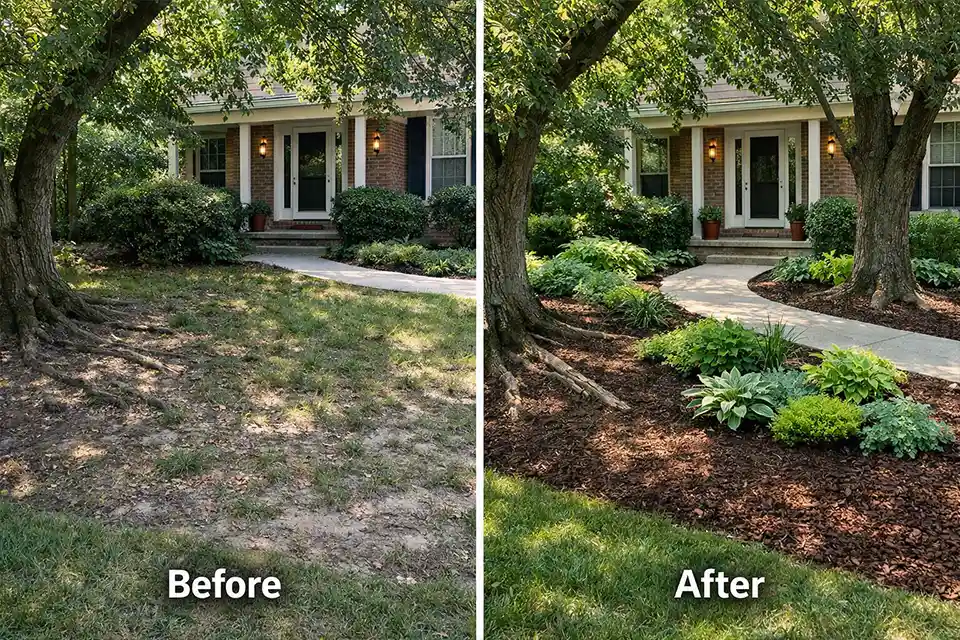
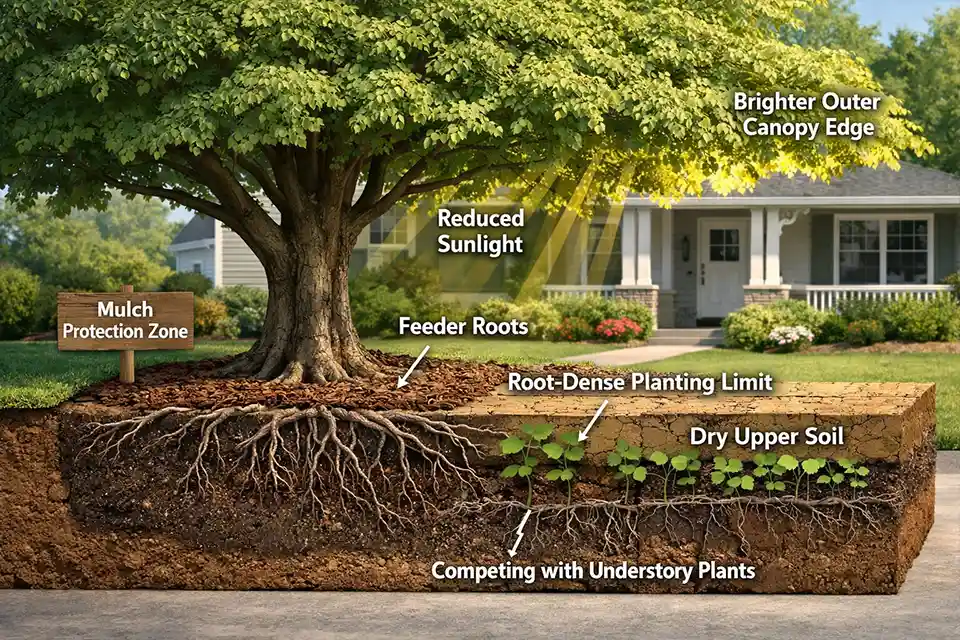
When mature trees block most of the sunlight in a front yard, the limiting factor is usually misread. Homeowners tend to treat it as a shade-plant problem when it is more often a site-capacity problem: not enough direct light, not enough open soil, and too much root competition in the top 6 to 8 inches.
Check those first. If the yard gets less than 2 to 4 hours of direct summer sun, turf is already a weak candidate. If the soil looks better right after watering but dries again within 24 to 48 hours, the tree is probably taking most of the moisture.
If a trowel hits roots every 8 to 12 inches, the site is already telling you to simplify. That is the key distinction from an ordinary shady bed near a house. In normal shade, plant choice can rescue the layout. Under mature trees, layout has to do more of the work.
What this yard can realistically be
Most front yards under mature trees can hold one of three stable identities: a reduced lawn with the brighter edges carrying the visual weight, a restrained understory planting, or a mostly mulched root zone with plants only where the tree leaves enough room.
Those options are not equally viable. If summer sun stays under about 3 hours and major roots are already visible near the surface, a conventional lawn is usually the wrong target. Shade seed mixes often sprout, which is exactly why people keep giving them one more chance. But early germination is a poor test. By midsummer, the same area usually thins out because the underlying conditions never changed.
That is why Front Yard Grass Not Growing Under Shade Trees is so closely related to this topic. The grass is only the visible failure. The actual constraint is low usable light plus chronic below-ground competition.
What people usually overestimate
The first overestimate is pruning. Canopy thinning can help, but rarely enough to change the whole design. If careful pruning buys you 60 to 90 minutes of additional direct light, that may improve the outer edge of the yard. It usually does not turn the center of the root zone into reliable lawn space or a durable mixed border.
The second overestimate is soil improvement. A little compost in selected planting pockets can help new plants establish. Reworking the whole area as if it were an open bed usually wastes time. More amended soil does not create more usable soil when feeder roots still occupy the same space.
The more useful question is blunt: do you have enough root-free pockets to place plants without fighting the tree every foot? If not, stop acting as if the bed just needs better species selection.
Treat it as a protected ground plane with limited planting capacity. That is exactly where Front Yard Design in Tree Root Zones becomes more helpful than a generic shade-plant article.
The layout that holds up longer
These yards usually perform better when the space is divided by function, not decorated evenly.
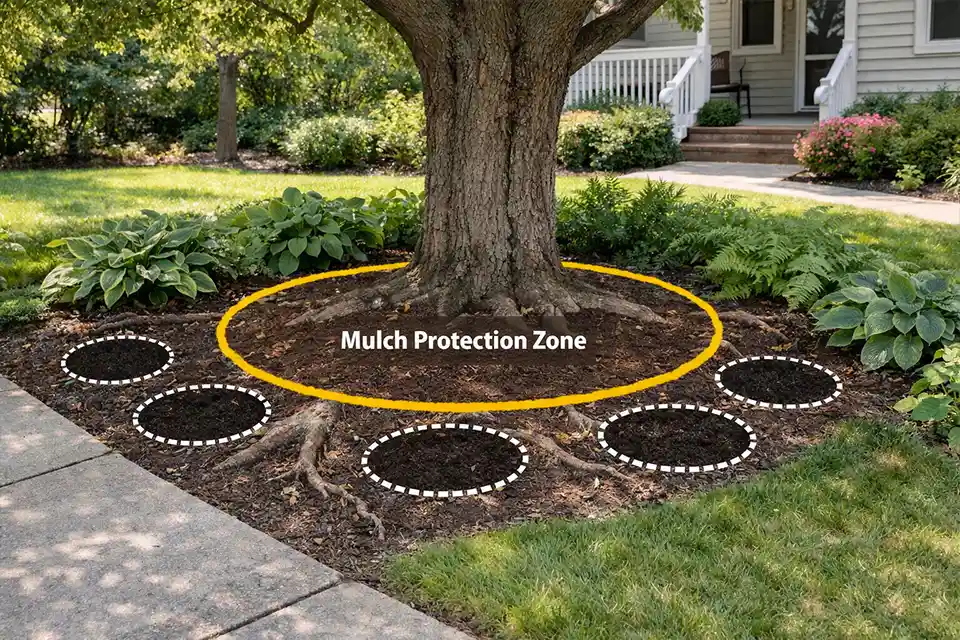
Closest to the trunk, keep a protection zone. Use 2 to 4 inches of mulch, but stop it 3 to 6 inches short of the trunk flare. Do not raise the soil level here, do not cut a crisp edge through visible roots, and do not build a little planting island to make the area look finished. Adding even 2 to 3 inches of grade in the wrong place can create more stress than the original bare patch.
Outside that, plant only where actual pockets exist. This is where sedges, hellebores, epimedium, cast-iron plant in warmer regions, or well-chosen native shade plants can work.
The common mistake is trying to make the bed look complete too fast. In root-heavy sites, planting to about 60% to 70% of the fullness you eventually want is usually smarter than crowding for instant coverage.
A slightly spare bed in year one often looks settled by 18 to 24 months. A crowded bed often starts looking uneven before then.
The brightest edge should carry the design. That is where repetition, cleaner borders, and evergreen structure are most likely to read from the street. The darkest center under the canopy is usually the wrong place to spend your best visual moves.
Pro Tip: In front yards like this, one strong edge treatment usually improves curb appeal more than adding five more plant varieties.
| Site condition | What it really tells you | What often wastes time | Better decision |
|---|---|---|---|
| Under 2 hours of direct summer sun | The area is functionally deep shade | Trying to restore full lawn coverage | Convert most of the zone away from turf |
| 2 to 4 hours of sun with fast-drying upper soil | Plants are fighting both shade and root competition | Seasonal flower beds | Use sparse shade planting and mulch |
| Soil dries again within 24 to 48 hours after soaking | Tree roots are dominating moisture use | Frequent shallow watering | Reduce planted area and water deeply |
| Roots visible in the top 3 inches | Planting volume is severely limited | Full bed excavation or tilling | Hand-dig only selective planting pockets |
| Reseeding more than once every 2 years | Turf is no longer a stable finish | Trying another shade mix | Stop treating grass as the default |
If the house sits close to the street and the front yard is already compressed, the margin for error gets even smaller. Front Yard Design with Minimal Setback Space matters here for the same reason: limited usable space rewards concentration, not equal treatment everywhere.
Why the obvious fixes disappoint
The most common wasted fix is trying to preserve the appearance of a sunny front yard in a site that no longer behaves like one.
That usually shows up as repeated re-seeding, replacing shrubs that never size up, or lengthening irrigation schedules while the bed still looks thin by late summer. Extra water can help during the first 8 to 12 weeks after planting, but it does not rescue a layout that asks the hardest ground to do the showiest work.
The next fix that usually disappoints is saving every fragment of lawn between roots, walkway, and driveway. Those pieces rarely unify the yard. They create one more strip to edge, one more patch to reseed, and one more weak area that makes the whole front yard look unresolved.
That is why Front Yard Design with a Large Driveway still connects here. In both cases, leftover spaces usually look better when they are simplified, not intensified.
There is also a point where “improving” the planting stops making sense. If the yard gets less than about 3 hours of direct summer sun, roots are obvious through the upper soil, and plants still stall after 1 to 2 growing seasons, another round of substitutions is usually just a slower way of redesigning late.
What actually changes the outcome
Once the site keeps rejecting lawn or dense planting, the better move is structural. Shrink the planted footprint by about 15% to 25%. Expand mulch where the tree clearly dominates. Move seasonal color into containers near the porch, entry, or front steps where soil depth and moisture are easier to control.
Then put the visual emphasis where the site still gives you leverage: the walkway edge, the brightest visible corner, the outer canopy line, or the area nearest the front door. People often underestimate how polished a quieter yard can look. They overestimate the value of saving every open patch of soil for planting.
A planting strategy that fits the site
Use fewer species, repeat them more clearly, and leave more breathing room than feels comfortable on install day. In deep shade, variety rarely reads as sophistication. More often, it reads as visual noise plus uneven performance.
Aim for hand-dug planting pockets at least 12 to 18 inches wide where possible. If you cannot find enough pockets that size without cutting significant roots, that is not a challenge to outsmart. It is the boundary.
In humid climates, crowding can keep foliage damp long enough to raise disease pressure. In dry western climates, the same yard may still turn droughty soon after irrigation because mature roots strip moisture so fast. Different climate, same hierarchy: shade matters, but root competition usually decides what survives.
The design priority most people get backward
A shaded front yard does not need every dark area to look planted. It needs the whole composition to look deliberate.
That changes nearly every decision. Instead of trying to force the hardest square footage into looking lush, let those areas stay calm and push more structure toward the places the site can actually support. The walkway approach, the porch edge, and the brightest visible margin usually matter more than the center of the root zone.
That is also why Front Yard Landscaping Ideas for Curb Appeal still applies here. Curb appeal in a shaded front yard does not come from beating the tree. It comes from reading the limits early and designing as if they matter.
A front yard under mature trees usually gets better when the design stops trying to make every square foot perform the same way.
For broader official guidance, see Penn State Extension’s guide to underplanting trees.