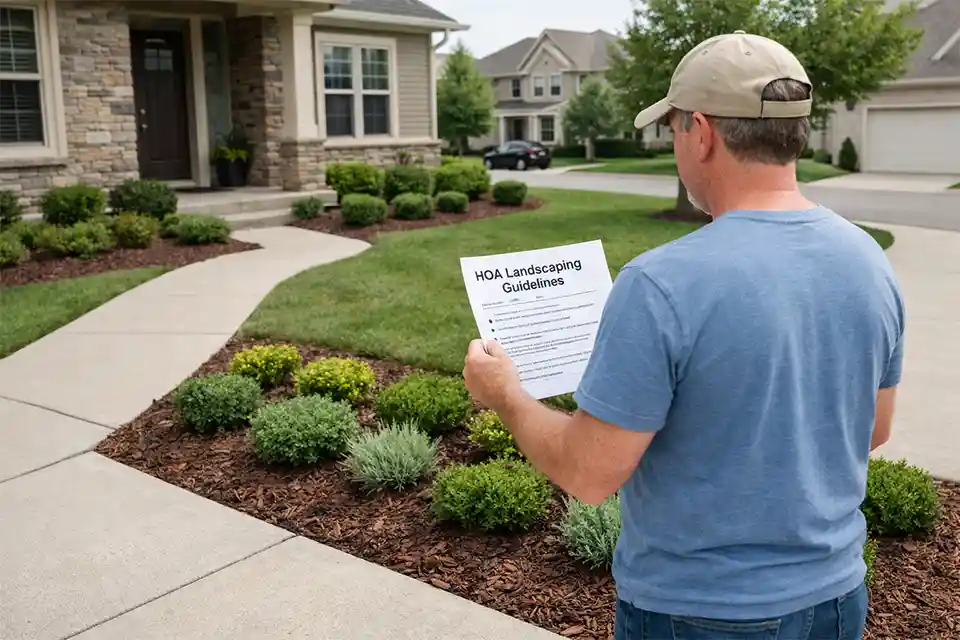
Most HOA front-yard design problems are not really about taste. They start when the approved plant list, the feature restrictions, and the yard’s actual geometry pull in different directions.
Check three things first: the narrowest planting depth, the practical height limit in visible front-yard areas, and the approval delay for anything beyond basic planting. If a bed is only 30 to 48 inches deep, many approved medium shrubs are already the wrong fit.
If visible plant height is effectively capped around 24 to 36 inches, privacy fixes change completely. And if walls, screens, gravel conversions, or edging changes take 30 to 60 days for review, “simple improvements” are often slower than they look.
That is what separates this from a normal curb-appeal problem. The issue is not finding prettier plants. It is figuring out which legal choices will still work after 2 to 3 growing seasons.
A yard can be fully compliant and still feel crowded, flat, awkward to maintain, or strangely unfinished. HOA approval is not a quality filter. It is only a boundary.
A plant being allowed does not mean it belongs in that space.
What This Kind of Yard Is Usually Fighting Against
The most common problem is not one dramatic ban. It is the stack of smaller limits that quietly shape the whole yard: no tall hedge, no front-yard screen, no unapproved wall, no oversized accent feature, no plantings that block views, and a shrub list full of choices that mature wider than the bed can really support.
That changes the design logic. In most cases, the real goal is not “add more personality.” It is “avoid creating a yard that looks controlled for six months and overworked for six years.” Homeowners often misread this and assume the approved list is the design itself. It is not. It is only the menu.
This is also where people overestimate hardscape. Under HOA rules, hardscape feels like the escape route because it looks permanent and neat. But if it needs approval, adds heat, creates edge maintenance, or still does nothing for privacy or spacing, it is usually not the smart workaround. It is just a more expensive detour.
Quick Diagnostic Checklist
Check these before you choose plants or submit anything for approval:
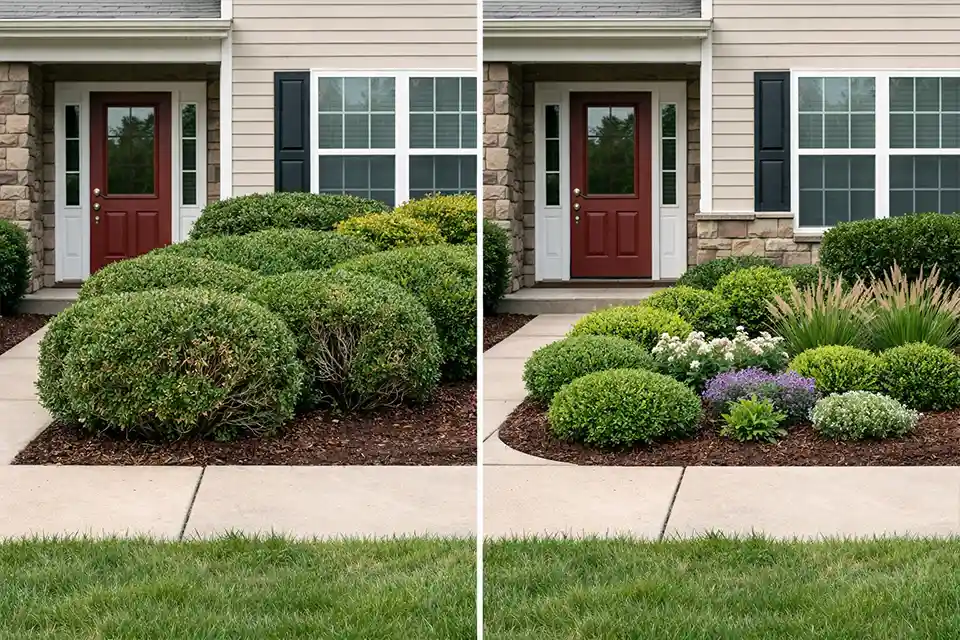
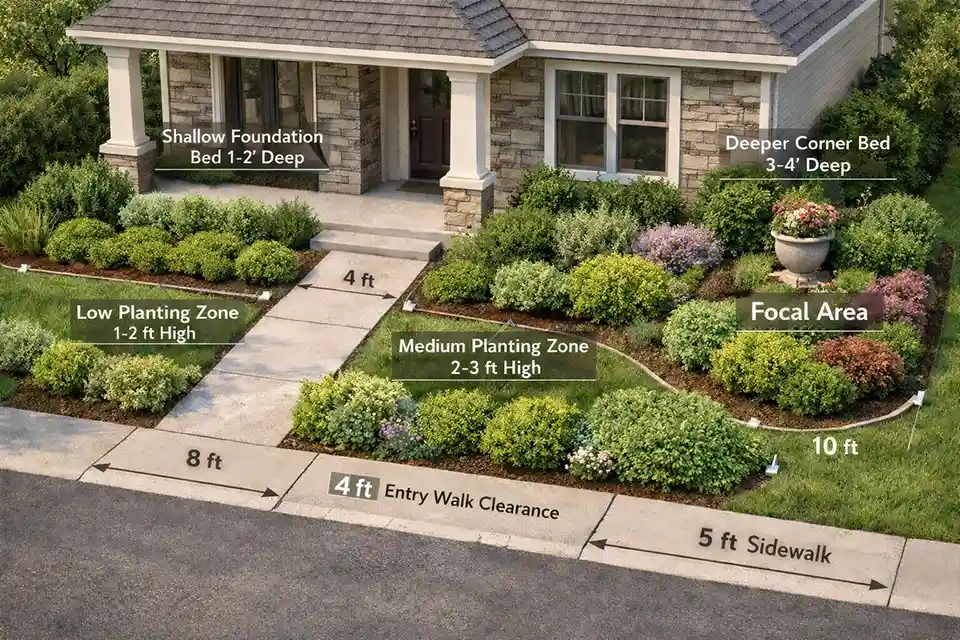
- Is the narrowest planting bed less than 4 feet deep?
- Are you counting on shrubs that mature to more than half the bed depth?
- Does the HOA keep visible front-yard planting close to 24 to 36 inches tall?
- Are you trying to create privacy with plants that will need trimming every 6 to 8 weeks in peak season?
- Would the hardscape fix you really want trigger a 30-day-plus review cycle?
- Are you adding features because the planting layout itself still looks weak?
If three or more answers are yes, the problem is structural, not decorative.
What People Usually Misread First
The first misread is assuming the main problem is plant restriction. Usually it is not. The deeper problem is plant size relative to usable space. A 30- to 48-inch bed eliminates a surprising number of approved shrubs before the project even starts. That matters more than whether the HOA allows 12 species or 40.
The second misread is privacy. When screens and fences are restricted, many homeowners default to the tallest allowed shrubs in the most visible part of the yard. That usually produces a clipped green line that never creates real privacy and makes the frontage feel tense. In many suburban layouts, selective sightline interruption works better than trying to build a low-height hedge into a job it cannot do. Front Yard Landscaping for Privacy Without Fences That Actually Works is relevant here because placement usually matters more than maximum height.
The third misread is assuming HOA approval means long-term success. It usually does not. HOA review protects neighborhood appearance first. It rarely protects you from a layout that becomes a pruning burden within 12 to 18 months or a border that always looks a little unsettled.
The Constraint That Deserves Priority
If this yard has one dominant constraint, it is mature plant width compared to usable bed depth. That matters more than bloom color, more than evergreen status, and usually more than the total number of approved choices.
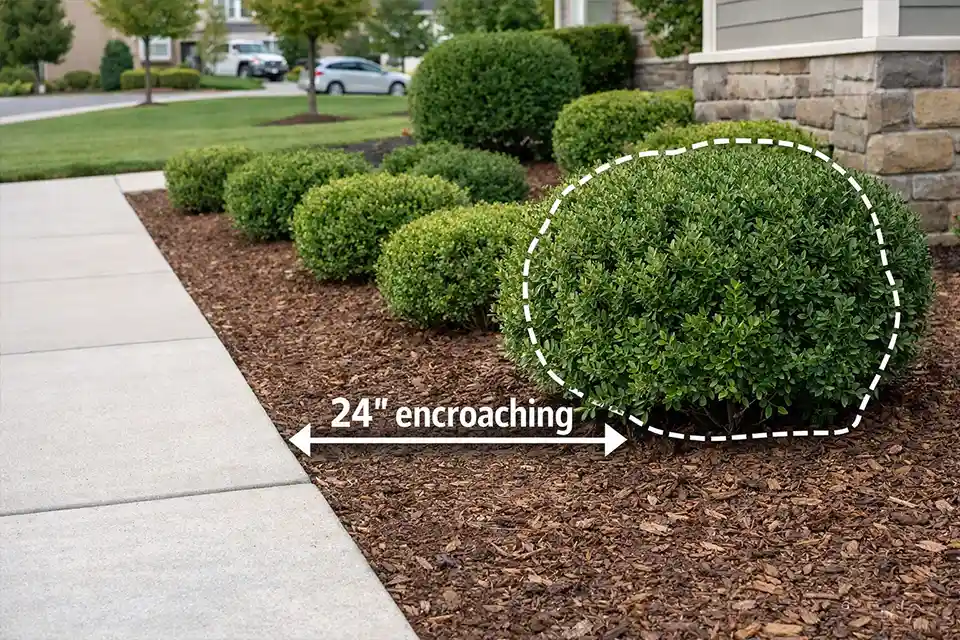
A practical threshold helps here. Once a shrub’s mature width passes about 50% of total bed depth, caution should go up. Once it reaches 75% or more, you are usually designing a future maintenance fight unless that plant sits in a deeper focal zone. In a 4-foot bed, a shrub maturing to around 24 to 30 inches wide is usually manageable. One maturing to 42 to 60 inches wide is usually the wrong bet.
This is where homeowners often make the expensive mistake. They overvalue fullness in the first season and undervalue shape control in year two and year three. A bed that looks slightly open in month four is not failing. A bed that needs repeated correction just to preserve walkway clearance is.
That is why Front Yard Small Plant Beds That Become High-Upkeep Fast connects so well to this scenario. Once the bed is tight, every sizing error becomes permanent work.
Pro Tip: Under restrictive HOA rules, sort candidate plants by mature width before bloom, color, or nursery appearance. That one filter removes a lot of future regret.
Why the Obvious Fix Usually Wastes Time
The obvious fix is usually one of four moves: use taller allowed shrubs, add decorative rock, install stronger edging, or add features to make the yard feel intentional. Under HOA restrictions, those are often the least efficient answers.
Taller shrubs fail when they need constant clipping to stay off the walk, below windows, or inside visibility rules. Decorative rock fails when people confuse “less lawn” with “less maintenance.” In hot climates, rock near paving can intensify reflected heat. In leafy neighborhoods, debris settles into the top 1 to 2 inches fast, and weeds follow if maintenance slips. Edging can help, but only when it clarifies bed lines without becoming another fussy element that shifts or makes mowing harder.
What wastes the most time is patching. Replacing annual color twice a year, trimming shrubs every 6 to 8 weeks from late spring into early fall, and adding one more decorative accent each season can feel productive. Usually it means the layout is still wrong. Cheap Front Yard Ideas That Cost More Later reflects the same pattern: low-commitment cosmetic choices often become recurring labor.
There is also a clear stopping point. If one full growing season passes and you are still fighting size, approval friction, and visual imbalance, the answer is usually not one more upgrade. It is a different structure.
What Holds Up Better Under HOA Rules
The strongest HOA front yards usually look more disciplined than homeowners expect. Not bare. Not generic. Just edited.
Use fewer plant forms and size them more precisely
A constrained front yard often works best with three layers, not seven. Keep the front layer around 10 to 18 inches high, the middle layer around 18 to 30 inches, and reserve anything taller for one or two deeper zones where mature spread will not collapse the layout. Variety is less important than control here.
Put visual weight where the yard can actually support it
Do not ask every bed to do the same job. The entry bed may only need to soften the walk. A deeper corner may carry seasonal interest. A side-facing area may interrupt one key sightline. A lot of HOA front yards get weaker because the homeowner tries to make the whole frontage equally full, equally colorful, and equally important.
Use spacing as the main design tool
When the feature list is narrow, spacing becomes the design. Plants set roughly 24 to 36 inches on center, with enough negative space to preserve mature shape, usually look stronger than a bed packed to feel finished immediately. People often overestimate early fullness and underestimate long-term legibility.
Choose climate fit inside the approved list
An approved plant is still a bad plant if the site works against it. In Florida humidity, tightly grouped low shrubs can stay damp and decline. In Arizona, reflective heat from paving and stone can scorch the wrong ornamental fast. In freeze-thaw climates, marginal evergreens can look fine in summer and ragged by late winter. Front Yard Landscaping Problems in Hot Climates matters here because “approved” and “site-appropriate” are not the same thing.
Better Moves vs. Attractive Mistakes
| Design move | Why people choose it | Where it breaks down | Better move |
|---|---|---|---|
| Tallest allowed shrubs across the front | Faster privacy and fullness | Becomes clipped, crowded, and visually tense | Use taller shrubs only in deeper anchor zones |
| Filling every bed immediately | Avoids a sparse first season | Plants collide within 12 to 24 months | Let spacing create structure |
| Large decorative rock areas | Feels clean and low-maintenance | Adds heat, weeds, debris, and visual heaviness | Use rock only where site conditions justify it |
| Multiple decorative features | Makes the yard feel more designed | Adds approval friction and clutter | Strengthen plant layout before adding objects |
| Choosing by bloom first | Delivers quick color | Ignores mature size and pruning load | Choose by width, then climate fit, then color |
One detail homeowners often underestimate is edge quality. Under HOA scrutiny, unstable borders weaken the whole yard fast. Clean, consistent transitions usually do more for curb appeal than one more accent object. Front Yard Edging That Keeps Shifting matters here because a bed line that never holds still can make a compliant design still look careless.
When the Standard Improvement Strategy Stops Making Sense
A routine improvement strategy stops making sense when the allowed ingredients cannot do the job the yard actually needs done. That usually appears in three forms.
First, the yard needs privacy, but the approved height range cannot interrupt the view at the right level. Second, the plant list looks broad on paper but is narrow in practice because most of the approved shrubs mature too large for the usable bed depth. Third, the features that would add structure move too slowly through approval, so the homeowner keeps making temporary decisions around them.
At that point, the better answer is usually not to keep decorating around the limitation. It is to simplify the role of the yard and make that version look intentional. In many HOA neighborhoods, the best front yard is not the one trying to feel secluded, colorful, lush, formal, and low-maintenance at the same time. It is the one that stays proportionate, readable, and sharp for 5 to 10 years with ordinary upkeep.
That is why Front Yard Design Ideas for Suburban Homes fits naturally here. Once the rules narrow the palette, composition matters more than abundance.
Questions People Usually Ask
Can a restrictive HOA plant list still produce a strong front yard?
Yes, but usually only if the layout is doing the heavy lifting. Restrictive plant lists punish poor spacing and oversizing faster than they punish limited variety.
Should you use the tallest shrubs the HOA allows?
Usually no. If the bed is shallow or the sightline is wrong, taller shrubs create more pruning than privacy.
Is hardscape the easiest way around plant restrictions?
Not usually. Hardscape helps only when it solves a real site problem, not when it is covering for a weak planting structure.
What is the clearest sign the yard needs redesign, not another tweak?
When one full growing season passes and the fixes are still mostly cosmetic, the structure is usually the real issue.
The best HOA front-yard designs usually improve the moment the homeowner stops trying to win every design battle at once. They choose the one job the yard can realistically do under the rules, then make that version look deliberate.
For broader official guidance, see the University of California Agriculture and Natural Resources landscape planning resources.