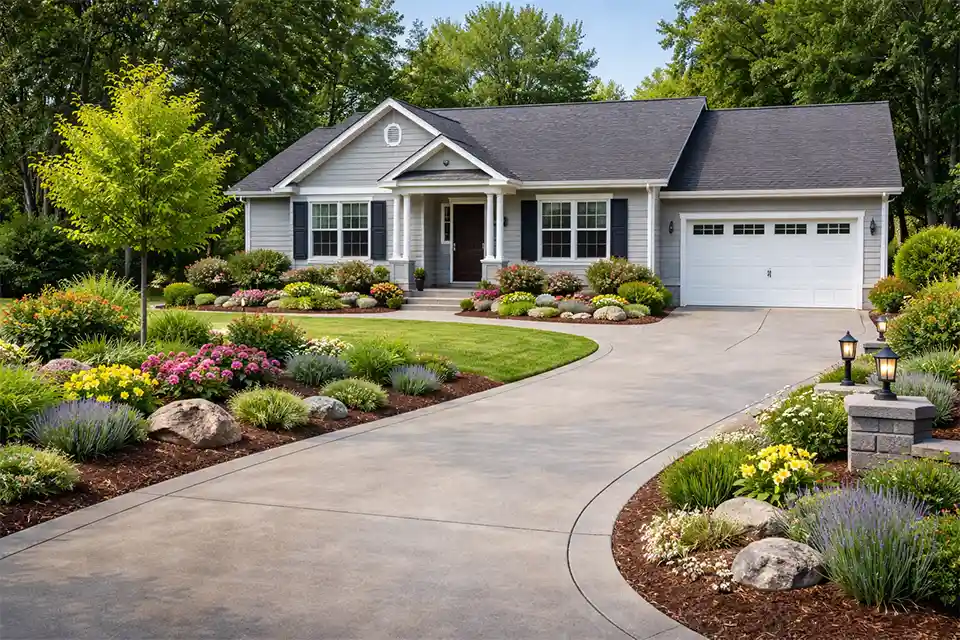
When a driveway takes up most of the front yard, the design problem is usually not plant selection first. It is space hierarchy. Once pavement covers roughly 50% to 70% of the frontage, the remaining yard often stops behaving like a normal front landscape and starts acting like leftover edge space.
The first useful checks are simple: how much bed depth is truly left after car-door clearance, whether the driveway flare or turnaround cuts into your best planting area, and how much reflected heat the adjacent beds take in during summer. In many cases, beds under 3 feet deep are not real design space. They are transition strips.
That is also why this problem gets misread so often. It looks like a small front yard issue, but it usually is not. A genuinely small yard can still feel balanced if open space, entry, and planting are proportionate. A driveway-dominated yard feels strained because one hard surface is already doing too much visual work. If that is not corrected, extra plants, pots, or decorative curves usually make the front look busier within one season, not better.
What the real constraint usually is
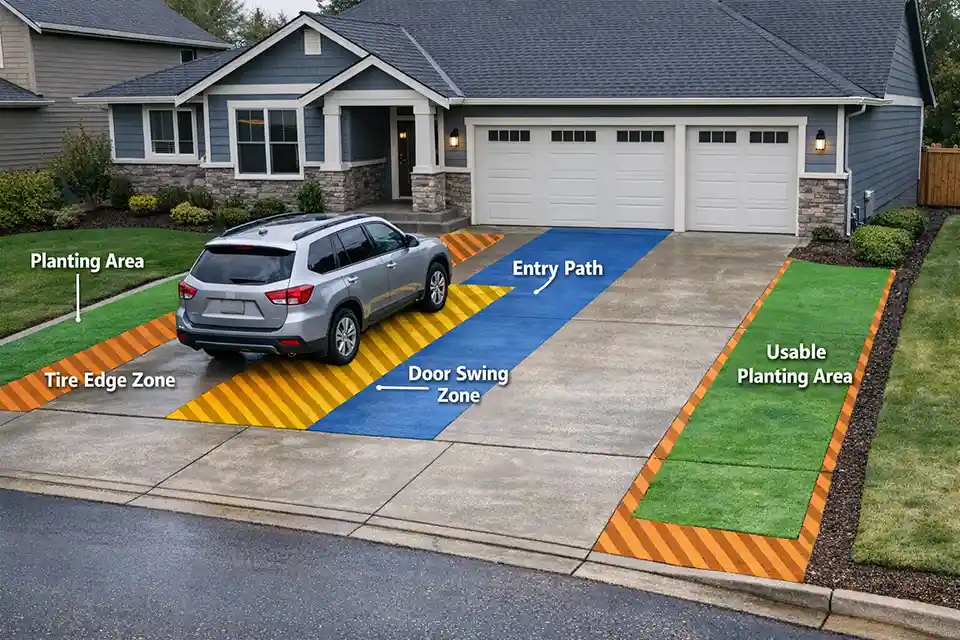
The biggest limitation is not total square footage. It is usable width in the right place. A front yard may look like it still has open areas on paper, but once you preserve 24 to 30 inches for car-door clearance, keep at least 36 inches for comfortable walkway movement, and avoid any edge where tires occasionally ride up or cut too close, the amount of genuinely plantable space shrinks fast.
That is why two front yards with the same driveway size can behave very differently. A straight single-lane driveway that leaves one 6-foot-wide planting side is workable. A double-wide driveway with a flare-out or extra parking apron may leave more fragmented space overall but less useful landscape space. That distinction matters more than the raw percentage of paving.
The house front also changes the design logic. If the garage dominates the façade, the landscape has to work harder to restore balance near the entry. If the front door already has some visual presence, the landscape can be quieter and still succeed. Many homeowners underestimate this. They think the yard feels empty because it lacks enough planting. Often it feels off because the entrance reads weaker than the driveway.
A similar planning mistake shows up when people borrow broad curb-appeal ideas without adjusting for hardscape dominance. General inspiration only helps when the layout is filtered through actual constraints, which is where pieces like Front Yard Design Ideas for Suburban Homes become useful only after the space has been diagnosed correctly.
The distinctions that matter early
A few distinctions change the whole approach:
Narrow strip vs. real bed
A 2- to 3-foot strip along concrete is usually not a full planting bed. It is best treated as a clean buffer with restrained planting. Once depth reaches 5 feet, you can start building a true layered composition. At 6 to 8 feet, the bed can carry real visual weight.
One strong side vs. equal treatment
If one side of the driveway has enough width and the other does not, stop trying to make them feel symmetrical. Unequal conditions need unequal design responses. Forcing balance usually makes both sides look undersized.
Entry compression vs. plant shortage
If visitors visually register the garage and driveway before they can clearly read the front door, the problem is entry compression, not a lack of flowers. That should be solved with spacing, framing, and hierarchy before adding variety.
Edge failure vs. planting failure
When mulch, gravel, or soil constantly migrate onto the driveway, that is not just a messy planting issue. It means the transition between hardscape and bed is failing. Replanting into a bad edge is usually wasted effort.
What people usually overestimate and underestimate
The most overestimated factor is plant diversity. People often think the leftover space needs more life, more color, or more kinds of plants. Usually it needs stronger massing and fewer visual interruptions.
The most underestimated factor is driveway-driven stress. Pavement next to a narrow bed changes how that bed lives. It reflects heat, speeds up drying, and often increases compaction near the edge. In hot regions or west-facing exposures, the first 2 to 4 feet beside the driveway often experience the hardest moisture swings. That is why flowers near the pavement may fade or stall even when the rest of the property seems fine.
Symptoms get mistaken for causes here. Weak bloom, thin growth, and repeated replanting are symptoms. The underlying mechanism is often some combination of shallow bed depth, heat reflection, runoff patterns, and edge disturbance. If those conditions stay in place, new plants may look fine for 8 to 12 weeks, then decline once summer stress stacks up.
That is also why oversized plant palettes backfire in constrained spaces. The more varieties you add to a stressed narrow bed, the more obvious its inconsistency becomes.
The layout moves that actually improve the yard
The most reliable fix is usually not adding more elements. It is assigning clearer jobs to the little space you have left.
Build one visual anchor, not several small ones
Most driveway-heavy front yards need one landscape area that carries the composition. That is usually the wider side of the driveway or the space closest to the entry. Give that bed enough presence to visually challenge the pavement. A scattered set of tiny islands almost never does the job.
Let the weak side stay quiet
If one side has only a thin return strip or a narrow band between driveway and property line, do less there. Use low plants, repeated forms, and a firm edge. Asking a 2-foot strip to behave like a showcase border is one of the fastest ways to create clutter.
Use vertical shape carefully
A layer in the 3- to 6-foot range often helps soften the horizontal spread of the driveway and restore scale near the house. But stuffing large shrubs into a bed under 4 feet wide usually creates future crowding, pruning problems, and driveway overhang. A cleaner strategy is selective height in one concentrated zone, not bulk everywhere.
Make the driveway edge deliberate
A consistent edge line often improves the front yard more than another plant group. If the transition is weak, the whole yard reads temporary. Narrow beds magnify that problem because even small amounts of drifting mulch or broken edging become visually dominant.
That is why ongoing issues like Front Yard Edging That Keeps Shifting matter more in these layouts than they do in broad planting areas. When the bed is tiny, the edge is a much larger percentage of the design.
Why the obvious fixes waste time
The most common wasted fix is symmetry. Homeowners see a wide driveway cutting through the yard and try to calm it by mirroring both sides. But when one side has 6 feet of width and the other has 2.5 feet, symmetrical planting only highlights the mismatch.
The second wasted fix is adding small decorative islands or curved cutouts into the driveway edge. These often look clever in plan view but high-maintenance in real life. Islands smaller than about 18 to 24 square feet usually need constant edging, irrigation attention, and seasonal cleanup. They also rarely make the overall yard feel larger. They just break the space into more pieces.
The third wasted fix is forcing lawn into leftover strips. Grass needs continuity more than people think. Long strips under 4 feet wide, especially beside concrete, often dry unevenly and mow poorly. If one narrow lawn strip turns brown 3 to 5 days before the rest of the yard during hot weather, that is usually not a fertilizer problem. It is a design mismatch.
A related maintenance trap shows up when people try to overplant undersized beds for instant fullness. That tends to produce the same problems described in Front Yard Small Plant Beds That Are Hard to Keep Up: too much material competing in a space that never had enough root room to begin with.
| Constraint | Common first fix | Why it usually fails | Better response |
|---|---|---|---|
| 2- to 3-foot edge strip | Treat it like a full garden bed | Too shallow for layered planting | Keep it simple and structural |
| Unequal driveway sides | Make both sides symmetrical | Highlights the imbalance | Strengthen the wider side only |
| Concrete-dominated frontage | Add small decorative islands | Increases fragmentation | Build one clear anchor area |
| Narrow hot lawn strip | Keep reseeding grass | Drying stays uneven | Use low planting or groundcover |
| Repeated mess at pavement edge | Add more mulch | Material keeps migrating | Rebuild edge and transition first |
When drainage and heat become the bigger story
Some front yards are not limited by layout alone. They are controlled by what the driveway does to water and temperature.
If the driveway slopes into a planting bed, runoff can strip mulch, compact the surface, and make the first few inches of soil behave badly. The top may crust while the lower zone stays erratic. That is why some narrow beds look dusty two days after rain but still struggle with root health.
A useful threshold is simple: after a moderate rain or irrigation cycle, water should not still be visibly ponding beside the driveway after about 24 hours, and the top 2 inches of soil should not swing from saturated to powder-dry almost immediately in mild weather. If that pattern repeats, the problem has moved beyond aesthetics.
At that point, planting changes alone are not enough. You are dealing with runoff direction, hardscape transition, or grade behavior. That is much closer to what happens in Driveway Runoff Problems in Front Yard Drainage than in a normal curb-appeal redesign. And if the site already has difficult grade, the driveway may just be amplifying a larger condition, which is where Front Yard Design on a Steep Sloped Yard becomes the more relevant model.
Pro Tip: If a driveway-adjacent bed always looks worst at the lower edge first, do not assume the plant there is weaker. Often that point is simply taking the most runoff, compaction, and heat stress at the same time.
A practical design formula that holds up better
For most suburban homes, the cleanest solution is not to disguise the driveway completely. It is to reduce how much visual authority it has.
Keep the narrow side minimal. Let it act as a neat edge condition, not a feature bed.
Make the wider side do the visual work. If there is room for a real layered bed, use that space to anchor the entry and soften the garage-dominant frontage.
Protect the front door zone. The entrance should still read clearly from the street even when the driveway is large. If necessary, landscape should strengthen the path to the door before it chases decorative fullness elsewhere.
Choose plant forms that stay inside their lane. Upright or mounded shapes usually perform better than loose, sprawling ones in constrained beds because they preserve line clarity.
Leave some space intentionally open. In these front yards, not every leftover pocket needs filling. Empty but controlled space often looks more expensive and more deliberate than overworked planting.
When it stops making sense to design around the driveway
There is a point where landscaping is no longer the main answer. If the driveway leaves only shallow strips, repeatedly overheats adjacent beds, sends runoff into the wrong places, and still creates awkward parking movement, then the real constraint is not planting design. It is the paved footprint itself.
That does not always mean immediate reconstruction. But it does mean being honest about the limit. Sometimes the smartest long-term move is to simplify the landscape now and reconsider driveway width, flare, or geometry later when replacement time comes. Until then, the goal is not to make every inch planted. It is to make the remaining front yard feel intentional instead of leftover.
For broader official guidance on residential runoff and hard-surface impact, see the U.S. Environmental Protection Agency.